 RSS Subscribe
Cosa Resources: Largest drill program to date at Murphy Lake North, a joint venture between Cosa and Denison Mines – Richard Mills

2026.05.29
Cosa Resources (TSXV:COSA, OTCQB:COSAF) is gearing up for its largest-ever drill program at Murphy Lake North, a joint venture between Cosa and Denison Mines (TSX:DML).
Cosa, the project operator, holds a 70% interest, with Denison holding 30%.
Murphy Lake North, or MLN, is located 3 kilometers east of IsoEnergy’s (TSX:ISO) Hurricane deposit, in the Eastern Athabasca Basin of Saskatchewan.
The Athabasca Basin is famous for its high grades — at over 20 times global averages. Some deposits are over 100x the world average including Cameco’s Cigar Lake which contains an average grade of between 15% and 17% U3O8.
Hurricane, the deposit that Cosa’s management team is credited with discovering, averages an astonishing 34.5% U3O8 and is just a few kilometers away from Cosa’s Murphy Lake North Joint Venture.
The Basin produces about 15% of world uranium supply. Major mines include Cigar Lake — held jointly between Cameco (TSX:CCO), Orano Canada and Tepco Resources — McArthur River and Rabbit Lake mines.
Summer drill program
Summer drilling at Murphy Lake North is expected to comprise approximately 15 drill holes totaling 6,000 meters, and will follow up winter 2026 drilling, which saw multiple intersections of unconformity-related uranium mineralization.
The mineralization remains open along strike for 600 meters in both directions.
Drilling is expected to begin mid-June and will focus on step-out tests of the Cyclone Trend mineralization about 265 meters below surface.
The roughly two-month program will be followed by drilling at the company’s Darby Joint Venture.
Denison is helping fund 2026 exploration at MLN to maintain its 30% interest in the project.
According to Cosa, drilling on section 3200E will target major faults with alteration which remain untested at the unconformity, including the area south of drill hole MLN26-016 where mineralization is open for 40 meters to the south.
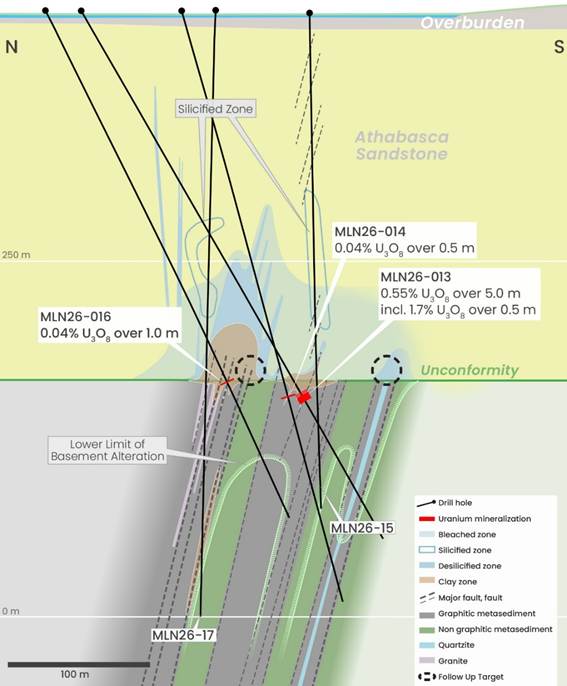
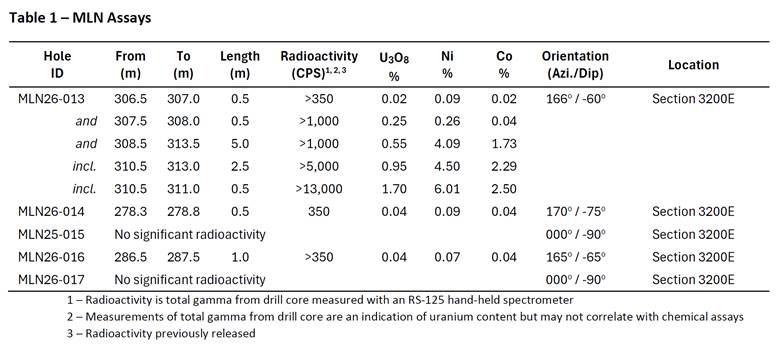
Drilling on 3200E will be followed by progressive step-outs along strike. Additional targets have been generated up to 600 meters to the east and up to 600 meters to the west by reinterpreting summer 2025 drilling results in the context of the winter 2026 results.
“Having intersected 5.0 metres averaging 0.55% U3O8 within an extensive structure and alteration zone that remains open along strike, we are eager to return to site and commence what will be the largest drill program for Cosa and the Murphy Lake North Joint Venture since the inception of the Company,” Cosa’s President and CEO Keith Bodnarchuk stated in the May 28 news release.
Andy Carmichael, Vice President of Exploration, commented: “Exploration at Cyclone has progressed from initial drilling on the trend to preparing to follow up multiple intersections of uranium mineralization with significant untested strike in both directions in less than one year. We draw great encouragement from the similarity of Cyclone’s sandstone alteration patterns to those at Hurricane, and from the significant nickel and cobalt coincident with uranium mineralization similar to Key Lake, Cigar Lake, and Hurricane.”
Cosa Resources
Cosa Resources is a Canadian uranium exploration company operating in northern Saskatchewan. The project portfolio comprises roughly 237,000 hectares and includes a mix of underexplored 100%-owned and Cosa-operated joint venture projects in the Athabasca Basin, the majority of which reside within or adjacent to established uranium corridors.
Cosa’s award-winning management team has a long track record of success in Saskatchewan. In 2022, members of the Cosa team were awarded the AME Colin Spence Award for discovering IsoEnergy’s Hurricane deposit. All four individuals — Andy Carmichel, Craig Perry, Steve Blower and Justin Rodko — are part of Cosa’s team.
Prior to Hurricane, Cosa personnel led teams or had integral roles in the discovery of Denison Mines’ Gryphon deposit and held key roles in the founding of both NexGen Energy (TSX:NXE) and IsoEnergy.
President and CEO Keith Bodnarchuk led strategy and corporate development for IsoEnergy and was project geologist at Denison Mines. VP Exploration Andy Carmichael is a professional geoscientist with 19+ years in mineral exploration, more than 17 of which has focused on exploring for mineral deposits in the Athabasca Basin, Hornby Bay Basin, Colorado Plateau and Namibia.
Carmichael served as VP Exploration at IsoEnergy, where he was also a member of the team that discovered the Hurricane deposit, currently the world’s highest-grade Indicated uranium resource. Previously, Carmichael worked at the Triple R, Phoenix, Gryphon, and J-Zone deposits.
Rounding out the team is Chad Sorba, technical advisor, who was instrumental in the discovery of Denison’s Phoenix and Gryphon uranium deposits and Davida Cates, Denison’s President and CEO, also holds the role of Advisor for Cosa.
Cosa-Denison collaboration
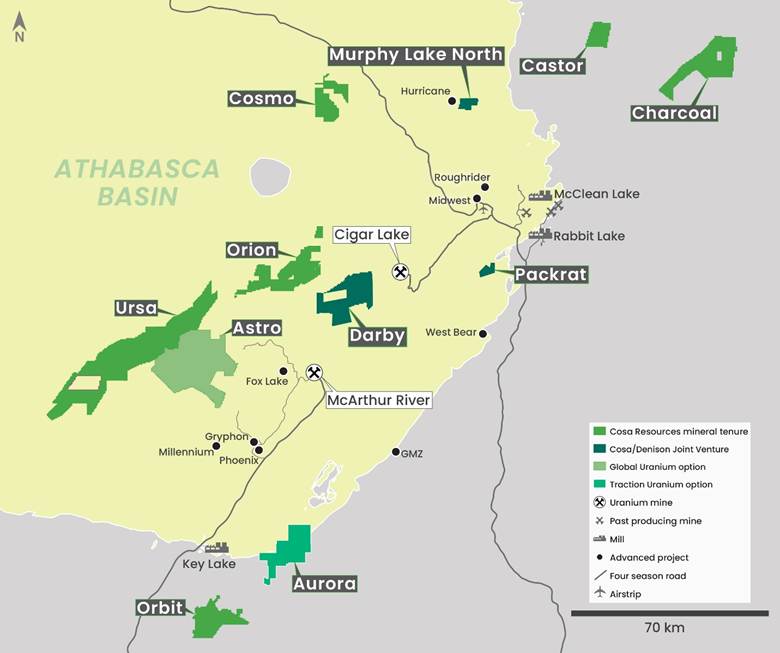
In January of 2025, the company entered a strategic collaboration with Denison Mines that has secured Cosa access to several highly prospective eastern Athabasca uranium exploration projects. The projects offer Cosa over 20,000 hectares of additional exposure into what Cosa considers to be mature, discovery-ready projects that are well-situated close to existing eastern Athabasca infrastructure and boast several walk-up drill targets based on encouraging results from historical drilling.
As Cosa’s largest shareholder, with equity rights to retain up to 19.95% ownership, Denison gains exposure to Cosa’s potential for exploration success and its pipeline of uranium projects.
Cosa has acquired a 70% interest in and will operate the Murphy Lake North, Darby and Packrat uranium projects. Denison Mines will remain as minority contributing partner.
Denison offers strong corporate, technical, and financial support to Cosa through participation in equity financings and joint venture funding.
As of September 2025, DML has a large treasury with over CAD$460 million in cash and cash equivalents, plus physical uranium and investments. It is a pioneer in In Situ Recovery (ISR) for extraction of unconformity-style uranium deposits. Denison has exposure to Cosa’s exploration success and potential pipeline of ISR-amenable uranium discoveries.
Murphy Lake North Project
Murphy Lake North (MLN) is a 70/30 joint venture between Cosa and Denison and is located at the northern end of the Larocque Lake Trend. The project is within 3 kilometers of and on trend with the Hurricane deposit. Initial drilling completed by Cosa during winter 2025 intersected broad zones of hydrothermal alteration of the sandstone, associated with prospective basement structures interpreted as the strike extension of those controlling the Hurricane deposit.
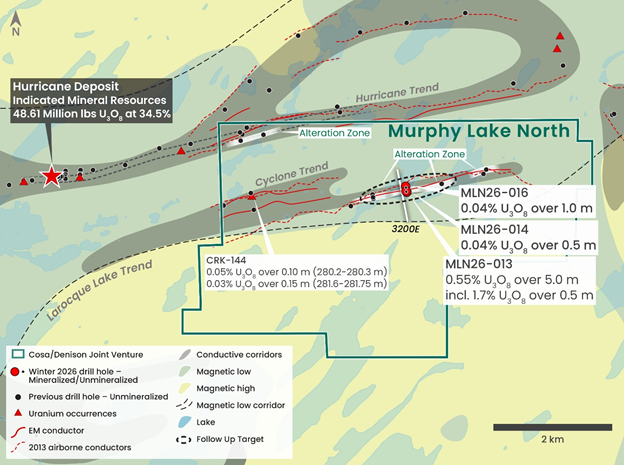
As mentioned, IsoEnergy’s Hurricane deposit was discovered in 2018 by Cosa’s management and currently holds the title as the world’s highest-grade Indicated uranium resource.
The Larocque Lake Trend hosts the high-grade Larocque Lake Zone, Yelka prospect and Alligator Lake Zone.
The Cyclone Trend is located south of and oriented sub-parallel to the Hurricane Trend. Since 1996, a series of historical airborne and ground electromagnetic (EM) surveys at MLN mapped several discrete conductors within the broader Cyclone Trend.
Conductivity at Cyclone is best defined in the central portion of MLN where 2020 EM surveying completed by Denison mapped a basement EM conductor coincident with a conductive trend identified by 2013 airborne surveying. Summer drilling planned to evaluate Cyclone at wide spacing for prospective structure and/or alteration.
In August 2025, Cosa reported that summer drilling successfully identified 2 km of highly prospective strike length characterized by strong sandstone alteration and graphitic faulting at the Cyclone Trend.
Cyclone was drilled on four sections over 2.4 kilometers of strike length. Six of seven drill holes intersected positive results; the seventh was interpreted as an overshot of the optimal target. Drilling identified geology considered highly prospective for an eastern Athabasca-style uranium deposit including significant unconformity relief associated with major structures hosted within graphitic basement rocks. Faulting controls broad zones of alteration in the sandstone and basement which are comparable to those associated with the region’s uranium deposits. Weakly elevated radioactivity was intersected at the unconformity and in the basement and is typically associated with hematite and/or clay alteration.
Results at Cyclone are exemplified by Section 2600E where the broadest and strongest alteration and structure were intersected. Three drill holes on 2600E define a significant graphitic basement fault zone within a broader package of graphitic rocks associated with 30 meters of unconformity relief.
Basement-rooted faulting is interpreted to extend through the entire 220-meter thickness of the sandstone as faulting is evident beginning at the top of bedrock. These vertically extensive structures control broad zones of hydrothermal alteration. In MLN25-010, nearly half of the sandstone is structured including a 70-meter interval with strong fracturing, faulting, fault gouges, increased clay content and sections of near-massive clay, rotated sandstone bedding, strong bleaching, desilicification, and decimeter-scale zones of increased radioactivity.
The continuity and intensity of alteration and structure are considered highly encouraging. The Cyclone alteration zone remains open in multiple directions and includes untested sections of up to 1.2 kilometers strike length.
Winter 2026 drilling
On March 24, 2026, Cosa reported that its first hole of the winter drill program at the Murphy Lake North Joint Venture intersected 5.0 meters of anomalous radioactivity.
Hole MLN26-013 registered up to 13,900 Counts Per Second (CPS) in the upper basement approximately 260 meters vertically from surface.
According to Cosa, strong, structurally controlled alteration in the sandstone and basement is open in all directions.
MLN26-013 is the lone drill hole within a 1.2-kilometer section of the Cyclone Trend where no previous drilling had been conducted.
Winter drilling at MLN followed up summer 2025 results at the Cyclone Trend, where broad zones of structure and alteration were intersected over a 2-km strike length. The program’s objectives were to target a gap in drilling at Cyclone and evaluate a potential untested trend approximately 100 meters south of Cyclone. MLN26-013 was the first drill hole of the program and targeted the main Cyclone Trend within a 1,200-meter gap between existing drill fences.
MLN26-013 intersected broad zones of moderately to strongly altered sandstone from 200 meters to the unconformity at 299.4 meters. The strongest structure was intersected from 221 to 242 meters and is pervasively bleached and desilicified. The basal 9 meters of sandstone contains meter-scale zones of moderate to strong argillization within broader pervasively bleached sections and hosts hydrothermal hematite in the basal 1 meter.
On May 26, 2026, Cosa reported that chemical assays confirm the previously announced radioactive intersections include up to 1.7% U3O8 within a broader interval of 5.0 meters of 0.55% U3O8.
This 0.5 meters of 1.7% uranium (U3O8) is the same half meter that registered 13,900 Counts Per Second (CPS). This is a major development for investors which I will discuss further in the section below.
According to Cosa, the uranium mineralization confirmed in three holes featured a best intercept in MLN26-013 of 5.0 metres averaging 0.55% U3O8, including 0.5m of 1.7% U3O8 along the Cyclone Trend.
Also important, the 5.0-meter intersection contains 4.1% nickel and 1.7% cobalt, consistent with multiple polymetallic Eastern Athabasca uranium deposits including Cigar Lake, Key Lake and Hurricane.
Cosa says the uranium mineralization is shallow at 265m depth and remains open along strike for 600m to the west and 600m to the east.
Chemical assays confirm uranium mineralization is the source of anomalous radioactivity intersected in three of five winter drill holes at the Murphy Lake North Joint Venture announced on April 13, 2026.
The 1.0-meter mineralized interval directly below the unconformity in MLN26-016 (reproduced in Section 3200 below) is immediately north of the strongest basement faulting intersected at Cyclone and 40 meters north of the nearest hole on section, suggesting a potential near-miss of the ideal target with significant space for additional mineralization.
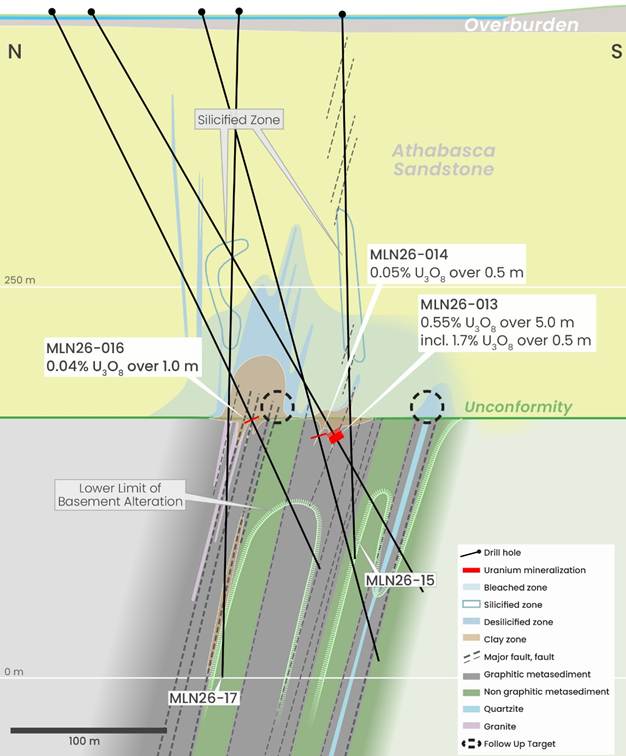
“This is a significant result for Cosa, with the assays confirming that Cyclone hosts uranium mineralization comparable to discovery intersections from multiple Athabasca uranium deposits,” President and CEO Keith Bodnarchuk said in the May 26 news release. “The Cyclone trend is an extensive corridor of strong structure and alteration that now features uranium mineralization that is open along strike for 600 metres in both directions.”
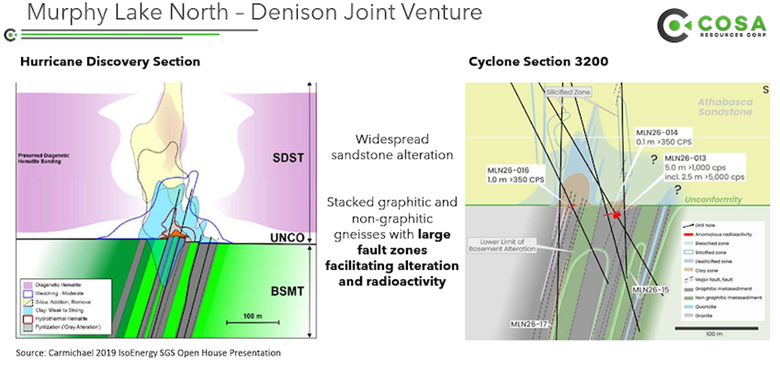
Andy Carmichael, Vice President of Exploration, commented: “Winter drilling showed that the Cyclone sandstone alteration patterns, basement lithologies, and faulting are strikingly similar to those at the nearby Hurricane deposit. Chemical assays indicate that Cyclone uranium mineralization contains significant quantities of nickel and cobalt, consistent with Hurricane and current- and past-producing mines like Key Lake and Cigar Lake. We are very encouraged that results have continued to improve as exploration advances and we are eager to continue follow up both on section and along strike.”
AOTH analysis
Uranium desperately needed
While obviously early-stage, Cosa Resources appears to have made a uranium discovery at the Cyclone Trend of Murphy Lake North. Hole MLN26-013, the first hole of the winter drill program, intersected 5 meters of anomalous radioactivity registering up to 13,900 Counts Per Second (CPS) on the scintillometer.
Assays confirm that the same intersection contains uranium — i.e., 5.0 metres averaging 0.55% U3O8, including 0.5m of 1.7% U3O8.
Also important, the 5.0-meter intersection contains 4.1% nickel and 1.7% cobalt, consistent with multiple polymetallic Eastern Athabasca uranium deposits including Cigar Lake, Key Lake and Hurricane.
This news comes at an interesting stage in the development of the Eastern Athabasca Basin.
At AOTH we believe Cameco and the French company Orano could be desperate for uranium. Cigar Lake is almost mined out, and while Denison is bringing on its Phoenix and Gryphon deposits — Denison is targeting first production for its flagship Phoenix in-situ recovery (ISR) uranium mine within the Wheeler Project by mid-2028 — the life-of-mine is relatively short and to extend it into a multi-decade mine will require more uranium.
Orano, which operates the McLean Lake Mill, has made significant investment into refurbishing the mill to handle ore from Cigar Lake. But the mine will be depleted in 10-12 years. I think this is why Orano developed its SABRE (Surface Access Borehole Extraction) technology. The surface-based hydraulic mining method is used to extract small, high-grade uranium deposits that are otherwise uneconomical to mine using conventional open-pit or underground methods.
Then there’s Cameco’s Rabbit Lake Mill in Northeastern Saskatchewan, currently on care and maintenance. Cameco might be eager to get more pounds in the Northeast so it can take a run at getting Rabbit Lake operational again.
The upshot is that Denison, Cameco and Orano all need new discoveries to keep their mines and mills going, and Cosa, on the verge of potential discoveries, might be the company to provide it.
Potential acquisition target
In fact, with a minimum amount of continued success, it wouldn’t surprise me to see a bidding war break out over Cosa’s Murphy Lake North — like the competition for Hathor’s Roughrider deposit that was eventually won by Rio Tinto.
Denison would be the obvious acquirer since it already owns close to 20% of Cosa and 30% of the Murphy Project. On the other hand, a 20% interest might not be enough to stop a competitor from swooping in. Consider: the company that buys Cosa will effectively control 70% of a potential Tier 1 deposit in Cameco’s backyard. Wildcards include Australia’s Paladin Energy (TSX:PDN), which owns the advanced-stage Patterson Lake South Project and UEC.
Hurricane look-alike/ extension?
Back to this week’s news releases, the key takeaways for me are:
1/ The 5-meter intercept that previously registered high radioactivity has now been confirmed by assay results to contain uranium (U3O8).
2/ Cosa has identified a large zone of zone of structure and alteration that is practically identical to, and may be an extension of, the Hurricane system. Remember that Hurricane is the world’s highest-grade Indicated uranium resource, at an astonishing average grade of 34.5% U3O8. Hurricane is just a few kilometers away from Cosa’s Murphy Lake North Joint Venture.
Moreover, initial drilling completed by Cosa during winter 2025 intersected broad zones of hydrothermal alteration of the sandstone, associated with prospective basement structures interpreted as the strike extension of those controlling the Hurricane deposit.
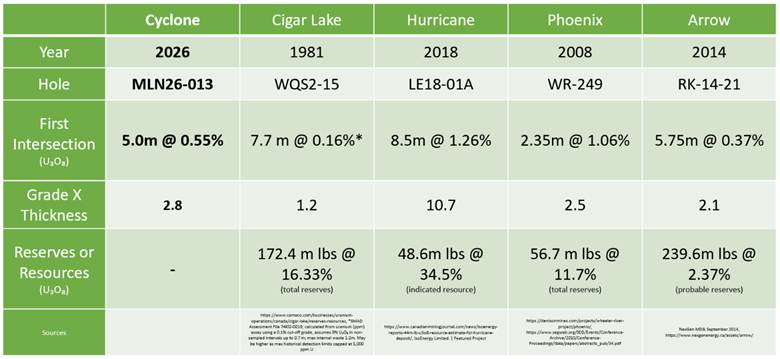
The below chart comparing early intersections at Murphy Lake North to Cigar Lake, Hurricane, Phoenix, Gryphon and Arrow is helpful.
Drill targeting in this area must be precise. The deposits, though high-grade, are small and hard to find. Cameco, for example, missed finding Hurricane in several places by as little as 40 meters.
IsoEnergy saw this a lot at Hurricane. The typical strategy was to drill a shallow-angled hole at the target. If you undershot and went into the basement, you could reliably hit high-grade mineralization where your largest faults intersected the unconformity. Alternatively, if you overshot, you’d see certain alteration — at Hurricane it was “grey” or “sooty pyrite” alteration – but it was pretty much 100% guaranteed that if you hit grey alteration in the sandstone, you just needed to drill underneath it and hit uranium mineralization, at Hurricane this was very high grade uranium.
The alteration and structure that Cosa is seeing in its drill holes tells them they might be right on the edge of a larger system, which will be the focus of this summer’s 6,000-meter drill program.
There are other indications that Murphy Lake North is a possible extension of Hurricane. We’ve already mentioned the rocks. Copper, nickel, cobalt and molybdenum are all strong indicators and that mix is the same mix of fluids that precipitated out at Hurricane.
There is correlation between the intensity of uranium mineralization and other metals. At Hurricane, some of the very high-grade uranium samples also contained up to 20% nickel.
It’s also the same kind of basement geology, i.e., a series of graphitic and non-graphitic gneisses with massive faults either within the graphitic units or on the edges of them; and a similar assemblage of sandstone alteration patterns.
Finally, Athabasca Basin uranium deposits are often described as a “string of pearls”, with one following another directionally. The controlling structures at Hurricane trend east-west. Following them leads directly to where Cosa just drilled.
Investment thesis
Investors should recognize that this summer’s drill program at Murphy Lake North could discover a new uranium deposit. If Cosa achieves this, it could trigger a bidding war among multiple companies seeking additional uranium supply to support their mines and mills for years to come.
It’s also important to understand that while there will be lots of eyes on the program it isn’t a “break it” drill program. If they miss at MLN, Costa still has the Darby Joint Venture to drill. And there’s next winter to get back on Murphy Lake North. On the bright side, it might even be possible, between these two projects, for Cosa to come up with more than one discovery.
Cosa’s management views Darby as a mature, discovery-ready project that is a strong analog for Larocque East, where IsoEnergy discovered Hurricane in 2018.
On May 15th yahoo!finance published an article on Denison Mines Corp. (TSX:DML, NYSE:DNN) featuring the uranium miner / processor as one of the best uranium stocks to buy according to Wall Street analysts.
“On May 6, Cosa Resources Corp. released winter 2026 drilling results from the Darby uranium project, which it co-owns with Denison Mines Corp. The project is a 70/30 joint venture between Cosa and Denison, and Cosa is the operator. It is located just 10 kilometers west of Cameco Corporation’s Cigar Lake Mine, which is one of the world’s largest high-grade uranium mines.
According to the drilling results, the winter program drilled three holes targeting three distinct geological trends, that is Charlie, Gamma, and Delta. At the Charlie Trend, drill hole DB26-39A returned strongly anomalous uranium concentrations in the sandstone, which averaged 5.6 parts per million (ppm) over 103.5 meters. The hole also intercepted a thin interval of actual uranium mineralization grading 0.04% U3O8 over 0.5 meters. The company said this is the second such interception at Charlie, and that it confirms the trend holds genuine exploration potential.
At the Gamma Trend, the project drilled a hole roughly 150 meters across, and it was characterized by graphitic basement faulting, zones of hydrothermal alteration, and significant unconformity relief. These features form a geological setting geologists consider highly favorable for uranium deposit formation, the company noted.
Cosa said results from the Delta Trend were less conclusive because the single drill hole did not return significant findings. However, the company added, geochemical assays are still pending and several kilometers of prospective strike length at site are still untested.”
Denison Mines (DNN) Drills Into Promising Uranium Ground Near Cigar Lake
In the meantime, there will be plenty of news flow for investors to digest as the summer wears on. A final point is that uranium exploration isn’t like copper or gold exploration, where investors must wait until assays come out to evaluate the success of the drill program. Due to the use of scintillators to measure the radioactivity of each hole and after receiving assays from that hole we can now correlate their scintillators count per second to assays, Cosa will announce CPS results while the drill is still turning, for investors this is important information.
The release of very high, +10,000, CPS counts has been a catalyst for Athabasca Basin uranium junior market caps for decades. It was most recently for Cosa when they announced 13,000 CPS after the first drill program at MLP.
Cosa Resources Corp.
TSXV:COSA, OTCQB:COSAF
Cdn$0.66 2026.05.28
Shares Outstanding 116.1m
Market Cap Cdn$77.6m
COSA website
Richard (Rick) Mills
aheadoftheherd.com

Subscribe to AOTH’s free newsletter
Richard owns shares of Cosa Resources Corp. (TSXV:COSA).
COSA is a paid advertiser on his site aheadoftheherd.com
This article is issued on behalf of COSA
Legal Notice / Disclaimer
Ahead of the Herd newsletter, aheadoftheherd.com, hereafter known as AOTH.Please read the entire Disclaimer carefully before you use this website or read the newsletter. If you do not agree to all the AOTH/Richard Mills Disclaimer, do not access/read this website/newsletter/article, or any of its pages. By reading/using this AOTH/Richard Mills website/newsletter/article, and whether you actually read this Disclaimer, you are deemed to have accepted it.