 RSS Subscribe
Under the Spotlight – Simon Ridgway, CEO Rackla Metals TSXV:RAK
2026.08.26
Richard Mills editor, Ahead of the Herd (AOTH): This afternoon I’m here with Simon Ridgway, CEO of Rackla Metals. We’re going to be talking about Rackla’s tungsten project, Lentung.
The Tombstone Gold Tungsten Belt is a thousand kilometer long magmatic arch stretching from Alaska through the Yukon into the Northwest Territories.
It’s defined by a distinct geological phenomena in that it’s eastern tail transitions from a gold dominant system into one of the richest tungsten environments on earth. In the western part of the belt, the Alaska-Yukon part, highly oxidized magmas generated massive gold systems such as Snowline Gold’s Valley Discovery.
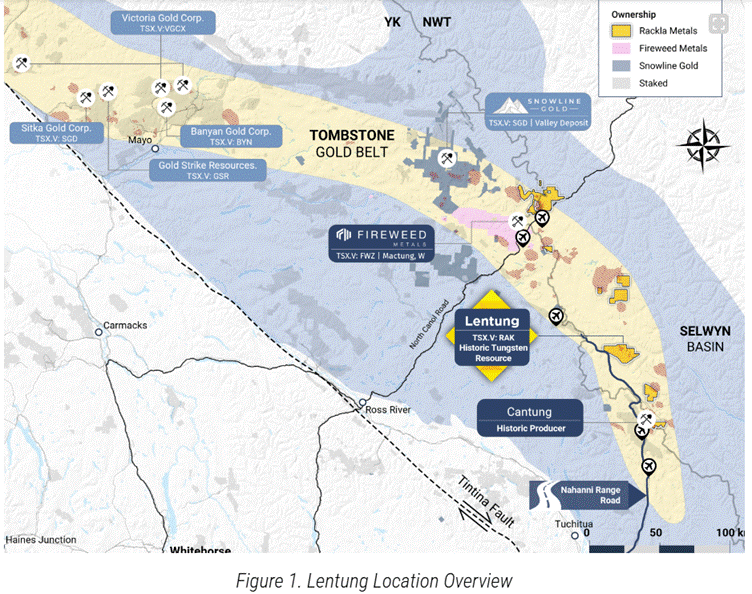
As the belt moves east in the Selwyn Basin where Lentung sits, the magmas become heavily reduced. These reduced magmas efficiently scavenge tungsten from surrounding limestones, cooking them into massive high-grade tungsten skarn deposits.
The eastern end of the belt features a tight geographic cluster holding the vast majority of North America’s premier tungsten assets.
Mactung, currently being developed by Fireweed Zinc (TSXV:FZW), is on the Yukon/ Northwest Territories border. It’s widely considered one of the largest and highest grade undeveloped tungsten skarn deposits globally.
Cantung is located 187 kilometers south of Mactung. This historic past producing mine historically supplied the west with high-grade ore before fluctuating markets impacted operations.
Lentung, formerly Lened, is positioned stragically between the two and features a 15 kilometer tungsten mineralized strike zone length with a non-43-101 compliant historical Union Carbide resource.
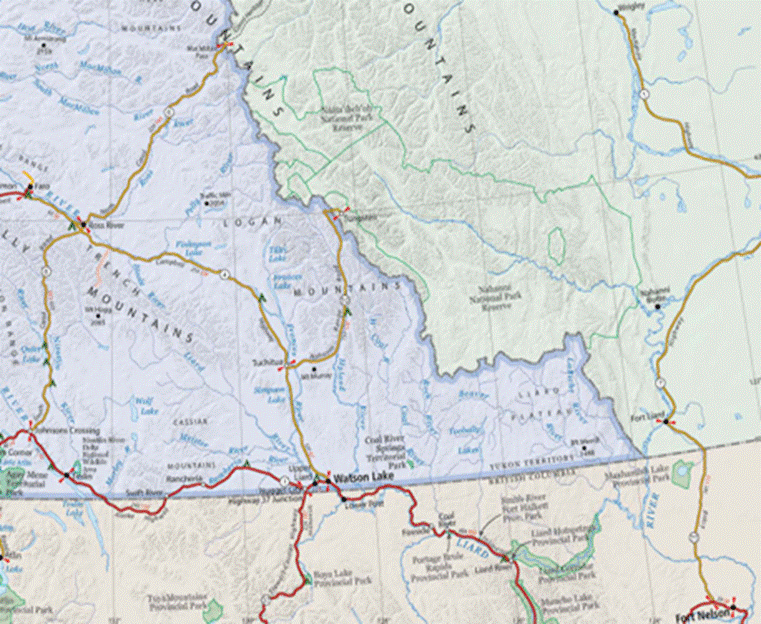
There are roads (Nahanni Range Road off the Robert Campbell Highway) from Watson Lake on the Alaskan Highway to Tungsten, Cantung and Lentung. Mactung is located near the end of the North Canol Road (Yukon Hwy #6).
Rackla Metals TSXV:RAK currently has a 10,000 meter drill program ongoing to confirm Union Carbide’s historic non-compliant resource and bring it into 43-101 compliance.
Simon, does that pretty much sum up where we stand at the moment?
Simon Ridgway CEO, Rackla Metals: Perfectly. That’s why we’re out there, started drilling about a week ago. It took us longer than I expected to get started.
There was a lot of snow, so a late spring break up in the Northwest Territories in that border area with the Yukon, this year. We entered in July, thinking we could get started in a few weeks. We had to put in a large camp, a +40 man camp, close to the area that Union Carbide drilled their resource.
That’s done now, and the drills have started turning.
RM: All of the work that was done by Union Carbide, you acquired all of that data. An immense treasure chest of all the technical engineering studies, etc. they did.
SR: Absolutely, we have all the drilling logs, sections, all data- locations of the pads. We digitized it all over the winter. We’ve got a really good idea where they drilled all of their good holes.
Just as important, maybe more important we also know where they missed. We started out the season by putting in a camp and doing LIDAR over the property and then doing drone supported MAGnetics.
As the scheelite is generally associated with Pyrrhotite you can get a good MAG anomaly where the scheelite is. We started drilling on the targets defined by that historic work and then extended where we see the Magnetic anomaly continues.
We’re twining some of those holes done by Union Carbide to confirm the reliability of their results. If we can twin about 20% of the holes and get the same grades as they reported, then we can use their data and core to form the basis of the resource and bring it up to 43-101 standards and then work on expanding it.
That’s what we’re doing at the present time. We’ve also taken an RC rig into the property. We get a diamond drill to confirm the geology of the zones and then use the RC rig to expand the resource. The zones are close to surface mostly, 30 to 40 meters below the surface forming the dip slope of the hill in many cases.
Once we get a diamond hole into the zone, we then step out in 20-meter intervals up dip, and down dip to establish the resource. This is the work underway on the central zone.
Like you said, the overall belt that we have from the work done by Union Carbide is about 15 kilometers strike with three large intrusive bodies and several other sills and dikes cutting the limestone beds creating these skarns.
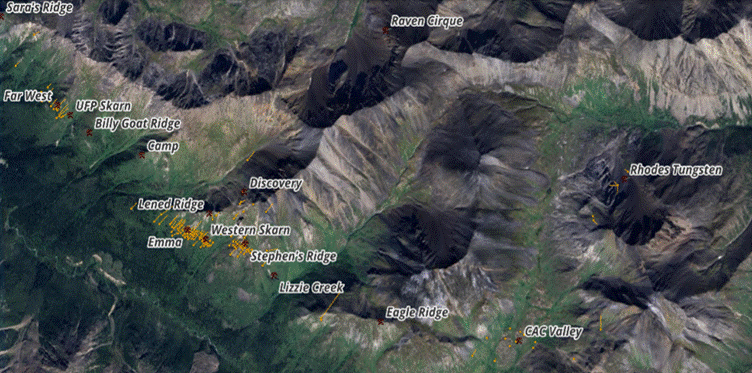
We have a lot of exploration to do, but right now we’re just focused on establishing that resource in the central zone. Potentially that could give us a few million MTUs of Tungsten sitting very close to the surface, good grade, an open pit design.
RM: You have relief. It’s all gravity downhill because of the elevation. From what I was looking at on the Union Carbide stuff, and I know we can’t talk much about this but they had one hell of a nice little open pit design.
SR: They did. The zone is forming to the dip slope of the hill. That’s what we’re trying to reestablish, taking that central zone to a 43-101 then we can start expanding from that.
The geophysics we’ve done, we did magnetics and gravity. We did the gravity, that was land-based, the mag was drone-based. Now we’re going to be doing a larger Helicopter magnetic survey with Precision GeoSurveys covering a larger area of the belt because the whole northern side of these intrusives cuts the same limestone beds and they have not been explored at all.
RM: Obviously, on top of converting the UC historical, the upside exploration potential on this is very, very significant. You’re going to have some news out tomorrow. Why don’t we talk a little bit about what you’re putting out tomorrow, we’re doing this the day before, that can help people understand where we are right now, what you’re doing.
Rackla Adds Second Drill Rig at Lentung Tungsten Project
SR: We’ve drilled 4 diamond drill holes, just finishing up the 5th one today. Two of those will be twins of Union Carbide’s work. The other two are up-dip and down-dip on the same skarn zones.
The news is mostly about the fact we’re taking in the RC rig and we’ll start drilling with the second rig right away. And then on the web site we’re just putting out some pictures of the core, pictures of the scheelite in the core that we see with the infrared light. We’re not talking about the extent of the zones, we’re just showing that we are seeing scheelite in the core where we’re supposed to be hitting it.
I really believe that we will be able to use all of this Union Carbide data. So far we’ve been pulling, you know, re-boxing all their core and we will be re-sampling it over the winter months if we confirm the work they did and results they got are reliable. It’s nice to see that in the intervals where they said there was tungsten, we’re seeing it in the core….of course we have to wait for assays to confirm grade, but visuals are a good start!
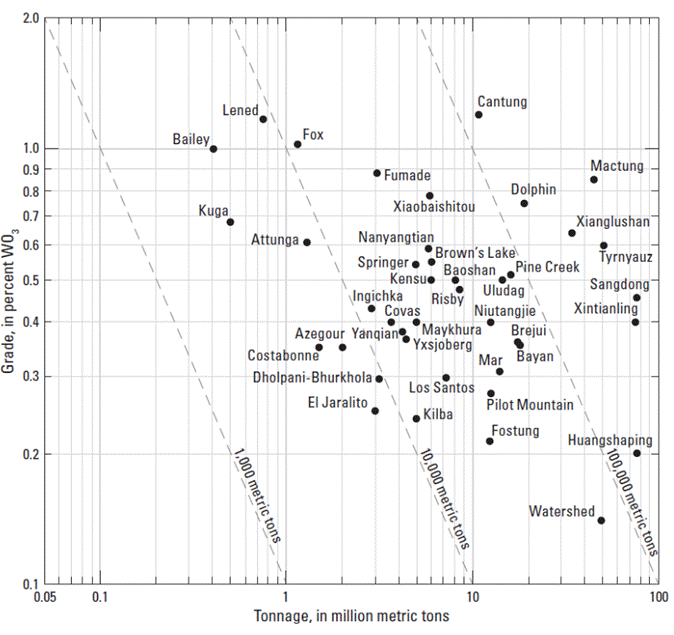
That’s all we need for now. We’ll be shipping the first four holes to the lab this week, but turn around will be slow, has been for years. The Yukon is just so active these days.
But I expect in a month, 5 weeks we’ll be getting results in, and then obviously once we get the first results we’ll have a steady flow. We hope to keep drilling with the RC rig late into October.
We’ve got good road access from the camp to the resource area. We cleaned up the old drill roads that were established by Union Carbide. With the track mountain RC rig, we can keep drilling, confirming grade and keep re-boxing and re-logging their core.
RM: Your drill program and everything is on track for where you want it to be or are we just a little tiny bit behind?
SR: We’re a tiny bit behind. I think we will be able to complete our plan if we can keep going into late October. I think we’ll get the 10,000 meters done.
We will raise a little more flow-through funding. It cost us a little more than we expected to get to where we are. I mean the company is well financed but I’d rather keep the hard money we have for the engineering studies road permitting etc.
We’re 7km from the from the Howards Pass access road. We can push that road through or at least get a winter road permit to get equipment in there next year. That will reduce our cost of drilling significantly.
RM: I think people have to realize too that things got a little more expensive. When you guys were planning this probably the war hadn’t even started yet and diesel prices were relatively tame. Everybody’s suffering from the same thing.
You had guys that wanted drill 5,000 meters and all of a sudden they’re cutting back to 4,000 meters and that’s because of cost. Diesel went up but it’s nice to see that you’re sticking to the 10,000 meters.
SR: Yes, also, other than the late spring break up, part of the delay was getting people, drillers. Camp builders etc. they are a lot more expensive than they were last year, that’s a bull market!
RM: Your drill program’s on track and we will be seeing some tungsten, we’re going to see some scheelite which is quite a nice electric blue colour under UV.
What you’re aiming to do is put out Rackla’s maiden Mineral Resource Estimate, an MRE.
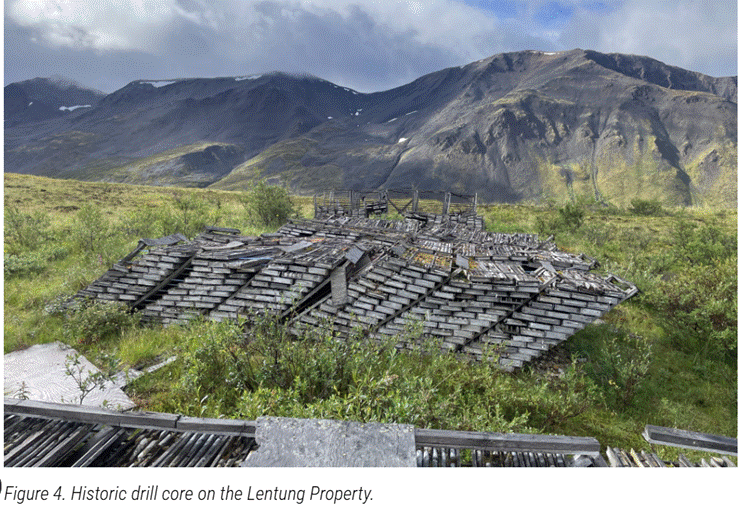
SR: The plan is for the first quarter next year to have that first resource on this property.
RM: If you have that you’d do a PEA.
SR: Yes, That is the plan. I would very much like to get started on that as soon as we’ve have the resource done. It’s close to surface open pit-able, it’s high grade, numbers should be good.
RM: I’m always interested in seeing a PEA on a high-grade open pit with relief. Is there anything better?
SR: No, I don’t think so.
RM: It’s a perfect mining scenario. The IRR could be spectacular.
SR: Yes, I believe it may.
RM: You’ve got the MRE, you’ve got a PEA, but you’ve also got something that I like to read and that’s a technical report coming out early in the new year. Is that correct?
SR: Yes. That’s a process we’ve got to get started as soon as we finish drilling, once we’ve got that resource done, we’ve got to start pushing out to get that approved. So that is the plan.
RM: Since the 4th of August, we’ve had roughly 19M shares trade hands, which is about one tenth of the outstanding float. Are you happy with those numbers?
SR: It’s good. It’s liquidity, the switch from being a gold company to a tungsten company takes a little time for people to digest.
I’ve been in this business for a long time and know we’ve got to be opportunistic. The fact that we could stake this resource, this historic resource acquired for the cost of staking is amazing.
We can’t walk away from something like that, so we switched from being a gold exploration company to being a tungsten development company.
I think a lot of people were disappointed with that and that was some of the selling. But the liquidity is great. I love to see it.
Hopefully we can keep it up for the rest of the year with constant news and developments.
RM: We talked about Lened and the tungsten potential in January of this year.
Do you think there’s any synergy between Cantung not going into remediation and Lentung?
SR: I think so, for sure. But let’s get this resource established before we start talking too hard or long about that.
But I do believe that there’s some synergies there and that Cantung could well come into play.
RM: We’re not as quite isolated as some people might think. Cantung is a former producer and has an awful lot of mining infrastructure that can be refurbished and brought back into use, always good to get more use from existing infrastructure.
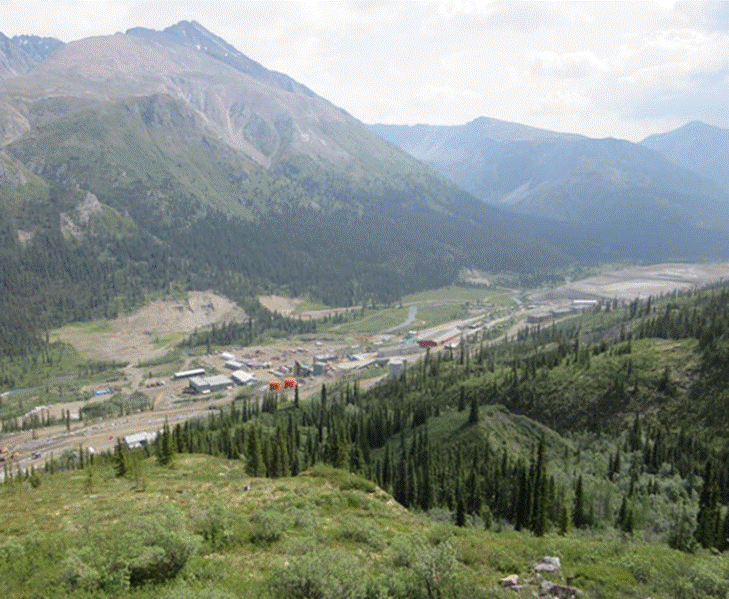
Not only that, the town site of Tungsten, that’s where the guys working on the current care and maintenance program stay. They’ve been been there taking care of the place since the last shutdown.
And we do know, and it’s unfortunate, that the Northwest Territories are losing the royalties from their diamond mines. And I think that’s going to play some part in this myself.
SR: Yeah, I think certainly the territorial government would love to see that Cantung brought back to life. So would many of the First Nations groups in the area. We’ve been spending some time recently talking with the First Nations groups in the area, some of them would love to see it back in production
RM: Yeah, let’s talk about that just a little bit. We have a land use plan from the Sahtu, which is for the Lentung. But we’re dealing with three First Nation groups here.
You have the territorial governments, two of them. You have three First Nations, you have the federal government, you have the remediation program for Cantung, Fireweed and Mactung are involved, there is a series of roads including in the park, there could be international involvement and then you’ve got your own Rackla and Lentung and an immense program going on.
All of that and trying to keep focused, keep driving to get the program done and get that resource done.
SR: Yes, my focus right now is to get this resource established, so people understand that there is a lot of money sitting on a hillside in Lentung.
That resource gives Rackla a seat at the table and a lot more to say about developments in the area.
RM: Absolutely. Everybody mentioned above has an interest in a piece of that money, they have a share of that money coming their way, a little bit of cooperation, and you never know what’s possible.
SR: That’s right, we’re just taking it slow and see how things develop.
RM: There’s a lot of grants available for Lentung specifically and area infrastructure.
There are a lot of Canadian federal programs targeting critical mineral supply chains and northern infrastructure together. So far you’ve currently funded pretty much everything through private placements.
There’s the First and Last Mile Fund, the Critical Minerals Accelerator Program, the Critical Minerals Research Development and Demonstration and the Canada Infrastructure Bank.
The Yukon government has the Resource Gateway Programs. They’re targeting key routes, Robert Campbell Highway, the Nahanni Range Road, the Howard’s Pass Access Road. They want to do a program called Early Mining Road Access.
And on the other side of the border, you’ve got the Northwest Territory Government taking care of permitting and park boundaries.
I have never seen so many projects, in one tightly grouped area, with the amount of synergy between, and the need for them, that there is for these projects. There are so many economic benefits for so many parties, and to research all the money that’s available to develop them that is non-dilutionary, never seen anything like it.
SR: Yes, it is quite amazing. I mean, this mineral belt is phenomenal.
You mentioned early on in the talk about the world class of this tungsten belt. I agree and I think there’s more to be found in the belt and that’s what we’re about.
I’m going back and reviewing all that historic data and, wow, there’s some strong targets, gold and tungsten anomalies in there.
We’re still spending a little bit of time on that regional work and we’ve seen some interesting things to follow up.
But the belt itself is not remote as people think, like I said, the access is there.
RM: Rackla Metals is a 100% critical metal tungsten focused company, but we also have to remember the rare earth is an extremely interesting angle because of the supply chains, of course, the rare earth magnets and the fact they are critical metals.
That’s very important. And then you found six and a half grams a ton of gold at the mouth of a creek. Now, that’s pretty concentrated, you know, from the creek and everything.
You’ve got to work backwards up that creek sampling and when you don’t have it in the sample bucket anymore, you might have some lode gold.
That’s nice to have both of those in your back pocket, but I wasn’t really going to talk too much about either one today because your focus is tungsten right now.
SR: Yes, our focus is 100% tungsten right now.
I’ll look forward to tomorrow’s response to the initial release and we will talk again soon.
RM: I always enjoy our talks Simon. Thank you for doing this.
SR: Thanks, Rick. Take care.
Richard (Rick) Mills
aheadoftheherd.com

Subscribe to AOTH’s free newsletter
Richard owns shares of Rackla Metals (TSXV:RAK). RAK is a paid advertiser on his site aheadoftheherd.com
This article is issued on behalf of RAK.
Legal Notice / Disclaimer
Ahead of the Herd newsletter, aheadoftheherd.com, hereafter known as AOTH.Please read the entire Disclaimer carefully before you use this website or read the newsletter. If you do not agree to all the AOTH/Richard Mills Disclaimer, do not access/read this website/newsletter/article, or any of its pages. By reading/using this AOTH/Richard Mills website/newsletter/article, and whether you actually read this Disclaimer, you are deemed to have accepted it.