 RSS Subscribe
Orestone to drill Francisa Gold-Silver Project, Argentina – Richard Mills
2026.06.08
Time after time I’ve said that if location, location, location is all about investing in real estate, then management, management, management is what investing in junior’s is all about.
Orestone is a great example of a company that, with good management, can secure a great project, build upon it and move it forward.
Just look at where Orestone has come from over the past year. The company has gone, in a little over a year, from raising money to target an oxide gold deposit mineable by open pit methods and amenable to heap leach gold recovery to an initial expansion of their Francisca Gold-Silver Project, the completion of a Phase I chip sampling and trenching program, the acquisition of the Francisca II concession and the purchase of historic geophysical survey data over the current and new land positions.

An amazing amount of work, and success, done all the while conserving the treasury and avoiding unnecessary share holder dilution. After raising $2.5 million last year the company still has $1.4 million in its treasury. Enough to do at least the first round of planned drilling.
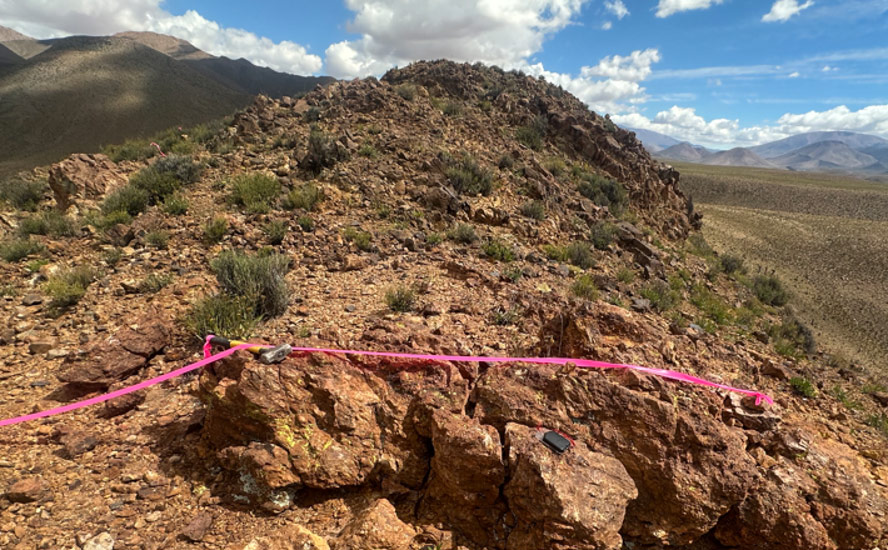
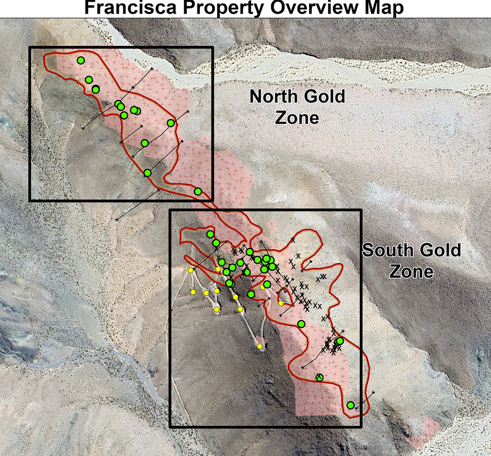
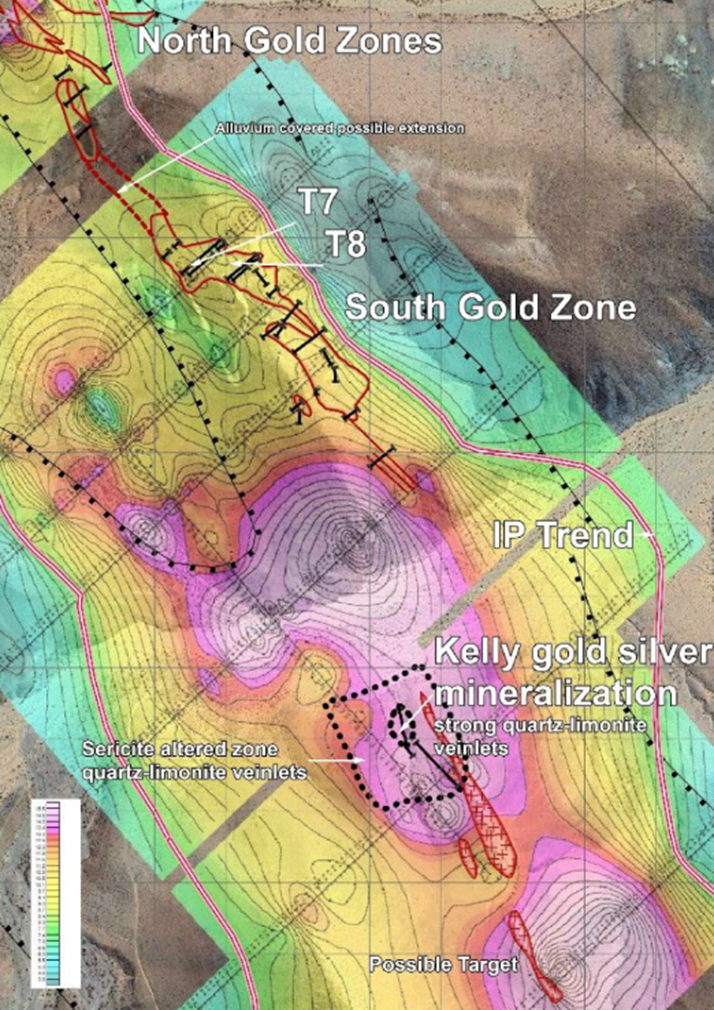
“With the addition of the Francisca II concession the mineralized trend now covers a northwest strike length of 1500 metres where an oxide gold-silver stockwork, vein and breccia system can be observed at surface in numerous large outcropping areas (North cluster, South Zone and Kelly Zone).
The outcropping zones are surrounded by a 500 to 1000 metre wide area of strongly hornfels altered sediments, further defined by a 1700 metre long by 500 to 700 meter wide IP chargeability anomaly of 7.9 mV/V that appears to be related to gold-silver mineralization. Several large, strong IP chargeability anomalies measuring up to 20 mV/V indicate the potential for a larger buried gold porphyry.
The oxide gold quartz limonite stock-work trend is associated with quartz feldspar porphyry intrusive dykes and intense sericite clay alteration along a NW trending fault system.”
What does all that mean in layman speak?
Hornfels-altered sediments refer to sedimentary rocks, like mudstone, shale, or clay-rich silt that have been “baked” and recrystallized by intense heat from an underground magma intrusion.
This contact metamorphism process changes the original sediment into a remarkably hard, dense, and durable metamorphic rock known as hornfels.
Finding these rocks means you are in, or near, a “metamorphic aureole”. This is the zone immediately surrounding a large underground magma body like a granite pluton, a volcanic dike, or a deep sill.
Magma intrusions act like massive heat engines for circulating fluids. The contact zone between the hot magma and the cooler sedimentary rock is a prime target for finding valuable hydrothermal ore deposits e.g., gold, copper, tungsten and tin that have precipitated out of the fluids.
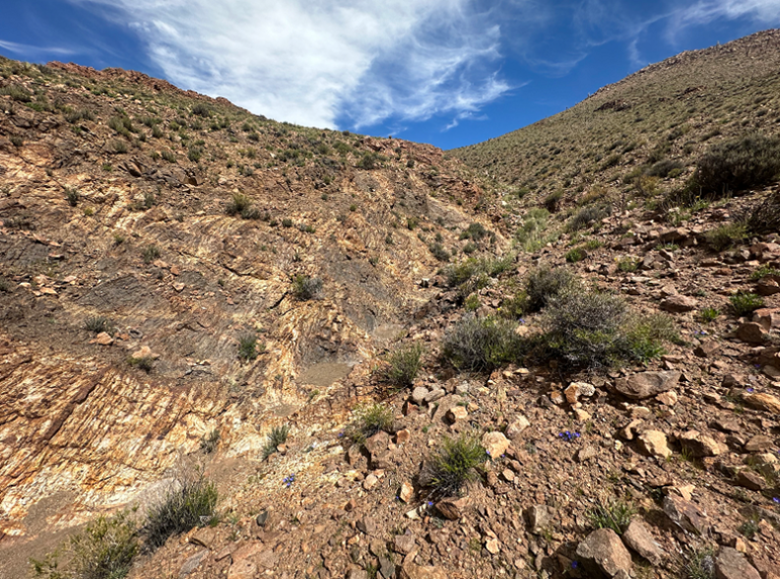
To a geologist finding oxide gold, quartz, limonite, and stockwork together it means he/ she has discovered a geologically highly promising, near-surface gold target formed by intense ancient hydrothermal activity and subsequent weathering.
Gold is primarily carried and deposited by ancient super-heated, mineral-rich water that fractures quartz to create veins. Gold is found in rock where minerals (like iron) have chemically reacted with oxygen, typically due to weathering at or near the surface.
Limonite is a yellow-brown to reddish-brown iron oxide. It is typically left behind when iron-rich sulfide minerals (like pyrite/fool’s gold) break down due to weathering. Because “hidden” gold is often locked inside these sulfides, their breakdown can leave behind highly concentrated “free” gold in the limonite.
This weathered rock is much easier and cheaper to process than unweathered “sulfide” gold.
Stock-work is a dense, complex network of tiny, intersecting mineral veins rather than one single, solid vein. Instead of mining one thin line of rock, miners can potentially mine a massive, widespread zone of rock, often making it ideal for large-scale, open-pit mining operations.
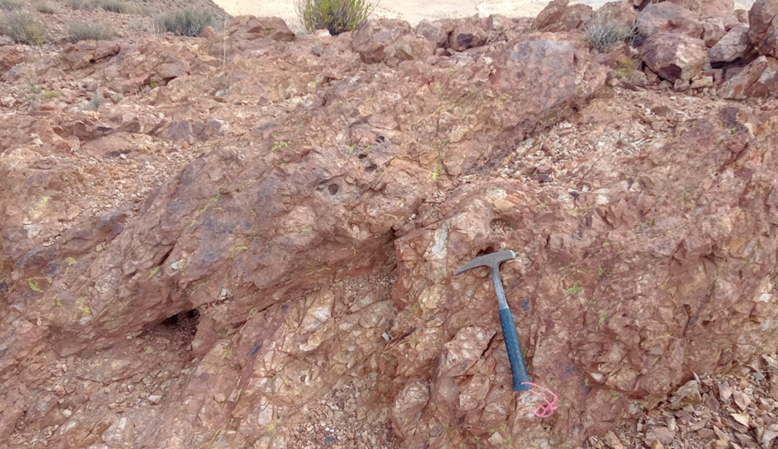
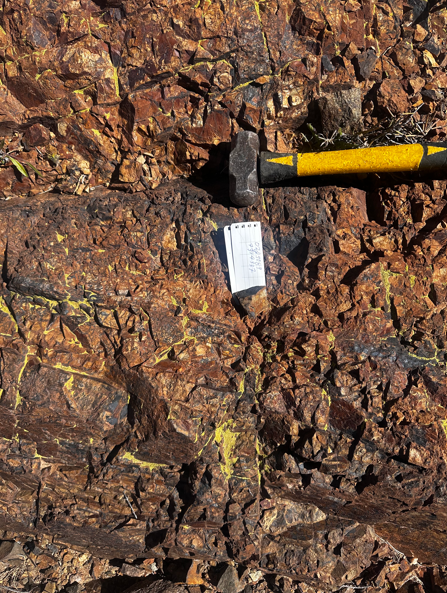
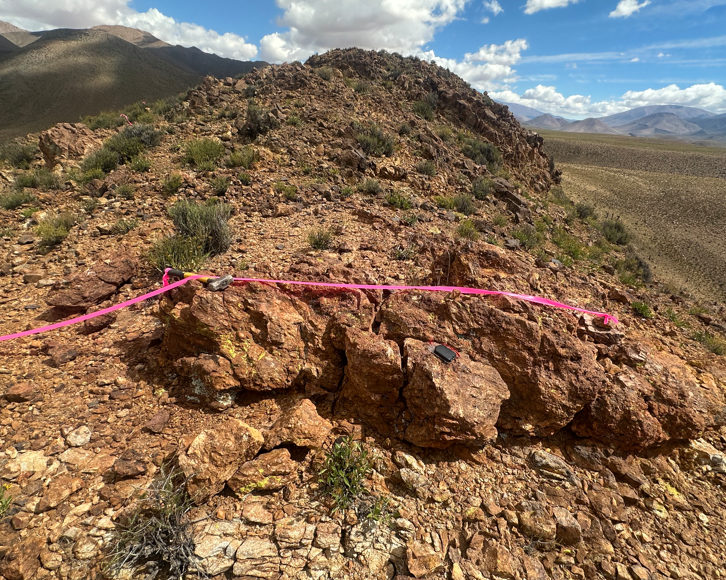
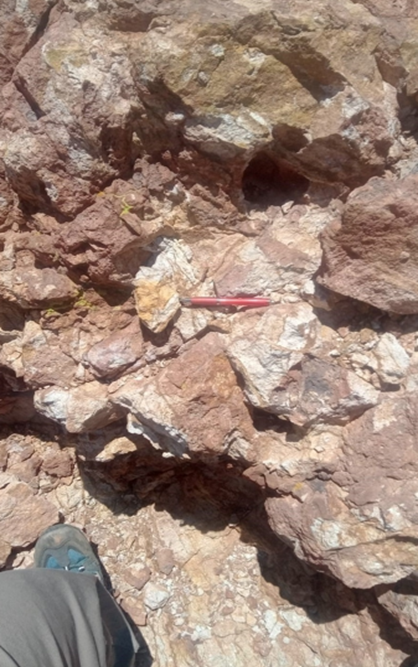
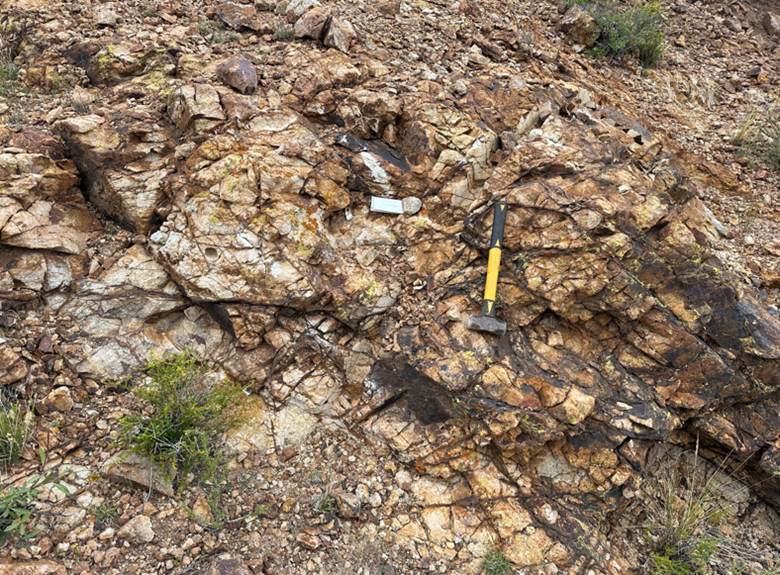
An up to 10 meters of a shallow (80 meters) historical drill hole intersected base metals and precious metals mineralization in porphyry-textured rock. Historical drill results are not 43-101 compliant and are not to be used for investment decisions.
What that says to Orestone’s management is that there is a potential porphyry intrusion, a heat engine, underneath the surface expressions of gold and silver.
After all completed Phase I assays results are received and analyzed Orestone plans to drill-test the gold/ silver oxide zone and the porphyry target during a Phase 2 drill program that is slated to begin shortly.
The first round of drilling will be around 1,300 meters and is expected to cost approximately CAD$700,000.
Conclusion
The setup here looks promising. When I talked to CEO David Hottman on Friday, June 5, he said Orestone is looking at a 1,500-meter-long stretch of outcrops — stockworks, veins and gold-mineralized material that pokes up at surface — with large IP anomalies in a trend that covers 1,700 meters.
“We’ve got a tiger by the tail, Francisca represents a multi-million-ounce opportunity for an open-pit gold project.” But he also added they have porphyry dikes that are exposed to surface and there is a big IP anomaly that indicates a larger porphyry target deeper.
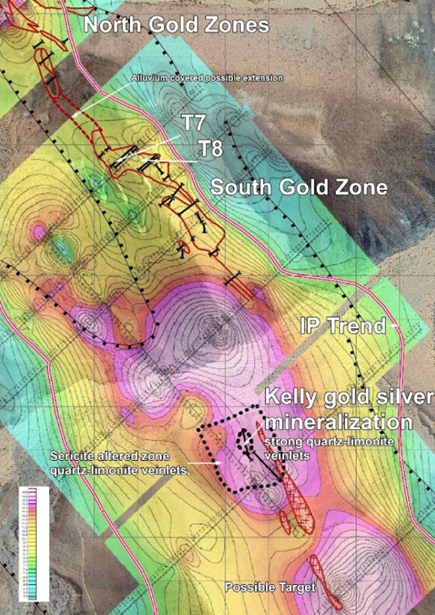
Indeed, strong geophysical survey results below widespread surface geochemical results is always a drill target. And 1.5 kilometers is a significant mineralized trend that points to a large oxide gold-silver system at surface, as confirmed by assays, while the geophysical survey, and an historical drill result, potentially indicates a porphyry target at depth.
I like Francisca because it looks like it could have some serious size to it and management has been involved in the development of several oxide heap leach deposits.
I’m looking at Orestone as a unicorn, a junior run by management that has built companies into cash flow and sold them.
Orestone Mining Corp.
(TSXV:ORS, OTC Pink: ORESF, FSE: O2R2)
2026.06.05 Share Price: Cdn$0.095
Shares Outstanding: 107.3m
Market Cap: Cdn$10.7m
ORS website
Richard (Rick) Mills
aheadoftheherd.com

Subscribe to AOTH’s free newsletter
Richard owns shares of Orestone Mining Corp. (TSXV:ORS).
ORS is a paid advertiser on his site aheadoftheherd.com
This article is issued on behalf of ORS.
Legal Notice / Disclaimer
Ahead of the Herd newsletter, aheadoftheherd.com, hereafter known as AOTH.Please read the entire Disclaimer carefully before you use this website or read the newsletter. If you do not agree to all the AOTH/Richard Mills Disclaimer, do not access/read this website/newsletter/article, or any of its pages. By reading/using this AOTH/Richard Mills website/newsletter/article, and whether you actually read this Disclaimer, you are deemed to have accepted it.