 RSS Subscribe
Mercado acquiring district-scale land package in San Dimas mining district, Mexico – Richard Mills

2026.05.04
Mercado Minerals (CSE:MERC) is expanding its silver-gold footprint in Mexico by acquiring two adjacent projects totaling 4,617 hectares.
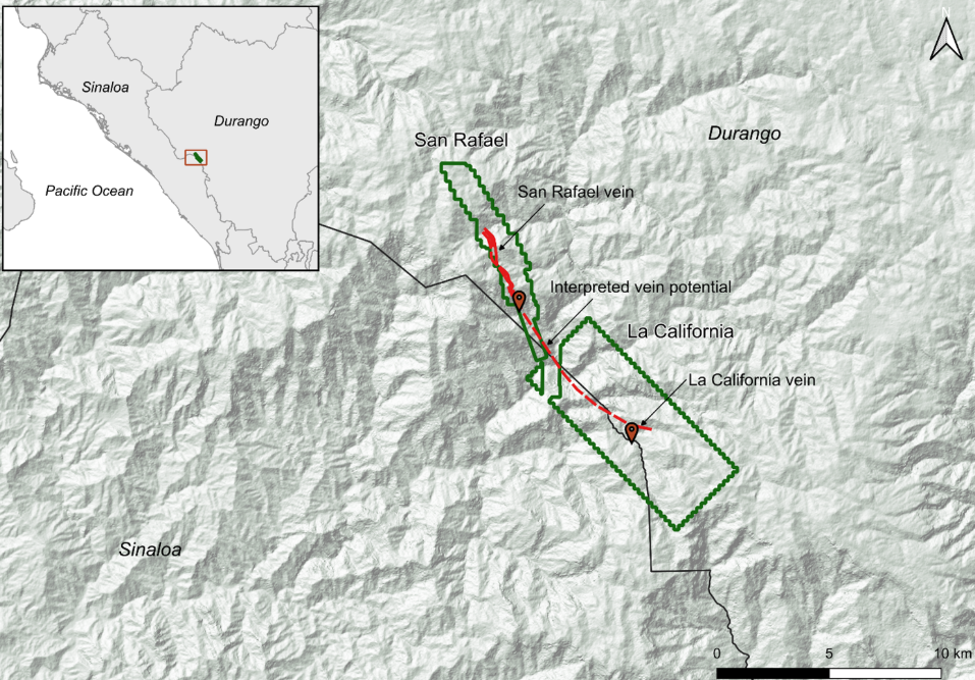
The company announced on June 2 that it has signed two LOIs (Letters of Intent) to acquire the San Rafael and La California projects — both located in the prolific San Dimas mining district in the state of Durango.
It is one of Mexico’s highest-grade silver-gold epithermal districts, with past production through December 2024 estimated at more than 766 million ounces of silver and over 11.1Moz of gold.
According to Mercado, the district-scale land packages span a NW-trending structural corridor exceeding 6.5 km along the Sierra Madre Occidental Silver-Gold Belt, the same trend hosting First Majestic Silver’s (TSX:AG) Tayoltita Mine.
San Rafael is a 1,004-ha property with 4.5 km of identified fault structures hosting intermittent vein mineralization and underground mine workings. Historical underground chip samples returned a highlight result of 1.4m of 316 g/t silver and 22.08 g/t gold.
La California consists of 3,613 ha, with over 2 km of cumulative vein strike length, and an average width of 4m. Historical channel sampling returned a highlight result of 2.5m of 380 g/t silver and 1.28 g/t gold.
Both projects can be acquired under five-year-long option agreements to earn 100% interest for cash payments totalling approximately CAD$5.6 million, with larger payments weighted in the later years.
There are no royalties or Net Smelter Return (NSR) royalty payments associated with the LOIs.
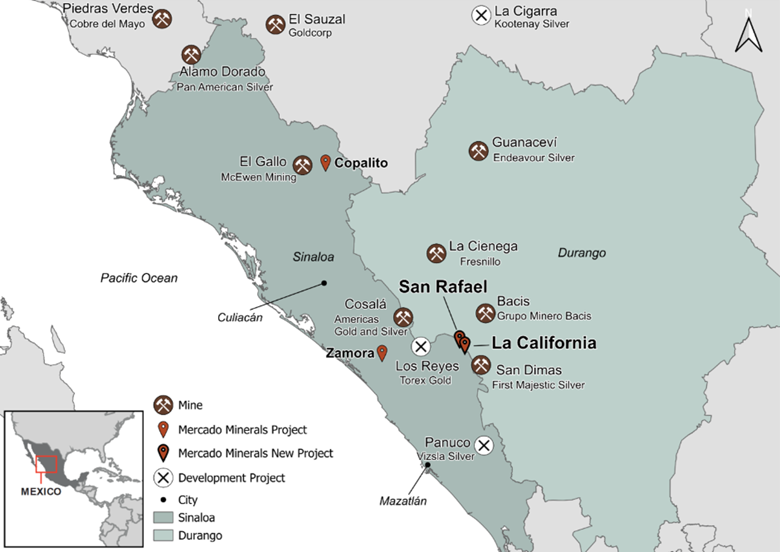
“This is exactly the type of opportunity Mercado is looking for. Our ability to access new projects because of our team in Mexico helped uncover this potential. We are now working towards building a truly district-scale presence with kilometres of cumulative vein strike length and numerous highly compelling targets,” CEO Daniel Rodriguez said in the June 2 news release. “Putting together land packages of this size in the San Dimas mining district — where hundreds of millions of ounces of silver have been discovered and mined — across two strategically positioned properties is the right kind of transaction to create value for our shareholders. We are excited to advance both La California and San Rafael, and I look forward to closing out our due diligence period and moving forward on all fronts.”
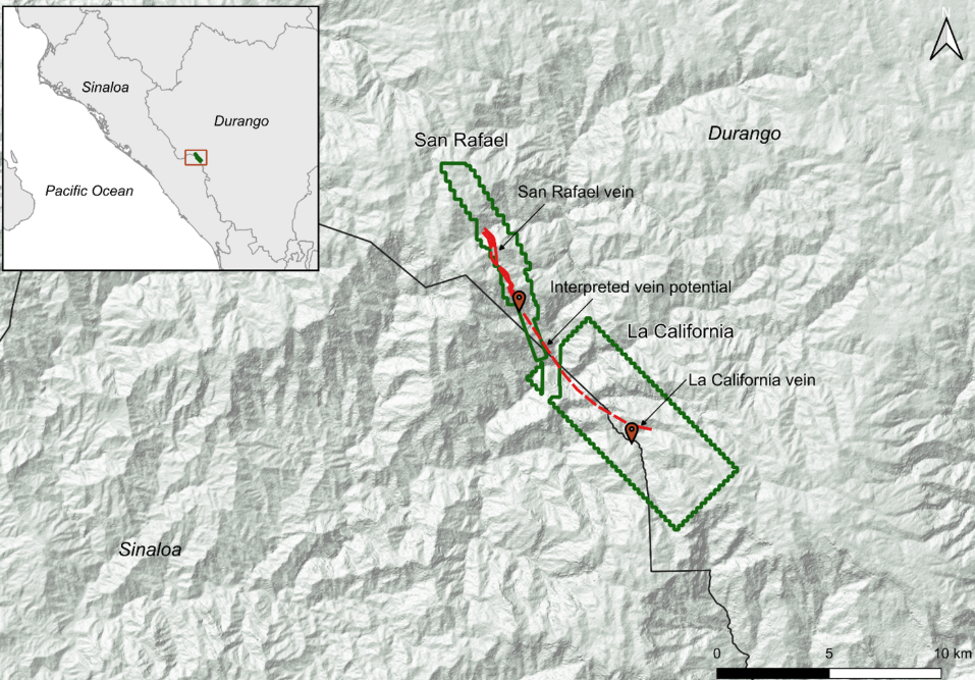
San Rafael Project
The San Rafael Project comprises five concessions totaling 1,004 hectares, situated approximately 154 km west-northwest of Durango. The property is accessible via a combination of paved and unpaved roads and has an airstrip and camp infrastructure.
The San Rafael Vein is a structurally controlled, low-sulfidation epithermal gold-silver system hosted in andesitic flows and tuffs of the Lower Volcanic Group — the same host package found at First Majestic Silver’s Tayoltita Mine and throughout the San Dimas mining district.
The vein strikes nearly north-south for over 2.8 km, dips 70-80 degrees east and has a 450m elevation difference between highest and lowest exposures. Width varies from a few centimeters to 15 meters. The San Rafael fault structure has been identified along 4.5 km of strike within the concession boundaries.
The San Rafael Project consists of a historical mine with four underground levels totaling 400m of development, plus other adits in other parts of the property. Work that dates to 1910 has concentrated on approximately 2.5 km of the structure’s strike length.
The most recent activity began in 1990 with road construction. A camp and airstrip followed in 1999-2000, and surface work in 2005 and 2008, where a total of 161 samples were taken.
Highlight results from this work includes a channel sample from the Palo de Judas level that returned 2.15 meters of 241 g/t silver and 10.1 g/t gold (Table 1). In 2014, a 700-m diamond drill program operated by Servicio Geologico Mexicano (SGM, a government-run geological agency) successfully tested the San Rafael structure with two holes below and along strike to the northwest of the historical mine workings. Drill hole SR-03-13 completed by SGM intersected 0.46m of 180 g/t silver from 356.76m to 357.22m.
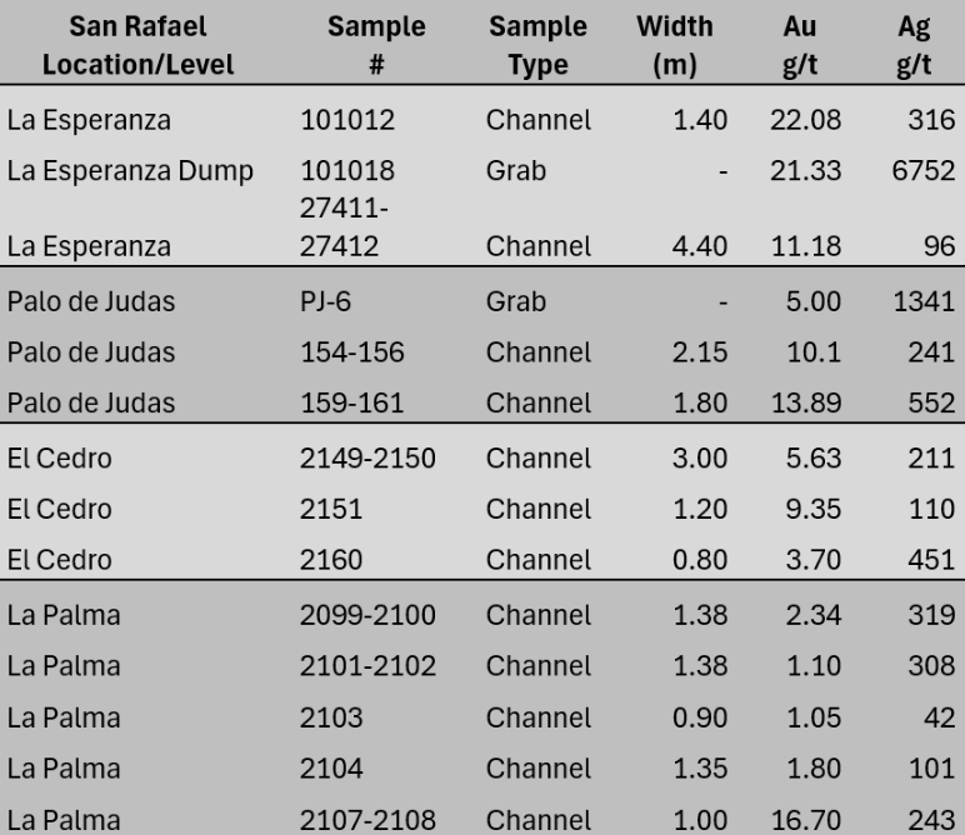
Mercado’s Qualified Person (QP) has not conducted sufficient work to independently validate the underground sampling or drill core results. Therefore, the company is treating technical information and data for the San Rafael results as historical in nature and should not to be relied upon for investment purposes. The QP will independently verify results of the historical work during a site visit later this year.
La California Project
The La California Project comprises five concessions totaling 3,613 hectares. It lies directly adjacent to the San Rafeal project and is situated approximately 145 km west-northwest of the city of Durango in the northern part of the San Dimas mining district. The project is accessible via a combination of paved and unpaved roads.
The La California vein is a structurally controlled, low-sulfidation epithermal gold-silver system hosted in andesitic flows and tuffs of the Lower Volcanic Group — the same host package as First Majestic Silver’s Tayoltita Mine and throughout the San Dimas mining district.
The main vein strikes north-south, dips 45-60 degrees northeast, and has been traced along more than 2 km of persistent outcrop. The vein’s width varies from 2m to 10m.
The La California Project consists of a historical underground mine that was in operation from 1912 to 1922, with a mill that reportedly processed 20-40 tons of material per day. The mine has three levels and only a short portion of the 2-km mineralized structure has been worked. The most recent exploration occurred in 2000, where 15 grab samples were taken including a channel sample that returned 2.50m of 380 g/t silver and 1.28 g/t gold (Table 2). La California has not received any systematic modern exploration.
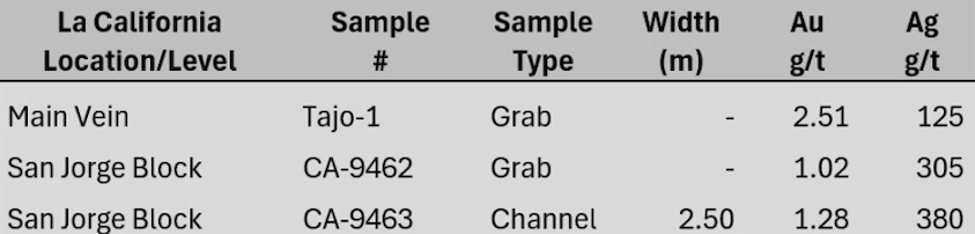
Again, Mercado’s Qualified Person (QP) has not conducted sufficient work to independently validate the underground sampling results. Therefore, the company is treating technical information and data for the La California results as historical in nature and should not to be relied upon for investment purposes. The QP will independently verify results of the historical work during a site visit later this year.
Copalito Project
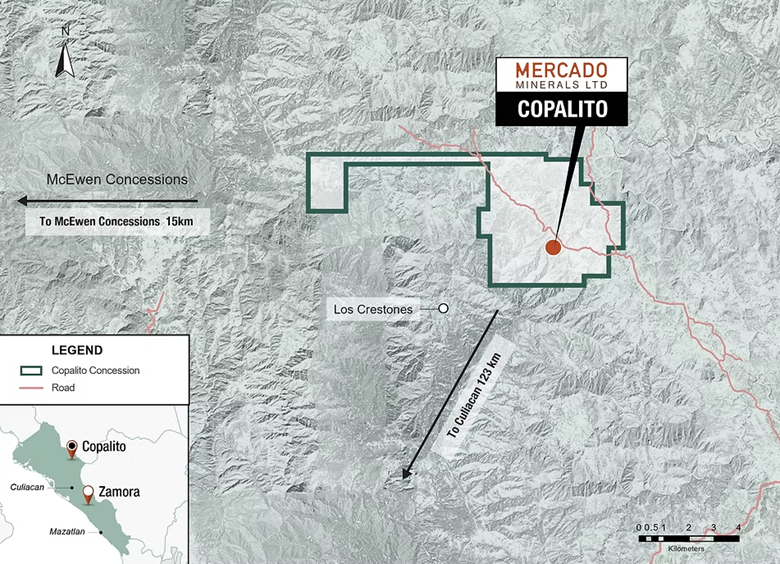
The Copalito Project is approximately 123 km northeast of Culiacan, Sinaloa state. The property has good access, moderate topography and infrastructure nearby. The neighboring property to Copalito is McEwen Inc’s (NYSE:MUX) El Gallo mine complex, located 35 km to the west.
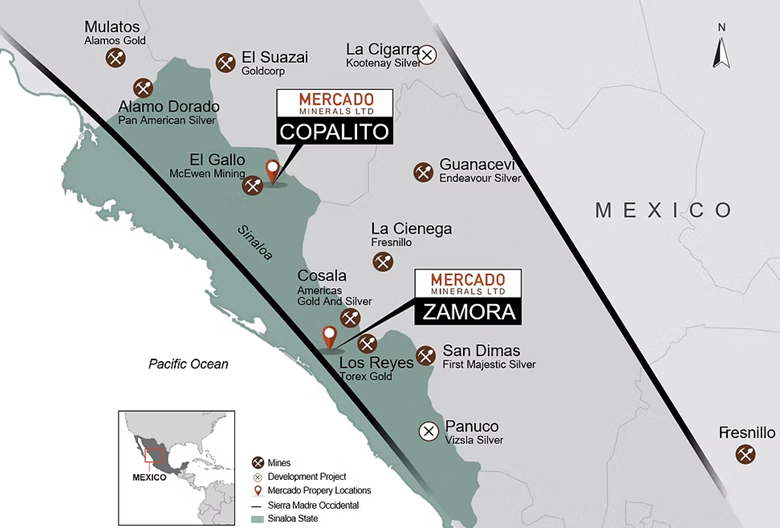
Mercado has acquired an option to purchase seven concessions covering 2,820 hectares. The option is to earn 100% over five years, with staged cash payments totaling $3.5 million. Six known veins on the project have a cumulative strike length of 8 km.
Copalito and Zamora, Mercado’s other project, are both located within the Western Mexico Silver Belt in Sinaloa state. The properties are near power, roads, infrastructure and local workforces in a mining-friendly jurisdiction. This emerging belt of the prolific Sierra Madre Occidental mountain range, which hosts existing mines and recent discoveries, includes:
- Vizsla Silver’s (TSX:VZLA) Panuco District
- First Majestic Silver’s (TSX:AG) San Dimas
- Pan American Silver’s (TSX:PAAS) Alamo Dorado
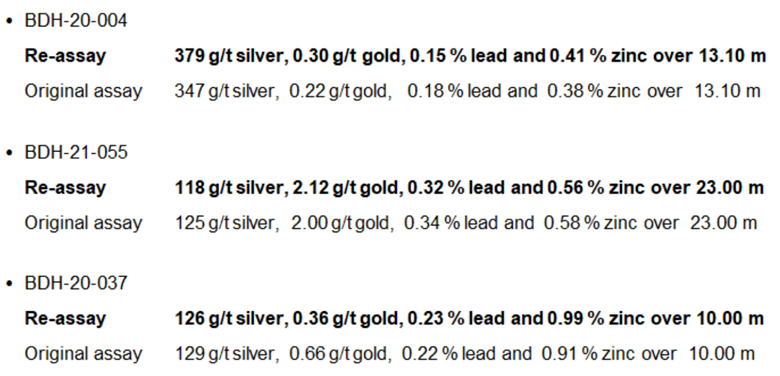
Historical third-party high-grade silver and significant gold and base metal drill intercepts include 347 g/t silver, 0.22 g/t gold, 0.178% lead and 0.38% zinc over 13.10 meters at the 5 Señores Vein; and 125 g/t silver, 2 g/t gold, 0.34% lead and 0.58% zinc over 23m at the El Agua Vein.
Kootenay Silver (TSXV:KTN) was the most recent operator.
Kootenay drilled 81 holes over six veins. Several productive veins and vein segments delineated in the drilling are ready for follow-up deeper drilling and along strike.
2026 exploration
Mercado Minerals has been in the field at Copalito since January.
The company identified three new veins just by walking the property and taking surface samples. For details of the vein discoveries, read Mercado commences maiden drill program at Copalito — Richard Mills
The field crew planned to resample gold, lead and zinc vein mineralization in select historical drill core from the six known veins.
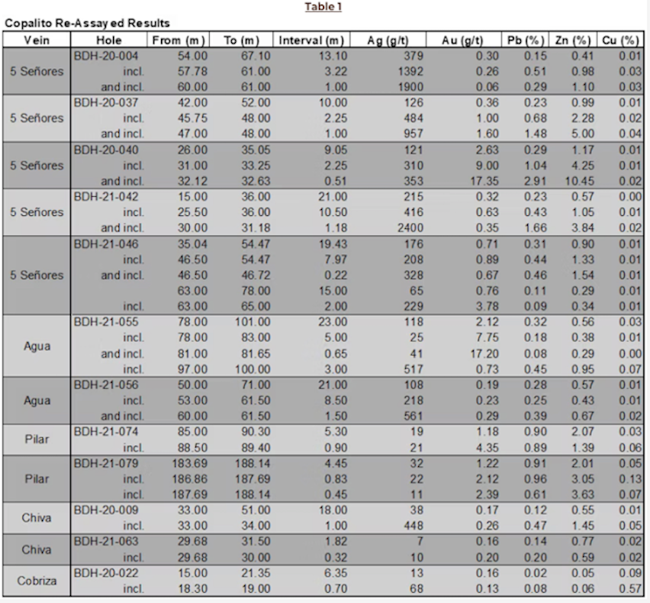
The results of the resampling program were released on April 14. The company reports that “in general, there is excellent agreement between the re-assay drill composite intercepts and previous drill composite intercepts as reported by a previous operator.”
The company says it inherited an extensive, high-quality dataset including assay information for 81 diamond drill holes, extensive mapping and rock sampling data for the Copalito Project, which has allowed Mercado to undertake exploration and drill targeting programs prior to the launch of its inaugural exploration drilling program, which began on March 10.
Twelve of the 81 historical diamond drill holes were resampled. The re-sampling allowed the Mercado technical team to review the six principal mineralized veins that were targeted by previous drill campaigns, and gain insights on potential mineralization controls that may define higher grade areas of the veins. Re-assay composite results are presented in Table 1.
Mercado has received assays back from the first three holes of a 3,000-meter drill program.
Mercado hits high-grade gold, silver at 5 Señores Vein, Copalito Project, Mexico – Richard Mills
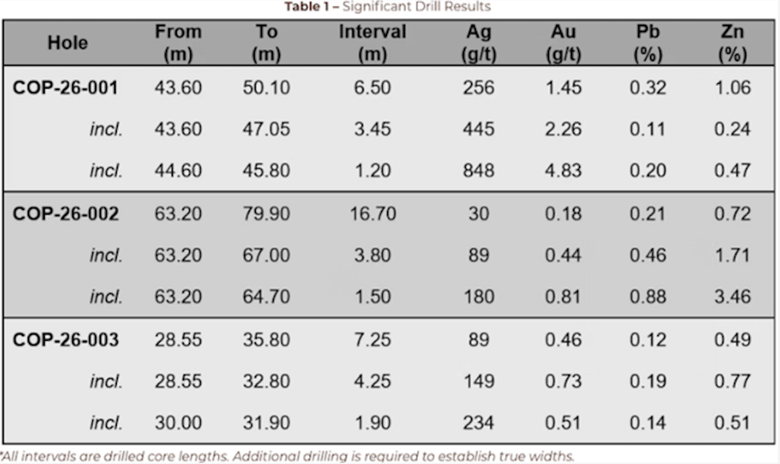
Highlighted results include 3.45 meters of 445 g/t silver, 2.26 g/t gold, 0.11% lead and 0.24% zinc, within a larger 6.50-meter intercept of 256 g/t silver, 1.46 g/t gold, 0.32% lead and 1.06% zinc (hole COP-26-001).
Hole COP-26-003 cut 7.25m of 89 g/t silver, 0.46 g/t gold, 0.12% lead and 0.49% zinc. Higher-grade intercepts within the section included 4.25m of 149 g/t silver, 0.73 g/t gold, 0.19% lead and 0.77% zinc; and 1.90m of 234 g/t silver, 0.51 g/t gold, 0.14% lead and 0.51% zinc.
“With these first three results we are proving the continuation of 5 Señores and growing the potential of that structure. We are happy with what we are seeing and looking forward to interpreting and analyzing the next batch of results. We have moved onto testing El Agua Vein and then El Pilar with a similar approach to what we did at 5 Señores,” CEO Daniel Rodriguez stated in the April 29 news release.
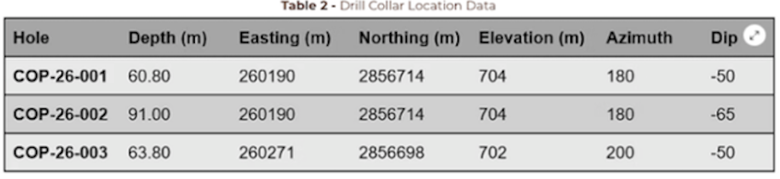
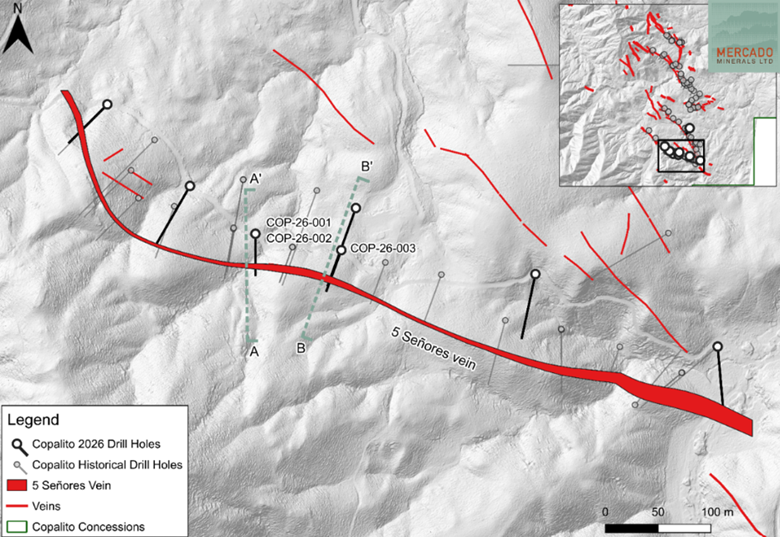
According to the company, drill holes COP-26-001 to COP-26-003 tested the 5 Señores Vein between drill holes completed by the previous operator, Kootenay Silver, where there is evidence for potential flexures in both the strike and dip of the vein, which could potentially yield thicker and higher-grade sections. Significant assay results from these holes are shown in Table 1, while the locations of the drill holes are shown in Figure 1 and Table 2.
On April 21, about halfway through the drill program, Mercado said the company had completed 12 drill holes and 1,479 meters, with 11 of the holes at the 5 Señores Vein, designed to infill previous results, test along strike and to depth.
An expanded soil sampling program also began, to cover additional prospective ground and provide infill detail.
“The goal has been to expand on the known and go test some of the unknown,” said Rodriguez, adding “We see potential to expand on known areas and new areas of interest as the team continues to uncover more through prospecting and sampling.”
Drilling has comprehensively tested along the strike of the 5 Señores Vein, infilling in areas where the company sees evidence for better thickness and grade, and some aggressive tests to depth. The drill is now testing the El Agua Vein with the same goals of testing along strike, infilling in key areas and some aggressive tests to depth.
Drill targeting has been refined, with two holes planned at the north junction of the Chente and Cobriza vein systems and the SE extension of 5 Señores – an approximately potential 250m strike length segment that has never been drill-tested before.
According to Mercado, only 60% of the 5 Señores, El Agua, La Chiva and El Pilar veins have been drilled to an average depth of 100 meters. The maiden drill program aims to determine possible structural controls on the strength of silver-gold bearing vein mineralization. Holes are targeting areas of potential thickening of vein mineralization, higher grades as well as step outs along strike and to depth in several areas.
Recent LiDAR and high-resolution airborne magnetic surveys with mapping and planning have assisted in pinpointing drill hole locations.
An April 2 news release says the LiDAR analysis shows several potential features that warrant follow-up exploration, including:
- 21 adits identified, including 19 previously known and two newly recognized;
- 56 pits mapped, comprising 12 known and 44 newly interpreted features;
- One shaft previously documented;
- 57 vein segments outlined, including 12 known and 45 newly interpreted structures;
- 64 outcrops detected across the project area.
Mercado Minerals Ltd.
CSE:MERC
2026.06.03 Share Price: Cdn$0.13
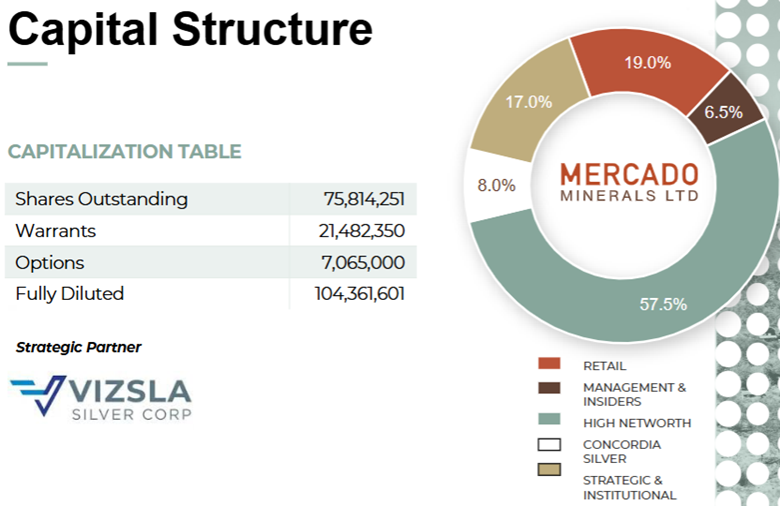
Shares Outstanding: 75.8m
Market Cap: Cdn$9.7m
MERC website
Richard (Rick) Mills
aheadoftheherd.com

Subscribe to AOTH’s free newsletter
Richard does not own shares of Mercado Minerals Ltd.
(CSE:MERC). MERC is a paid advertiser on his site aheadoftheherd.com
This article is issued on behalf of MERC
Legal Notice / Disclaimer
Ahead of the Herd newsletter, aheadoftheherd.com, hereafter known as AOTH.Please read the entire Disclaimer carefully before you use this website or read the newsletter. If you do not agree to all the AOTH/Richard Mills Disclaimer, do not access/read this website/newsletter/article, or any of its pages. By reading/using this AOTH/Richard Mills website/newsletter/article, and whether you actually read this Disclaimer, you are deemed to have accepted it.