 RSS Subscribe
Au Gold identifies additional gold targets from early exploration results at its Havelock Gold-Antimony Project, Victoria, Australia – Richard Mills

2026.05.27
Au Gold Corp (TSXV:AUGC) this week provided an update on exploration activities and analytical results received to date at its Havelock Gold-Antimony Project in Victoria, Australia.
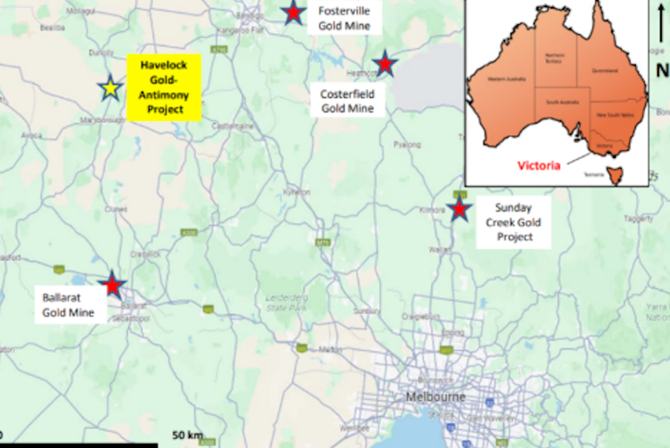
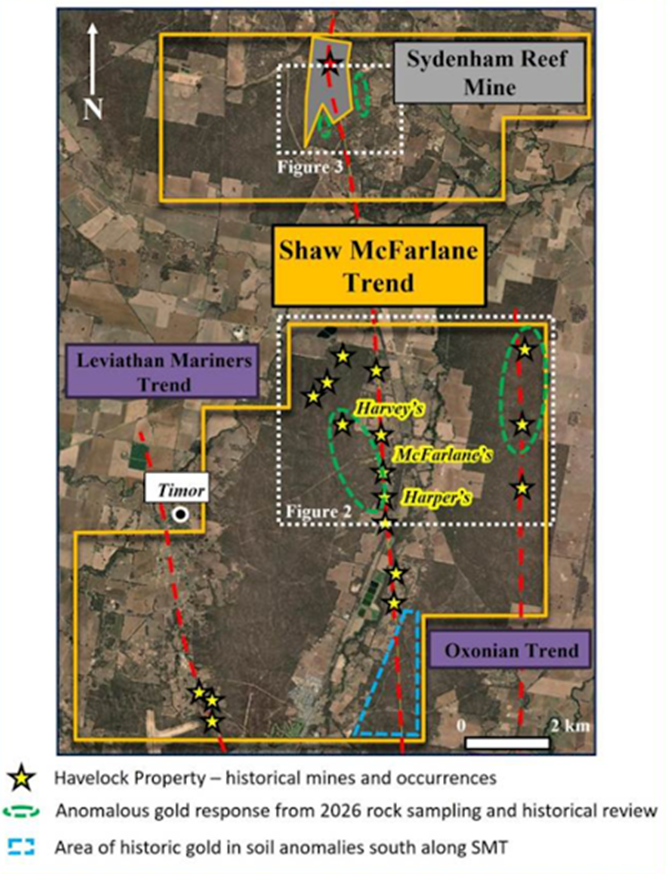
Eighty-nine orientation rock samples were collected and analyzed from various locations on the project (Figure 1), returning values up to 25.10 grams per tonne (g/t) gold. Only gold values have been received to date; multi-element results, including antimony, are pending.
Two new areas of interest have been identified on the northern claim block through historical data review proximal to the Sydenham Reef mine, owned by a third party.
Historical soil geochemistry data has been acquired and added to the project’s digital data set, resulting in the identification of anomalous gold results on the southern end of the Shaw-McFarlane Trend, between Shaw’s Reef and the southern property boundary. The anomalies appear to have had no follow-up to date.
Field personnel are mobilizing to collect an additional 1,000 soil samples, comprising infill and extension around existing anomalies. Further prospecting, sample collection and interpretation will be carried out in June.
“Overall, we are very pleased with progress to date at Havelock,” stated Marc Blythe, Au Gold’s founder and CEO, in the May 21 news release. “We are progressing a very methodical approach, including wringing as much information out of historical work by others at the project as possible to ensure that our own work programs are tightly focused and efficient.”
First-phase orientation rock sampling results
During March, company personnel collected 89 orientation rock samples, comprising both select and in-situ samples at a range of sites across the project. Target areas (shown in Figure 1) included two sites along the main Shaw-McFarlane Trend reef line and several historical sites to the west assessing parallel structures including potential extensions of Harvey’s Reef. In addition, a 3-kilometer portion of the Oxonian Trend was prospected.
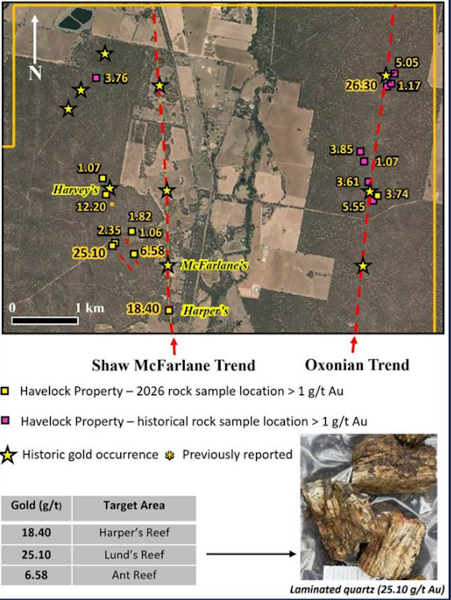
Samples consisted dominantly of massive to thinly laminated quartz reef material and iron carbonate-iron oxide quartz breccias. Samples were collected from historical dump piles and shallow pits as well as undisturbed areas. Twenty-eight samples returned anomalous gold values between 100 parts per billion (ppb) and 25.10 g/t (Figure 2).
At Harper’s Reef, located on the Shaw-McFarlane Trend, two samples returned anomalous gold values of 0.98 and 18.40 g/t gold. The 18.40 g/t sample consisted of a composite of weakly laminated white quartz pieces collected from the top of the Harper’s Reef dump pile. The grade is in line with historical production records. This appears to be the only sample documented from this site.
Between McFarlane Shaft and Harvey’s Reef (Figure 2), 17 samples returned anomalous gold values between 100 ppb and 25.10 g/t. The sample grading 25.10 g/t was a composite of laminated quartz reef material averaging 7 centimeters thickness from an area of shallow workings (<1 m deep) referred to in the historical literature as Lund’s Reef. Angular blocks up to 30 cm thick of hydrothermally altered siltstone containing quartz stringers, secondary manganese and siderite returned 6.58 g/t gold from a parallel series of shallow workings known as the Ant Reef.
Prospecting and localized sampling along the Oxonian Trend returned mostly sub-gram gold samples with exception of one in-situ sample from an 11-cm exposure of quartz-siderite which graded 3.74 g/t gold.
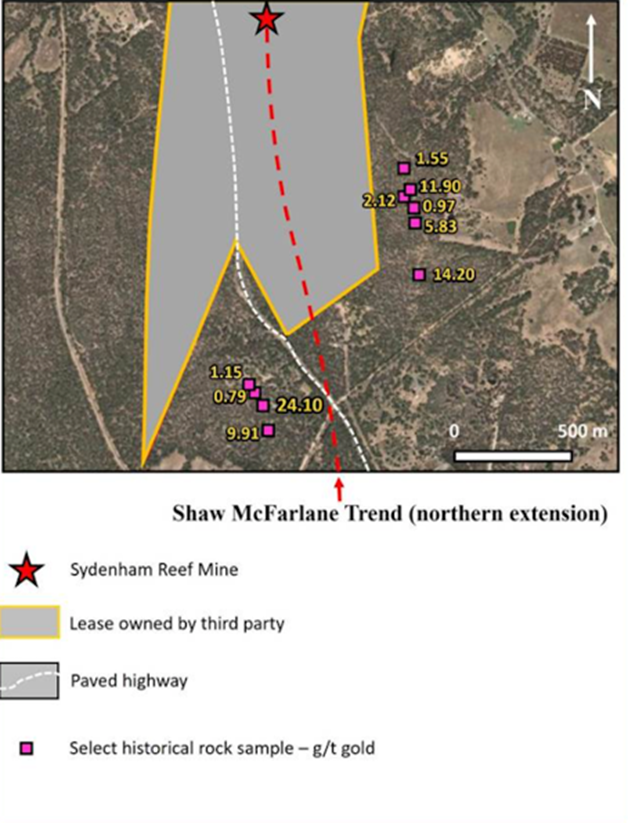
Recent completion of the Havelock data set review identified two well-defined northerly trends of gold-bearing float and in-situ samples in the northern Havelock claim block (Figure 3). This region of the project is host to the Sydenham Reef mine developed along the northern extension of the Shaw-McFarlane Trend. The mine is currently owned by a third party and believed to be inactive.
The two trends are delineated by rock samples grading between 0.79 g/t and 24.10 g/t gold. The rock samples were contained in a historical data set and appear to have had no follow-up. The Sydenham Central Trend of anomalous rock samples is 210 m in length and is centered on an in-situ sample returning 24.10 g/t gold, however the thickness of the sample was not provided. The Sydenham East Trend of anomalous rock samples is 500 m in length with peak values of 14.20 g/t and 11.90 g/t gold at the southern and northern ends of the trend, respectively.
Historical data set review
Part of the recent data set review included the identification and location of historical soil sampling results. These were added to the digital data set, which led to the identification of a 2-km section of the Shaw-McFarlane Trend (Figure 1) in the southern part of the property containing weak and moderate intermittent gold-in soil anomalies. There are no recorded rock samples in this area, suggesting no follow-up work has been conducted.
Next steps
AUGC will be commencing its phase 2 work program at Havelock shortly, which will consist of collecting approximately 1,000 soil samples in parts of the property supplementing broadly spaced historical anomalies. Focused prospecting will also continue along the Shaw-McFarlane and Oxonian trends.
The recent sampling results, along with the upcoming phase 2 work program and historical data set review, will provide the basis for identifying additional high-priority drill targets at Havelock. AUGC’s drill program, which is expected to commence in Q3 2026, will constitute the first modern drill program on the Shaw-McFarlane Trend.
The company continues to engage with the community, in particular private landowners within areas of interest on the project.
Havelock Gold-Antimony Project
Au Gold’s Havelock Gold-Antimony Project is in the Victorian goldfields near Maryborough, roughly halfway between Bendigo and Ballarat, and about 90 minutes’ drive from Melbourne, Australia. Paved highways and roads along with gravel tracks provide year-round access. Land ownership is a combination of Crown land and private property.
Havelock includes two large-scale (>10 kilometers combined) structural gold-bearing trends with multiple undrilled targets.
At the Shaw-McFarlane Trend, targets include the McFarlane Shaft and McFarlane Dam, both situated in the central portion of the 9-km trend and are 150 meters apart.
The McFarlane Shaft contains gold/antimony quartz reef mineralization with historical high-grade production. Highlights:
- Never drill-tested
- Mined to 122m depth
- Historic production grades 10 ounces gold per ton (avg. 22.5 g/t)
- Mining stopped due to dewatering issues and separating gold from stibnite
- 6 tons of stibnite (antimony sulfide) recovered from the dumps
At the McFarlane Dam, coarse gold was recovered near surface. Highlights:
- Never drill-tested
- Excavated in 2010
- 514 ounces of gold recovered, including 23 kg of reef quartz
- Potentially represents the top of an in-situ high-grade gold-bearing quartz reef
At the Leviathan-Mariner’s Trend, highlights include:
- Covers 3 km of historical workings
- In 2021, the previous operator completed an 8-hole diamond drill program along a 270m portion of the trend. The program returned significant results from 4 of the 8 drill holes, justifying further work
Under the Spotlight: Quinton Hennigh, CEO, San Cristobal Mining:
2026.04.08
Rick Mills, Editor/ Publisher, Ahead of the Herd:
The last time we talked was two months ago, and I mentioned Au Gold (TSXV:AUGC), Mark Blythe’s Havelock Project in the Victoria goldfields, Australia. You said you really liked it and you wanted to get involved in it a little bit. Did you ever manage to?
Under the Spotlight – Marc Blythe Founder, President, CEO & Director Au Gold Corp
Quinton Hennigh, CEO, San Cristobal Mining:
I did. I put some money into the last private placement. I think the project does look like it’s a true epizonal gold system. The structural controls look pretty intriguing. It’s got that structural sauce that I like to see, they call it a complex structural system that can host a lot of ounces.
Au Gold Corp Identifies High-Grade Gold Targets at its Havelock Project, Victoria, Australia
It reminds me of Southern Cross Gold’s (TSXV:SCGC) Sunday Creek project down there.
RM: There are several epizonal deposits in the area, Sunday Creek, Fosterville and Costerville These deposits formed roughly 60 million years later than the deeper, classic mesozonal system like Ballarat and Bendigo.
QH: Yes, they’re of the same ilk. They’re kind of sprinkled into the Victorian gold fields. There’s several of these epizonal systems, meaning shallow, high-grade gold systems, probably associated with late-stage granites that are part of the orogenic systems down there. They tend to have an antimony component, that’s a signature of these epizonal systems. You certainly see that with Au Gold’s project.
Au Gold Corp
TSXV:AUGC
2026.05.25 Share Price: Cdn$0.22
Shares Outstanding: 58.5m
Market Cap: Cdn$8.7m
AUGC website
Richard (Rick) Mills
aheadoftheherd.com

Subscribe to AOTH’s free newsletter
Richard owns shares of Au Gold Corp (TSXV:AUGC).
AUGC is a paid advertiser on his site aheadoftheherd.com
This article is issued on behalf of AUGC
Legal Notice / Disclaimer
Ahead of the Herd newsletter, aheadoftheherd.com, hereafter known as AOTH.Please read the entire Disclaimer carefully before you use this website or read the newsletter. If you do not agree to all the AOTH/Richard Mills Disclaimer, do not access/read this website/newsletter/article, or any of its pages. By reading/using this AOTH/Richard Mills website/newsletter/article, and whether you actually read this Disclaimer, you are deemed to have accepted it.