 RSS Subscribe
Kodiak Copper, the hub-and-spoke model – Richard Mills

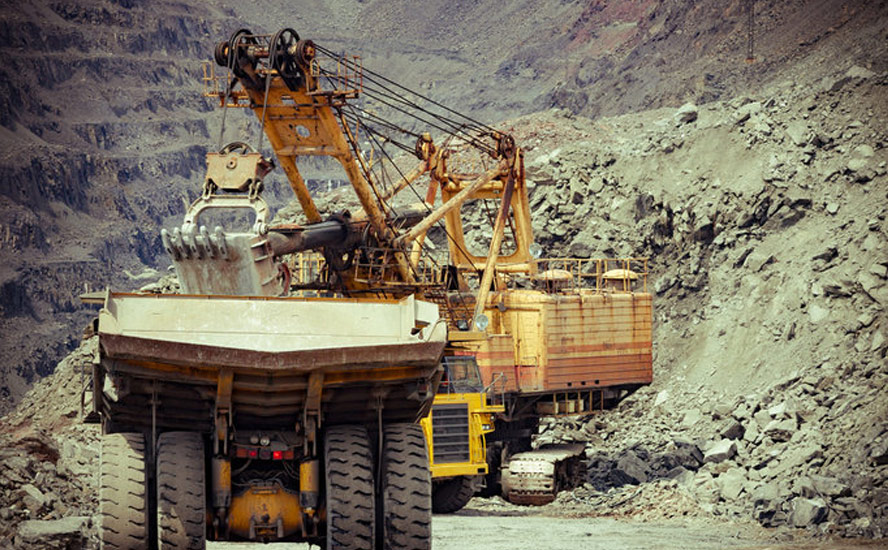
The hub-and-spoke mining model is an operational strategy where multiple satellite ore deposits (the “spokes”) feed a single, centralized processing facility (the “hub”). In southern British Columbia’s Quesnel Trough, this approach has become a dominant mechanism for copper-gold porphyry systems.
By consolidating smaller, multi-centered deposits into one operational loop, mining companies drastically reduce the massive capital expenditures (CapEx) required to build independent mills for every individual find.
Kodiak Copper Corp. serves as a textbook example of this strategy at their flagship MPD Copper-Gold Project.
Copper going forward: volatile but moving higher
The Quesnel Trough is Canada’s copper heartland, characterized by large, multi-centered porphyry systems. However, porphyry deposits in this region are often deeply interconnected but dispersed across a broad geographic footprint.
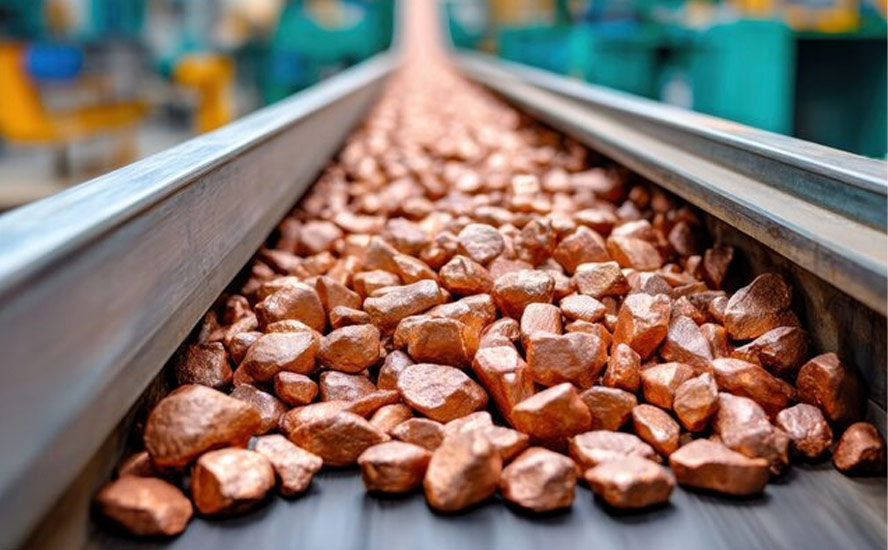
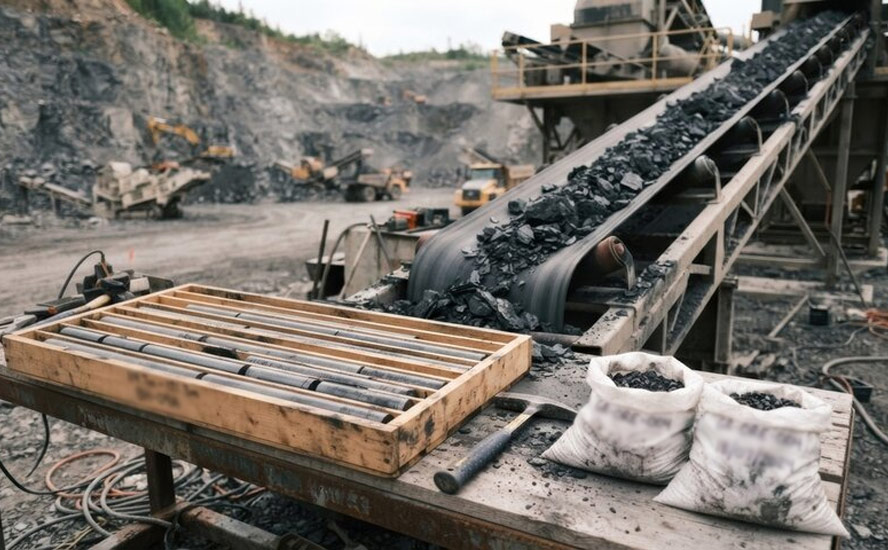
Instead of constructing multiple mills, operators establish one central, high-capacity mill and tailings management facility. This hub handles the crushing, grinding, and flotation stages to produce metal concentrates.
The “spokes” are distinct mineralized zones located within trucking distance of the hub. In a typical lifecycle, these deposits are mined in sequence or blended together to optimize the mill’s feed grade.
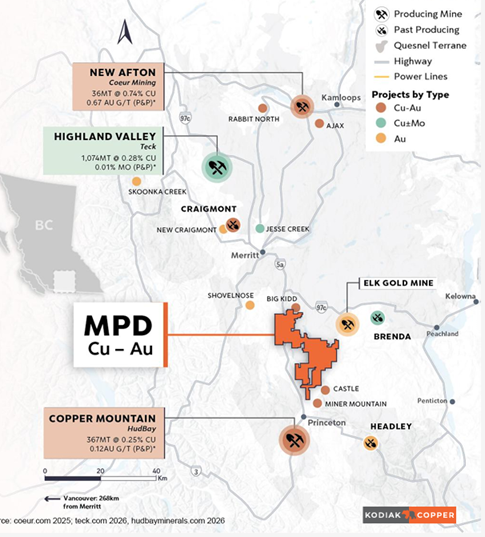
The model relies entirely on low-cost transportation. Southern BC is uniquely suited for this due to its existing infrastructure, including:
- Direct access to paved highways (e.g., Highway 5 and 97C/97D).
- Proximity to regional mining hubs like Kamloops and Merritt.
- Nearby grid power, reducing reliance on expensive remote diesel generation.
- Railroads
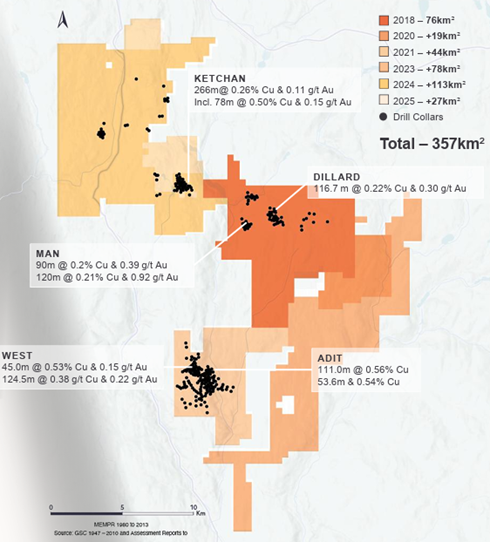
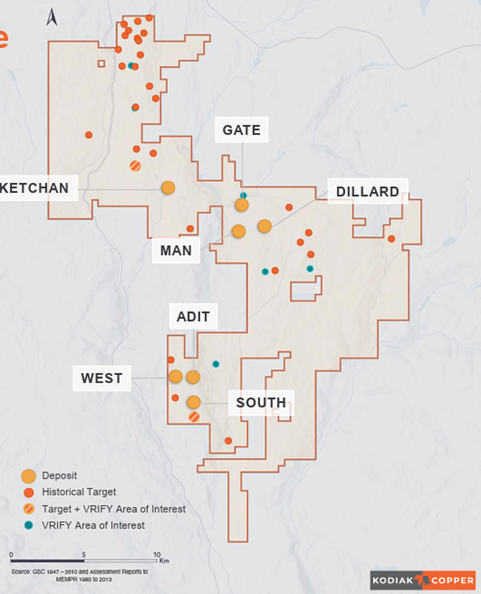
Kodiak Copper has systematically applied the hub-and-spoke ideology to unlock their consolidated 357-square-kilometer MPD land package located between Merritt and Princeton:
- Kodiak published a comprehensive initial Mineral Resource Estimate (MRE) that outlines seven substantial deposits (including Gate, West, Adit, and Ketchan). Rather than treating these as separate projects, they are viewed as individual spokes feeding a grander concept.
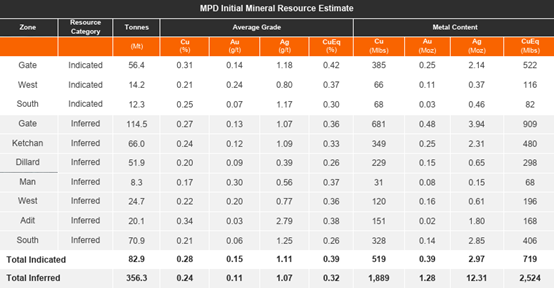
- Porphyry systems historically worked by separate owners (the Man, Prime, and Dillard claims, hence “MPD”) were stitched together into a single project. This prevents the operational fragmentation that killed the economics of these zones in the past.
- Metallurgical testwork dictates how ore from different spokes can be blended. Near-surface high-grade zones (like the West or Adit zones) could potentially be mined early to accelerate payback of the central hub infrastructure.
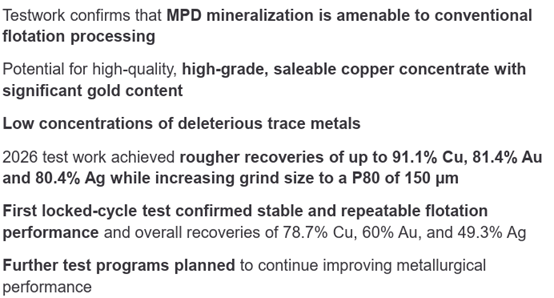
Using Kodiak’s strategy in the Quesnel Trough highlights three structural benefits:
A modern mill can cost upwards of hundreds of millions of dollars. Building one instead of three alters the economic threshold, allowing lower-grade material (common in BC porphyries) to become profitable.
Because the project sits adjacent to major highways, the capital required to build haulage roads between the “spokes” and the “hub” is minimized.
One centralized tailings storage facility and mill site results in significantly less surface disturbance and a streamlined environmental permitting process compared to scattering infrastructure across the valley.
Another potential advantage of multiple pits is that mined out pits can be used for tailings storage, thus minimizing the size of a central tailings storage facility.
Kodiak Copper eyes billion-dollar peer valuations as drilling more than doubles
Anglo Teck
Major tier-one producers leverage the hub-and-spoke mining model on a grand, district-scale level. Teck Resources (which is merging with Anglo American to form Anglo Teck) showcases how a major producer can scale this strategy using its massive infrastructure footprint in the Quesnel Terrane.
While a junior exploration company like Kodiak Copper applies the model to a single 357 km² project block, Teck applies the strategy on a regional macro-scale across thousands of square kilometres.
Teck’s ultimate operational anchor in the southern Quesnel Terrane is Highland Valley Copper Operations, located near Logan Lake, BC. It is Canada’s largest base metal concentrated mill.
HVC acts as a massive processing engine. Instead of regarding an open-pit mine as a single deposit, Teck treats the entire Highland Valley district as an interconnected web of separate porphyry “spokes” (including the Valley, Lornex, Highmont, and Bethlehem deposits) that have historically fed, or currently feed, the massive, centralized processing infrastructure.
In late 2025, Teck initiated construction on the HVC Mine Life Extension project, pushing the facility’s operational lifespan from 2028 out to 2046. Extending a hub’s life changes the regional economics of the Quesnel Terrane. Because the massive mill will remain operational for decades, any smaller satellite deposit discovered within trucking or rail distance instantly becomes a viable “spoke.”
Further north in the BC copper-gold belts, Teck utilizes district-scale joint ventures to consolidate adjacent orebodies. For instance, their advancements at the Galore Creek and Schaft Creek copper projects rely heavily on evaluating shared infrastructure pipelines. By co-developing regional infrastructure, majors ensure that multiple massive orebodies can eventually feed shared processing hubs, maximizing the efficiency of every dollar spent on roads, power grids, and tailings facilities.
Kodiak Copper
TSXV:KDK, OTCQB:KDKCF, Frankfurt:5DD1
Cdn$0.68, 2026.10.08
Shares Outstanding 111.9m
Fully Diluted 129.8m
Market Cap Cdn$76m
KDK website
Richard (Rick) Mills
aheadoftheherd.com

Legal Notice / Disclaimer
Ahead of the Herd newsletter, aheadoftheherd.com, hereafter known as AOTH.Please read the entire Disclaimer carefully before you use this website or read the newsletter. If you do not agree to all the AOTH/Richard Mills Disclaimer, do not access/read this website/newsletter/article, or any of its pages. By reading/using this AOTH/Richard Mills website/newsletter/article, and whether you actually read this Disclaimer, you are deemed to have accepted it.