 RSS Subscribe
Canada’s Prime Minister, Elbow’s Up and Gold – AOTH

In a wide-ranging interview with The New York Times, Canadian Prime Minister Mark Carney reiterated his long-held stance that a global financial system wholly dependent on the U.S. dollar is unsustainable. He advocated for a transition to a multipolar system featuring several reserve currencies, which he argues would provide greater global flexibility.
The comments come amid a broader breakdown in Canada-U.S. relations, highlighted by the recent collapse of trade talks and dollar-for-dollar retaliatory tariffs enacted between Prime Minister Carney and U.S. President Donald Trump.
Carney noted that the demand for alternatives to the dollar will continue to grow as Washington increasingly uses trade policies and tariffs as a tool for economic coercion, prompting international allies to seek diversification.
This is not a new position for Carney. While serving as the Governor of the Bank of England in 2019, he similarly argued that the dollar’s extreme dominance was a barrier to sustainable global growth and proposed a network of central bank digital currencies to act as an alternative.
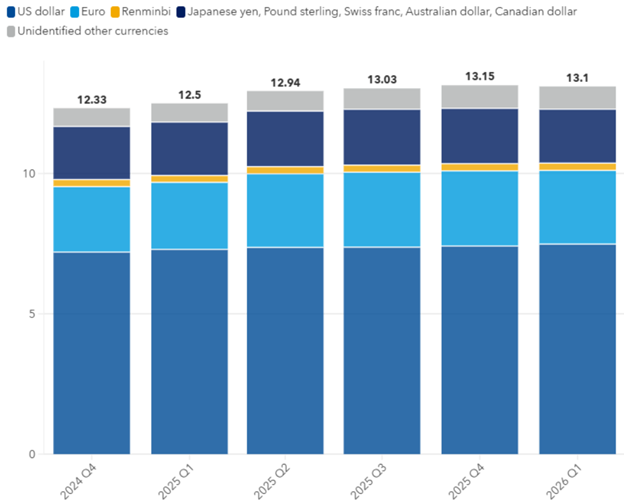
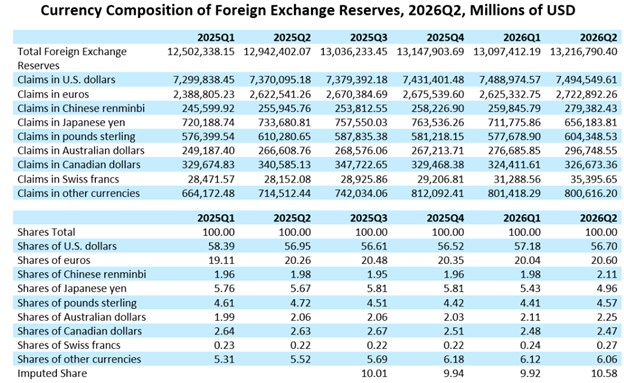
While the U.S. dollar’s share of foreign exchange reserves held by global central banks has dropped from roughly 70% in 2000 to around 57%, it still vastly outstrips the U.S. share of global trade (12%) and the overall world economy (26%).
Instead of recommending a direct, single replacement for the greenback, Carney has championed two primary alternatives to reshape the global financial architecture.
The Synthetic Hegemonic Currency (SHC) which is a global digital reserve asset managed by a public coalition of central banks.
During his tenure at the Bank of England, Carney actively expanded Chinese currency trading hubs in London to prepare for its larger global role. More recently as Canada’s Prime Minister, his administration signed a new bilateral currency swap with Beijing as part of Canada’s broader pivot to diversify away from American trade reliance.
While Carney views the renminbi as the most logical geopolitical challenger to the dollar, he has explicitly noted that its ascension is strictly contingent on China liberalizing its financial system. Until Beijing allows its currency and capital flows to move freely without heavy state controls, its capability to serve as a true alternative remains capped.
Carney’s pragmatic view of China and his promotion of a multipolar currency system directly explains his administration’s aggressive trade pivot toward Beijing – if the U.S. dollar is going to lose its absolute monopoly, China’s economy—and its state-backed industries—must be integrated into Canada’s economic hedge against the United States.
This geopolitical mindset is the driving force behind two of his most significant domestic policies, the Canada-China Strategic Partnership and the 2026 Automotive Strategy.
Trade security
Carney’s trade strategy has infuriated American officials, who see it as a direct threat to North American trade security.
U.S. Trade Representative Jamieson Greer and President Trump have publicly warned that Carney is turning Canada into a backdoor” for subsidized Chinese goods to bypass tariffs and flood the U.S. market. Trump went as far as threatening a 100% tariff on all Canadian exports if Ottawa deepens its integration with Beijing.
Nevertheless, Carney’s actions demonstrate that his critique of the U.S. dollar is not merely academic theory—he is actively restructuring Canada’s trade, automotive, and currency networks to match that multipolar worldview.
Hedging your bet
Carney’s multipolar worldview is heavily matched, and actively pursued, by a growing number of countries. While the movement began as a defensive strategy by geopolitical rivals, the landscape in 2026 shows that aggressive U.S. tariff policies and the “weaponization” of the financial system have driven even traditional Western allies to hedge their bets.
The most coordinated effort to shift away from the dollar comes from the expanded BRICS bloc (which now includes Brazil, Russia, India, China, South Africa, Iran, Egypt, the UAE, and Ethiopia).
At the 2026 BRICS Summit in New Delhi, the alliance formalized the New Delhi Declaration, explicitly focusing on bypassing traditional financial channels like SWIFT. Rather than creating a single joint currency, they are prioritizing cross-border payment interoperability and trade in local currencies.
China and Russia have moved nearly 100% of their bilateral trade out of the greenback. India has also heavily embraced the framework, executing its largest-ever oil settlements with Russia using the Chinese yuan and UAE dirhams rather than the dollar.
The European Central Bank (ECB) has actively supported the internationalization of the Euro (€) to solidify its status as the world’s clear number-two reserve currency within a multipolar framework.
Market analysts noted that France recently repatriated its remaining gold reserves held in New York back to Paris, replacing them with compliant gold bars stored on European soil. Additionally, Carney himself recently addressed the European Parliament to pitch a joint Canada-Europe digital payment system specifically designed to bypass U.S. financial coercion.
In 2026, the 11 nations making up the Commonwealth of Independent States (including Kazakhstan, Uzbekistan, and Armenia) announced that the U.S. dollar had ceased to be their primary currency for cross-border operations, with 85% of their trade now successfully processed in local currencies.
Many countries across Asia and the Middle East are joining platforms like mBridge—a multi-central bank digital currency platform that allows local currencies to settle directly with one another without needing to go through American clearing banks.
Despite this global alignment with Carney’s view, international economists agree that the dollar is not going to collapse overnight. The global monetary system is not witnessing a “total replacement” of the greenback by another single superpower, but rather a gradual fragmentation.
The transition away from unipolar dollar dominance relies on three foundational mechanisms. For decades, the U.S. dollar’s ultimate leverage lay in its clearing infrastructure—chiefly the SWIFT messaging system.
Today, countries concerned about geopolitical choke points are scaling separate rails:
- China’s CIPS Expansion: The Cross-Border Interbank Payment System (CIPS) directly clears transactions in renminbi, entirely bypassing Western correspondent banks. In 2026, its monthly settlement volumes peaked at over $2.6 trillion USD equivalent.
Driven by the Bank for International Settlements, Project mBridge uses blockchain ledger technology to allow central bank digital currencies (CBDCs) to settle trade directly with one another instantly. This completely removes American clearing banks from the loop. - Diversification Into “Nontraditional” Assets: According to IMF COFER data, the U.S. dollar’s share of allocated global foreign exchange reserves sat at 57.13% in early 2026. While this represents a multi-decade structural decline from over 70% in 2000, the capital isn’t flowing purely into the Euro or the Chinese Yuan (which remains constrained to around 2% due to capital controls).
Instead, reserve managers are shifting to nontraditional reserve currencies—such as the Canadian dollar, Australian dollar, and Swiss franc—and significantly increasing physical gold holdings. A World Gold Council survey revealed that 74% of central banks expect global U.S. dollar reserve holdings to decrease over the next five years, using gold as a hedge against sovereign asset freezing. - Bilateral Commodity Trade Channels: The bedrock of the dollar’s unchallengeable status was the “petrodollar”—the global convention of pricing and settling oil and gas exclusively in greenbacks. This convention has fragmented. Major energy trade corridors—including Russia-India and Russia-China—now settle up to 90% of their energy trade in national currencies like the yuan, dirhams, and rupees.
Trading partnerships across the ASEAN bloc and Latin America are standardizing cross-border mobile QR code and local settlement frameworks to insulate their internal merchant networks from the volatility of U.S. monetary policy shocks.
For decades, the United States and Canada reaped the structural rewards of a hyper-globalized, dollar-centric world economy. This baseline insulated consumers from high import costs and secured cheap capital.
As geopolitical alliances split financial systems into regional silos, the everyday consumer faces two clear structural shifts: persistently higher consumer prices (inflation) and elevated long-term borrowing costs.
The transition away from an optimized, single-currency trade framework systematically drives up the cost of everyday consumer goods through two distinct channels:
- Supply Chain Inefficiencies: When trade fragments—such as Canada carving out independent auto supply chains or imposing targeted tariffs—the overall cost of inputs climbs. Multi-sector structural models from the Bank of Canada indicate that a broad 10 percentage-point increase in bilateral trade costs drives up CPI inflation by roughly 0.32 percentage points.
- Currency Depreciation and Import Shocks: As international institutions diversify their reserves away from the U.S. dollar, the structural demand for the greenback eases. A weaker domestic currency makes imported electronics, food, and manufactured final goods significantly more expensive for retail buyers. Broad analyses by the World Economic Forum (WEF) warn that severe fragmentation can compounding global inflation by up to 5% to 6.1% in worst-case scenarios.
The historic advantage enjoyed by the U.S. economy was its ability to borrow vast capital at ultra-cheap rates. Because foreign central banks needed trillions of dollars to settle oil and trade, they consistently bought U.S. Treasury bonds, artificially pushing down American interest rates. De-dollarization reverses this dynamic.
As foreign central banks reduce their allocations of U.S. debt, Washington loses its unchallengeable monopoly on global savings. With fewer automatic foreign buyers for government debt, Treasury yields must climb to entice private and domestic investors.
Beyond his statements on reducing reliance on the greenback, Canadian Prime Minister Mark Carney has deeply alienated the Trump administration and U.S. officials through a series of bold geopolitical shifts, retaliatory trade measures, and public dismissals.
Carney abruptly suspended Canada–U.S. trade negotiations after accusing American negotiators of introducing unfair, late-stage demands. Instead of conceding to threats of 50% tariffs, Carney immediately enacted $20 billion in “dollar-for-dollar” retaliatory tariffs on more than 700 U.S. products, including metals, agricultural goods, and appliances. This blunt refusal to yield prompted President Donald Trump to label Canada as “one of the worst countries in the entire world” regarding trade.
In the highly controversial interview with The New York Times, Carney revealed that his government had analyzed the potential for U.S.-led military action against Canada. Though he classified it as a highly unlikely “extreme tail risk,” his assertion that it would be irresponsible for Canada not to prepare for American aggression sparked immense blowback from Washington.
Carney has also infuriated Washington by declaring that Canada has historically relied “too much” on its cross-border ties. He has actively bypassed U.S.-controlled financial infrastructure by proposing independent Canada-Europe payment systems.
His aggressive pivot away from the U.S. culminated in a standing ovation at the European Parliament, where European Commission President Ursula von der Leyen backed making Canada the EU’s first associate member.
Carney has repeatedly used public humor to dismiss American pressure, further aggravating U.S. trade officials including:
- When U.S. Trade Adviser Peter Navarro ordered Canadian lobbyists to “get the hell out” of the U.S., Carney laughed out loud on camera and refused to offer a serious response.
- When Trump claimed Canada would soon return to the bargaining table to apologize, Carney simply laughed and reiterated that Canada would only negotiate in good faith.
- He publicly scolded Trump’s cabinet ministers for “throwing shade” and “doing memes,” calling their insulting rhetoric about Canada’s military “beneath their office”.
Carney – Canada came to realize that sometimes the U.S.’s signature ‘was written in pencil’
Carney has also taken direct aim at American business interests by issuing a fierce rebuke against U.S.-based steelmaker Cleveland-Cliffs (the parent company of Stelco). After the company laid off 500 Canadian workers due to the ongoing trade war, Carney accused them of betraying workers, blamed the Trump administration’s corporate allies, and threatened to pursue U.S. corporate entities to the full extent of the law.
The process of de-dollarization is not a sudden, dramatic collapse. Instead, it is a slow, structural shift toward global financial fragmentation. Rather than migrating to another single superpower currency, the world is moving toward alternative payment networks, physical assets, and non-traditional currencies.
Historically, the world has relied on a single physical standard—gold—to anchor global trust. Following the Bretton Woods agreement, that anchor shifted seamlessly to the U.S. dollar, transforming it into the default baseline for global trade. Today, the macro reality is that nations are actively learning to manage a multipolar financial landscape where only one single asset holds an absolute monopoly over global trust.
As central banks diversify, global gold holdings reached a record $5.1 trillion, officially surpassing total foreign holdings of U.S. Treasuries.
The world is actively learning to live with a single, unchallengeable financial anchor.
Conclusion
Is elbow’s up working (the phrase comes from ice hockey, popularized by legendary Canadian player Gordie Howe, earning him the nickname “Mr. Elbows”)?
Whether Prime Minister Mark Carney’s high-stakes confrontation with the Trump administration is in Canada’s best interest or a self-inflicted wound is currently a fiercely debated question in Canadian politics and economics.
There is an ongoing, deep division between economists, political analysts, and the public on whether his strategy represents necessary structural headway or economic devastation.
Over 75% of Canadian exports (and 90% of its crude oil) go to the U.S.. Proponents argue that when a major trading partner uses that integration as geopolitical leverage or coercion, diversification is no longer an optional policy; it is an existential requirement.
Carney has used this crisis to push through massive, historic infrastructure approvals that languished for years under previous governments. For example, the government just designated the Pacific Link pipeline (from Alberta to Delta, B.C.) a “project of national interest,” which aims to bypass U.S. markets entirely and ship 1 million barrels of oil a day to Asia and Europe—slashing oil dependency on the U.S. down to 65%. He also recently greenlit the massive LNG Canada Phase 2 project.
Politically, standing up to Trump has given Carney a staggering popular mandate. Recent Nanos Research polling shows Carney as the preferred choice for Prime Minister for over 60% of respondents, shielding him from standard opposition attacks and allowing him to aggressively rewrite Canada’s economic and defense policies.
By building independent avenues with the European Union and mending fractured ties with India, China, and Saudi Arabia, Carney is praised by global investors for charting a path where middle-powers can defend their sovereignty through “friend-shoring” rather than bowing to superpowers.
Detractors point out that you cannot easily replace your closest neighbor and largest customer. Building infrastructure to ship goods across oceans takes years and billions of dollars, whereas the immediate economic pain from U.S. friction hits Canadian businesses today.

Legal Notice / Disclaimer
Ahead of the Herd newsletter, aheadoftheherd.com, hereafter known as AOTH.Please read the entire Disclaimer carefully before you use this website or read the newsletter. If you do not agree to all the AOTH/Richard Mills Disclaimer, do not access/read this website/newsletter/article, or any of its pages. By reading/using this AOTH/Richard Mills website/newsletter/article, and whether you actually read this Disclaimer, you are deemed to have accepted it.