 RSS Subscribe
Harvest Gold: A true gold exploration play – Richard Mills

2026.05.02
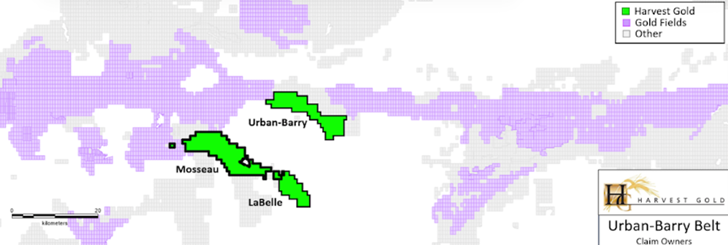
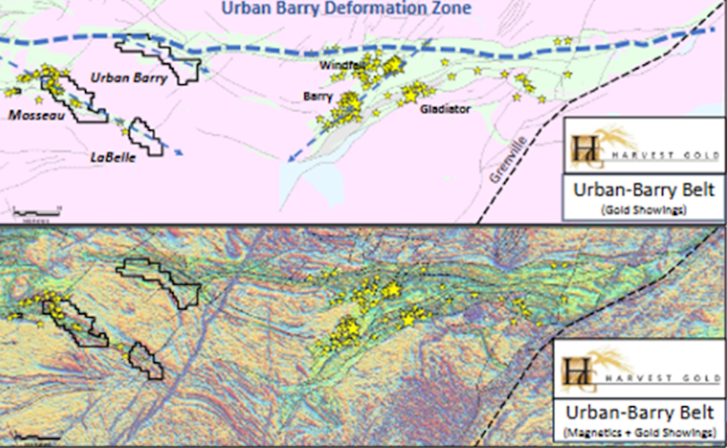
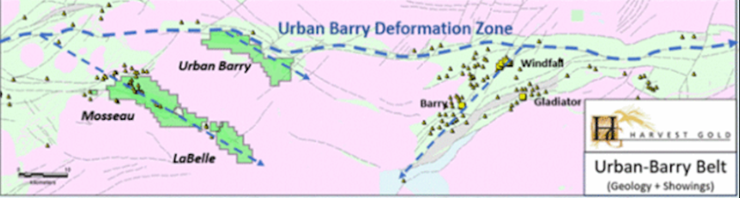
The world-famous Abitibi region is a geological formation dominated by Gold Fields (NYSE:GFI). Harvest Gold (TSXV:HVG) controls three large prospective land packages (Urban Barry, Mosseau and La Belle) all overlaying the same geological contact within the Urban Barry Greenstone Belt.
The Mosseau is where Harvest Gold is focusing their drilling; it has a north, central and southern area, where La Belle is connected onto it; it’s their flagship project.
Central Mosseau
The central portion of the Mosseau property has seen significantly less historical exploration than the northern part of the property. Limited previous drilling by Vior Inc. in 2017 within the central part of Mosseau identified gold mineralization associated with a shear zone along the Kiask River Deformation Zone, returning 1.13 g/t gold over 16.0 meters, including 2.93 g/t gold over 5.0 meters.
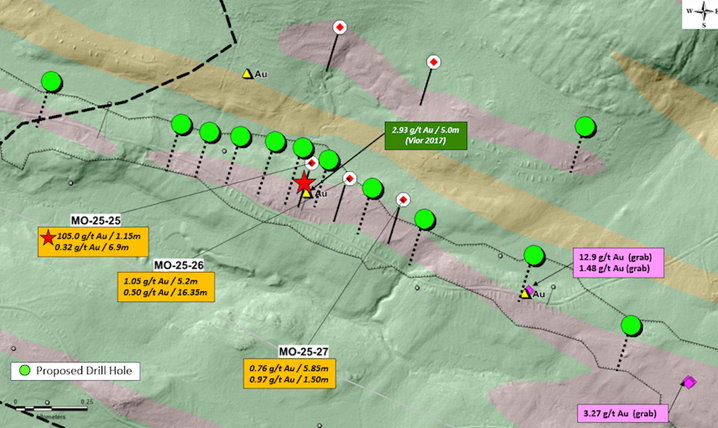
A subsequent high-resolution magnetic survey completed by Harvest Gold outlined a potential second dilation zone, similar in character and larger in scale than the mineralized structures identified in the northern part of the property. Prospecting and mapping by Harvest Gold along these linear magnetic features traced this horizon for approximately 3 km along strike and returned grab samples ranging from 0.24 g/t gold to 3.27 g/t gold. In addition, a soil survey completed in 2025 identified multiple gold-in-soil anomalies, including down-ice from known gold showings associated with the Kiask River Deformation Zone.
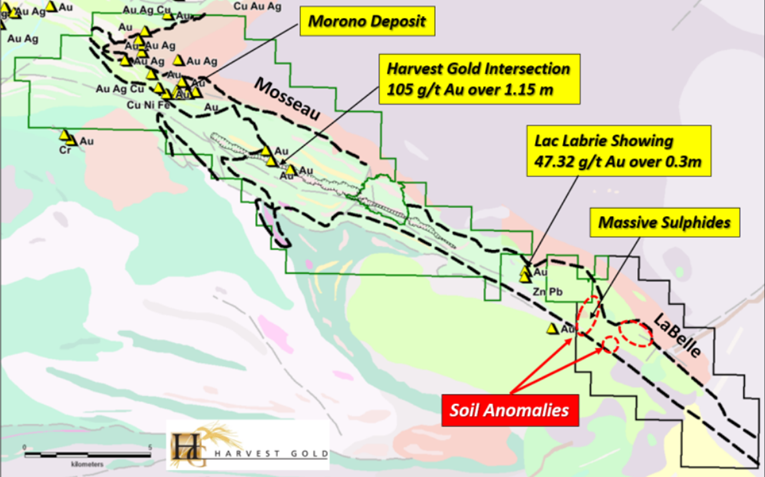
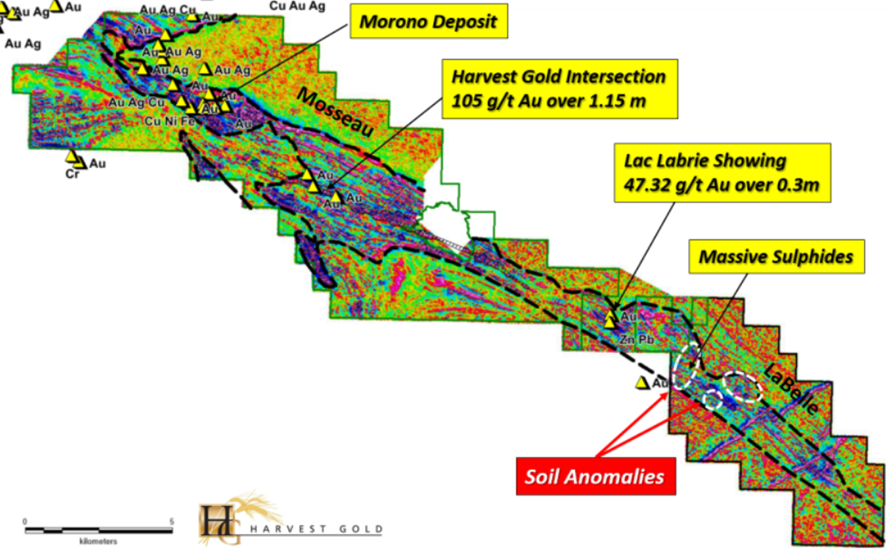
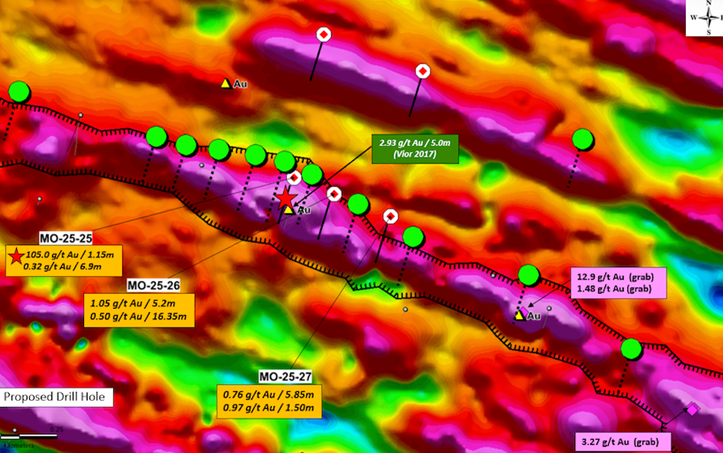
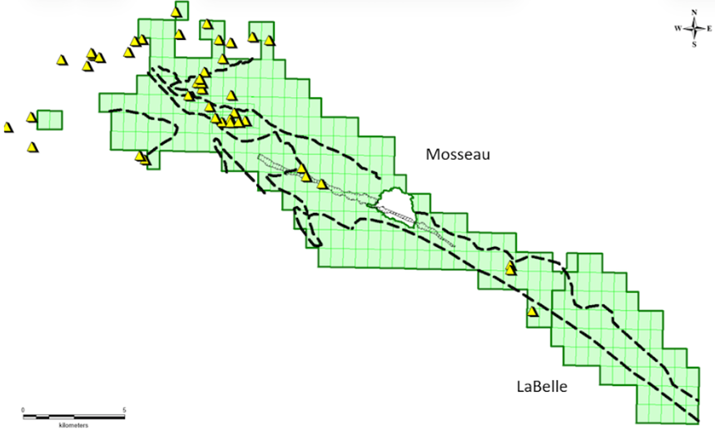
On Feb. 11, 2026, Harvest Gold announced results from the first five holes completed in 2025 in the central part of the Mosseau property. Each hole is within the Kiask River Deformation Zone (Figure 1).
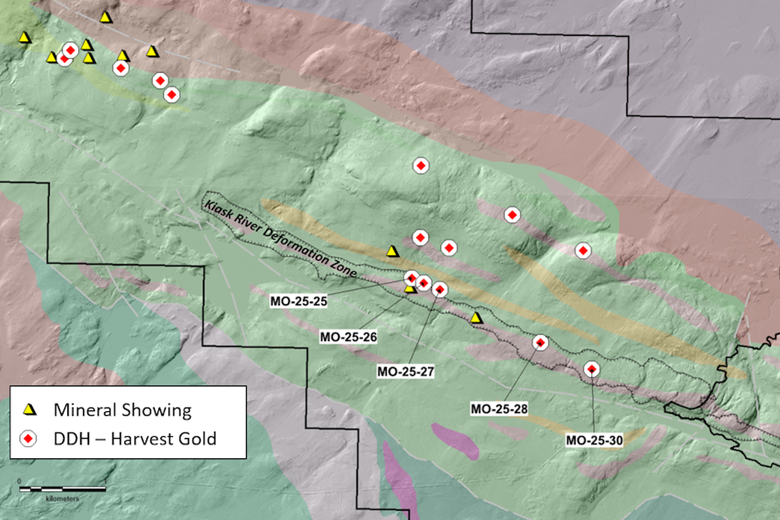
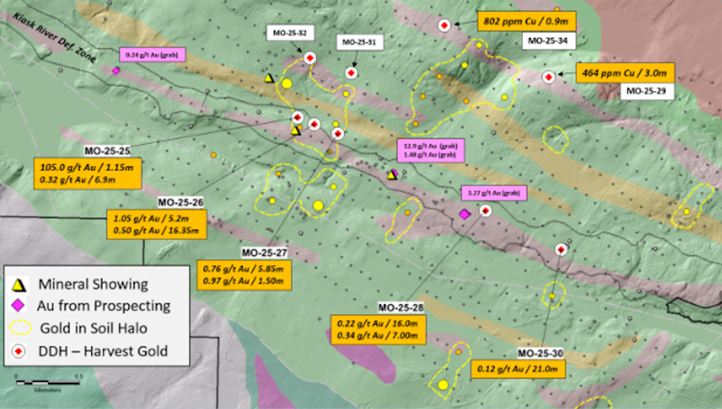
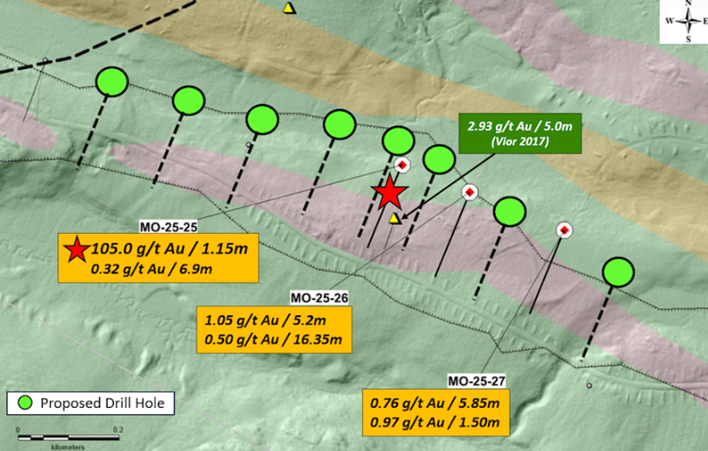
The most significant intersection to date on the Mosseau property was obtained in hole MO-25-25:
- 105.0 g/t gold over 1.15 meters, including visible gold, 4.3 g/t silver and 464 ppm (parts per million) copper.
This high-grade gold interval is associated with a broader lower-grade halo of mineralization that returned 0.32 g/t gold over 6.9 meters.
High-resolution airborne magnetics and prospecting work by Harvest Gold have traced the Kiask River Mineralized Corridor (KRMC) for over 10 km along strike across the underexplored central and southern part of the Mosseau property.
Drilling along the Kiask River Deformation Zone intersected mineralized shear zones that are comparable in style and size to the broad gold envelopes with silver and copper pathfinders previously identified and reported by Harvest Gold in the area of the Morono deposit (see news releases dated January 8, 2026 and January 29, 2026).
Rick Mark, President and CEO of Harvest Gold, stated: “Intersecting 105.0 g/t gold over 1.15 meters in the central part of the Mosseau Property is important to our developing value proposition at Mosseau. This discovery within the Kiask River Deformation Zone indicates it can host very high-grade gold mineralization to accompany the various intersections we have identified elsewhere on the property. And again, we see the presence of a broader Au-Ag-Cu halo proximal to this high-grade interval.”
Under the Spotlight – Quinton Hennigh CEO, San Cristobal Mining
April 8, 2026
Richard Mills: We were very high on Harvest Gold (TSXV:HVG).
We went into the drill program, I’ll say, with some high expectations. We talked about the northern part of the Mosseau and we got smoke.
We got some good solid sniffs of copper and gold smoke. We came down, we drilled some holes into the central, the Kiask River Fault, which a lot of the length seems to be a mirror image of the rocks over where Gold Fields’ (NYSE:GFI) Windfall deposit is. We talked to Louis Martin and Rick Mark, and we’re talking structures, we’re talking layers, we’re talking just exceptional exploration potential.
We did hit 100-and-some grams per tonne over 1.15 meters. And it wasn’t just one chunk. Apparently, the visible gold was spread over the entire 1.15 meters. Where are you on HVG right now?
Quinton Hennigh: They’re going to have to raise some more money. But as a first pass drill program goes, any time you manage to hit a 100-gram meter hole, I don’t care if it’s, like you said, just 1.15 meters of 100 and something grams. That’s fine.
Okay, that works. You don’t have to hit 100 meters of a gram or something like this. I actually like the high-grade nature of this particular hit, because this camp is known for high grades, okay? You don’t hit stuff like this at random in a hole out in the middle of miles and miles of nothing.
To manage to find a geophysical target, the structural target, go in there, poke a hole and hit high grade, that’s a good omen. Yeah, they could have got lucky. Sure, that’s a possibility.
I’d love to think that all geologists are just inherently lucky. But the corollary is it’s telling us something about the geology. There is gold here.
And it is high grade. And I think everybody should pay attention.
Now, the company has thought about picking up a few scraps of additional land, which I think is good. And they’re collecting other data. But yeah, they’re going to have to get some money in the bank and go out there and give this thing another go.
I bought shares, would I participate in another placement? Yeah, I’d probably participate in a placement. I think it’s a discovery. It’s not like super flash in front of everybody’s face — 100 grams over a meter.
Yeah, it goes kind of quick in many people’s views; everybody’s got ADHD. But in my view, it didn’t slip by me. I’m a believer.
RM: It’s easy for a deposit like Windfall to be hiding in those rocks that we’ve got to go back.
QH: I agree. I’m right with you.
Under the Spotlight Rick Mark CEO Harvest Gold & Louis Martin Technical Adviser Harvest Gold
Feb. 27, 2026
Richard Mills: Let’s move down to the central part of Mosseau and take a look at the recently released assays. You worked up a number of drill targets, we drilled, and we’ve now got five holes back, with more coming. What was the impetus for going into that particular area?
Louis Martin: We started our exploration program in the north part of the property, it was a good area to learn and apply our theories, because of the amount of known mineralization in the area.
What we learned from the northern part, we were able to apply to the central portion of the property. The central portion had a lot less previous work and exploration. One of the reasons is the northern part was developed earlier and had more forestry access roads, so more prospectors, and more exploration companies can get in there and do work.
With the high-resolution mag we had flown in the north, we were able to use those same criteria when looking at the central part and say, “Hey, we’ve got a similar, yet large dilation zone out here too.” We’ve got the shear zones that we’re seeing in the north continuing across. We did a soil geochemistry survey last fall, something that had never been done on the property.
Then we started seeing these gold dispersion trains being identified in the central part of the property. So, we said, “Let’s overlay the mag, the structural zones, the favourable geology, the soil sampling results, and with this we began the targeting process.”
We defined 10 targets in the central part. At this point in time, we’ve released the assay results of the first five holes in the central part of the property.
RM: The Kiask River Deformation Zone, does that have the same kind of rocks as what we’re looking for, a comparable to Windfall?
LM: Yes, we’re still in the same type of favourable greenstone rocks. Again, we’re in the Abitibi, we’re in the volcanic sequence. Windfall represents a structural splay off the Urban Barry Deformation Zone, and we’re drilling on a similar structure. Almost like a mirror image of it, except with a northwest-southeast direction.
RM: What do you think was the most important hole and why? What do we see from the results?
LM: I’m more excited about the central holes than I am about the northern ones. The northern ones were good learning holes allowing us to develop our theories. I think there are still excellent targets to go after in the northern part, but the central holes, that is where the excitement is, those five holes, all hit broad mineralized halos. Some of those intersections measure from 7 meters up to 21 meters in width.
All five of them line up in a row and intersected the targeted shear zone.
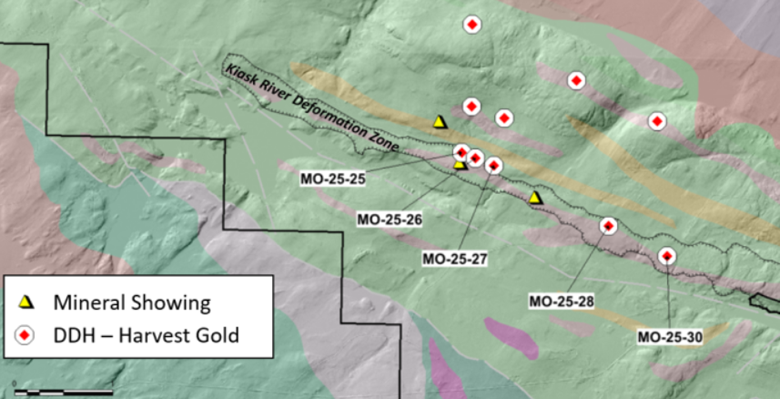
There’s a broad halo with gold mineralization, and there is some copper and silver in there also. So, I think it proves up our concept that this is an excellent mineralized structure to explore along. And, again, focus on its extensive strike length.
We did only five holes on this structure, but from prospecting and other work, we know it extends at least 3 kilometers along strike. Looking at the mag data, we can easily triple that strike length opening up new exploration targets.
RM: How important was it to have that visible gold, the VG?
LM: I think the visible gold is important. It proves up our concept that high-grade mineralization does exist. The visible gold, with 105 grams is one sample, with the grade averaged out over the entire length of that sample.
There are multiple specks of visible gold in that sample. But more importantly, it was in the right rock type and shear zone that we were targeting.
Our exploration focus will continue testing those wide shear zones as defined by the gold and or silver and copper halos.
The follow-up work will consist of following those halos and finding out where they’re going to concentrate the gold.
Our very first hole, hole SW-25-25, did get that right. It intersected a 7-meter wide shear zone or halo with mineralization. And right next to it, there was the 105-gram material. So, it does prove the concept of the best place to be is along that wide shear zone.
And, again, those multiple widths, that long strike length says it’s going to be a big system.
RM: And potentially a rich one.
LM: That’s the whole goal; we want to find where we get a combination of nice shear zone widths and high-grade gold material.
Remaining 5 holes
Fast forward to April 29, a news release detailing the results of the remaining five holes, among other accomplishments.
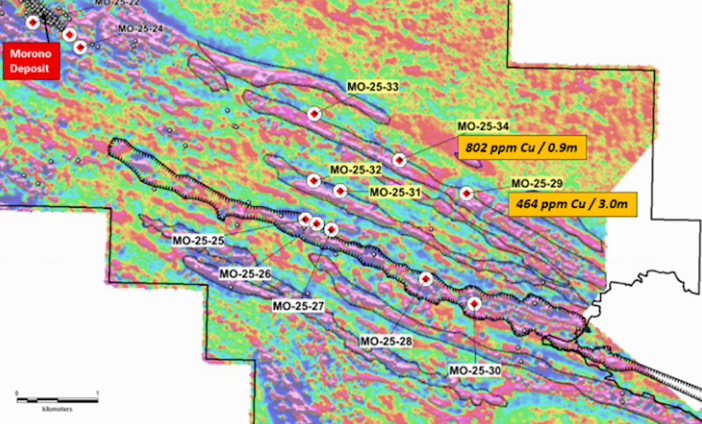
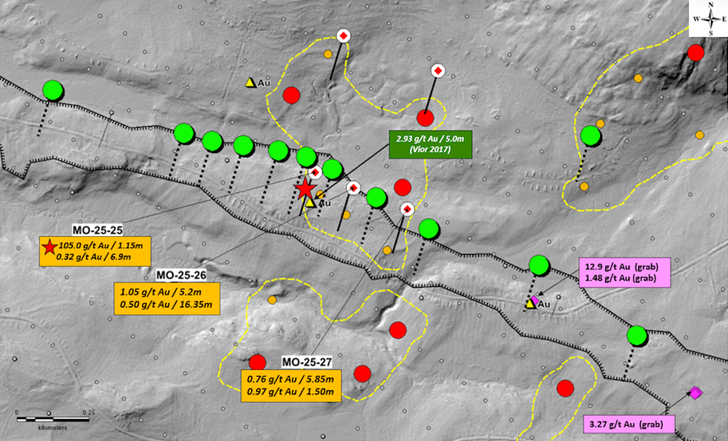
The drill holes targeted gold in soil anomalies associated with magnetic highs to the north of the Kiask River Deformation Zone, in the central part of the Mosseau property (Figures 2, 3). The most significant results from these five drill holes included anomalous copper intersections of 464 ppm copper over 3.0m (SW-25-29) and 802 ppm copper over 0.9m (SW-25-34). These anomalous copper intersections are considered significant in that it reinforces copper as a key pathfinder for gold mineralization on the Mosseau property.
Connecting LaBelle to Mosseau
A high-resolution airborne magnetic survey was remarkably instructive as it showed that the KRMC extends far beyond the current drill area.
The KRMC can now be traced for approximately 32 kilometers along strike and continues directly onto the LaBelle property. Exploration at LaBelle, including magnetic surveys, soil geochemistry, prospecting and mapping confirmed this southeastern extension and identified several priority follow-up drill targets, highlighting strong district-scale discovery potential.
The company then acquired 24 additional mineral claims (1,356 hectares) from two prospector groups, effectively linking the Mosseau and LaBelle properties. These new claims, also within the KRMC, now provide Harvest control over approximately 32 continuous kilometers of prospective strike length.
2025 exploration
At Mosseau, drilling confirmed strong gold mineralization in both the northern and central parts of the property. The company spent approximately $3 million on exploration in the second half of 2025 with the majority on a 21-hole, 4,692-meter drill program. The program returned several significant gold intersections, one of the most notable in the central part of the property, within the KMRC, included a high-grade intercept of 105.0 g/t gold over 1.15 meters.
Additional broader intercepts along strike confirmed a mineralized corridor up to 21 meters wide extending for approximately 3 kilometers, which remains open in all directions. In the northern part of the property, the best intersection included 8.67 g/t gold, 203 g/t silver, 2.26% copper, 0.16% zinc and 0.05% lead over 0.6 meters associated with semi-massive sulfides within a broader zone of 1.90 g/t gold over 5.4 meters.
Regional till sampling program
In the fall of 2025, a regional till sampling program was conducted by IOS on behalf of Harvest Gold. A total of 137 till samples were collected using hand shovels that yielded a total of 1,175 gold grains. The average normalized gold grain count per sample is 10.52 grains, with a maximum of up to 27 gold grains.
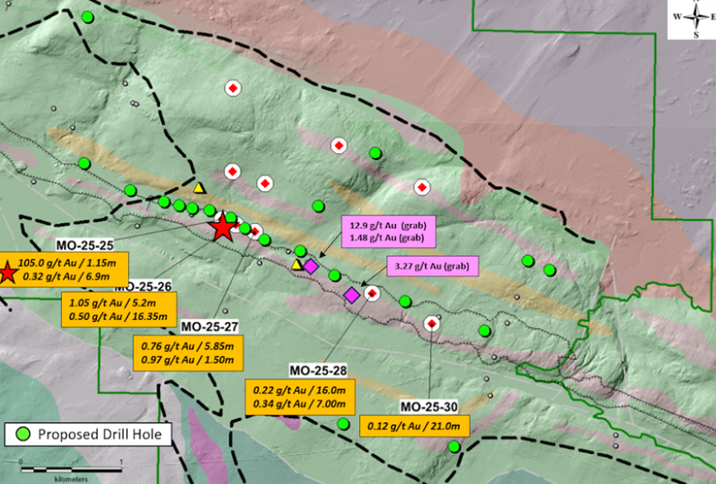
Eight samples are considered anomalous in term of gold grain count. These samples are focused in an area in the northwest part of the property, stretching about 2.5 km long by 1.3 km wide, a dispersal train largely composed by modified grains and is outlined along the main last glacial ice-direction to the southwest (Figures 4, 5). This area contained 30% of the pristine gold grain identified on the Urban Barry Project. Three samples from that same dispersal train have anomalous and enriched content in nickel and chromium in the fine fraction of till, suggesting an association with ultramafic rocks. Other cluster of till samples enriched in cobalt, nickel, silver and zinc were also identified.
The results of the till survey will be integrated with the existing datasets and a field reconnaissance and geological mapping survey of the outcrops in the vicinity of the identified dispersal train will be undertaken to prioritize future drilling.
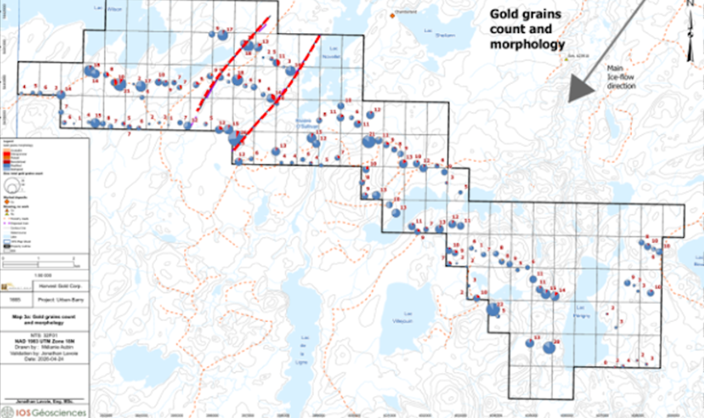
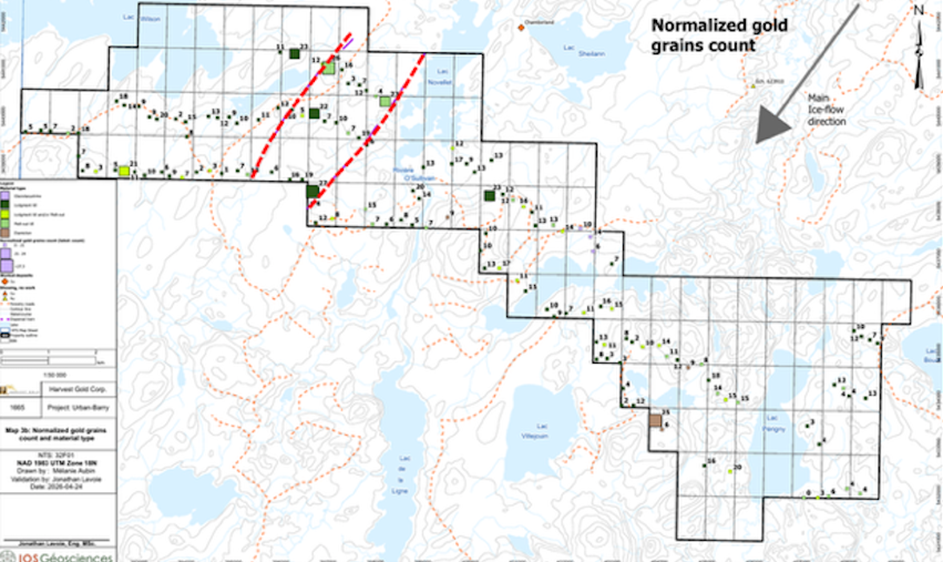
Figure 5: Urban Barry till survey – normalized gold grains count
2026 exploration
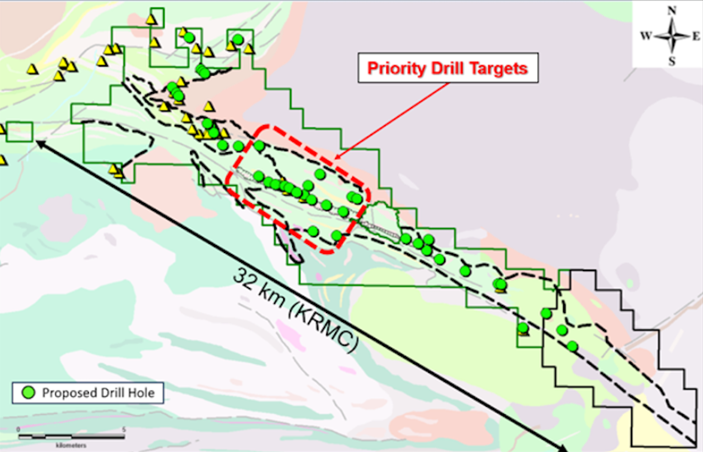
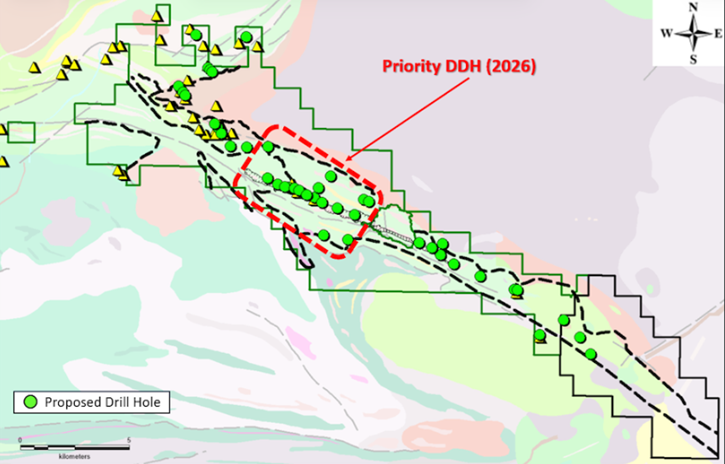
An April 16 news release announced that Harvest Gold’s geological team has defined 50 drill targets along the 32-kilometer length of the Kiask River Mineralized Corridor within its 100% controlled, now combined Mosseau/LaBelle property in the Urban Barry Greenstone Belt, Quebec (Figures 6, 7). Harvest Gold has prioritized 20 targets for its planned 2026 drill program in the central part of the Mosseau property (Figure 5).
Eleven of those 20 priority targets are along a 2-kilometer stretch of a critical magnetic high feature (Figures 2, 3, 4). At least eight of those holes will be within 500 meters of the discovery hole, which assayed 105 grams over 1.15 meters (MO-25-05) as announced on Feb. 11, 2026 (Figure 1).
Rick Mark, President and CEO of Harvest Gold, states: “Last year, in our maiden drill program, we drilled 21 exploratory holes over approximately 9 kilometers of the Mosseau property. Since then, we have acquired 24 claims and now fully control the Mosseau/LaBelle property, which includes the entirety of the 32-kilometer-long Kiask River Mineralized Corridor. This year, after analyzing 2025 drill results, revisiting historical data bases and adding new geochemistry and prospecting results, we have 50 defined drill targets along the 32 kilometers, but will focus on 20 holes emanating from our 2025 discovery hole.”
The most significant exploration results of the program were obtained in the central area along the KMRC, which had seen very limited historical exploration. Drilling in this area confirmed the presence of a continuous gold-bearing corridor and returned high-grade mineralization, including an intersection of 105.0 g/t gold over 1.15 meters which included visible gold, 4.3 g/t silver and 464 ppm copper, occurring between 120.9m and 122.5m down the hole in DDH 25-25.
This interval occurs within a broader halo of lower-grade mineralization and is supported by several additional intercepts along strike that demonstrate both continuity and scale, including 0.50 g/t gold over 16.35 meters (MO-25-026), 0.76 g/t gold over 5.85 meters (MO-25-027), and 0.22 g/t gold over 16.0 meters (MO-25-028). Collectively, the drilling defines a mineralized corridor up to 16 meters wide, traced over approximately 3 kilometers and tested only to shallow depths of roughly 100 meters. The system remains open in all directions and represents a compelling exploration target for future work.
Vior agreement update
The April 29 news release says Harvest is quickly moving towards an 80%/20% joint venture with Vior on Mosseau. The key element, the work commitment component of the agreement, requires Harvest Gold to spend a minimum of $1.3M on Mosseau before Dec. 31, 2027. The company intends to meet that threshold in the summer of 2026.
Conclusion
Harvest Gold has identified 20 priority drill targets for its 2026 program at Mosseau. At least eight of these targets lie within 500 meters of the high-grade discovery hole (105 g/t gold over 1.15m), highlighting strong near-discovery expansion potential.
CEO Rick Mark told me what makes him confident about 2026 drilling is that Harvest Gold’s targeting ability has been enhanced.
“We have a sharper focus. We have new pathfinders, and that’s the kind of thing that will give me confidence to say, this next drill program, we will expect results that will then impact the market.”
Harvest Gold has 50 kilometers of strike length in the Abitibi, including the Kiask River Deformation Zone. High-resolution airborne magnetics has traced the KRDZ for roughly 33 km. They’ve got confirmed polymetallic mineralization, vectors, halos, dilation zones, deformation zones, along with multiple stacked and wide shear zones.
Harvest Gold Corp.
TSXV:HVG
Cdn$0.05 2026.05.01
Shares Outstanding: 123.6 million
Market Cap: $6.7m
HVG website
Richard (Rick) Mills
aheadoftheherd.com

Subscribe to AOTH’s free newsletter
Richard owns shares of (Harvest Gold Corp.
TSXV:HVG). HVG is a paid advertiser on his site aheadoftheherd.com This article is issued on behalf of HVG
Legal Notice / Disclaimer
Ahead of the Herd newsletter, aheadoftheherd.com, hereafter known as AOTH.Please read the entire Disclaimer carefully before you use this website or read the newsletter. If you do not agree to all the AOTH/Richard Mills Disclaimer, do not access/read this website/newsletter/article, or any of its pages. By reading/using this AOTH/Richard Mills website/newsletter/article, and whether you actually read this Disclaimer, you are deemed to have accepted it.