 RSS Subscribe
In a K-shaped recovery consumers feel squeezed – AOTH

The phrase, “Productivity growth is strong, and capital investment is robust” is a direct quote from the official Federal Open Market Committee (FOMC) statement issued by the Federal Reserve.
The economic landscape supporting this assessment includes:
Labor productivity in the U.S. nonfarm business sector has maintained a healthy upward trajectory. On an annual basis, U.S. labor productivity grew by 2.2% year-over-year, significantly outperforming other advanced economies. Economists attribute much of this sustained momentum to structural shifts, such as the ongoing integration of digital technologies and initial gains from artificial intelligence (AI) adoption.
Driven heavily by massive spending on artificial intelligence infrastructure, tech hyperscalers, data centers, and advanced manufacturing equipment, fixed business investment has been a primary engine of U.S. economic growth. Non-residential fixed investment jumped by 8.5% in recent quarterly tracking, fueled by immediate depreciation tax incentives and a corporate push for operational efficiency.
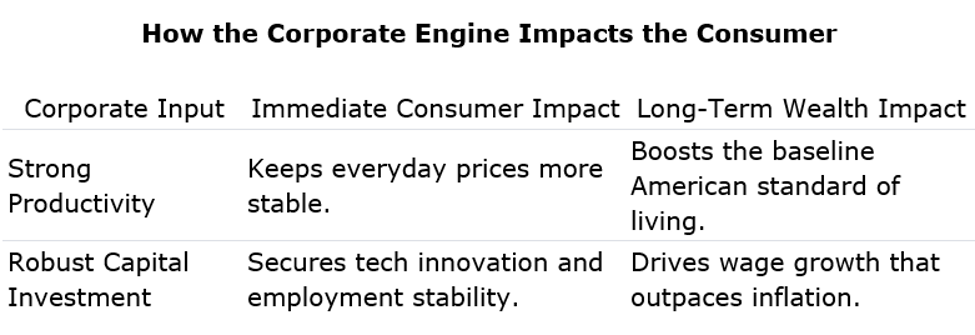
What it is supposed to mean for the everyday American, or global consumers, is that strong productivity growth and robust capital investment should act as a foundational shield and an economic engine. Together, they directly influence purchasing power, wage growth, and the cost of living.
When companies are highly productive, they can produce more goods or deliver services with the same amount of effort and hours.
Because capital investment (like new AI tools, software, and advanced machinery) makes operations highly efficient, companies can control their expenses.
Instead of passing higher costs onto the consumer, companies can absorb cost pressures. This allows the economy to grow without reigniting a rapid spiral in consumer prices.
Historically, sustained rising living standards are impossible without productivity gains.
When a worker’s output increases due to better technology or equipment, employers can afford to pay higher wages without needing to hike retail prices to fund those raises.
Wages that grow alongside productivity mean consumers gain real purchasing power—their money actually buys more, rather than just keeping up with inflation.
The combination of these two forces is supposed to impact the macro environment where consumers borrow and save.
Because productivity keeps inflation at bay, the Federal Reserve doesn’t have to keep interest rates aggressively high to cool the economy. Over time, this helps lower borrowing costs for consumers on mortgages, auto loans, and credit cards.
Robust capital investment shows that corporations are confident in the future. Companies investing heavily in their own infrastructure are far less likely to engage in mass layoffs, stabilizing the job market for workers.
K-shaped recovery
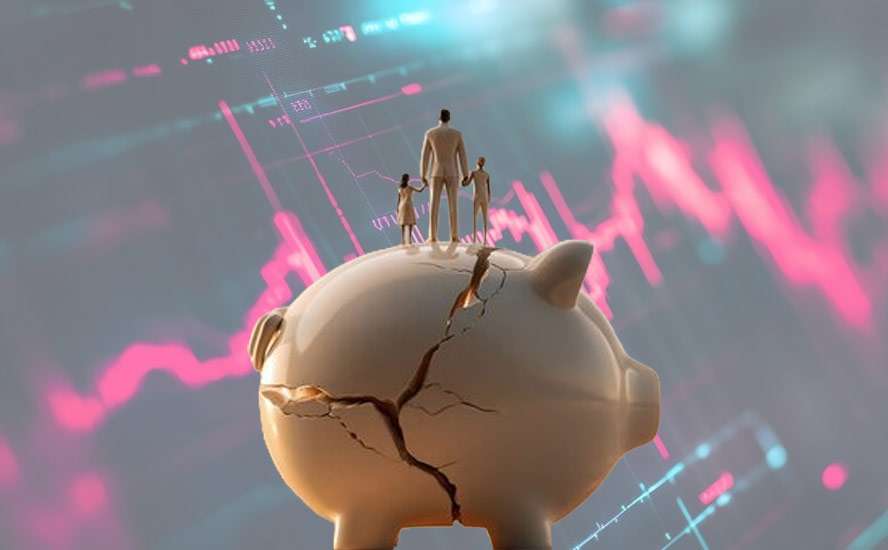
Yet there is a massive, very real divide between macroeconomic data (what the Federal Reserve and corporate balance sheets see) and the microeconomic reality (what everyday consumers actually feel).
This phenomenon is often called a K-shaped recovery because while the corporate engine is firing on all cylinders, the average consumer feels squeezed.
While macro economists point to “strong productivity growth” to explain why GDP is rising, the reality of how that money is distributed tells a different story.
When a company becomes more productive through tech investment, those financial gains initially go to corporate earnings and shareholders, not directly into worker paychecks. This explains why macro numbers are robust while many feel their individual wages are stagnating.
United States nominal wage growth sits at 3.47% YoY (July 2026), but when adjusted for a 3.40% inflation rate, real wage growth is effectively flat or slightly negative (-0.30% YoY in August 2026).
Even though productivity helps slow down future price hikes, it doesn’t automatically lower the high prices consumers are already facing for everyday necessities like food, rent, and insurance.
Anxiety vs. Economic Data
Public behavior is being heavily shaped by the fear of AI-driven job displacement, creating a protective psychological shift among workers.
Broad labor data from institutions like the Stanford Digital Economy Lab shows that AI isn’t causing mass layoffs for seasoned workers yet. However, it is heavily impacting younger workers (ages 22 to 25). Companies are using AI to handle entry-level coding, writing, and administrative tasks, leading to sharply lower job-finding rates for recent graduates.
(Presenting an interesting future dynamic, the young not able to find work to support a rapidly aging out demographics globally – Rick)
Tech executives often claim AI creates jobs rather than killing them. While true in aggregate (e.g., massive hiring booms to build data centers and power grids), the people losing office-based positions are rarely the ones getting hired to build electrical infrastructure. This structural mismatch drives intense worker anxiety.
Consumers Are Responding to the Strain
Because of this mix of sticky inflation, flat wages, and tech anxiety, American consumers are actively changing how they manage their lives.
The personal savings rate in the United States sits at 4.1%, which is less than half of the long-term historical average of 8.37%. At the exact same time, credit card interest rates have climbed to historic highs—frequently hovering above 21% APR—while total U.S. credit card debt has ballooned to a record $1.26 trillion.
Fearing future tech displacement, consumers are pulling back on discretionary spending. They are prioritizing emergency savings over luxury goods.
Rising essential costs (housing, energy, and medical care) are pacing ahead of disposable income growth. Over 40% of Americans report that housing costs alone are preventing them from building savings.
A high percentage of consumers are exhausting their paychecks before the month ends, meaning “saved” funds are frequently diverted to cover existing credit card debt rather than building a liquid emergency cushion.
In sectors highly exposed to AI (like finance, corporate tech, and professional services), workers are experiencing diminished bargaining power. Conversely, blue-collar and experiential roles—which AI cannot easily replicate—are seeing much stronger wage growth.
In short, the macro economy is highly efficient, but the human transition into this new AI-driven era is proving to be incredibly bumpy, uneven, and stressful for household budgets.
When you look past the headline numbers of GDP and corporate productivity, the severe strain on the American household budget becomes starkly visible through several key mechanics.
After dealing with cumulative inflation that has pushed consumer prices up, millions of lower- and middle-income households have entirely depleted their pandemic-era savings cushions. Because everyday costs for necessities like groceries and rent remain so high, people simply do not have left-over cash to save.
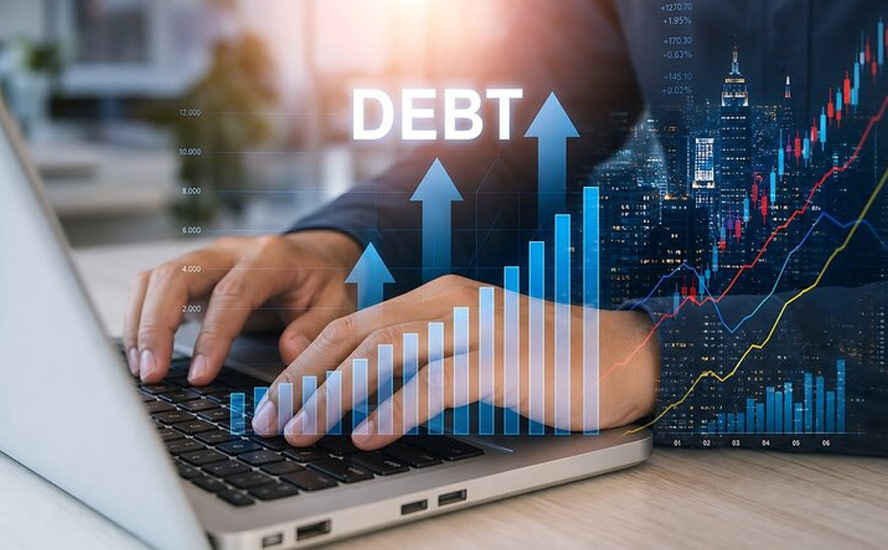
Instead of using credit cards for discretionary luxury spending, a growing segment of the population is relying on plastic as an essential lifeline to cover baseline utilities, medical emergencies, and groceries. Bankrate data reveals that nearly 29% of Americans now have more credit card debt than emergency savings.
Because the Federal Reserve raised interest rates to cool the economy, commercial banks pushed credit card APRs to record maximums. Carrying a balance from month to month is now more expensive than ever before. For a consumer forced to buy groceries on credit, the 21%+ interest rate acts as a secondary inflation tax, compounding their debt and making it incredibly difficult to break out of the cycle.
This stress is hitting unevenly. While high-income cohorts still maintain stable balances and investments, subprime credit card delinquencies among lower-income households have spiked significantly, highlighting a visible breaking point for vulnerable consumers.
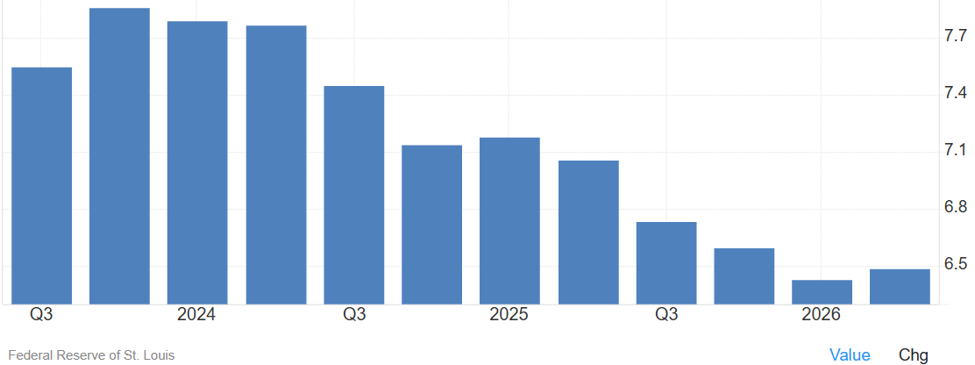
Corporate investments and productivity are booming, but a massive portion of the consumer base is actively taking on expensive debt just to bridge the gap between flat wages and high living costs.
Red flag
The below Axios scenario is a major red flag for American consumers because it shows they are maintaining their lifestyle by draining their savings and taking on debt, rather than through growing income. While the headline economic growth looks strong, the underlying foundation for the average household is increasingly fragile.
When inflation-adjusted income stalls but spending jumps by 0.6%, consumers are experiencing a negative structural gap. They are buying the same (or slightly more) goods and services, but it is costing them a much larger percentage of their take-home pay.
A drop from 5.2% to 4.1% in just one year means the financial cushion for households is evaporating.
A 4.1% saving rate is well below the historical U.S. average (which typically hovers around 7% to 8%).
Credit card interest rates are at historical highs. Relying on credit cards means consumers aren’t just paying higher prices for goods—they are paying high-interest penalties on top of those prices.
This dynamic is unsustainable.
Consumers can outspend their income for a few months by tapping savings and charging credit cards, but they eventually hit a wall. When consumers finally hit their credit limits or run out of savings, spending will drop sharply.
Because consumer spending drives roughly 70% of the U.S. and global economies, a sudden slowdown in spending usually triggers a broader economic slowdown or a recession.
“Axios Macro
For households, the on-paper economic boom is not translating into stronger purchasing power:
- Disposable income, adjusted for inflation, stalled in August — down from a 0.3% gain in July. (A separate measure of real wage growth has declined for five straight months.)
Consumers kept spending anyway, according to monthly data released this morning.
- Real personal consumption expenditures jumped 0.6% in August, far outpacing income growth and pushing the personal saving rate down to 4.1% from 4.6% in July.
- Americans are saving a smaller share of their income than they were this time last year. The saving rate has fallen from 5.2% in August 2025 to 4.1%, near the lower end of its post-pandemic range.
- “Households pinched by higher prices have been either reducing their monthly savings rate or relying more on credit,” Nationwide chief economist Kathy Bostjancic wrote in a note.”
Conclusion
A classic financial vulnerability cycle is underway. Income shortfalls are forcing reliance on credit and savings, which eventually hits a hard ceiling, triggering a consumption cliff and subsequent recession.
If central banks hold interest rates higher for longer to permanently stamp out remaining core inflation, they raise the borrowing costs of that very credit card debt, accelerating the timeline toward the consumer wall.
Conversely, easing rates too quickly risks reigniting inflation before the consumer’s primary engine—real, un-leveraged wage growth—can fully recover.

Legal Notice / Disclaimer
Ahead of the Herd newsletter, aheadoftheherd.com, hereafter known as AOTH.Please read the entire Disclaimer carefully before you use this website or read the newsletter. If you do not agree to all the AOTH/Richard Mills Disclaimer, do not access/read this website/newsletter/article, or any of its pages. By reading/using this AOTH/Richard Mills website/newsletter/article, and whether you actually read this Disclaimer, you are deemed to have accepted it.