 RSS Subscribe
Copper production to decrease for first time in 9 years – Richard Mills
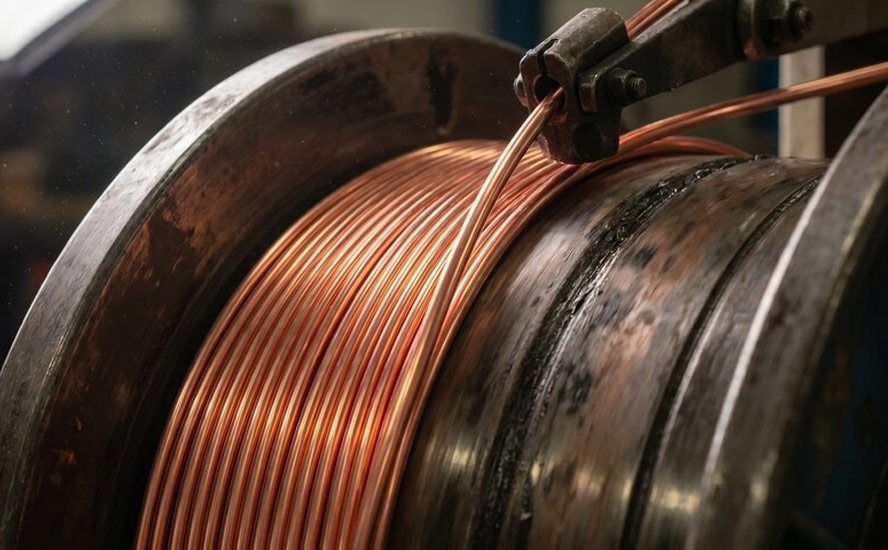
Global mined copper output is set to fall in 2026 for the first time since 2017. Key supply constraints include declining ore grades, mine disruptions, and slow project pipelines.
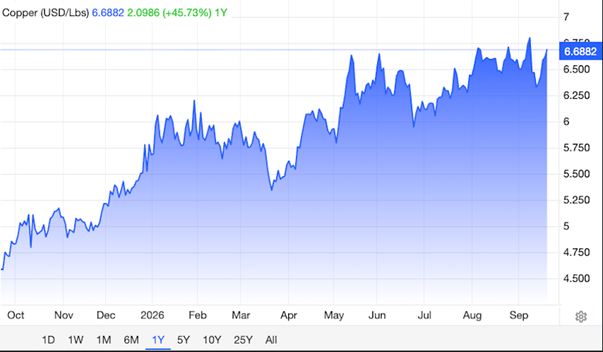
US copper futures climbed to around $6.65/lb on Monday, extending gains for a fifth consecutive session, supported by signs of stronger demand and expectations of tighter supply. (Trading Economics)
Prices are close to the all-time high reached on Jan. 29, 2026 of $14,527.50 per tonne or $6.58/lb.
Average ore quality has dropped from ~1.6% Cu in 1990 to under 0.6% Cu, meaning miners must move significantly more rock for less metal.
Output setbacks at prominent assets like Freeport-McMoRan’s Grasberg mine in Indonesia and operations in Chile and the DRC have severely squeezed raw concentrate availability.
According to the International Copper Study Group, global output fell 1.1% in the first half, with major producers Codelco and Freeport-McMoRan posting double-digit declines.
Large mining companies that account for two-thirds of global supply
saw first-half output fall 3.5%, including a 4.1% second-quarter drop driven mainly by Freeport, Codelco, Ivanhoe Mines and Antofagasta. (Bloomberg)
Freeport’s Grasberg, the world’s second largest copper mine, is still underutilized due to a mudslide in September 2025 that triggered a force majeure.
State-run copper miner Codelco expects flat production in the coming years. When asked in July if the company was on track to meet its 1.7Mt per year target by 2030, chairman Bernardo Fontaine said Codelco expects production to stay similar to current levels.
Copper price riding $6 wave on supply concerns, sulfuric acid crisis — Richard Mills
Chile, the world’s top copper-producing country, posted its weakest Q2 output in 19 years, cutting its full-year production forecast for a second straight quarter; it now expects a 2.6% decline.
Weather is adding to supply concerns, particularly in Chile which is prone to droughts, Congo and Zambia, whose mines rely on hydroelectric power. Forecasts are for a strengthening El Nino, and mine disruptions are historically greater during El Nino years.
With copper prices so high, why don’t the majors bring on new projects that would be uneconomic at lower prices?
The problem is that bringing a new copper mine from discovery to production takes an extensive lead time of 15 to 30 years.
Moreover, an analyst at Morgan Stanley says the industry is now feeling the effects of sharp cuts to mining investment following the commodity downturn a decade ago, leaving a much thinner pipeline of new projects. She sees the possibility of an annual decline in mine output.
Bloomberg notes that copper trading near record highs should encourage miners to maximize output. Deteriorating ore quality, accidents, project setbacks and extreme weather are frustrating those efforts, and fueling concerns about whether supply can keep pace with demand as electrification gathers pace over the coming years… and bulls are betting those limitations will ultimately drive prices higher.
The difficulties miners face in boosting output are the underlying theme of a “very, very tight market,” Evy Hambro, BlackRock Inc.’s thematic and sector investing global head, said last month in a Bloomberg Television interview. “It’s declining grades at existing operations,” he said. “It’s tired, very, very old assets. It’s a lack of new development of supply coming into the market.”
Demand drivers
- AI Data Centers: Exponential growth in computational power and data infrastructure has massively amplified power-grid and wiring requirements.
- Energy Transition: Rapid adoption of electric vehicles and renewable energy grid expansions require intensive copper deployment.
- Defense Spending: Rising global geopolitical tensions are projected to drive defense budgets higher, adding further pressure to raw material supply chains.
Major tech companies are on track to spend between $745 billion and $760 billion on capital expenditures in 2026, driven largely by artificial intelligence and data center expansion.
Data centers rely heavily on copper for electrical conductivity, power distribution and heat management. Where copper is used:
- Power Distribution: Thick copper busbars, transformers, and switchgear deliver high-volume current with minimal energy loss.
- Hardware & Circuitry: Server boards, internal wiring, power connectors, and chips use copper for reliable electrical paths.
- Thermal Management: Cooling systems and heat sinks use copper’s thermal properties to dissipate heat from high-density GPUs.
Copper and silver usage in data centers, robotics and solid state batteries — Richard Mills
A standard data center uses 5,000 to 15,000 tons of copper, while large AI hyperscale sites — the kind built to run artificial intelligence — can require more than three conventional facilities, up to 50,000 tons.
Driven by the AI boom, data center demand is expected to push global copper consumption significantly higher through the decade. The IEA believes that data centers could be consuming more than half a million tonnes annually by 2030, at which time they would gobble up 3% of the world’s electricity supply, twice that of the United Kingdom currently.
Long-term deficit projections
- S&P Global Forecast: A massive cumulative shortfall of up to 10 million metric tons is projected by 2040 as demand surges 50%.
- S&P AI & Electrification Study: A 24% supply gap (roughly 10 million tonnes short of 42Mt demand) is expected by 2040.
- Near-Term Physical Tightness: UBS forecasts a refined market deficit of 219,000 tonnes in 2026, widening to 379,000 tonnes in 2027.
The copper industry is entering a structural deficit, with demand from electrification and AI expected to outpace new mine development.
Recycling is essential for filling this gap, but it is not currently capable of meeting the entire deficit on its own.
Why we’re running out of copper — Richard Mills
While the copper market was roughly balanced in 2025, meaning that refined production met consumption, mine supply was severely disrupted and will likely create a deficit in 2026, states the International Institute for Strategic Studies (IISS).
A significant long-term deficit is projected, potentially exceeding 6 million tonnes annually by the early 2030s. Total output from copper mines in 2025 was 23 million tonnes, according to the USGS.
A study released on Jan. 8 by S&P Global Market Intelligence and S&P Global Energy found that copper supply is expected to fall 10Mt short of demand by 2040, putting at risk industries such as artificial intelligence, defense spending and electrification.
The shortage would be 23.8% shy of the projected demand of 42Mt, even as copper recycling doubles to 10Mt. AOTH research has found that copper supply has not been able to meet demand without recycling for the past several years.
Conclusion
Is $6 copper sustainable?
The answer, in my view is yes. A combination of factors underpin a bullish narrative.
First is the supply-demand imbalance. Mine supply is on track for the first deficit since 2017.
Operational issues continue, especially in number one producer Chile. State miner Codelco forecasts flat production over the next few years despite attempts to bring on new projects that address declining ore grades.
Second is the global sulfuric acid shortage, which has driven copper prices to historic highs, while directly threatening up to 20% of global mine production. Because so much of Chile’s operations are heap-leach, it is the country most vulnerable to sulfuric acid supply hiccups.
Spot prices for sulfuric acid in key import hubs like Chile have roughly doubled. Overall, acid prices have surged by as much as 156%. That’s with the Strait of Hormuz closed.
On top of this, China since May 1 has implemented a complete ban on sulfuric acid exports to protect its domestic fertilizer supply.
Chile imports more than a million tonnes of Chinese sulfuric acid annually for the heap-leach operations that produce roughly a fifth of global copper.
According to the International Energy Agency, copper mines producing more than a seventh of the world’s primary supply are now hostage to a sulfuric acid market thrown into chaos by the Middle East conflict and Beijing’s export ban.
The bottom line is, without a resolution to the Iran war the world’s top copper mining countries needing sulfuric acid for metals extraction will be forced to cut production, further widening the gap between demand and supply.
Third is stockpiling ahead of a US tariff on refined copper cathodes in January 2027. An estimated 900,000 tonnes of copper have moved into US warehouses this year, as traders position themselves ahead of the potential tariff, reducing available supply outside the US.
Copper and gold senior merger and acquisition activity
The already tight copper market is getting tighter. Copper futures have risen 50% since Aug. 4, 2025, and are likely to remain above $6 for some time.
Richard (Rick) Mills
aheadoftheherd.com

Legal Notice / Disclaimer
Ahead of the Herd newsletter, aheadoftheherd.com, hereafter known as AOTH.Please read the entire Disclaimer carefully before you use this website or read the newsletter. If you do not agree to all the AOTH/Richard Mills Disclaimer, do not access/read this website/newsletter/article, or any of its pages. By reading/using this AOTH/Richard Mills website/newsletter/article, and whether you actually read this Disclaimer, you are deemed to have accepted it.