 RSS Subscribe
The US debt is now bigger than its economy. Why this matters – Richard Mills

2026.08.15
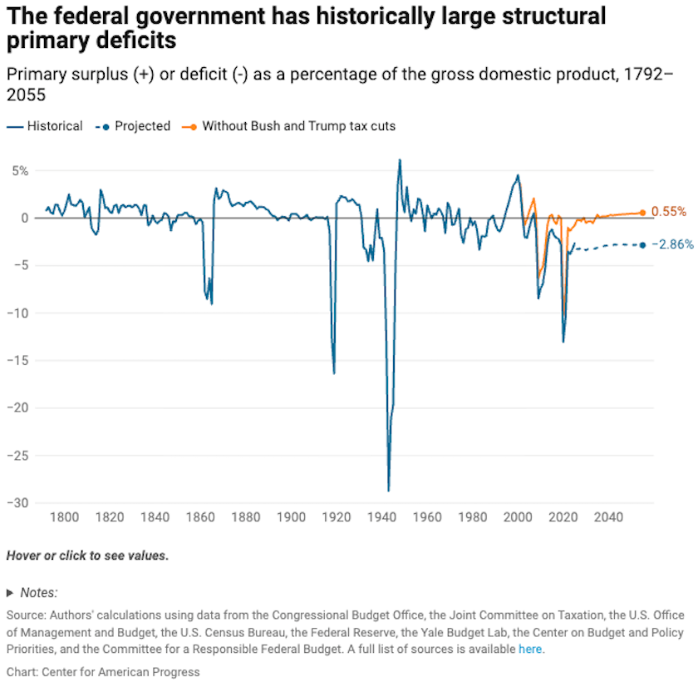
The US has the largest national debt of any country at $39 trillion. While the US debt-to-GDP ratio of 122% is smaller than Japan’s 204% and Singapore’s 172%, economists are worried about the level of the US’s debt because it restricts the levers that the Federal Reserve can pull.
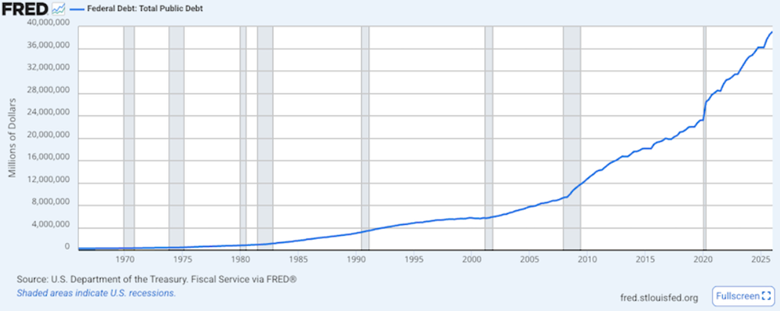
Investors are demanding higher yields on long-term US bonds. The deficit is approaching $2 trillion. The only way the government can pay for it is to print money, which is inflationary.
People are increasing worried about the US government’s ability to finance its own deficits and debt, but bond investors are also concerned about inflation destroying their yields. When this happens, arguably the game is up and nobody will want to purchase US Treasuries.
Deficits and interest payments
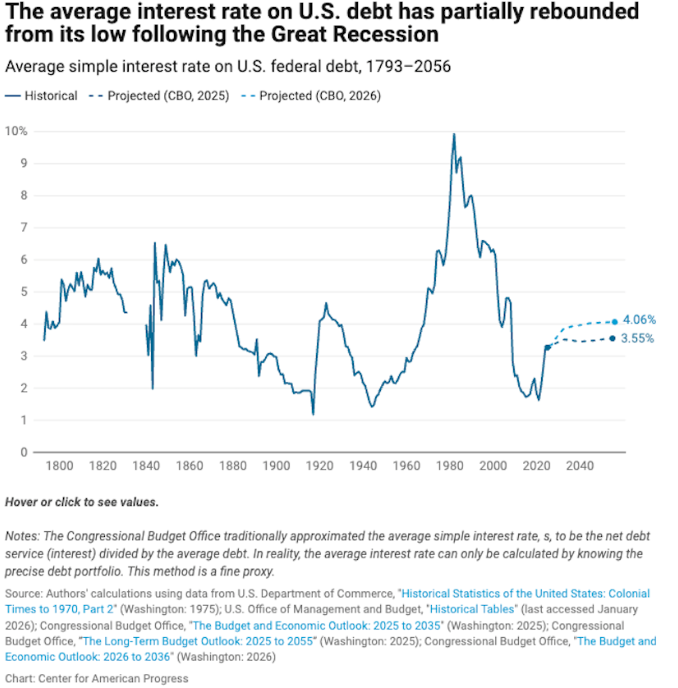
High interest rates and massive short-term debt servicing costs force the US government to spend over $1 trillion annually on net interest. This crowds out public investments, inflates federal deficits, and risks higher taxes or cuts to vital programs.
Heavy government borrowing redirects capital away from private markets, driving up interest rates for businesses and consumers.
Expensive credit restrains business expansion and productivity gains over time.
If the government prints money or continually expands deficits to manage debt burdens, it risks fueling further inflation.
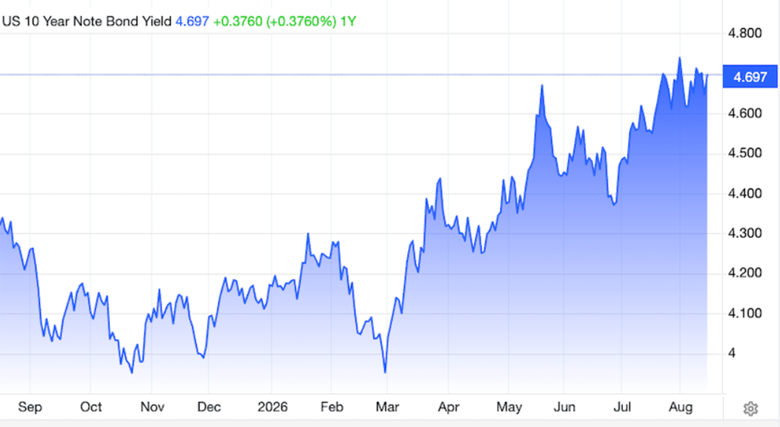
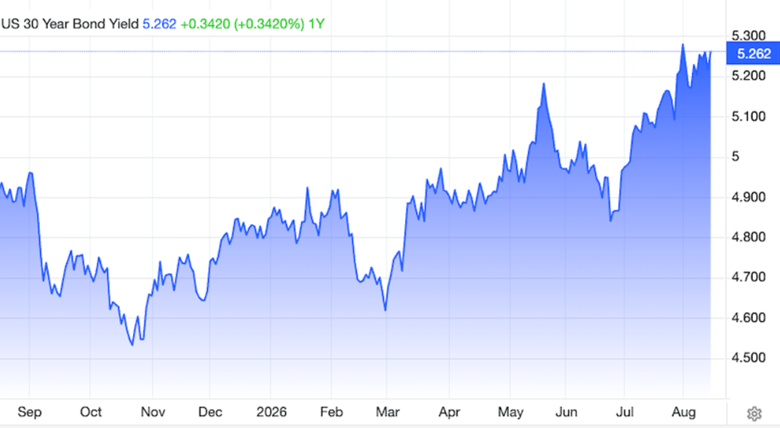
Bloomberg reports that the US government on Thursday, Aug. 13 offered to sell $25 billion of 30-year bonds at the highest rate in 25 years — 5.24%. This is the highest borrowing cost since 2001.
The article notes that Long-term yields surged past 5% this year on investor concerns that a rise in energy prices will boost cost pressures, forcing the Federal Reserve to keep interest rates elevated for years to come….
Interest on the public debt continues to be a key driver of the nation’s budget deficit. For the fiscal year to date, the tally is $1.17 trillion — a 15% increase, thanks in part to higher yields on Treasuries…
And as traditional sources of demand have moved away from Treasuries, private market participants have stepped in — demanding juicier yields in the process.
According to Bloomberg strategist Brendan Fagan, “Borrowing at fresh multi-decade highs may simply become the norm from now on.”
Putting the interest on the debt in perspective, a new report by the Congressional Budget Office (CBO) says the government’s nearly $40 trillion national debt is now costing the Treasury more than $3 billion a day in service payments.
Interest payments on the debt have grown by $117 billion or 14% compared to the same period last year.
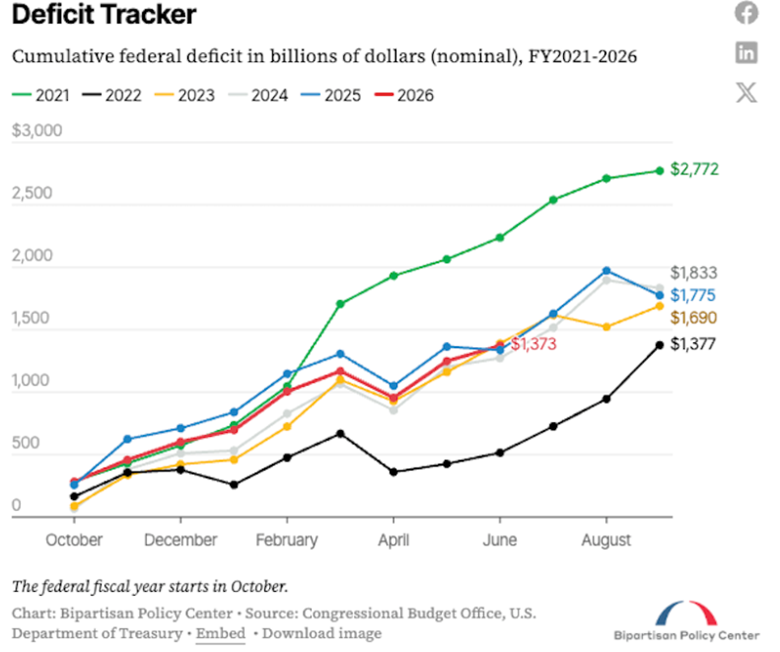
Debt hawks complain that deficits totaled $1.8 trillion in the first 10 months of this fiscal year, $169 billion more than the deficit recorded during the same period last fiscal year.
The CBO projects the deficit for the total fiscal year will be $2.1 trillion, $200 billion more than the amount forecasted in February. In other words, the deficit is getting worse.
The concern for debt hawks is that the U.S. debt-to-GDP ratio is becoming unbalanced (currently at 122% per the St. Louis Fed), and lenders at some stage will attach a higher risk premium to lending, pushing up interest as a result…
Bridgewater Associates founder Ray Dalio has warned as much, saying a “debt-induced heart attack” will be prompted by debt payments crowding out public spending.
The Bipartisan Policy Center notes that each year’s deficit adds to the already enormous national debt, with interest costs driving further spending growth.
The federal government’s cumulative deficit for fiscal year 2026 totaled $1.4 trillion at the end of June. This is 3% higher than at the same point last year. Total fiscal year-to-date revenues were 4% higher, while total spending was 3% higher.
Debt-to-GDP ratio
The US debt and deficit situation is even more alarming when we examine the climbing US debt-to-GDP ratio. The national debt now exceeds the value of the economy measured in gross national product (GDP).
The last time the US debt-to-GDP surpassed 100% was during the aftermath of World War II in 1946.
This grim milestone was reached on March 31 when US publicly held debt reached $31.265 trillion, or 100.2% of GDP. (Atlantic Council)
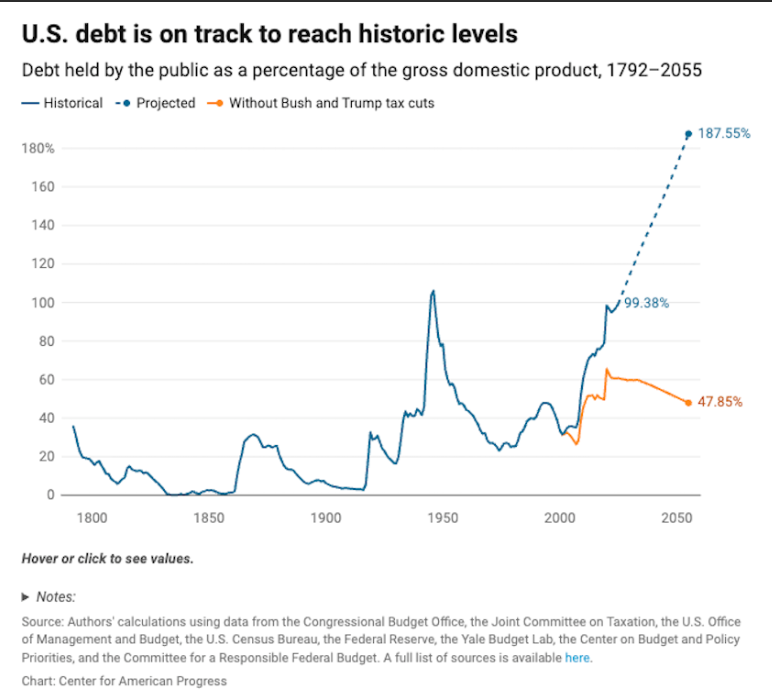
In a column, the Atlantic Council’s president and CEO Frederick Kempe points out “the real trouble” with US debt topping 100% of GDP:
Debt at this level constrains choice. It narrows the room to respond to crises, whether financial shocks, global conflicts, or natural disasters at home…
Washington now spends more on interest payments than it does on many core government functions.
For instance, defense. Over the past 50 years, the US government spent about twice as much on defense as on net interest payments. In 2024 net interest payments surpassed defense spending. The CBO predicts that by 2036, interest payments will nearly double defense spending, reaching 4.6% of GDP compared to 2.4% for defense.
As we pointed out in a previous article, the United States’ indebtedness is causing many to ask whether the US dollar is worthy of being the global reserve currency.
Does the US deserve to have the world’s reserve currency? — Richard Mills
In Kempe’s words:
The United States’ ability to borrow at scale, the so-called “exorbitant privilege” of having the world’s leading reserve currency, rests on international trust—in our economy, our institutions, and our democracy. Persistent deficits, rising debt, and growing policy unpredictability all test that confidence. If that trust erodes, the consequences would be profound: higher borrowing costs, a weaker dollar, and diminished global influence.
Economic historian Niall Ferguson simplifies this as Ferguson’s Law, named for the philosopher Adam Ferguson, which states that “any great power that spends more on debt servicing than on defense risks ceasing to be a great power.”
Interest-to-GDP ratio
Globe and Mail columnist Andrew Coyne points to another metric we can use to describe out-of-control US government debt: the interest-to-GDP ratio.
Start by acknowledging the interest costs on US government debt currently amount to about 3.3% of GDP. The ratio is projected to be nearly triple that in 30 years, but this assumes the average interest rate on US debt rises to only 4.2%.
Were it to rise, instead, to 5.2%, the interest-to-GDP ratio climbs to 15%. At 6.2% interest, the ratio is a whopping 22%.
Even at 10 per cent of GDP – the “rosy” scenario – interest costs would be eating up more than half of all federal revenues… The U.S. is heading straight for a fiscal cliff.
Japan is a warning
In late July the US Treasury tapped the foreign exchange market to buy up to $10 billion worth of Japanese yen to support Japan’s currency. Japan spent an estimated $59 billion to $85 billion selling reserves to prop up the yen.
The US intervention was done to prevent a disorderly currency collapse from triggering massive Japanese sales of US Treasury bonds, which would have spiked American borrowing costs, worsened financial volatility, and destabilized regional trade across Asia.
Japan owns $1.4 trillion in US Treasury securities, the most of any country.
A recent article by The Daily Economy states that Japan’s problems threaten to hasten the United States’ journey down the path to crisis. How could this happen? Rising interest rates.
Start with the observation that in July, the Japanese yen was the weakest in relation to the US dollar in 40 years. ($1 bought 162 yen).
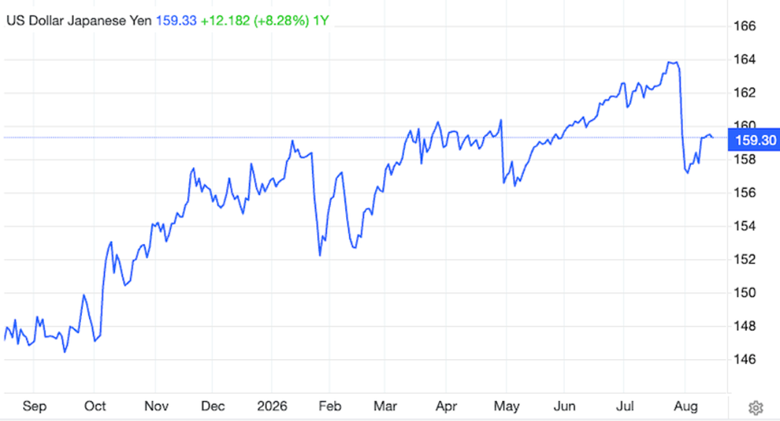
To boost the yen’s value, the Japanese government sold US bonds in return for dollars, which they used to purchase yen. This resulted in a rise in US Treasury yields, which, as we have explained, means higher borrowing costs to finance US debt.
Recognizing this, the US Treasury has stepped in to buy yen with dollars, but this is only a temporary fix. The underlying problem remains, as Robin Brooks notes: Japan’s bond yields are still not high enough to reflect its true fiscal situation, but Japan cannot afford for them to rise any higher.
Japan has borrowed itself into a corner. Many other countries, including the United States, are on track to join it.
AI to the rescue?
It should by clear by now that high interest rates are a problem for indebted governments. The Economist notes that every percentage-point rise in America’s bond yields costs it extra interest payments worth 1.3% of annual GDP within a decade. The government could reduce spending or raise taxes to offset the higher payments; neither are likely. The tax cuts from the Trump administration’s Big Beautiful Bill Act alone cost $5.8 trillion.
Instead, governments are looking at increasing productivity, and they think artificial intelligence might do the trick.
The problem is that AI has yet to boost productivity, even in China, where the technology is furthest along. The other problem is that AI will probably result in job losses, meaning more government spending on unemployed workers. If AI sparks an arms race, more defense spending will ensue. If AI allows people to live longer, it will raise spending on pensions.
Economists at the Brookings Institution, a think-tank, reckon these factors plus higher interest rates could more than halve the positive impact of AI-induced growth on American deficits.
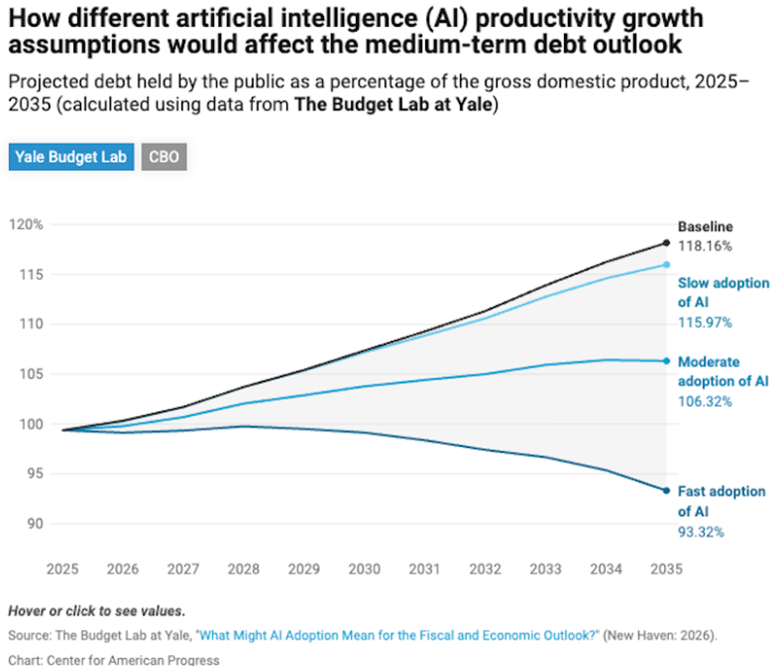
The Center for American Progress starts with the presumption that, should AI significantly increase productivity, it would result in faster GDP growth and lower debt ratios going forward.
However, to do this, productivity would have to grow at rates well above historical averages. Whether AI will improve the productivity of incumbent workers or displace labor is subject to debate, but the key insight for fiscal analysis is that either way, output will go up.
The question is by how much. Most economists’ forecasts are 0.1 to 1.5% a year, much lower than “AI insiders” are predicting.
The CAP says the biggest challenge to the “AI-to-the-rescue” scenario pertains to the productivity growth rate itself. While AI may boost productivity at first, it is doubtful whether that growth rate will persist.
The following example demonstrates the concept quite well:
Consider a factory wherein 5 people make 10 widgets. Output per person is 2 widgets—the total of 10 is divided by 5 workers. Productivity is typically measured as output per hour versus per person, but that does not matter here. Now imagine AI enables the workers to increase their output by half, to 15 widgets, boosting their productivity level to 3 (15 divided by 5). Productivity growth is 50 percent, from 2 to 3. Now, assume the 5 workers keep using AI to produce 15 widgets. Their productivity level stays at 3, and thus their productivity growth rate does not rise further. For continued productivity growth, AI would have to make them increasingly productive.
Dot-com versus AI boom
The early 2000s dot-com boom relied on ultra-cheap and easy money while today’s AI boom is driven though borrowing much more expensive money because of much higher high interest rates.
Also, during the dot-com era, companies backed loans with highly speculative collateral, like overvalued company stock, brand names, or unproven intellectual property. Today, tech companies are using tangible physical infrastructure—specifically high-end AI microchips and cloud data centers—as physical collateral to secure billions of dollars in debt.
While using physical chips sounds safer than the dot-com era’s imaginary paper wealth, it introduces a dangerous new risk: hardware depreciation.
If Nvidia or its competitors release a brand-new, vastly superior generation of chips next year, the older chips being held as collateral could suddenly lose their market value. If an AI startup defaults in a market flooded with newer tech, the lenders will find themselves holding warehouse floors full of obsolete, near-worthless silicone.
Retail wearing rose tinted glasses, got gold?
Conclusion
The US federal budget deficit is projected to climb from $1.9 trillion in fiscal year 2026 to over $3.1 trillion annually by 2036, driven primarily by soaring net interest payments on the national debt, mandatory spending and increased military spending.
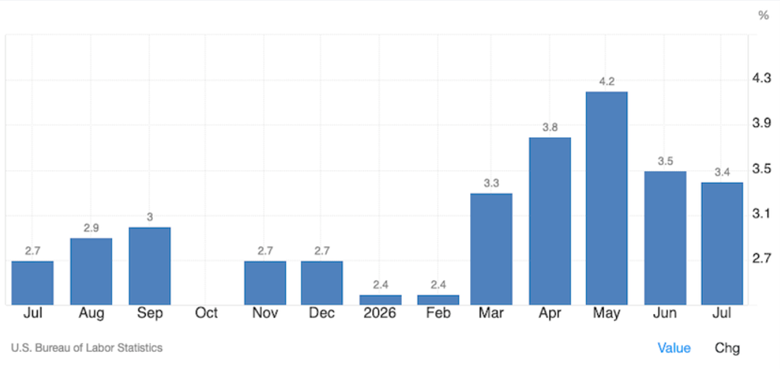
Unsavory as this possible rate hiking cycle is for the government, it’s better than the alternative, of inflation getting so high that foreign investors stop buying Treasuries because real interest rates (net yields), are approaching zero, or worse go negative.
Interest on the 10-year is currently at 4.6% and CPI inflation is 3.4%, leaving a net yield of 1.2%. If inflation reclaims its 4.2% May level, the net yield will be only 0.4%.
Gold has overtaken US Treasuries in global central bank reserves and recent surveys indicate that more central banks plan to decrease their dollar allocations than increase them.
Gold is climbing a staircase — Richard Mills
Richard (Rick) Mills
aheadoftheherd.com

Legal Notice / Disclaimer
Ahead of the Herd newsletter, aheadoftheherd.com, hereafter known as AOTH.Please read the entire Disclaimer carefully before you use this website or read the newsletter. If you do not agree to all the AOTH/Richard Mills Disclaimer, do not access/read this website/newsletter/article, or any of its pages. By reading/using this AOTH/Richard Mills website/newsletter/article, and whether you actually read this Disclaimer, you are deemed to have accepted it.