 RSS Subscribe
Rackla potentially destined to play an important part in reviving a world-renowned tungsten belt – Richard Mills
2026.06.25
Rackla Metals (TSXV:RAK) is beefing up its senior executive and advisory teams as it prepares to drill its Lentung Tungsten Project in the Canadian Northwest Territories.
The project could offer a major boost to the NWT, which is seeing diamond mines on their last legs due to resource depletion.
Diamond mining is the cornerstone of the Northwest Territories’ economy, accounting for up to 33% of its GDP.
As diamond mines phase out, the territory is transitioning to a “replacement economy” heavily anchored in critical minerals. The NWT holds vast, untapped deposits essential for global clean energy technology, battery storage and digital supply chains.
A fresh territorial mineral potential study identified 1,721 mineral showings containing 19 critical minerals. Exploration and development are targeting several key commodities and high-profile projects, including the Cantung-Mactung deposit, one of the world’s highest-grade tungsten resources outside of China.
Appointments
On June 4, Rackla announced the appointment of Jeff Reinson to the company’s board of directors.
Reinson is a seasoned mining executive with more than 25 years of experience. His appointment adds significant mine development and operating expertise to Rackla’s board at an important time, as the company evaluates the potential of its tungsten assets in the Northwest Territories and the broader opportunity to participate in the redevelopment of a Canadian tungsten district.
Reinson previously served as vice president of operations at Burgundy Diamond Mines (ASX:BDM), where he oversaw the 24-hour operation of the Ekati Diamond Mine. Prior to his tenure at Burgundy, he was chief operating officer at First Mining Gold (TSX:FF). He is currently senior vice president of development at Li-FT Power (TSXV:LIFT), another critical minerals company.
On June 17, Rackla announced that Paul Gruner has joined Rackla’s advisory committee to assist the company in developing its indigenous partnership strategy and engagement framework in connection with the advancement of its northern critical minerals assets.
Gruner is a senior executive with extensive experience in indigenous business leadership, mining, infrastructure, renewable energy, economic development, and partnership-building across northern Canada. He brings a deep understanding of the practical, commercial, cultural, and governance considerations required to build durable relationships between resource companies and Indigenous governments, development corporations, and community stakeholders.
Gruner currently serves as CEO of Tlicho Investment Corporation, the economic arm of the Tlicho First Nation. He previously served as chief executive officer of Det’on Cho Management LP, the economic development arm of the Yellowknives Dene First Nation, and as chief executive officer of the Tahltan Nation Development Corporation, the business arm of the Tahltan Nation. In these roles, Gruner has led major Indigenous-owned businesses involved in mining services, infrastructure, logistics, construction, energy, and community economic development.
Lentung Project
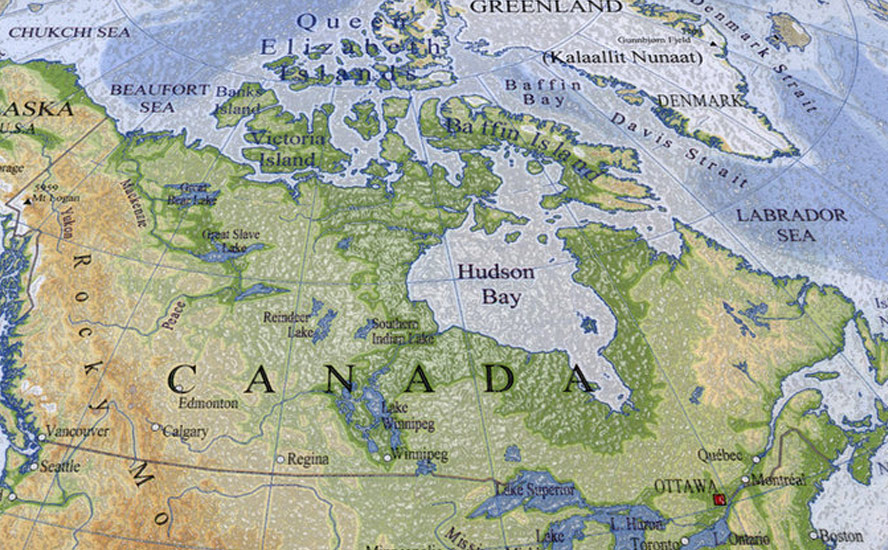
The project is located within the Tombstone Tungsten Belt of the western Northwest Territories and is approximately 60 km north of the past-producing Cantung tungsten mine.
Between 1977 and 1982, Union Carbide Exploration Corporation conducted a comprehensive exploration program on the Lentung property (previously called Lened) which included 26,900 meters of diamond drilling, geochemical and geophysical surveys, detailed geological mapping, trenching, metallurgical, engineering, economic and environmental studies.
In 1982, Union Carbide submitted the project to the Federal Environmental Assessment and Review Process (EARP) seeking a mine permit. However, due to declining tungsten prices, the company withdrew the application and paused all activities at the site. There has been no significant work done since then.
Rackla has acquired the original Union Carbide files including original drill logs, assay sheets, mylar maps, metallurgical, environmental, resource, economic and geophysical studies.
The review of the files to date has shown a quality dataset that is confirming a robust deposit with high-grade open pit potential.
The historical work by Union Carbide includes 26,900m of drilling across 178 holes, identifying 15 tungsten occurrences over a 15-km strike length, highlighting significant scale and upside.
Historical internal resource and feasibility work indicate robust economics, including average mill grades of 1.14% WO3 and strong recovery assumptions.
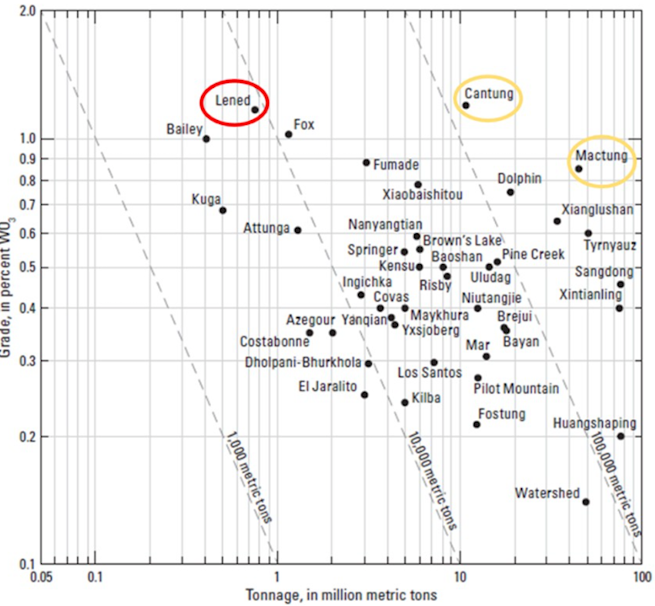
The deposit ranks among the highest-grade tungsten skarn systems globally and is located in close proximity to the world-class Cantung and Mactung tungsten deposits.
(While the data set is extensive and, according to Rackla, appears to be high quality, it is historical, mostly internal to Union Carbide, and assembled prior to NI 43-101 reporting requirements. The grade and resource numbers are not to be relied upon for investment purposes.)
The historical resource estimate by Union Carbide was calculated for only three of the 15 tungsten occurrences on the Lened property and ranks as one of the highest-grade tungsten skarn deposits in the world according to the US Geological Survey (USGS). Lened/ Lentung is located in a region hosting world-class tungsten deposits including the past-producing Cantung mine and the Mactung deposit (Figure 1).
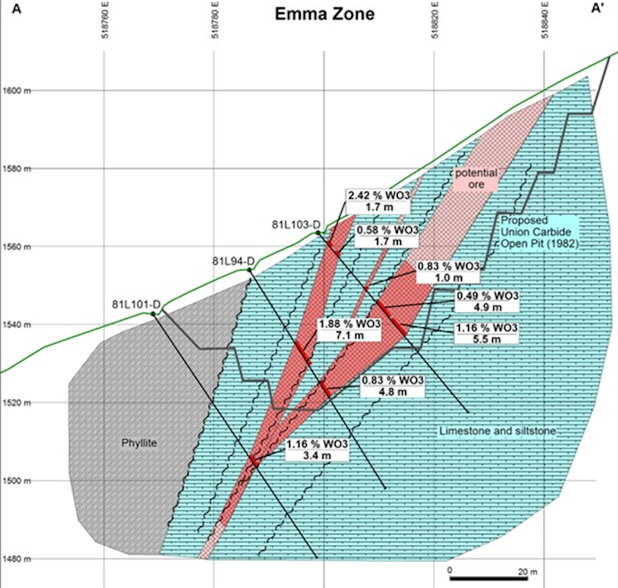
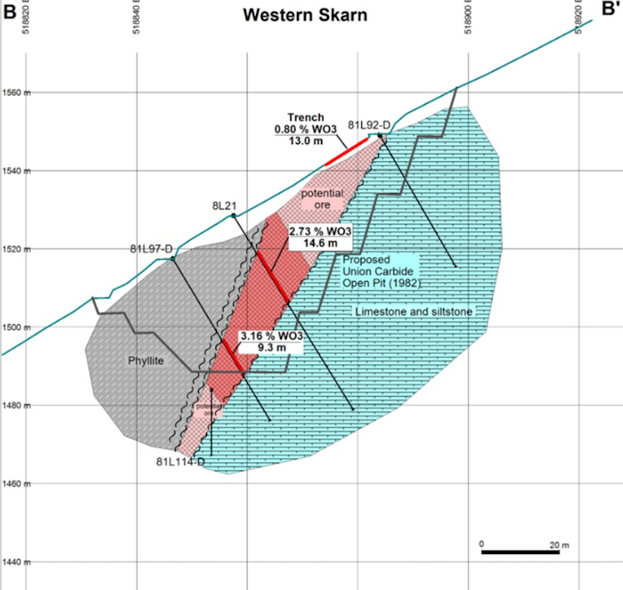
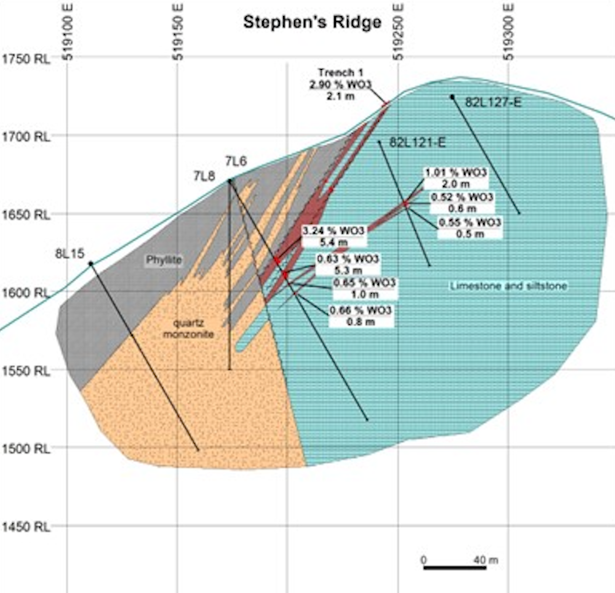
The tungsten mineralization at Lentung is hosted in altered limestone along the margins of Cretaceous alkalic (quartz monzonite) intrusions belonging to the Tungsten Suite (Lened, CAC and Rudi plutons, Figure 2). Mineralization consists of the tungsten mineral scheelite with minor copper and gold associated with the skarns. The mineral resource was calculated on the Emma, Western Skarn, and Stephen’s Ridge occurrences.
Figures 3 through 5 demonstrate the open-pit potential of the mineralization.
It’s worth noting that Union Carbide’s historical mineral resource was done using a 0.6% cut off grade, which for a tungsten open-pit resource done today seems extremely high, Rackla, imo, will likely use a much lower cut off, many resources are going to market with a 0.02% cutoff.
According to AI-generated search results, the average grade of global open-pit tungsten resources evaluated today ranges from 0.11% to 0.23% WO3, while the typical cut-off grade for an economically viable open pit mine is usually between 0.05% and 0.08% WO3. This information is not to be used for investment purposes.
The price of a metric tonne of 65% tungsten trioxide (WO₃) concentrate (typically traded as 65% wolframite or scheelite) currently trades around RMB 450,000 per metric tonne (approx. $62,000 to $63,000 USD).
Tungsten concentrates are sold on the basis of their contained weight. One metric tonne containing 65% WO₃ holds 650 kilograms of pure tungsten trioxide.
Because the market experiences volatility due to supply quotas and geopolitical shifts, prices are often calculated and quoted in Metric Ton Units (MTU), where 1 MTU = 10 kg
With its land-use permit secured, which includes drilling permits, Rackla will twin historical drill holes and re-verify the data to produce an NI 43-101-compliant resource calculation.
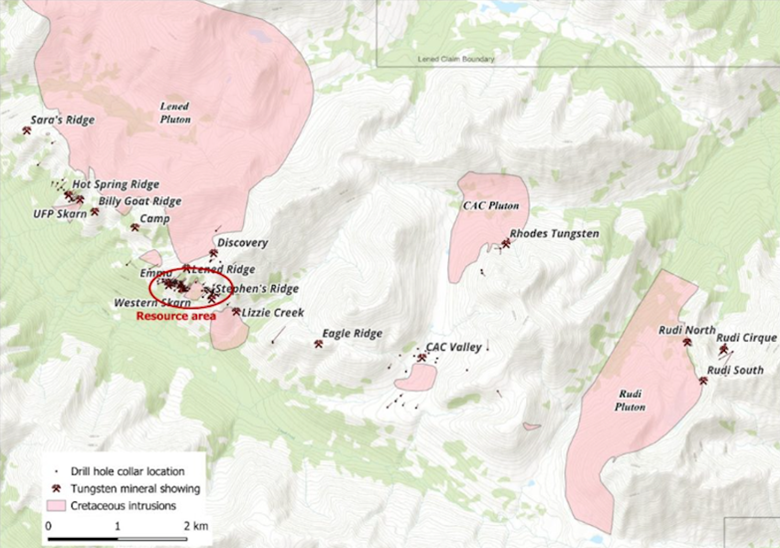
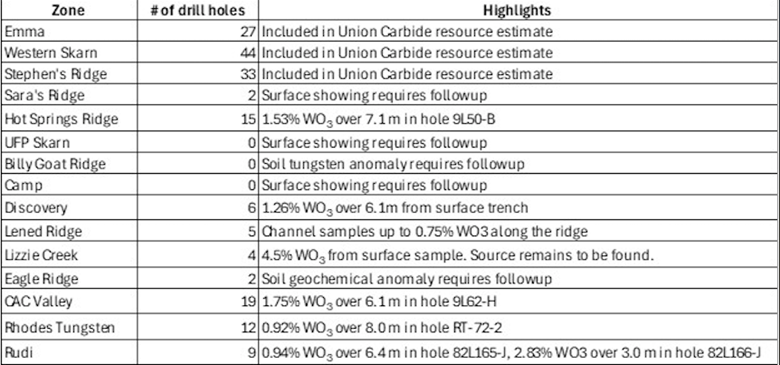
Elsewhere on the property, tungsten skarn mineralization is observed where the quartz monzonite intrusions interact with limestone-bearing units to form an additional twelve skarn occurrences. These occurrences have undergone only minor exploration and drilling and further work on these is planned to determine if they could contain additional resources.
Where the intrusions encounter carbonate rocks like limestone and dolomite, there is potential for tungsten skarn mineralization and Rackla will be exploring this potential. Table 1 lists some of the highlights from each of these other zones.
Cantung mine
According to Rackla, the proximity of the Lentung project to the Cantung mine presents a compelling exploration opportunity given strong tungsten prices, the growing global interest in critical minerals, and the desire for a stable, secure North American supply. The Cantung mine began production in 1962 and operated intermittently until 2015, when it shut down due to low tungsten prices.
The Cantung Mine—located just over the NWT border, roughly 300 km north of Watson Lake, Yukon – has extensive production and operational infrastructure in place which includes a fully-equipped mill complex, gravity concentrator and flotation cells. There are also newly constructed water treatment facilities, and five tailings management areas, a gravel airstrip, active and closed landfills, fuel storage tanks, and various pipelines. AND a workforce camp fully capable of supporting operations.
Cantung used on-site milling that combined gravity and flotation circuits to process its ore. This separation method successfully extracted the valuable tungsten mineral (scheelite), producing two grades of tungsten concentrate alongside a copper concentrate byproduct. The mined ore was processed into: Premium Gravity Concentrate: Averaged 65% tungsten trioxide (WO₃). Flotation Concentrate: Averaged 35% tungsten trioxide (WO₃). Copper Concentrate: Averaged 28% Copper.
The concentrated tungsten products were then trucked out via the Nahanni Range Road to Watson Lake in the Yukon. From there, the shipments were transported to major distribution and market hubs in Edmonton, Alberta, and Vancouver, British Columbia, ultimately serving international markets in the United States and Western Europe (with major historical clients including manufacturers like Sandvik Coromant and Osram Sylvania).
The site is accessed year-round via an all-season road connected to the Alaska Highway at Watson Lake. The road goes past Cantung to Lentung.
The mine is currently on care and maintenance.
Open-pit resources at Cantung are severely depleted. Any future restart will likely be a fully underground operation to target the remaining resources. The high-grade open pit tungsten at Lentung could contribute to the re-establishment of tungsten mining in this region.
The company is working in consultation with the Sahtu Dene First Nation, the Dehcho First Nations and local communities.
“Again, we are grateful for the support and feedback we received throughout the permitting process from communities across the region, including the Dehcho First Nations and Sahtu Dene and Métis, to local organizations, regional regulators and government,” Rackla’s CEO Simon Ridgway stated in the May 21 news release. “Since staking Lentung during the 2025 exploration season and acquiring the full historical database compiled by Union Carbide, we have been keen to return the drills to the property and revitalize this world-renowned belt with a new wave of tungsten exploration. We view the Northwest Territories as a favorable jurisdiction, due to the clear and efficient permitting process that supports responsible mineral exploration, and we recognize the long-term economic opportunities exploration can bring to the region.”
2026 plans
Rackla’s 2026 plans for the Lentung Project are to:
- Establish a new 49-person camp.
- Complete 4,000m of diamond drilling by twinning 27 holes to confirm Union Carbide results and to bring their findings up to a modern standard.
- Complete 6,000m of reverse circulation drilling to further define the known occurrences.
- Conduct surface trenching to expose shallowly buried tungsten bodies.
- Clear and repair the 25 km of existing roads and trails on site and the access trail to the Howards Pass Access Road.
- Produce an NI 43-101 resource calculation following the exploration season.
The 2026 field program commenced in late May.
Earlier that month, Rackla obtained the final permit allowing it to conduct exploration on its Lentung Tungsten Project.
Rackla’s Lentung Project new fully permitted for 2026 exploration — Richard Mills
The company on May 21 announced that that it has obtained a five-year Type A land use permit from the Sahtu Land and Water Board.
The permit allows for the establishment of a 49-person camp, a drill program, and the repair, maintenance and use of trails and access routes at Lentung. The Lentung Project is now fully permitted for the upcoming 2026 exploration season.
Rackla plans 10,000m drill program at Lentung tungsten property — Richard Mills
Conclusion
Tungsten (W) is one of the world’s hardest and hardest-to-source materials. It tolerates the most extreme-temperature environments, making it useful for lights, transistors, construction equipment, and parts for cars and aircraft. Tungsten-based alloys are used in a variety of industries, including defense, aerospace, energy and electronics.
Because tungsten is extremely hard, it is essential for armor-piercing munitions and high-end tooling. This has turned tungsten into a frontline strategic material. No wonder that several countries, including Canada and the US, have classified it as a critical mineral.
Even mining depends on tungsten, as diamond drill bits rely on tungsten components.
Just over half of the globe’s tungsten reserves are in China. Other reserve holders include Canada, Russia, the US, Vietnam and Bolivia, in descending order. Canada’s only producing tungsten mine, Cantung in the Northwest Territories, closed in 2015. Vietnam is boosting its output to overtake Russia.
But China controls roughly 80% of the world’s primary tungsten supply, but state-backed traders and companies are aggressively scouring scrap yards and dumps in the US and globally for used drill bits, mining tools, and discarded industrial equipment.
This paradoxical situation is driven by a combination of domestic policies, military demand, and processing bottlenecks.
To preserve its geological advantage and control environmental impacts, Beijing heavily restricts how much raw ore can be mined domestically, forcing Chinese companies to seek outside sources to meet soaring demand.
Beijing also implemented strict dual-use export controls on raw tungsten. Because it is a cornerstone metal for munitions, missiles, and aerospace, tightening the global market has created an international bidding war where Chinese buyers frequently outbid Western recyclers at scrap yards to buy back supply.
Tungsten supply isn’t keeping up with demand, which is why tungsten prices are soaring. On April 29, Reuters reported prices of ammonium paratungstate (APT), used to produce tungsten metal, were above $3,000 per tonne in Rotterdam, up more than 200% since the start of the year.
Factors include China cutting its mining quota by 6.5% last year, Chinese export controls and industrial demand.
Outside of China there are only a few tungsten mines, making exploration imperative.
Rackla is planning 4,000m of diamond drilling by twinning 27 holes to confirm Union Carbide results, and 6,000m of reverse circulation drilling to further define the known occurrences. 10,000 meters in total.
The grades and exploration potential of Lentung make it an extremely interesting project.
Historical work by Union Carbide includes 26,900m of drilling across 178 holes, identifying 15 tungsten occurrences over a 15-km strike length, highlighting significant scale and upside.
Historical internal resource and feasibility work indicate robust economics, including average mill grades of 1.14% WO3 and strong recovery assumptions.
The historical resource estimate by Union Carbide was calculated for only three of the 15 tungsten occurrences on the Lened property and ranks as one of the highest-grade tungsten skarn deposits in the world according to the US Geological Survey (USGS).
If the Cantung mine re-opens — and why wouldn’t it with high tungsten prices and the Canadian government’s focus on critical minerals development — the Lentung deposit could provide mill feed that starts for years and extends the life of mine. The site already has the mining infrastructure needed for a tungsten operation, including underground workings, a 1,000 tonnes-per-day mill, five permitted tailings containment areas, and multiple waste rock dumps.
The Lentung ore could also be used by Fireweed Metals (TSXV:FWZ), if it successfully develops the Mactung deposit into a mine. According to a project page, Fireweed has been awarded USD$15.8 million by the US Department of Defense under the Defense Production Act to advance Mactung.
A 2023 mineral resource estimate shows 30,156,000 tonnes of contained tungsten grading 0.73% WO3 (Indicated open pit + underground), and 7,205,000 tonnes Inferred at 0.59% WO3 (open pit + underground).
They could in a potential stand alone scenario do the same as the old operators of Cantung did. Cantung used on-site milling that combined gravity and flotation circuits to process its ore. The concentrated tungsten products were then trucked out via the Nahanni Range Road to Watson Lake in the Yukon. From there, the shipments were transported to major distribution and market hubs in Edmonton, Alberta, and Vancouver, British Columbia and ultimately serving international markets.
Rackla could be destined to play an important part in reviving the world-renowned NWT tungsten belt anchored by the Cantung mine and the Mactung deposit — together considered one of the world’s highest-grade tungsten resources outside of China.
This could bring long-term economic opportunities to a region that has seen its prospects dim due to the impending closures of the diamond mines that have provided up to a third of Northwest Territories’ GDP.
Rackla’s treasury is now $13 million following a May 25 financing.
Rackla Metals Inc.
TSXV:RAK
Cdn$0.145 2026.06.24
Shares Outstanding 162.9m
Market Cap Cdn$24.1m
RAK website
Richard (Rick) Mills
aheadoftheherd.com
Subscribe to AOTH’s free newsletter
Richard does not own shares of Rackla Metals Inc. (TSXV:RAK).
RAK is a paid advertiser on his site aheadoftheherd.com
This article is issued on behalf of RAK
Legal Notice / Disclaimer
Ahead of the Herd newsletter, aheadoftheherd.com, hereafter known as AOTH.Please read the entire Disclaimer carefully before you use this website or read the newsletter. If you do not agree to all the AOTH/Richard Mills Disclaimer, do not access/read this website/newsletter/article, or any of its pages. By reading/using this AOTH/Richard Mills website/newsletter/article, and whether you actually read this Disclaimer, you are deemed to have accepted it.