 RSS Subscribe
Military spending and the metals needed – Richard Mills
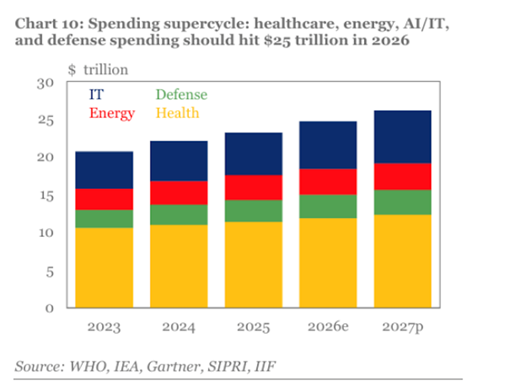
Most of the investment pouring into the world economy is split between artificial intelligence and defence spending. While AI is a huge driver of stock market gains particularly in the US where the “Magnificent Seven” tech stocks dominate, the amount of money being spent on re-arming the world’s militaries is equally eye-popping despite flying under most radars.
Fact is the planned increase in Group of Seven defense spending over the next decade may match Big Tech and AI.
Former US Navy Admiral James Stavridis, now managing director and partner at The Carlyle Group, estimates that additional defence commitments from G7 governments over the next 10 years amount to some $8 trillion of additional re-armament spending on top of prior trends. G7 defense spending has risen to 2% of GDP, its highest share in over 30 years; 3.8% is projected by 2030.
For Europe alone, an additional $4.5-$5.7 trillion is estimated over the coming decade, and that’s before “adjacent infrastructure is included.” As for the United States:
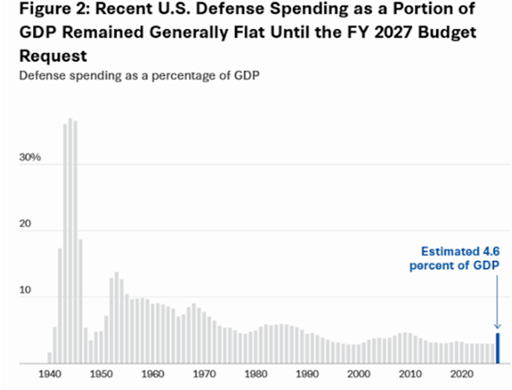
The earmarked increase in US defence outlays in the 2027 fiscal year to a record $1.5 trillion would surpass the World War Two peak in inflation-adjusted dollars.
(The Trump’s administration’s defense budget ask marks a more than 40% increase from previous baseline spending. It also amounts to half of the current global military expenditure.)
And according to the Center for Strategic and International Studies estimates that Stavridis cites, that level of defence spending by then would amount to some 4.6% of US GDP — just shy of 2009’s peaks and approaching levels last seen at the height of the Cold War in the 1980s.
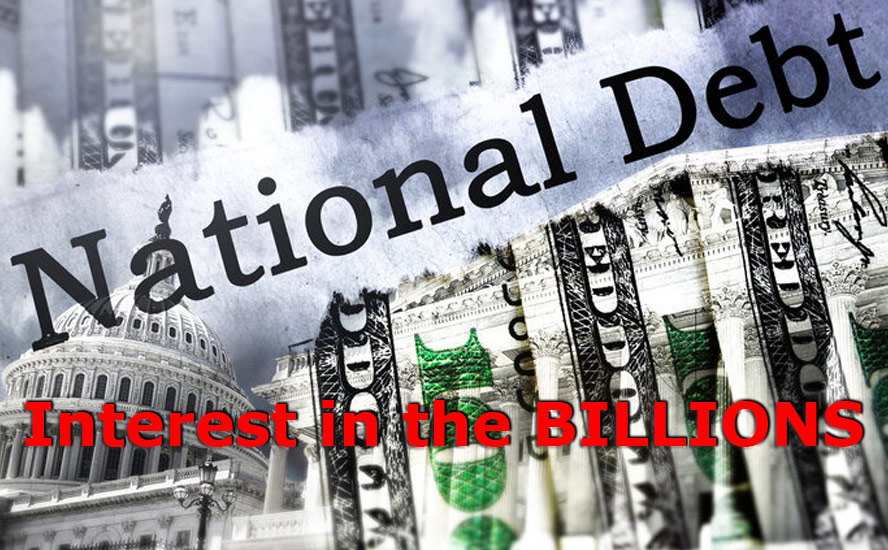
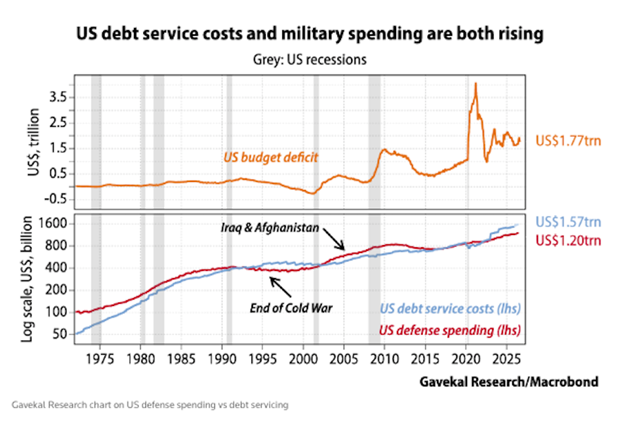
That budget boost may bring the US defence bill back above the current estimate for annual Treasury debt servicing costs…
The US debt is now bigger than its economy. Why this matters — Richard Mills
An earlier report by the Stockholm International Peace Research Institute (SIPRI) found governments worldwide spent nearly $3 trillion on military equipment in 2025, representing the highest level of military spending ever recorded after 11 straight years of growth.
Two salient points concern procurement and the overlap between AI (and broader tech spending) and defense spending.
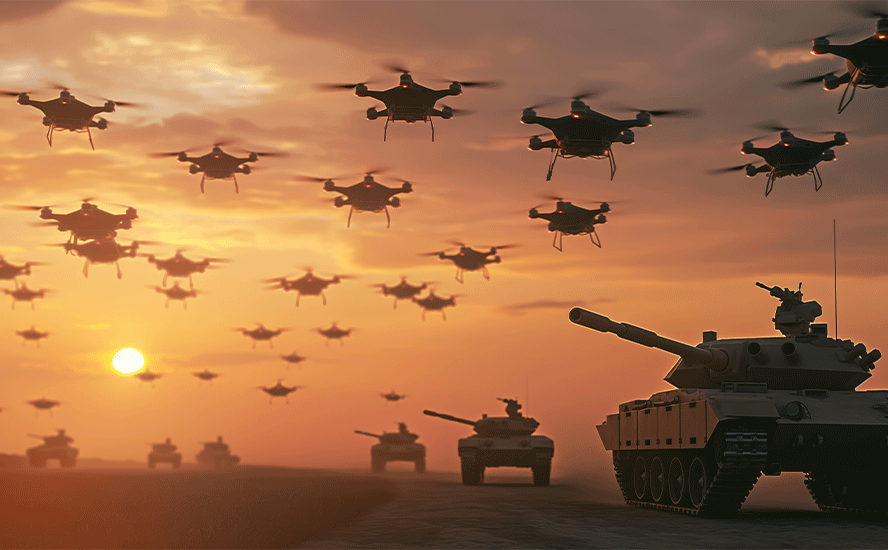
Today’s expenditures on the military are likely to be less focused on equipment such as warships and tanks and more on tech, drones, cybersecurity and battlefield AI.
Meanwhile, data centers and their security are common factors for both AI and defense spending.
This is nowhere more salient than in Europe, where the Russian threat to Europe’s eastern borders, doubts about US commitment to the North Atlantic Treaty Organization (NATO) under Donald Trump, and a ratcheting up of defence spending across the continent combine in ways that some hope will also boost its tech sector.
“Two decades of declining European defense investment tracked closely with two decades of declining European tech competitiveness, a pattern the current rearmament cycle appears determined to reverse,” Stavridis noted.
Who’s spending?
While spending only rose 2.9% over 2024, in Europe it climbed 14% and in Asia by 8%. Unsurprisingly, the biggest expenditures came from military giants the United States, China and Russia. While the US leads global military spending, Washington spent less on defense in 2025 because it cut assistance to Ukraine.
(Even if we take the United States out of the total, world military expenditures in 2025 still went up by 9%.)
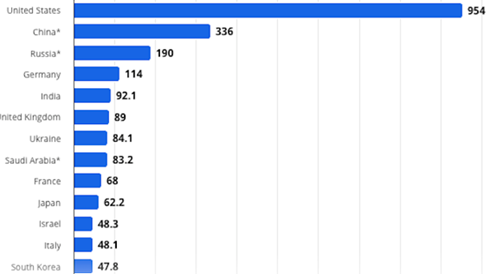
China follows with a steady, long-term military expansion, and Russia, where defense spending is increasingly driven by war.
Spending is also rising across regions. Countries are now devoting a larger share of their economies to the military than at any point since 2009. The main driver of that is Europe.
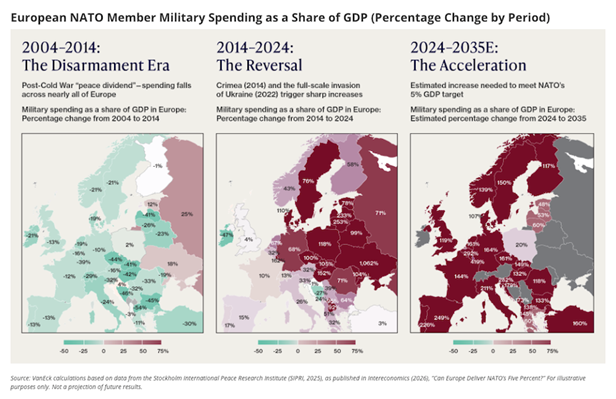
Military spending across the continent surged in 2025, the fastest growth in decades as governments responded to the war in Ukraine and growing doubts about long-term US security guarantees. Germany is at the center of that shift. Now the largest military spender in Europe, Berlin is increasing its forces, boosting recruitment and reshaping policy with ambitions to build the continent’s strongest army. The country spent 2% of its GDP on defense in 2025 for the first time since 1992.
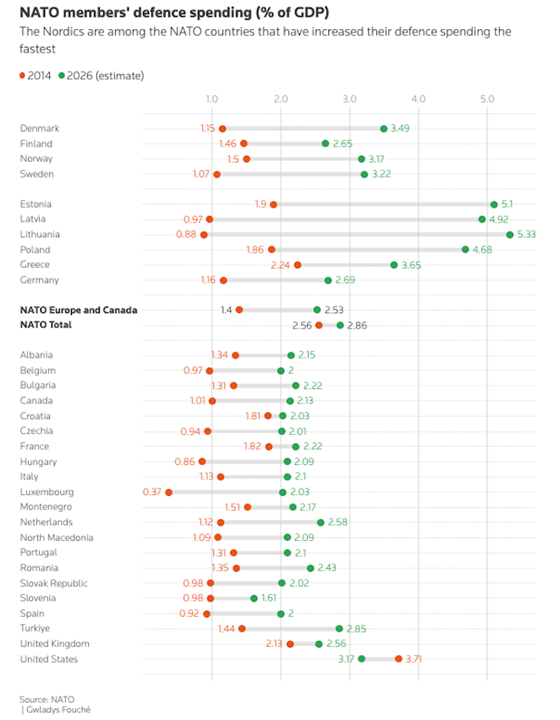
For too long, America’s European allies and Canada were over-reliant on US military might.
But there has been a change of mindset, a collective recognition of the changed security environment. The government of Canadian Prime Minister Mark Carney has spent over $63 billion to meet NATO’s 2% of GDP defense spending target and pledged $500 billion over the next decade toward military modernization and infrastructure. The Carney Liberals are targeting 3.5% for core defense and 1.5% for security and infrastructure by 2035.
The trend is also accelerating in Asia. Spending across the region is rising at its fastest pace in years, driven by regional tensions and growing uncertainty over US support as countries respond to China’s expanding military power.
For the first time in decades, the number of nuclear warheads is on the rise. Nuclear testing is back on the table.
And some governments are openly mulling the acquisition of these horrific weapons. (TRT World). They include South Korea, Japan, Poland, Germany, Turkey and Saudi Arabia.
Factors behind rearming
From Ukraine to the Middle East and across Asia, governments are pouring more into defense, responding to conflict and preparing for what may come next.
The share of global GDP dedicated to the military is the highest since 2009. Everything points at a world that feels less secure, with countries spending on their militaries to compensate.
The problem with rearming is it leads to an arms race. And once countries escalate their military expenditures, the compulsion is there to use the new weaponry and equipment.
“I think we’re seeing a classic security dilemma play out here where one country invests in its own defense,” said Robert Hamilton, president of the Delphi Global Research Center and a retired U.S. Army colonel.
“It is investing to increase its own security, and it doesn’t necessarily have aggressive designs on neighbors, but the neighbors don’t know that, because they can’t see inside the minds of the leaders of country A. And so country A’s investment in its own security threatens country B, then country B raises its military spending, and then you do get this spiral.”
As to the second point, Lorenzo Scarazzato, researcher in the SIPRI Military Expenditure and Arms Production Program, said “Why spend on military if you’re not going to use it? That’s exactly the point, in the sense that the risk there is, once you have a hammer, everything starts to look like a nail. The fear here is that there’s going to be a new normal where countries feel the need to increase their own military expenditure and their adversaries do the same.
“The new normal doesn’t make anyone safer. Instead, we step onto a spiral where escalation is the new norm.”
David Andrews, senior policy advisor at the Australian National University’s National Security College, wouldn’t use the term “arms race” but rather said “I think we’re seeing a natural response and correction to a long period of relative underfunding of defence by a lot of countries.”
By “natural response and correction,” Andrews pointed to countries in the Indo-Pacific region that are threatened by China’s aggression in the South China Sea, such as Japan and the Philippines.
“And looking at Europe, clearly there’s a response that has to be made to Russia’s invasion of Ukraine and many European countries’ support for Ukraine. So that’s leaving large gaps in their infantries that have to be refilled.”
Col. Hamilton agreed that part of the reason for global rearming is chronic military underfunding, which he noted did not start with the Trump administration. At the 2025 NATO Summit, member countries agreed to a 5% of GDP target for defense spending. The focus is on hardware, with members directing 32% of budgets to procurement. There is long-term demand for weapons, equipment, infrastructure and other military expenditures. The spending is structural, projected to more than double to $6.8 trillion by 2035.
Hamilton also said the rise in US defense spending has as much to do with beefing up security in Europe, the Indo-Pacific or the Middle East, as the specific goals of the Trump administration. He pointed to vanity projects such as the Trump-class battleships, estimated to cost $23 billion, and suggested the planned $1.5 trillion could be better spent.
“We’re underfunding things like Tomahawk cruise missiles, Patriot PAC-3 interceptors, which we burned through at a really furious rate in the war with Iran. Those need to be replenished. And there’s no simple way to replenish them, because the supply chains and the precursor chemicals and the rare earth minerals and all the things that go into making these really highly capable weapons take a long time to produce,” he said.
US risks running out of missiles in war with Iran — Richard Mills
Beyond the need to refund the military and to shore up defensive capabilities in conflict regions such as central Europe, the Middle East, the Indo-Pacific and Southeast Asia is the breakdown of political order and the rise of fascism.
Scholars and historians state that while classic 20th-century fascism is not governing nations in the exact form of 1930s Europe, far-right authoritarian and nationalist movements are gaining influence and straining democratic institutions in several parts of the world.
Germany is one example, the United States is another.
On September 6, 2026, the Alternative for Germany (AfD) won a historic 43.8% of the vote in the Saxony-Anhalt state election. Falling just three seats short of an absolute majority, this marks the first time since World War II that a far-right party has positioned itself on the precipice of state-level governance in Germany, states The Guardian.
Recent national polling by the INSA institute placed the AfD at an all-time record of 30% support nationwide.
American author Ernest Hemingway was living in a volatile period between the Great Depression and the rise of European fascism when he wrote “Notes on the Next War: A Serious Topical Letter.”
Hemingway correctly predicted that a major European war would erupt within a few years), and he pleaded with readers to recognize the economic manipulations of the “criminals and swine” leading the march toward it.
From 1934 to 1936, the U.S. Senate held the famous Nye Committee hearings, which investigated the theory that greedy bankers and munitions manufacturers—labeled “merchants of death”—had tricked America into entering World War I. Hemingway’s assertion that wars are fought for the financial prosperity of a corrupt few perfectly validated what millions of anxious Americans were reading in the newspapers every day.
This is starting to sound awfully familiar.
Historians and investigative journalists have documented multiple instances where official justifications for US military interventions were exaggerated, manipulated, or based on false intelligence. Two examples prove the point.
Declassified documents from the 1964 Gulf of Tonkin incident showed that the second attack on US destroyers off the coast of Vietnam used to justify the escalation of the Vietnam War did not occur as claimed.
During the Iraq War of 2003, assertions regarding weapons of mass destruction used by the Bush administration to launch the invasion were later found to be false.
War critics often point to the military-industrial complex — a term famously highlighted by President Dwight Eisenhower — as evidence that defense contractors, lobbyists, and financial institutions benefit heavily from continuous military engagement.
The new metals race
Increased defense spending is driving up demand for critical minerals including copper, silver, antimony, graphite and manganese.
As mentioned, global rearmament is being led by a record $1.5 trillion US defense request and NATO’s pledge to reach 5% of GDP.
According to VanEck, a global investment management firm known for its ETFs, the rearmament surge “is fundamentally a hardware build-up, making it a metals order in disguise.”
It notes “The last great rearmament — WWII and Korea — drove one of history’s largest commodity super-cycles. By 1950, shortages of copper, steel, aluminum, and tungsten so slowed U.S. arms production that Washington bartered wheat for foreign bauxite, chrome, and tin. The metals, not the armies, set the pace. They may again.”
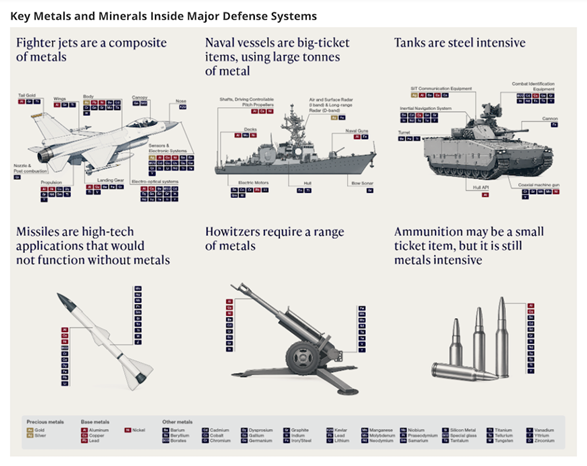
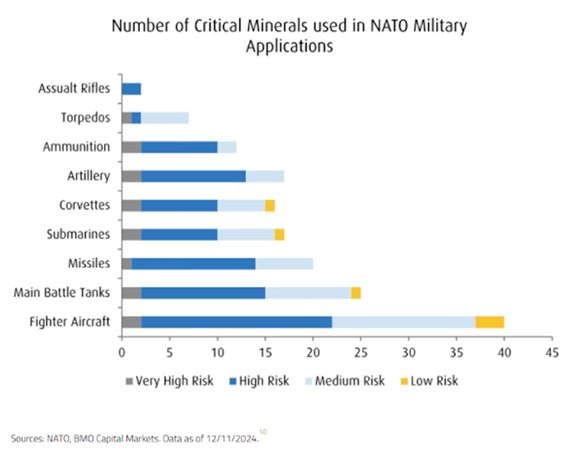
The chart above does not include drones, which are increasingly more prevalent in the battlefield and require rare earths for motors, communications, optics and targeting systems. Battery materials like lithium, cobalt, nickel and graphite are required to run drone power systems. (ETF Trends)
Copper
Copper is the unsung hero powering modern military technology. From advanced tanks and fighter jets to drones and AI-driven weapons, copper’s unmatched conductivity, durability and heat dissipation make it vital for military electronics, communication systems, and cutting-edge innovations, states ‘Copper: The Secret Weapon Powering Modern Warfare!’
“Copper conducts the war — moving the power, carrying the data, and lining the munitions, from a warship’s miles of wiring to a Tomahawk’s guidance and the band that spins every artillery shell,” VanEck states. The ETF provider notes that military production consumed 2.10 million tonnes of copper in 2021 — over 10% of the world’s refined output — and has compounded at roughly 14% a year since. Growth has room to run, with drone- and missile-heavy warfare consuming more copper per dollar than ever.
A January report by S&P Global projects that demand for the metal from military applications and artificial intelligence will be among its fastest-growing uses, with demand from each source expected to roughly triple by 2040. That equates to about 4 million metric tons of additional copper demand — equivalent to about one-sixth of the world’s current annual copper production.
Silver
The US military has long treated silver as essential for precision guidance and communications. Silver is used in almost every defense application — not in massive amounts, but in mission-critical component such as missiles and guidance systems, satellites and spacecraft, and military aircraft.
The Pentagon’s Defense Logistics Agency has historically stockpiled silver specifically for its role in electronics, optics and energy applications. (Birch Gold Group)
Mining Newswire adds silver’s uses in military applications includes bombs and shells, missiles and rockets, satellites, fighter jets, night vision gadgets, torpedoes, submarines and tanks, communications devices, space technology, radar systems and nuclear technology.
The military leverages silver for its conductivity, corrosion resistance, heat conductivity, reflectivity and antimicrobial properties.
Graphite
In 2023, China imposed export restrictions on gallium, germanium and graphite, disrupting supplies to the United States. Graphite is an important component of helicopters, submarines, artillery and missiles, but 70% of graphite production comes from China (and 100% of processed graphite). Virtually every US military system requires mineral components, from steel and titanium to graphite composites and cadmium alloys. Global defense spending shows that military demand is increasing for these platforms, munitions, and thus minerals. (Modern War Institute)
Graphite’s warfighting capabilities — Richard Mills
Video: Both graphite and rare earths have military and civilian applications
Graphite is the ideal material for defense purposes thanks to its unique properties, i.e., it is able to withstand very high temperatures with a high melting point; it is stable at these high temperatures; it is lightweight and easy to machine; and it is corrosion-resistant.
Tungsten
Tungsten is one of the world’s hardest and hardest-to-source materials. It tolerates the most extreme-temperature environments, making it useful for lights, transistors, construction equipment, and parts for cars and aircraft. Tungsten-based alloys are used in a variety of industries, including defense, aerospace, energy and electronics.
Because tungsten is extremely hard, it is essential for armor-piercing munitions and high-end tooling. This has turned tungsten into a frontline strategic material. No wonder that several countries, including Canada and the US, have classified it as a critical mineral.
According to Investor News, “without tungsten, the modern military-industrial machine quite literally grinds to a halt.”
Tungsten and antimony: mission critical exploration — Richard Mills
Antimony
Antimony is primarily found in the mineral stibnite (the primary ore mineral of antimony, containing 71.4% antimony and 28.6% sulfur). It is widely used across several industries including defense applications, where it is a key component in flame-retardant materials, armor-piercing ammunition and explosives.
VanEck notes mentions “antimony, the hardened bullet core and the tracers and flares that light the night.”
The metal is also an important ingredient in lead-acid batteries; in the production of semiconductors (diodes and infrared detectors); in flame-retardant materials used in plastics, textiles and electronics; and it is alloyed with lead and tin to increase hardness and durability for bearings, ammunition and solders.
Manganese
Manganese is directly used in warfighting, and it is officially classified as a defense-critical raw material by both NATO and the US Department of Defense.
While military drones, loitering munitions and electronic systems heavily rely on manganese-based batteries, the metal’s impact on warfighting actually stretches far beyond just energy storage.
Before manganese ever entered a battery, it was a legendary armor material. In fact, its toughest warfighting application is protecting soldiers and vehicles from explosions.
Military vehicles, bunkers, and ballistic shields use a specialized alloy containing 12% to 14% manganese. This steel has a unique property called “work-hardening.” The harder it is hit by a bullet or shrapnel, the tougher and more dent-resistant the metal’s outer layer becomes.
Because it absorbs shock waves without shattering, manganese steel is used to manufacture blast-resistant hulls for armored personnel carriers and lightweight combat helmets.
Manganese is an essential structural element in advanced weapon systems. It is blended into high-strength, lightweight aluminum and copper alloys used in military aircraft structures and submarine hulls.
Modern warfare relies heavily on unmanned systems (like reconnaissance and kamikaze drones), which are the largest driver of defense industry battery demand.
The absolute mainstream battery technology for high-end military drones is Lithium Nickel Manganese Cobalt (NMC). Manganese provides structural stability and safety, allowing drone batteries to handle high power output, rapid maneuvers and long flight times.
Missiles, torpedoes, and loitering munitions require batteries that can sit in storage for years but activate instantly under extreme heat and vibration. Manganese-rich chemistries prevent the battery from overheating or catching fire during high-speed combat flights.
Manganese was a critical mineral in 1940 — Richard Mills
Conclusion
Defense procurement and artificial intelligence are huge recipients of global investment currently.
The planned increase in Group of Seven defense spending over the next decade may match Big Tech and AI.
Additional defence commitments from G7 governments over the next 10 years amount to some $8 trillion of additional re-armament spending on top of prior trends.
In 2025, governments worldwide spent nearly $3 trillion on military equipment, representing the highest level of military spending ever recorded after 11 straight years of growth.
There is increasing overlap between AI and defense spending, especially as defense goes high-tech.
Military spending across Europe surged in 2025, the fastest growth in decades as governments responded to the war in Ukraine and growing doubts about long-term US security guarantees.
Germany leads the European powers in military spending, with ambitions to build the continent’s strongest army.
There are several factors behind the rearming trend, including a shift from decades of underinvestment; beefing up security in Europe, the Indo-Pacific and the Middle East; the pro-war Trump administration; and the worldwide rise of fascism.
Several countries rearming all at once is causing fears of a global arms race, where escalation is the new norm.
Increased defense spending is driving up demand for critical minerals including copper, silver, tungsten, antimony, graphite and manganese. One of the biggest challenges in the new “metals race” is breaking China’s near-monopoly on critical minerals.
After Chinese export restrictions were imposed, the price of antimony rose 2,600%, tungsten surged 557%, germanium went up 400% and gallium 365%.
Gallium makes the Patriot missile’s radar; germanium, the infrared optics in night-vision sights and heat-seeking missiles.
For now, Canada, the US, and much of the rest of the world is dependent on Chinese exports of critical minerals for defense, AI, electrification and other important uses.
One of the ways to reduce this dependence is to mine more domestically.
Junior resource companies play a key role in discovering critical minerals, locating and advancing the early-stage deposits that major mining corporations will eventually need to replace depleted reserves.
Metals security of supply depends on junior resource companies — Richard Mills
Richard (Rick) Mills
aheadoftheherd.com

Legal Notice / Disclaimer
Ahead of the Herd newsletter, aheadoftheherd.com, hereafter known as AOTH.Please read the entire Disclaimer carefully before you use this website or read the newsletter. If you do not agree to all the AOTH/Richard Mills Disclaimer, do not access/read this website/newsletter/article, or any of its pages. By reading/using this AOTH/Richard Mills website/newsletter/article, and whether you actually read this Disclaimer, you are deemed to have accepted it.