 RSS Subscribe
The new stay at home economy
2020.03.21
For a lot of workers, the coronavirus is starting to get personal.
As the crisis deepens, with the number of cases and deaths around the world increasing, leaders and health officials are discouraging travel, telling people to restrict gatherings, stay at home and practice social distancing.
Many businesses have been forced to close by ordianance, or due to a severe drop in clientele.
Among the industries hardest hit by covid-19 restrictions are hospitality – including hotels, restaurants, cafes and bars – travel (airlines and cruises), the auto sector and the oil patch.
This week, among efforts to contain the pandemic, Canada shut its borders to foreigners including its southern border with the United States – an unprecedented move that restricts all non-essential crossings. Trade flows and seasonal workers are exempted.
Flights to Canada are restricted to Vancouver, Calgary, Winnipeg and Toronto.
Several Canadian cities and provinces have declared states of emergency, including a health order that bans large public gatherings, closes gyms and casinos, and allows the prosecution of people who fail to comply.
In the United States which has nearly 20 times as many coronavirus cases, they are seeing even tighter restrictions around movement.
For example California’s stay-at-home order mandates all Californians to self-isolate except to get food, prescriptions and health care, look after a friend/ relative, or walk the dog and take outdoor exercise. As other states lock down, including New York, New Jersey, Connecticut and Illinois, 75 million Americans are under orders to stay home.
Most business venues such as indoor malls are closed, as are dine-in restaurants, bars, nightclubs, gyms, fitness studios. Convention centers and public events are also out of bounds. Only businesses providing essential services have remained open. These include grocery stores, food banks, convenience stores, banks, doctor’s offices and pharmacies.
Many companies are suddenly finding they can no longer count on routine business to keep cash flows intact.
A recent survey in Seattle found 60% of small businesses are considering wage cuts and staffing reductions. 35% say they may have to close and over 80% expect the situation to get worse, CNN Business reported.
CIBC warns virus-related interruptions could hike Canada’s jobless rate to 7%, from its current 5.67%. The US economy is expected to grow slightly by 0.6% in the first quarter before falling a steep 12.9% in the second, states a Deutsche Bank forecast.
On Friday, Goldman Sachs came out with a shocking unemployment prediction, that a record 2.25 million Americans could enter claims for unemployment benefits this week.
The influential bank bases its numbers on Labor Department data showing unemployment filings last week shot up 70,000, to 281,000. That would mean an 8-fold increase in jobless claims, blowing past the record of nearly 700,000 [weekly claims] set in 1982, Markets Insider reported.
“Even the most conservative assumptions suggest that initial jobless claims are likely to total over 1 million,” according to Goldman economists, who note a surge in claims across 30 states.
The statistics are certainly ugly, and more proof that the coronavirus has slammed the brakes on business as usual. The virus, its economic fallout and efforts by governments/ front-line health care workers to contain it, have seemingly permeated every aspect of society – perhaps none so much as the nature of work.
A recent article in Forbes details the winners and the losers of an economy hit by “the coranavirus effect”:
The big winners will be the online companies that don’t rely upon brick-and-mortar locations, healthcare providers, supermarket chains—especially those with a robust online presence— pharmaceutical companies working on cures for diseases, technology companies and services, such as Zoom, that cater to people working from home…
On the other hand, there are a number of other sectors in which jobs will be savagely cut. Companies that are in the travel, hotel, airlines, sporting events, concerts and restaurant sectors will be crushed. International travel to Europe has been banned by President Donald Trump. Companies have generally prohibited business travel. Families are afraid to fly in fear of getting infected. After what we’ve seen, nobody is going to take a cruise for a while.
This all has a ripple effect. Airlines, aircraft manufacturers and their suppliers, resorts, hotels, restaurants, sporting events, cruise lines, conferences and music concerts will be negatively impacted. With the sudden cessation of business, companies in these areas will be forced to downsize their employees or radically cut the hours that they work. Many businesses may not make it and close down.
A better way to work
However some companies, those able to let its employees work from home, are doing what they can to maintain business as usual – conducting meetings by Skype, setting employees up with remote access to servers, using social media platforms like What’s App to keep group discussions going.
In the UK, among the companies that have released compulsory working from home guidelines, are Google, JP Morgan and Twitter.
These firms are not only avoiding layoffs and retaining valuable employees, they will likely increase employee job satisfaction and productivity, and may even save money in the process.
Obviously not every position can be done from home, jobs like construction workers, doctors, lab technicians, oil workers, etc., but with today’s technology, and degree of workplace computerization, a great many can.
Anyone who works from a computer terminal can theoretically work remotely, especially as technology becomes more portable (why not bring your laptop to a coffee shop and work?) and production is digitized.
Of course, telecommuting has been part of the workplace way before the coronavirus came along.
A Gallup poll found 43% of US employees worked from home at least some portion of the week. Globally, 70% of professionals reported working from home at least one day a week and just over 50% worked from home for half the week or more.
What’s so great about working from home? Anybody who has to ask this question, has probably never done it! Certainly the idea of waking up when you want, setting your own hours, never having to answer to an in-person boss, or sit in a cubicle 8 hours a day, is appealing to many.
According to Global Workplace Analytics, two-thirds of employees want to work from home, and 36% would choose it over a pay raise. A poll of 1,500 technology professionals found 37% would take a 10% pay cut just so they could telecommute.
Sure it’s popular, for the above-cited reasons and others, but how productive are these people, who in theory could be watching TV and “working” in their pajamas?
A “gig economy” platform called Airtasker asked that question, in a survey of 1,004 employees, half of whom worked from home a majority of the week. The amount of break time was comparable, 22 minutes a day for the remote workers versus 18 minutes for office workers. Work distractions proved more tempting for office workers, who wasted about 37 minutes a day versus remote workers’ 27 minutes of idle time.
When screen times or mouse movements were tracked, in-office workers were 17% more likely than remote employees to avoid working.
In fact, at-home workers put in an average 1.4 more days each month, or 16.8 days a year, compared to their office counterparts.
Ways to keep productive working at home include taking breaks, having set working hours, and keeping a to-do list.
A Chinese work-from-home experiment found a 13% productivity increase, a 50% drop in turnover, and remote workers taking shorter breaks and fewer sick days. The company also saved around $2,000 per employee on lease costs. Another study, of a travel website, discovered that allowing some workers to regularly work remotely resulted in them making 13.5% more calls in a week, the equivalent of nearly an extra day’s worth of work.
When Best Buy introduced a flexible work program, employee productivity jumped 35%. A fifth experiment, reported by Forbes, found 77 percent of remote workers get more done in fewer hours thanks to fewer distractions like meetings, conversations, and noisy coworkers.
Remote workers also report being healthier due to having no commute.
Research quoted in Business News Daily found commuting led to at least one in four survey respondents quitting a job. The average American’s commute is nearly half an hour. Eliminating the daily slog to and from the office saved remote workers over $4,500 in annual fuel costs, the research found, with employees also saying they had an extra 17 days of free time as a result.
Many used the new time to exercise, with remote employees hitting the gym, pool, squash court or yoga studio 2 hours and 44 minutes a week – 25 minutes more than office workers.
Good for the environment
All of those foregone car rides and transit trips have a net positive effect on the environment, including less gasoline use, reduced carbon emissions/ air pollution, a lower amount of energy used in offices, and less plastic consumption.
For example, 24.7 million American employees working from home save the nation nearly 30 million gallons of gas each workday – the equivalent of driving 744 million miles, close to the distance between planet Earth and Saturn.
By not driving their cars, remote workers significantly reduce greenhouse gases like carbon dioxide, as well as nitrous oxides, particulate matter and volatile organic compounds, all contributors to air pollution.
Sun Microsystems found 24,000 of its US employees who participated in the Open Work Program, avoided producing 32,000 tonnes of carbon dioxide.
Politicians are starting to recognize the value of remote work to meeting emissions goals. Recently Charlie Baker, the governor of Massachusetts, announced an $18 billion transportation investment bill that includes a tax credit for companies that offer work-from-home perks to their employees.
Beyond cuts to fossil fuel use and tailpipe emissions, working from home also reduces traffic jams, prevents accidents, and takes the pressure of crumbling transportation infrastructure.
Fortunately we have very recent data and visuals to indicate the positive effects on air pollution that working from home can have. Lockdowns in China, Italy and New York City have all resulted in dramatically improved air quality, in areas badly hit by the coronavirus.
Early results from New York show carbon monoxide, mostly from cars, has been cut in half compared with March, 2019. What’s more, in May, when CO2 emissions are highest due to the composition of leaves, the Daily Mail reports the levels might be the lowest since the financial crisis a decade ago. Traffic in the Big Apple is estimated to be down 35% compared to the same time last year.
In Philadelphia, where 400,000 people drive to work each day, air pollution is reportedly at one of its lowest levels.
Smog in London has dropped by nearly a third, as Londoners self-isolate or work from home. An EU air quality monitoring website found the city of 8.9 million saw a drop from 96 last Sunday to 20 on Monday. Weekday numbers are normally higher than weekends.
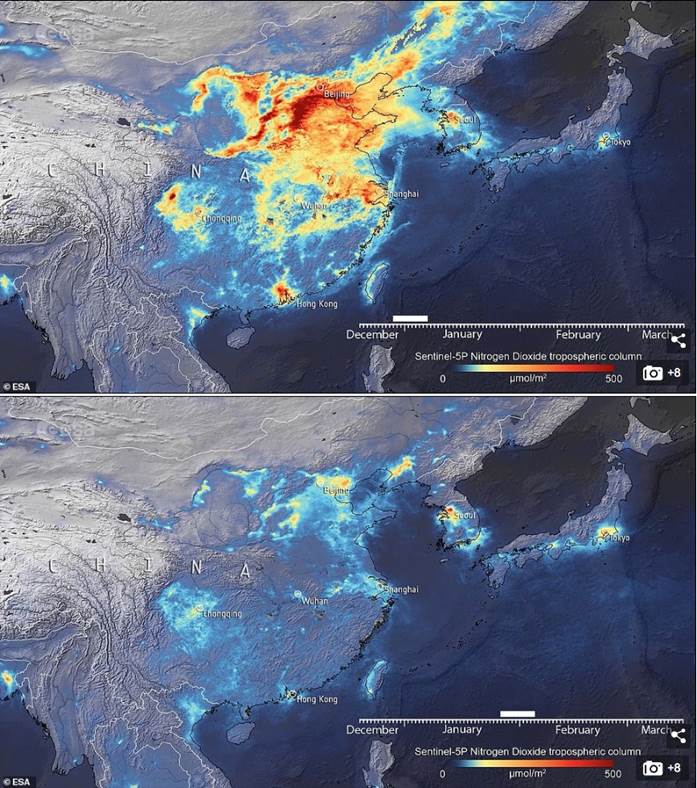
The most visible effects of covid-19 travel and work restrictions, however, can be seen in satellite photos of China, before and during the outbreak. Data from Italy, hit several weeks later, shows a similar pattern.
For example an analysis carried out for climate website Carbon Brief, found a 25% drop in energy use and emissions in China, over a two-week period. Data from the European Space Agency’s Copernicus Sentinel-5P satellite, which monitored nitrogen dioxide emissions between Dec. 20 and March 16, reveal a 40% reduction in nitrogen dioxide emissions over Chinese cities. (nitrogen dioxide is released from vehicles, power plants and industrial facilities) A similar pattern emerged regarding carbon dioxide released from the burning of coal.
In Hubei province, the epicenter of the outbreak, a lockdown that included shuttering factories and clearing streets, resulted in a 21.5% increase in “good quality air days”. From Feb. 1 to March 3, carbon dioxide emissions were down at least 25%.

CNN notes, As the world’s biggest polluter, China contributes 30% of the world’s CO2 emissions annually, so the impact of this kind of drop is huge, even over a short period. CREA estimates it is equivalent to 200 million tons of carbon dioxide — more than half the entire annual emissions output of the UK.
The New York Post adds a human touch to the story of cleaner air resulting from the coronavirus. The newspaper has air quality expert Marshall Burke estimating that in China alone, cuts to harmful emissions “have saved the lives of 4,000 kids under five and 73,000 adults over 70.”
However Burke also notes the good news obviously masks a deeper narrative of pandemic-related suffering in China, telling ‘MIT Technology Review’: “Emissions in China are down because the economy has stopped and people are dying and because poor people are not able to get medicine and food.
“This is not an analogy for how we want to decrease emissions from climate change.”
Conclusion
True enough, but these data and images also suggest the powerful impact that scrapping the daily commute can have on air quality in China, Italy, New York City and London.
We recognize that a significant part of these emissions reductions particularly in China, came from closing factories, that were constantly emitting smokestack pollutants. However, just imagine if even half, or a third of those forced to work from home, remained at home, out of their cars. Surely it would make a difference to meeting stricter and stricter auto emissions targets we at AOTH are well aware of, considering the steady demand for palladium used in gasoline autocatalysts.
I also realize that working from home isn’t for everyone. Those with young kids in the household may find it a challenge best avoided. If you’re a person easily led to distraction, a remote job might not be for you, either.
One of the most common arguments against telecommuting is that it blunts creativity and collaboration. For some industries that might be true. But I also think that, in today’s age of advanced communications, where doctor’s visits can be done by Skype, and programs like Zoom allow anyone with an Internet connection to join a virtual meeting, these challenges can be overcome.
The almighty dollar, too, is a factor. Nearly 6 in 10 employers say cost savings is a significant benefit of telecommuting, for example, by reducing or even eliminating office space. The bottom line? If your business can save money and get more productivity out of your employees by letting them work from home, why wouldn’t you try it?
Richard (Rick) Mills
subscribe to my free newsletter
aheadoftheherd.com
Ahead of the Herd Twitter
Legal Notice / Disclaimer
Ahead of the Herd newsletter, aheadoftheherd.com, hereafter known as AOTH.
Please read the entire Disclaimer carefully before you use this website or read the newsletter. If you do not agree to all the AOTH/Richard Mills Disclaimer, do not access/read this website/newsletter/article, or any of its pages. By reading/using this AOTH/Richard Mills website/newsletter/article, and whether or not you actually read this Disclaimer, you are deemed to have accepted it.
Any AOTH/Richard Mills document is not, and should not be, construed as an offer to sell or the solicitation of an offer to purchase or subscribe for any investment.
AOTH/Richard Mills has based this document on information obtained from sources he believes to be reliable but which has not been independently verified. AOTH/Richard Mills makes no guarantee, representation or warranty and accepts no responsibility or liability as to its accuracy or completeness. Expressions of opinion are those of AOTH/Richard Mills only and are subject to change without notice. AOTH/Richard Mills assumes no warranty, liability or guarantee for the current relevance, correctness or completeness of any information provided within this Report and will not be held liable for the consequence of reliance upon any opinion or statement contained herein or any omission. Furthermore, AOTH/Richard Mills assumes no liability for any direct or indirect loss or damage or, in particular, for lost profit, which you may incur as a result of the use and existence of the information provided within this AOTH/Richard Mills Report.
AOTH/Richard Mills is not a registered broker/financial advisor and does not hold any licenses. These are solely personal thoughts and opinions about finance and/or investments – no information posted on this site is to be considered investment advice or a recommendation to do anything involving finance or money aside from performing your own due diligence and consulting with your personal registered broker/financial advisor. You agree that by reading AOTH/Richard Mills articles, you are acting at your OWN RISK. In no event should AOTH/Richard Mills liable for any direct or indirect trading losses caused by any information contained in AOTH/Richard Mills articles. Information in AOTH/Richard Mills articles is not an offer to sell or a solicitation of an offer to buy any security. AOTH/Richard Mills is not suggesting the transacting of any financial instruments but does suggest consulting your own registered broker/financial advisor with regards to any such transactions
Legal Notice / Disclaimer
Ahead of the Herd newsletter, aheadoftheherd.com, hereafter known as AOTH.Please read the entire Disclaimer carefully before you use this website or read the newsletter. If you do not agree to all the AOTH/Richard Mills Disclaimer, do not access/read this website/newsletter/article, or any of its pages. By reading/using this AOTH/Richard Mills website/newsletter/article, and whether you actually read this Disclaimer, you are deemed to have accepted it.