 RSS Subscribe
US 10-year bond yield redlines at 5% – Richard Mills
2026.09.15
The yield on the US 10-year Treasury bond is one of the most closely watched financial metrics because it serves as the primary global benchmark for long-term borrowing costs, asset valuations and economic sentiment.
The 10-year yield tracks closely with 30-year fixed home loans. When the yield goes up, buying a home becomes more expensive.
Companies also use this rate as a baseline. Higher yields mean higher costs to run or expand a business.
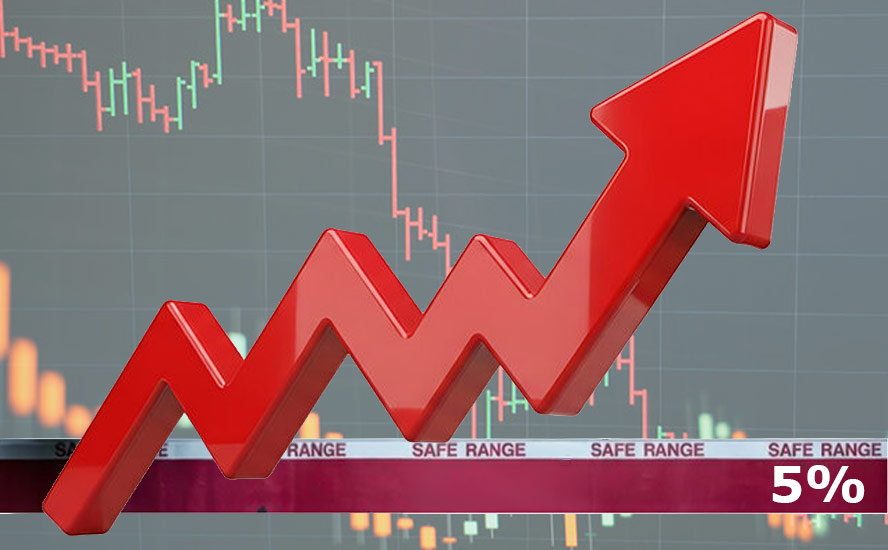
On Monday, Sept. 14, the 10-year yield crossed the critical 5% threshold, a level not seen since 2023 and otherwise since 2007.
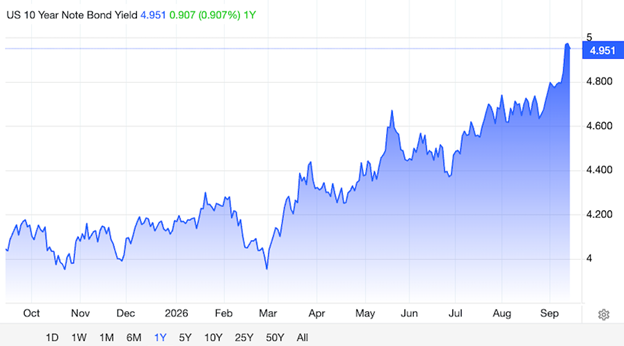
That year, the 10-year rose firmly above 5%, marking the final peak of the economic boom before the housing bubble burst and triggered the Great Financial Crisis.
The global bond market, dominated by the almost $32 trillion US Treasury market, has sold off as investors grapple with a mosaic of concerns, from soaring energy prices and expectations for central banks to raise interest rates to uncertainty about the war with Iran and unchecked government spending amid mounting debt.
Yields on government bonds across the globe have touched multi-year and multi-decade highs this year, raising the cost of borrowing money. It’s compounding concerns about affordability, adding to unease about governments’ enormous debt burdens and threatening to weigh on the stock market.
Yields rise when bonds price falls. The bond market sell-off this year has pushed prices lower and sent the 10-year yield toward levels not seen in nearly two decades.
– 10-year Treasury yield hits 5%, critical threshold for US economy and markets
Some perspective here is helpful: five years ago, the 10-year yield traded at 1.3% five years ago. Now, it is at 5%.
Why are yield rising?
US Treasury yields are rising due to three key factors: inflation fears; heavy government debt; corporate and AI borrowing; and shifting Federal Reserve policies.
Surging oil prices driven by the war in Iran have stoked concerns about renewed inflation, which devalues fixed returns over time.
Expanding federal deficits and large-scale debt issuance mean governments must offer higher yields to attract buyers for long-term bonds.
A massive surge in corporate debt issuance to fund artificial intelligence infrastructure and data centers has increased competition for capital.
Markets face greater ambiguity around monetary policy and reduced forward guidance from the Fed under Chairman Kevin Warsh, prompting investors to demand a higher term premium (interest rate) for holding long-term debt.
Implications
Could the redlining 5% threshold be a harbinger of impending disaster?
The move certainly makes it harder for Americans and US businesses to borrow money.
As the 10-year yield surges, mortgage rates are climbing in lockstep. The average 30-year fixed mortgage rate rose to 6.76% last week, up from 6.15% at the start of the year.
There are also concerns about the stock market, which thrives on cheap credit. So far the S&P 500 seems bulletproof to rising yields, but that could change, especially if higher borrowing costs cause earnings to fall. CNN states:
The 10-year yield at 5% “is seen by some as a threshold above which financial markets might go into meltdown,” John Higgins, chief economic adviser for financial markets at Capital Economics, said in a note.
Traders see nearly an 89% chance that the Fed will deliver a 25 bps rate hike this week, which would be its first increase in borrowing costs since 2023.
Market-watchers expect the Federal Reserve to raise the target federal funds rate by one-quarter of a percentage point on Wednesday amid rising energy prices and prolonged tensions with Iran. For consumers, the move could increase borrowing costs at a time when U.S. households are already under financial strain.
– The Fed is likely to raise interest rates as inflation persists. What that means for consumers
Where the rubber really hits the road is government borrowing.
The US has the largest national debt of any country at $39 trillion.
The US debt is now bigger than its economy. Why this matters — Richard Mills
While the US debt-to-GDP ratio of 122% is smaller than Japan’s 204% and Singapore’s 172%, economists are worried about the level of the US’s debt because it restricts the levers that the Federal Reserve can pull.
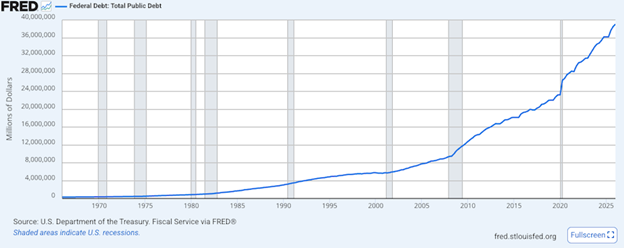
Investors are demanding higher yields on long-term US bonds. The deficit is approaching $2 trillion. The only way the government can pay for it is to print money, which is inflationary.
People are increasing worried about the US government’s ability to finance its own deficits and debt, but bond investors are also concerned about inflation destroying their yields. When this happens, arguably the game is up and nobody will want to purchase US Treasuries.
High interest rates and massive short-term debt servicing costs force the US government to spend over $1 trillion annually on net interest. This crowds out public investments, inflates federal deficits, and risks higher taxes or cuts to vital programs.
Heavy government borrowing redirects capital away from private markets, driving up interest rates for businesses and consumers.
Expensive credit restrains business expansion and productivity gains over time.
If the government prints money or continually expands deficits to manage debt burdens, it risks fueling further inflation.
Consumer sentiment
Higher borrowing costs driven by higher yields feed into the affordability crisis that is plaguing the United States.
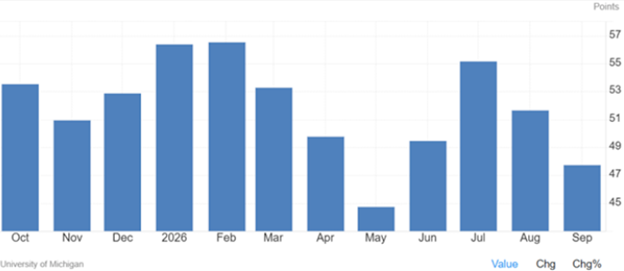
According to the University of Michigan Survey of Consumers, consumer confidence plummeted to a dismal 47.8 points in September 2026. Historically, when sentiment sits in this bottom tier, the economy rarely escapes without a rough ride.
The American trap: running out of credit
For a long time, the US consumer kept shopping by relying on plastic. Now, that safety valve is breaking.
Credit card debt is at an all-time high ($1.26 trillion).
Delinquency rates jumping to 12.8% means more than 1 in 10 credit card users are falling seriously behind on payments.
People are tapped out. When gas prices spike, they can no longer just put it on the card. They have to stop buying other things, which is why retail sales are dropping.
Current compounding risk much more dangerous than what the world faced 50 years ago – Richard Mills
The Canadian trap: the housing and trade squeeze
The Canadian consumer is dealing with a different kind of pressure cooker — mostly tied to shelter and global uncertainty.
Canadians carry some of the highest household debt in the world, mostly tied up in expensive mortgages. When interest rates stay high, it eats up money that would normally go into the local economy.
Canadians are deeply worried about what is coming next. Between high gas prices and potential trade tariffs with the US, people are terrified that things will get even more expensive.
Instead of spending extra money — like government benefits — Canadians are hoarding cash out of fear.
Both populations have moved from “spending freely” to “survival spending.” They are trading down to cheaper grocery brands, skipping vacations, and focusing entirely on the basics like rent, mortgages, and food.
Both countries citizens fear a painful cycle of stagflation — a destructive mix of stagnant economic growth paired with rising, stubborn inflation.
While standard economic slowdowns usually bring prices down, a destructive, newly ignited trade war between the US and Canada threatens to do the exact opposite. Both sides heavily fear that upcoming economic pain won’t be solved by just cutting interest rates, leaving everyday citizens stranded in a high-cost, low-growth trap.
There are specific, overlapping fears deeply worrying economists, policymakers and consumers in both nations.
The tariff-driven inflation spike
In late August, the US implemented 50% tariffs on roughly $20 billion worth of Canadian products, hitting critical sectors like vehicles, machinery, and paper. In a direct “dollar-for-dollar” response, Canada retaliated with its own 15% to 50% counter-tariffs on $20 billion of American goods, including steel, aluminum, clothing, and dairy.
Tariffs are essentially heavy taxes on imports. Both nations consumers fear that businesses will pass these multi-billion-dollar costs directly onto them. This means grocery store items, vehicles, and everyday retail goods will see immediate, artificial price spikes.
Conclusion
A hike in short-term interest rates is the next shoe to drop for cash-strapped Americans and Canadians. There is an 89% chance of the Fed returning to a rate-hiking cycle this Wednesday, starting with a quarter-point raise.
A 0.25% increase adds between $44 and $63 per month to the average US mortgage payment.
The Canadian central bank usually follows what the Fed does. The last time the Bank of Canada raised interest rates was in July 2023.
Canada’s annual inflation rate sits at 3.0% as of August 2026, while the US inflation rate has recently tracked higher around 3.4% to 4.2%. But it’s enough to warrant a raise, given all the other economic headwinds Canada is facing.
The last time the yield on the 10-year US Treasury bond hit 5%, we had a global financial crisis. Not saying that’s going to happen, but the AI bubble that has driven US stock markets to record vaulations is already showing signs of popping.
AI-linked equities and major tech indices have faced recent sell-offs and corrections as investors grow nervous over sky-high valuations.
Prominent industry leaders — including Anthropic CEO Dario Amodei, OpenAI CEO Sam Altman and Elon Musk — have publicly called for the industry to pace itself and slow down frontier development to manage safety risks, further rattling skittish markets.
Massive capital expenditures projected to hit $1 trillion globally in 2026 have outpaced actual incoming revenues, forcing Wall Street to question when and if these infrastructure investments will pay off.
Holders of stocks and mutual funds now have reason to fear a market crash, adding to their concerns over inflation and higher borrowing costs.
Richard (Rick) Mills
aheadoftheherd.com

Legal Notice / Disclaimer
Ahead of the Herd newsletter, aheadoftheherd.com, hereafter known as AOTH.Please read the entire Disclaimer carefully before you use this website or read the newsletter. If you do not agree to all the AOTH/Richard Mills Disclaimer, do not access/read this website/newsletter/article, or any of its pages. By reading/using this AOTH/Richard Mills website/newsletter/article, and whether you actually read this Disclaimer, you are deemed to have accepted it.