 RSS Subscribe
Control of the gold market is moving – Richard Mills
2026.09.07
Global gold buying by central banks has undergone a dramatic transformation. The world has shifted from a period of massive selling to an era of historic, aggressive hoarding:
- Central bank global official gold reserves have recently hit an all-time high of roughly 36,600 tonnes.
- Poland is leading the global buying pace as part of a national strategy to push gold to 20% of its total currency reserves.
- China is continuing a multi-year accumulation streak, raising its official reserves past 2,330 tonnes.
- Countries like Guatemala, Cambodia, Indonesia, Malaysia, the Czech Republic, and Serbia have entered or returned to the market.
Countries are buying gold because they want their reserve assets free from foreign sanctions/ freeze risks and are aiming to reduce long-term reliance on fiat currencies like the U.S. dollar.
Central bank net gold purchases generally fall into three distinct historical phases:
- For decades following the collapse of the Bretton Woods system in 1971, central banks were net sellers of gold. Many governments viewed gold as a stagnant legacy asset that didn’t pay any yield or interest. Western nations regularly offloaded hundreds of tonnes of gold onto the open market each year.
- The 2008 global financial crisis triggered a complete shift in mindset. Western selling ground to a halt, and emerging-market nations stepped in as buyers to protect their wealth. During this 11-year span, global central banks purchased a steady average of roughly 473 tonnes per year.
- In 2022, a major geopolitical structural break occurred. Following Western nations freezing Russia’s foreign currency reserves, central banks worldwide realized that paper currency held abroad could be turned off, and their assets frozen, at any moment.
The direct correlation between accelerated central bank gold hoarding and global bullion prices is clear. Following the freezing of Russia’s foreign reserves in 2022, central banks doubled their historical buying pace to over 1,000 tonnes a year, sparking an unprecedented multi-year bull run.
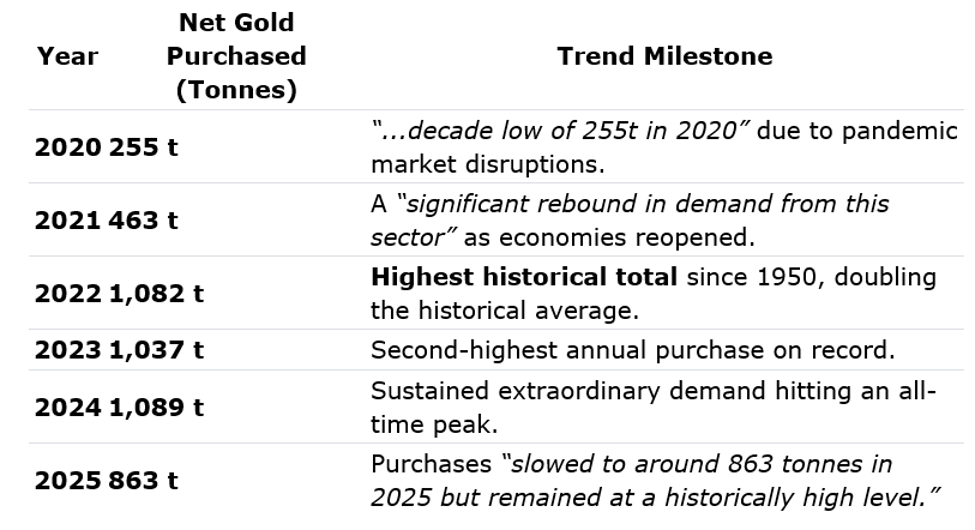
Between 2022 and 2024, global central bank net purchases more than doubled, continuously smashing through historic levels by exceeding 1,000 metric tons each year. While buying moderated slightly to 863 metric tons in 2025 as gold prices hit all-time highs, official accumulation remains nearly twice as high as the historical average from the prior decade with recent multi-year purchasing volumes sitting approximately 104% higher than totals from earlier mid-decade periods like 2014–2016.
A recent World Gold Council survey revealed the main drivers pushing central banks to adjust their strategies:
- Countries are seeking safe, sanction-proof reserve assets following international conflicts and economic sanctions.
- Emerging market central banks continue to reduce their long-term reliance on U.S. dollar reserves.
- Annual net purchases have consistently shattered historical baselines since 2022
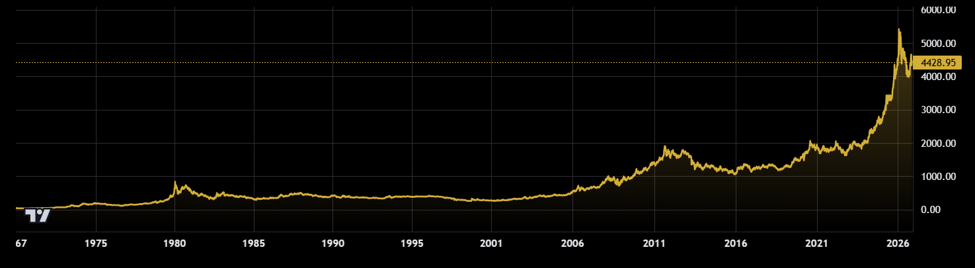
Because central banks buy gold to hold for the long term rather than to trade, their massive purchases remove millions of ounces from the open market, creating a persistent supply squeeze. This relentless demand played a direct role in driving gold prices from roughly $1,800 per troy ounce in late 2022 to an all-time high of over $5,500 in early 2026.
“Their actions can drive up global gold prices by both reducing available supply and signaling confidence in gold as a strategic asset.” Investopedia
Central Bank buying creates a price “floor,” preventing deep sell-offs and keeping the market highly resilient.
Gold Stockpiles
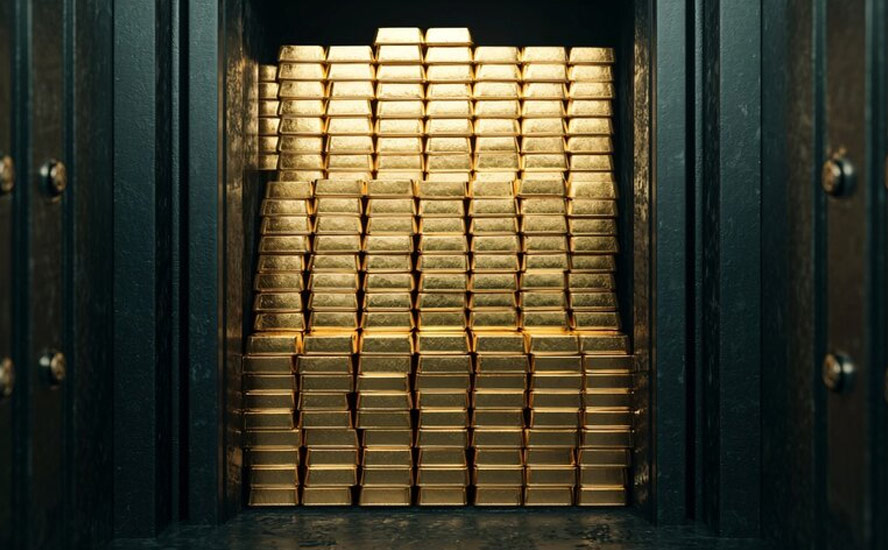
The United States holds the largest overall official gold stockpile in the world by a massive margin, safeguarding 8,133.5 tonnes of the precious metal.
This sovereign cache is larger than the reserves of the next three countries combined.
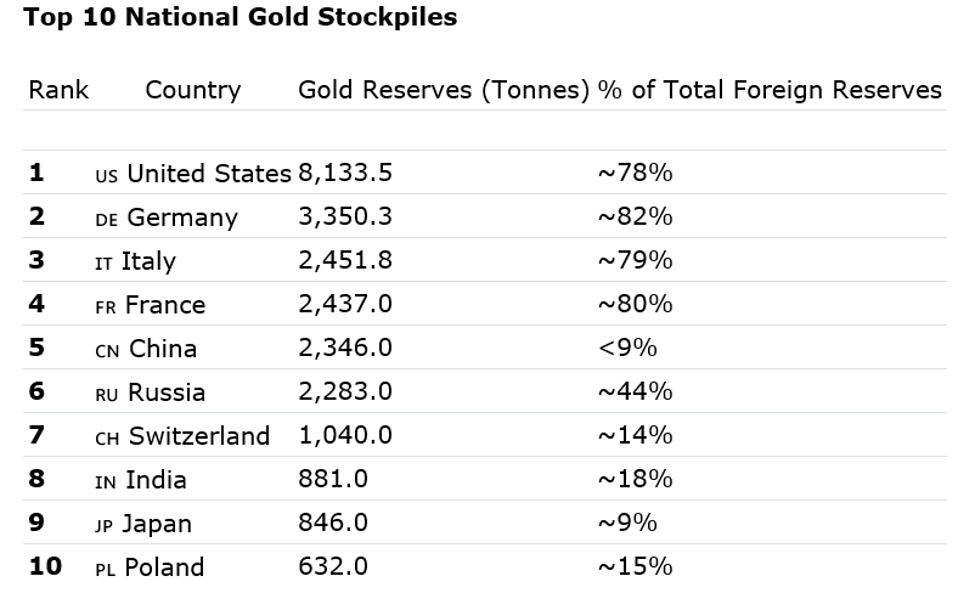
(Note: The International Monetary Fund (IMF) owns 2,814 tonnes of gold)
Unlike regular investors who buy gold exchange-traded funds (ETFs) or gold futures contracts to make a quick trade, central banks want physical bars to lock away in vaults. This means once central banks take delivery of gold, that supply is effectively removed from global circulation indefinitely. Lower circulating supply meeting steady global demand naturally drives the price higher.
(Annual global gold mine output has seen very little volatility, averaging a near-zero annual change despite Central Bank buying and surging market prices.)
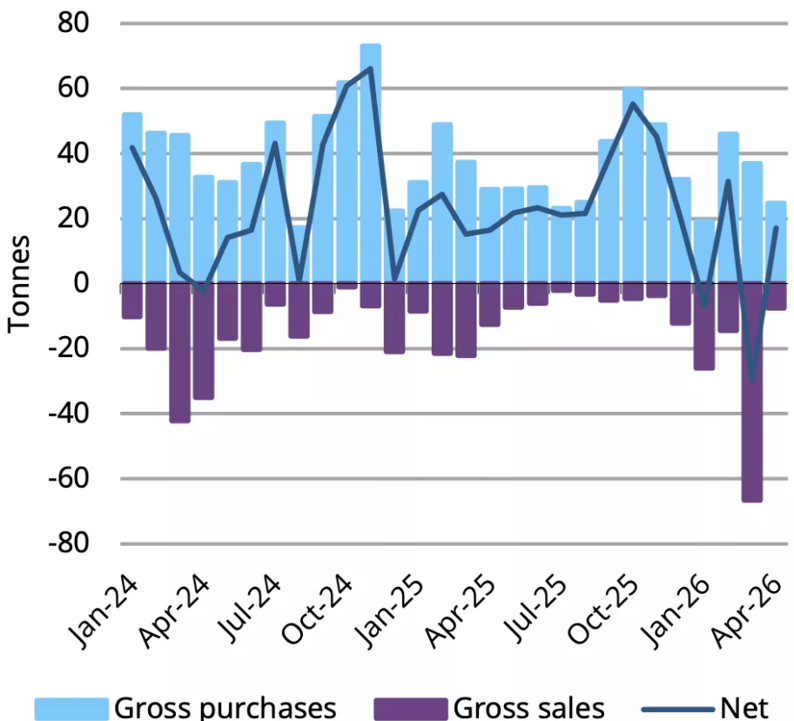
As of late 2026, while official buying has slowed slightly from its absolute peak pace, institutions like Goldman Sachs Research note that central banks are still purchasing gold at nearly triple their pre-2022 monthly average.
Bottom line for Central Banks is that unlike digital/ fiat currencies, physical gold held in a country’s own vaults cannot be frozen or seized by foreign governments; fiat currencies also lose purchasing power due to high inflation; but gold traditionally gains or maintains its real value and acts as the ultimate safe-haven when wars or economic recessions hit.
Good Delivery
London is the undisputed capital of the global gold trade. All the gold held in the Bank of England’s London Bullion Market Association (LBMA) must meet modern international trade standards and is regarded as the world’s most easily tradable gold and will therefore be the most readily available to a bank in a crisis situation.
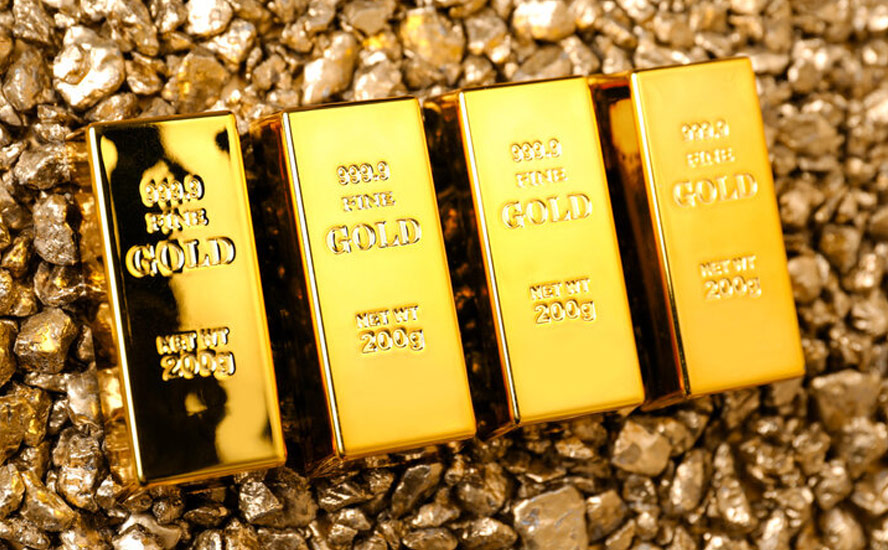
To meet LBMA ‘Good Delivery’ standards it requires a minimum purity of 99.5% in 400-ounce bars. According to historical U.S. Mint and government audit data, the average purity of the U.S. gold reserve is only 91.67% (22-karat gold). The gold bars must also be stamped by an approved, modern refinery.
Because the gold in London meets these exact rules, no buyer will waste time demanding that the bars be re-tested or melted down.
Blame FDR
Most of the US’s gold held in the Fort Knox and West Point repositories does not meet modern international trade standards, it is not considered equal to the London Bullion Market Association (LBMA) “Good Delivery” bars meaning U.S.-stored gold is too illiquid and difficult to trade quickly in an emergency.
The U.S. government built its reserves decades ago by melting down old 90% pure gold coins and historical coin bars, 83% of US owned gold bars sitting in US vaults fall below the 99.5% international trading standard.
Because Fort Knox gold is impure, it cannot be easily or legally settled on the modern global market. Even the foreign-owned gold held at the New York Federal Reserve is slower to trade because it lacks the unified, hyper-liquid clearing network that uniquely belongs to the London market
Blame President Franklin D. Roosevelt, the reason U.S. gold is impure goes back to 1933 when he confiscated the American public’s gold. The Mint took millions of circulating 21-karat and 22-karat gold coins off Americans, tossed them into furnaces, and poured them into bars. They did not pull out the copper and silver alloys because “coin gold” was a perfectly acceptable backing for the U.S. dollar.
Allocated gold
Gold is held on an “allocated” basis. Because all bars strictly meet LBMA rules and the Bank of England connects directly to the LBMA electronic clearing system all it takes is just moments and ownership of the gold can be digitally transferred from one country to another without it ever leaving the vault.
(Holding gold on an “allocated” basis is the absolute highest standard of safety for a central bank. In simple terms, it means the bank owns specific, physical, real gold bars, not just a number on a paper balance sheet. The custodian cannot lend the gold out to short-sellers or other banks.)
Almost all major central banks and global commercial banks have gold accounts at the Bank of England, a country or bank can sell its gold or use it to get a loan instantly. The bank simply changes the name on the digital ledger from say the “Netherlands” to the buyer.
Coin melt
The gold held by the U.S. government are allocated, meaning the bars do physically exist in sealed vaults, but, as I said, 83% of US gold fails the modern international purity test – so it is classed as ‘coin melt’ not ‘good delivery.’
International trade requires a purity of 99.5% or higher – only 17% of the bars meet or exceed the 99.5% modern international standard. But US gold’s purity is just one of the liquidity problems.
While the modern international standard requires bars to be highly uniform, historical U.S. gold bars are incredibly inconsistent. According to the official U.S. Mint specifications, a standard US gold bar is a brick measuring roughly 7 inches by 3.6 inches. Each bar weighs approximately 400 troy ounces (about 27.5 pounds or 12.4 kilograms).
Because these bars were made by melting down old circulating coins in the 1930s, the U.S. Mint poured them into molds using whatever amount of metal they had confiscated at the time. Instead of every bar being a perfect 400 ounces, their actual weights vary wildly. For example, a single historic bar held by the U.S. Treasury might be stamped with an exact weight like 389.27 ounces or 402.10 ounces.
It might weigh roughly 400 gross ounces on a scale but because it is only 91.67% pure, it only contains about 366 ounces of pure gold. The remaining weight is made up of copper and silver alloys.
Almost all US gold lacks a standardized modern refinery stamp, a standardized uniform weight, and the mandatory 99.5% purity.
Statutory value
The U.S. government calculates the value of its 400-ounce bars using a massive accounting trick. On the official ledger, the U.S. Treasury does not look at the actual market price of gold. Instead, federal law mandates they use a frozen price called the statutory value – exactly $42.2222 per fine troy ounce.
Across all vaults the U.S. owns roughly 261.5 million fine troy ounces of gold. At the $42.22 rate, the ledger states the entire U.S. gold reserve is worth just $11.04 billion. On the open market, the actual value of that exact same stockpile exceeds $1 trillion.
This $42.22 price is a ghost from the Bretton Woods monetary system. After President Richard Nixon permanently unlinked the U.S. dollar from gold in 1971, Congress adjusted gold’s official price one final time in 1973 to $42.2222.
Talks have recently re-emerged via the White House and through legislative proposals like the American Reserve Modernization Act, which floated studying a plan to revalue America’s gold closer to actual market value.
The “paper profits” generated by this accounting upgrade would then be used to buy up to 1 million Bitcoins over a five-year period.
Investors saw the idea as an acknowledgment of severe underlying debt issues, triggering a wave of defensive gold buying. Analysts warned that a gold revaluation is essentially a “backdoor inflationary scheme” used to fund government spending without raising taxes. This weakened confidence in the long-term purchasing power of the fiat U.S. dollar. Bond traders viewed the proposal as a sign that the government is seeking a politically convenient escape route from its massive interest payment obligations. This fueled long-term inflation expectations, adding pressure to U.S. Treasury yields.
Changing this ledger value today would require Congress to pass a new law. Doing so could trigger global panic, as it might look like the U.S. is trying to artificially print money or manipulate the dollar against its gold reserves.
Therefore, the U.S. is currently leaving their 1970s math alone, letting a trillion dollars in wealth sleep on their books valued at pennies on the dollar.
Repartition
Currently the U.S. government owns 8,133.5 metric tonnes of gold equal to about 261.5 million fine troy ounces. The absolute peak of U.S.-owned gold happened in 1941 when the Treasury held over 20,000 tonnes. But during the 1950s and 1960s foreign countries traded their paper U.S. dollars for physical American gold (at $35 an ounce). Today, US owned gold is stored at Fort Knox, West Point and in Boulder Colorado.
The Federal Reserve Bank of New York vault acts as a giant safety deposit box for foreign central banks. At its peak, it held over 12,000 tonnes of foreign gold
Today the bank stores approximately 6,200 metric tonnes (around 199 million troy ounces) of gold for foreign nations, + 36 foreign central banks and international entities like the International Monetary Fund (IMF).
Many countries moved their gold reserves out of the United States—primarily from the New York Federal Reserve—back to their home countries to increase national security and control:
- The Dutch Central Bank (DNB) executed a massive relocation, moving 86 tonnes of gold out of the Federal Reserve Bank of New York and Ottawa, Canada, shifting it directly to London.
Their reason?
“Gold that is held with the Bank of England must meet modern international trade standards and is regarded as the world’s most easily tradable gold and will therefore be the most readily available for DNB in a crisis situation. Gold reserves left behind in North America cannot be utilised as quickly and directly in such a situation.”
- Germany’s Bundesbank previously kept the majority of its gold in New York. Between 2013 and 2017, they physically shipped 300 tonnes from New York back to Frankfurt. German lawmakers have continued to renew calls to bring the remaining 1,236 tonnes home.
- France moved its remaining foreign-stored gold reserves back onto its home shores.
- In 2011–2012, Venezuela completely repatriated 160 tonnes of its gold out of the U.S. and Europe back to Caracas.
- Germany (which still keeps about 1,236 tonnes in New York) and Italy (which keeps roughly one-third of its gold there) are experiencing intense domestic political pressure to follow France and the Netherlands by bringing the rest of their gold home.
According to official data compiled by the World Gold Council, only 14% of global central banks choose to store their gold at the New York Fed, dropping from 17% just a year prior.
Central banks view gold as the ultimate insurance policy. If global trade routes break down or a systemic computer blackout happens, a country wants its physical gold bars resting in its own local vaults—not thousands of miles across the ocean.
Other countries have been moving their gold:
- The Reserve Bank of India has quietly been on one of the largest physical relocation missions in modern history, moving over 280 tonnes of gold back to domestic soil. While much of it came from London, significant tranches were pulled from various Western holdings to ensure local custody.
- Serbia returned its entire foreign gold stock—worth roughly $6 billion—back to its domestic vaults.
- Poland and Turkey have heavily prioritized local vaulting over the last few years. Poland previously repatriated 100 tonnes from London and has kept almost all its record-setting 2024–2026 gold purchases inside its own borders rather than storing them in New York.
As trust in Western custodianship fractures, alternative financial centers like Singapore and Hong Kong are aggressively building new specialized gold-clearing and high-security vaulting services to capture the migrating bullion.
Conclusion
The global gold market is experiencing a massive geographic shift as physical bullion flows steadily out of Western financial centers like New York and London and into Eastern nations like China, India, and the Middle East.
This is not just a change on paper. It involves thousands of tonnes of heavy gold bars physically leaving Western vaults and flying across the globe to Eastern buyers.
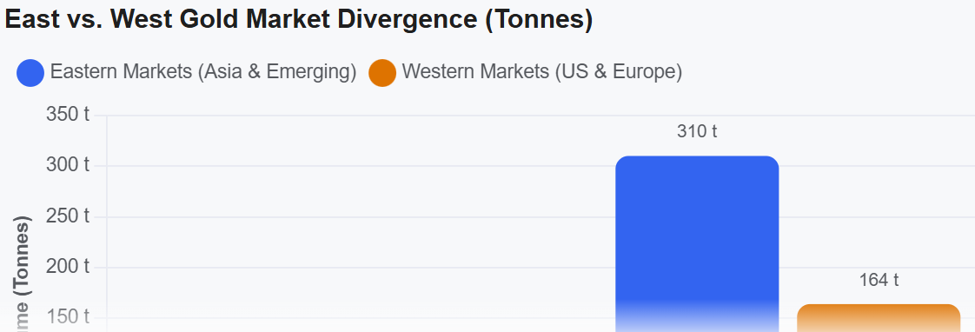
In the East, gold is viewed as the ultimate tangible store of wealth. When Western investors sell and cause the price of gold to dip, Eastern buyers view it as a massive discount sale and aggressively buy up the actual physical metal.
“While North American gold ETFs saw outflows of 16t in Q1, Asian funds alone added 84t.” James Campion on eToro
This dynamic reflects a trend where Western retail money aggressively drops gold on minor price dips, while Eastern investors view those dips as strategic buying opportunities.
“China recorded the largest increase in gold reserves over the period, adding more than 350 tonnes.” Visual Capitalist
Eastern central banks (like China and India) are aggressively hoarding physical bullion to reduce exposure to Western financial systems.
“Primarily eastern emerging market central banks have leaned into lower gold prices to buy aggressively for secular reasons.” Kitco News
They are buying for long-term safety, whereas the West is trading gold strictly on interest rate expectations.
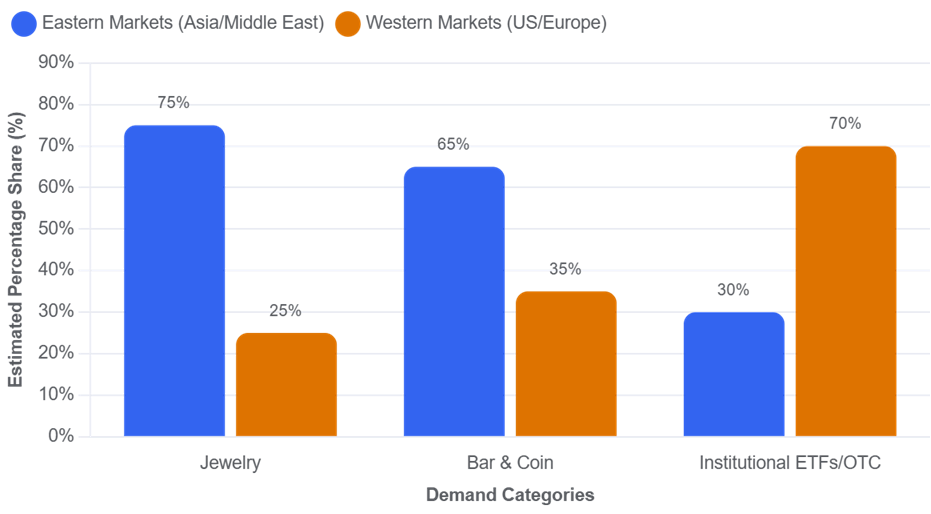
“Many MENA states like Qatar, Egypt and the UAE have acquired between 25- 50% of their total gold holdings in the last few years alone.” Deutsche Bank Research.
The relentless movement of physical gold from Western vaults to Eastern treasuries is causing a major shift in the global financial system.
For nearly a century, Western institutional traders in New York and London set the price of gold based on US interest rates and the value of the US dollar. Today, that traditional playbook is breaking down.
The end result? A permanent loss of Western control over the world’s ultimate safe-haven asset.
Eastern nations are building a parallel financial system that operates entirely outside the reach of Western jurisdiction – physical gold stored inside domestic Eastern vaults is an asset that cannot be digitally hacked, frozen, or seized by Western governments.
Historically, Western institutions depress gold prices by selling massive amounts of “paper gold” (futures contracts and ETFs) without ever moving physical metal. Now, when the West tries to heavily short paper gold, Eastern buyers gladly step in and demand physical delivery of the actual bars.
The global safety net is shifting to physical possession and gold is actively replacing the US dollar as a core reserve asset among emerging markets. As fewer central banks buy US Treasury bonds, the United States faces a shrinking global audience to purchase its national debt, structurally weakening Western fiat currencies over time.
The East has reclaimed gold as the ultimate foundation of true economic power and sovereignty. When is the west going to realize that gold can no longer be treated as just another speculative financial asset to trade when interest rates change?
Richard (Rick) Mills
aheadoftheherd.com

Legal Notice / Disclaimer
Ahead of the Herd newsletter, aheadoftheherd.com, hereafter known as AOTH.Please read the entire Disclaimer carefully before you use this website or read the newsletter. If you do not agree to all the AOTH/Richard Mills Disclaimer, do not access/read this website/newsletter/article, or any of its pages. By reading/using this AOTH/Richard Mills website/newsletter/article, and whether you actually read this Disclaimer, you are deemed to have accepted it.