 RSS Subscribe
Kodiak Copper expands MPD Project; Initiates next phase of metallurgical testwork – Richard Mills

2025.10.31
Kodiak Copper (TSX-V: KDK, OTCQB: KDKCF, Frankfurt: 5DD1) is back in the news, announcing an expansion to its MPD copper-gold porphyry project in southern British Columbia, and the start of an additional metallurgical test work program to build on the maiden test results received in the second quarter.
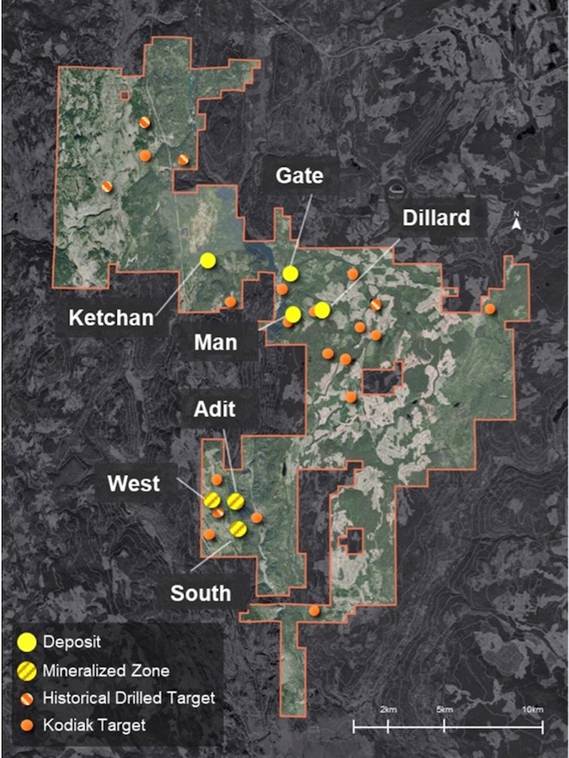
The program, to be managed by JDS Energy with assistance from Kodiak advisor Mike Westendorf, will include composite samples from six deposits and mineralized zones at MPD: Gate, Man, Dillard, West, Adit and South (see Figure 1). The test work will focus on enhancing recoveries for copper and gold through gold characterization studies and the optimization of rougher and cleaner flotation processes. The results from the program are expected in Q1 2026 and will be used to support mineral resource definition work.
“We are pleased to initiate the next round of metallurgical test work, an important de-risking step as we advance our MPD Project,” Kodiak President and CEO Claudia Tornquist said in the Oct. 28 news release. “The program will build on the positive metallurgical results received thus far and is designed to optimize the recovery of both copper and gold, aiming to unlock further potential to enhance the project’s resource estimation and future economic prospects.”
Eight days earlier, Kodiak said it entered into a purchase agreement with Eagle Plains Resources (TSXV:EPL) to acquire a claims package adjacent to Kodiak’s 100%-owned MPD Project, expanding the company’s landholdings to 357 square kilometers. The newly acquired claims now form part of the MPD Northwest project area, where a soil program has been initiated to advance multiple targets.
The newly acquired claims comprise 13.1 square kilometers adjacent to the MPD Northwest area, including the 12.1 square-kilometer Ketch claim block located north and along trend of the Ketchan deposit, a large mineralized zone that has been drilled over 1800 by 500 meters and forms an important part of the initial mineral resource estimate for MPD.

The Ketchan deposit is associated with a northwesterly geophysical trend which continues onto the Ketch claim package. Further work will be required to determine if an extension to the Ketchan deposit is present along this trend.

The claims will also allow Kodiak to expand operations in other prospective areas at MPD Northwest, which hosts 24 known mineral occurrences, including six with significant porphyry-related copper-gold mineralization, as seen in Figure 1.
A soil geochemical program consisting of 2,000 samples is currently being initiated to explore targets on the MPD Northwest claims. The program will investigate historical showings as well as VRIFY AI targets and the area around the Ketchan deposit. It is expected to be completed in November.
“Kodiak’s strategy to consolidate the MPD district over the past seven years has been key in generating the critical mass to bring this project to fruition and demonstrate that it has the potential to become a major mine in the future,” Tornquist said in the Oct. 20 news release.“ The acquisition of the Ketch claim package is a logical next step, and I am glad we were able to secure these strategically located claims which could potentially host an extension of our Ketchan deposit. I am looking forward to the results of the current soil program which focuses on advancing several promising targets on the prospective MPD Northwest area.”
Copper market
The news from Kodiak comes at an interesting time in the copper market.
On Wednesday, Oct. 29, copper prices hit a new record in London on the prospect of easing US-China trade tensions. The presidents of the two countries reached a trade deal — though not yet signed — while meeting at a summit in Busan, South Korea on Thursday.
Three-month copper futures reached an intraday peak of $11,146 a ton ($5.57 a pound), topping a previous $5.50 high set in May 2024.
The base metal has advanced 27% year to date.

Prices have been supported by robust demand from electrification and decarbonization — EVs contain four times as much copper as gas-powered cars. Technology companies are investing hundreds of billions of dollars to build AI data centers requiring reams of copper wiring.
Demand for copper — the cornerstone for all electricity-related technologies — is set to grow by 53% to 39 million tonnes by 2040, according to BloombergNEF.
The bigger copper story though is undersupply.
Several recent mine interruptions and closures have upended the copper market, pushing it towards a deficit after two consecutive years of surplus.
In May, seismic activity caused flooding at the Kakula mine in the DRC owned by Ivanhoe Mines (TSX:IVN). Kakula and adjacent Kamoa produced about 437,000 tonnes of copper in 2024.
In June, port and mill disruptions hit two Teck Resources’ (TSX:TECK.B) operations in Chile. A tunnel collapse at state copper miner Codelco’s El Teniente mine, resulting in six fatalities, halted activities for over a week.
El Teniente is the world’s largest underground copper mine.
The worst incident occurred at the world’s second largest copper mine, Grasberg in Indonesia. In September, 800,000 tons of mud slid into the Grasberg Block Cave mine — the underground portion of the former open pit — killing seven workers.
Mine operator Freeport McMoran (NYSE:FCX) suspended operations, declaring “force majeure”, essentially an unforeseen circumstance that releases an operator from its contractual obligations to customers.
Meanwhile, some of the biggest copper miners, including Anglo American (LSE:AAL) and Teck, have warned that their copper production may fall below expectations in 2026.
Reuters metals columnist Andy Home wrote that “next year is when the copper market looks set to feel the full impact of this year’s string of mine supply shocks.”
According to the International Copper Study Group, despite anticipated slower demand in 2026, metal production is expected to fall short by 150,000 metric tons. In April the group expected a 209,000-ton surplus.
The ICSG also cut its 2025 supply forecast, with growth forecasted to be 1.4%, compared to a previous forecast of 2.3%, and 2024’s 2.8% growth.
Analysts at Citi and UBS are forecasting “no growth” and “negligible growth,” respectively this year, states Home in his Oct. 27 column.
Copper market tightness has been exacerbated by the Trump tariffs, first the threat, then the imposition, of a 50% tariff on imports of semi-finished copper products and derivatives.
After the proposed tariff was announced, exporters began shipping copper from London to New York to avoid the Aug. 1 levy, causing New York prices to trade at a premium to the London Metal Exchange, and putting strains on copper supply elsewhere.
Tallied together, the production mishaps mean global annual copper production is on course to contract for the first time since the onset of the pandemic, according to CRU [Commodities Research Unit].
This has analysts turning bullish on copper. Citigroup is calling for prices to hit $12,000 a ton ($6/lb) in the first half of next year, while Morgan Stanley predicts the market will face its most severe deficit in more than 20 years in 2026.
It’s a good time to be exploring for copper in the southern Quesnel Terrane, British Columbia’s primary copper-gold-producing belt.
Kodiak Copper
TSXV:KDK, OTCQB:KDKCF, Frankfurt:5DD1
Cdn$0.76 2025.10.30
Shares Outstanding 85.8m
Market Cap Cdn$65.2m
KDK website
Richard (Rick) Mills
aheadoftheherd.com

Subscribe to AOTH’s free newsletter
Richard does not own shares of Kodiak Copper (TSXV:KDK). KDK is a paid advertiser on his site aheadoftheherd.com This article is issued on behalf of KDK.
Legal Notice / Disclaimer
Ahead of the Herd newsletter, aheadoftheherd.com, hereafter known as AOTH.Please read the entire Disclaimer carefully before you use this website or read the newsletter. If you do not agree to all the AOTH/Richard Mills Disclaimer, do not access/read this website/newsletter/article, or any of its pages. By reading/using this AOTH/Richard Mills website/newsletter/article, and whether you actually read this Disclaimer, you are deemed to have accepted it.