 RSS Subscribe
Bond market working fine – Richard Mills

2026.09.16
“Far from having broken down, today the market for Treasury bonds is not even showing much stress. On September 10th America auctioned off $22bn-worth of new 30-year Treasuries at a yield of 5.3%.
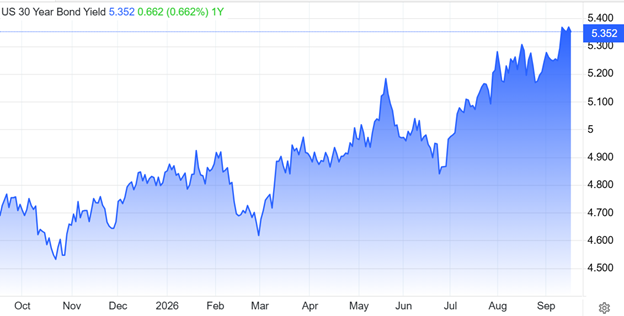
Traders made bids for more than two-and-a-half times that amount—a ratio that CME Group noted was at the upper end of the range for similar recent auctions. The exchange pointed out that non-dealers accounted for 98% of competitive bids, “suggesting excellent investor interest, presumably reflecting the recent rise in yields.
True, that recent rise has carried American borrowing costs to their highest in nearly 20 years. But it was the low-rate 2010s that were odd. By pre-2007 standards today’s yields would look perfectly normal. Over the decade before that the ten-year Treasury yield averaged 5% and the 30-year averaged 5.4%.
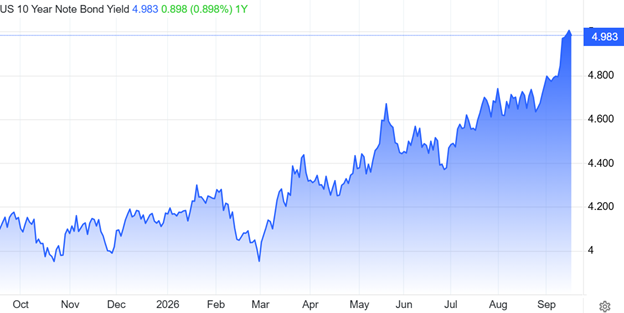
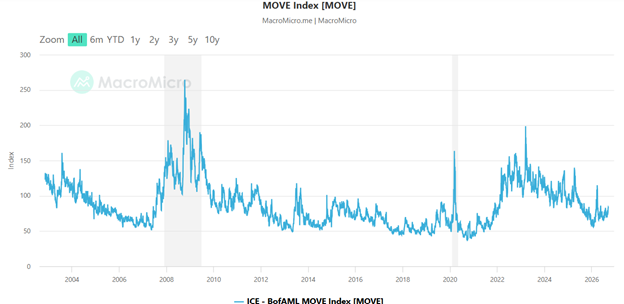
Other gauges of market strain tell a similar story. If bondholders were panicking that Uncle Sam might default, they would insure themselves against this. Yet premiums for credit-default swaps, derivative contracts which do just that, suggest few are clamouring for them. If traders were worried that bond-market dysfunction might send yields swinging wildly, they would bake this expected volatility into options contracts. Yet the MOVE index, which measures such expectations, is far lower than it was a few years ago when post-pandemic inflation soared.
If anything, it is remarkable how smoothly the market is functioning. There are two big problems with Treasuries, and the main one is that America is issuing far too many of them. With one month left in this fiscal year, the Congressional Budget Office reckons the government has already borrowed nearly $2trn, or 6.3% of GDP. The other big problem is that it is doing so while pursuing policies, from tariffs to war in Iran, that push up inflation and so devalue the bonds it has already sold. Investors’ response—demanding higher returns—shows the market is working.” https://www.economist.com/finance-and-economics/2026/09/15/scott-bessent-should-stop-blaming-the-bond-market
Credit-default swaps (CDS)
Bondholders are not clamoring for credit-default swaps (CDS) on U.S. government debt, as premiums remain low and stable. However, investors are clamoring for CDS contracts in specific corporate sectors, particularly on technology and artificial intelligence (AI) firms, as well as in the private credit market where default rates have hit record highs.
United States 5-Year CDS value, https://www.worldgovernmentbonds.com/cds-historical-data/united-states/5-years/, sits at roughly 31.95 basis points. This means it costs just under $32,000 annually to insure $10 million of U.S. debt. This premium translates to a tiny 0.53% market-implied probability of default.
Investors are buying high volumes of credit-default swaps on big tech companies. Tech firms are taking on massive debt loads to build out infrastructure for Artificial Intelligence. Bondholders are using derivatives to hedge against the risk that these heavy AI investments might not pay off.
The Fitch Ratings U.S. Private Credit Default Rate, https://www.fitchratings.com/research/corporate-finance/fitch-ratings-us-private-credit-default-rate-remains-at-record-high-in-july-2026-13-08-2026 has plateaued at record highs near 6.0%. Because small and mid-sized companies are struggling under high interest rates, lenders and institutional investors are increasingly turning to the broader derivatives market to offset risk.
While overall public corporate default rates look stable on paper, the risk is deeply fragmented. Bondholders are selective, using credit swaps to micro-manage exposure to weaker, highly leveraged companies.
MOVE Index
MOVE stands for the Merrill Option Volatility Estimate. It’s a critical financial tool often called the “VIX for bonds.” While the famous VIX measures fear and volatility in the stock market, the MOVE index measures expected volatility and fear in the U.S. government bond market.
The MOVE index tracks the erratic behavior of interest rates. It is calculated by looking at the prices of options contracts on U.S. Treasury bonds. It does so by tracking a mix of 1-month options across four different bond timeline milestones: 2-year, 5-year, 10-year, and 30-year Treasuries. It tells investors how much wild swinging or instability the market expects in interest rates over the next 30 days.
An options contract is a financial agreement that gives someone the right to buy or sell an asset (like a bond or stock) at a set price before a certain deadline. Think of options like insurance. If you think a house might catch fire, you buy insurance.
Volatility is the missing link that determines how expensive that insurance is:
- Implied Volatility (IV): This is the market’s mathematical guess of how crazy price swings will be in the future. If investors are terrified that interest rates will unexpectedly spike or plunge, they rush to buy options contracts to protect themselves.
- The Law of Supply and Demand: High demand pushes the price (or premium) of these options contracts upward.
- The Calculation: The MOVE index reverses this math. It looks at the expensive premiums people are paying for bond options, extracts the implied volatility, and spits out a final index number.
Unlike stock market gauges, the MOVE index counts its value in basis points (a financial unit where 100 basis points equals 1.00%). The index sits at roughly 83.90.
MOVE Index Level
What it Means for the Market:
Below 60 Calm: The bond market is stable, interest rates are predictable, and options are cheap.
80 – 120 Moderate Stress: Investors are uncertain about inflation or what the Federal Reserve will do next.
Above 120 Severe Panic: Wild swings in rates. This happened during the 2008 Financial Crisis and the 2023 regional banking crash.
Conclusion
For the most part, the U.S. bond market is functioning smoothly, even if it is operating under a “new normal” of higher interest rates.
While you might see scary headlines about national debt, the market itself is not showing signs of panic or structural breakdown.
The U.S. government has to sell trillions of dollars in new bonds to fund its spending. Buyers—like banks, pension funds, and foreign countries—are still showing up in droves to buy them.
As mentioned earlier, the price to buy insurance against a U.S. government default (Credit-Default Swaps) is very low. Investors fully expect to get their money back.
The MOVE index is sitting at a reasonable level around 83 basis points. This tells us that bond yields are moving in a predictable, stable window rather than swinging wildly from day to day.
While the market is working fine, it has changed in two major ways that investors are keeping an eye on:
- For a long time, short-term bonds paid higher interest than long-term bonds (a weird phenomenon called an “inverted yield curve“). The curve has mostly un-inverted. Long-term bonds now pay more, which is how a healthy market is supposed to work.
- Because the government keeps printing a massive supply of new bonds, investors are demanding a slightly higher interest rate to hold onto 10-year or 30-year bonds. It is not a panic; it is just buyers demanding a better deal because they have so many options to choose from.
In short, the U.S. bond market is behaving less like a crisis zone and more like a massive, stable machine adjusting to a higher-rate world.
Richard (Rick) Mills
aheadoftheherd.com

Legal Notice / Disclaimer
Ahead of the Herd newsletter, aheadoftheherd.com, hereafter known as AOTH.Please read the entire Disclaimer carefully before you use this website or read the newsletter. If you do not agree to all the AOTH/Richard Mills Disclaimer, do not access/read this website/newsletter/article, or any of its pages. By reading/using this AOTH/Richard Mills website/newsletter/article, and whether you actually read this Disclaimer, you are deemed to have accepted it.