 RSS Subscribe
Under the Spotlight – Keith Bodnarchuk, CEO Cosa Resources (TSXV:COSA, OTCQB:COSAF)
2026.06.20
Rick Mills, Editor/ Publisher, Ahead of the Herd:
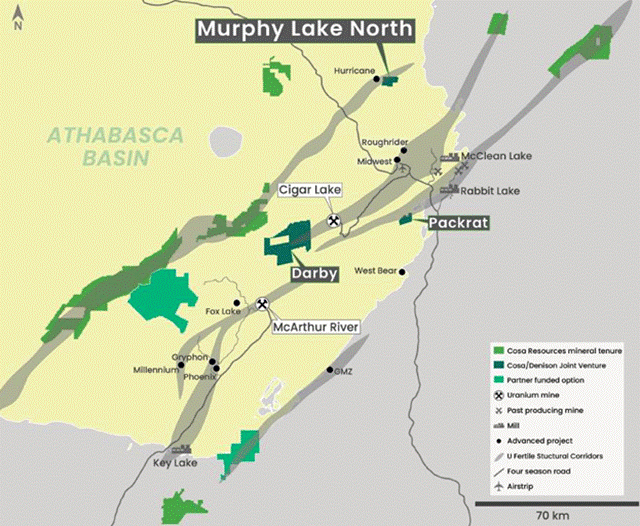
Keith, you’re in the Athabasca Basin, the eastern part. These are the highest-grade uranium deposits in the world.
Their average is 20 times the average uranium deposit grade. Some places it goes up to 100 times. You’ve got some of the biggest, highest-grade uranium mines nearby: Cigar Lake, Rabbit Lake, McArthur River.
Your neighbors are Cameco (TSX:CCo), Denison (TSX:DML), Orano, and you’re literally hunting for uranium with the big boys, this is the big leagues in uranium exploration. There’s no other way to describe this, except your exploring among giants, or is there?
Keith Bodnarchuk, CEO, Cosa Resources (TSXV:COSA, OTCQB:COSAF)
No, I completely agree.
I think you hit the nail on the head that we’re a group that’s been in the uranium space for a number of years now. I started in 2007. We’ve scoured the planet for assets over the years, looking at different things.
And we keep coming back to this one area in northern Saskatchewan, just because it’s in such a great jurisdiction. And it’s home to the highest grade and best uranium deposits in the world. It’s the ultimate treasure hunt.
It’s competitive. But if you do have success, it’s highly rewarding for everybody involved, including shareholders, stakeholders, etc. So that’s why we keep coming back to that area in the Eastern Athabasca Basin.
Where we have projects, you’re right, it’s home to the largest uranium mines in the world. It’s home to all the current infrastructure and mills. And where we have projects, we’re sitting in amongst some of the largest uranium companies in the world.
RM: It’s not like you guys don’t deserve to be working there. Your Hurricane discovery and even long before, when your management team was at IsoEnergy (TSX:ISO, 34.5% uranium, the highest-grade uranium resource in the world, bar none. Cosa management discovered that.
KB: For sure. Myself, I’m fortunate to be surrounded by such a terrific team that does have that track record of making discoveries. And it goes beyond that.
Our chairman, Steve Blower, was the VP Exploration of Denison Mines when they expanded the Phoenix deposit and discovered the Gryphon deposit. Craig Parry was part of our group, he’s a strategic advisor. He was a founding director of NexGen.
So, we were all together for that ISoEnergy success, but our resume goes beyond that. We’ve had our fingerprints on a lot of the success in this part of the world over the past 15 years. We’re looking to do it again here with Cosa.
RM: Your Murphy Lake North, which you just started a drill program on, is 70% Cosa, 30% Denison. Murphy Lake North is just 3 kilometers east of IsoEnerg’s Hurricane deposit, which we said you guys are credited with discovering. So, you’re basically on trend with that deposit.
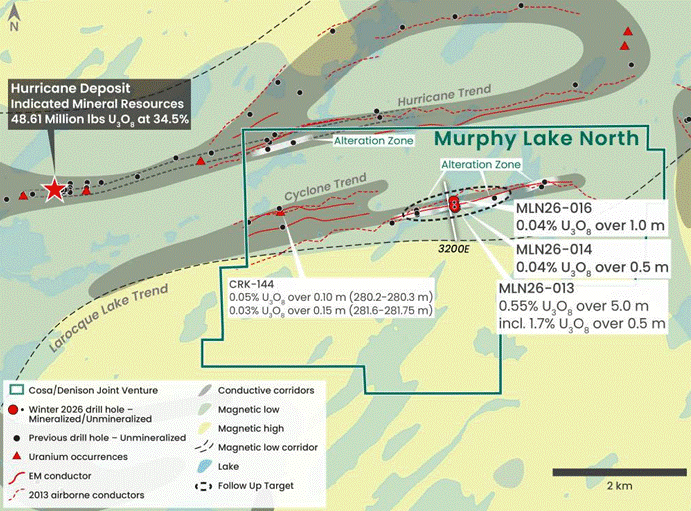
KB: Exactly. That’s the reason why we really wanted to do a transaction, was to get our hands on that terrific project. It’s also shallow. In Athabasca Basin terms, it’s 250-300 meters down to the target depth. For perspective, a lot of the mines are 400-meters-plus down.
This is cost-effective exploration in this area. You’re right, it’s sitting right next door to the highest-grade Indicated uranium resource in the world. We jumped at the opportunity to get a project like that and also team up with Denison Mines, where I worked for nine years.
We have a longstanding, terrific relationship with the team over on the Denison Mines side. So, it was really a win-win, that transaction we did to acquire that project. And yes, we ended up in an area that we thought we might never get a chance to explore again.
We were excited to do that transaction with Denison.
RM: Yes, having Denison as a strategic partner, and investor, is quite a coup.
KB: Right. Obviously, it’s one of the best development stories in the uranium space. They’re working to build the Phoenix mine, just starting on that. They’ve been absolutely fantastic since we did the transaction. Having them support us at a corporate level, also at a project level, being able to access their fantastic team has been a huge win for us.
And them also participating when we raise capital to maintain an interest in us really shows the market that they’re backing what we’re doing. We aim to raward them along with everybody else that continues to support our story.
It’s been a great relationship and I think it’s been an important one because we also gained access to fantastic projects which they had but they weren’t going to be able to get to during this uranium cycle with their focus being in and around their flagship Wheeler River Project with the Phoenix mine that they’re building.
RM: Does it make a difference that Denison is a pioneer in in-situ recovery (ISR) for unconformity-style uranium deposits? And the fact that what you’re looking for here is quite a bit higher up in the stratigraphy than most of these uranium deposits. Is it an advantage?
KB: You could say that, having your joint venture partner, also your largest shareholder pioneering a technology that could really change the landscape of the game for what is considered an economic deposit in that part of the world. That’s definitely a huge advantage with them leading the way.
If we do have success on one of the projects, that’s probably an easier pathway for us to do something with them to take advantage of that technology that they’re doing a great job with.
RM: You don’t need the extremely high grade, it’s not really about grade is it?
KB: Yes, it’s more the size. The old back-of-the-envelope size used to be around 100 million pounds before it’s economic in that part of the world.
They’re quickly proving that that’s wrong with their Phoenix deposit. They’re starting to do studies on even much smaller deposits than Phoenix, and those could be viable. So, it’s a breakthrough moment for operations and mining in Saskatchewan with this technology that they’re deploying, because all of a sudden the threshold greatly lowers on what is considered an economic unconformity uranium deposit.
It’d be a windfall for Saskatchewan and Canada if they’re continuing to be successful with it. So yes, it’s a great thing that they’re doing.
RM: When you drilled your winter program at Murphy Lake North you had some success. This summer drill program that you just started is based on that success. Can you tell us a little bit about the results from that winter drill program?
KB: Yes, certainly. We already touched on Murphy Lake North, that it is located next to the Hurricane deposit. The important thing with Murphy Lake North was that one, it’s right next door to a high-grade uranium deposit. It’s shallow.
It’s very cost-effective exploration, and I think that further lowers the economic threshold going after stuff that’s shallower. And finally, it had two parallel trends that were untested, the one being the main Hurricane Trend, and then also this parallel trend where we had over 6 kilometers that had never been drill-tested. So, when we did the acquisition in 2025, the first drill program we explored the Hurricane Trend, hit good alteration.
For your readers, these uranium deposits, they’re very high-grade. They’re quite small, their footprint, but when they form, it requires a lot of fluid. In around the uranium deposit, the rocks really alter, they often turn from competent rock into sand and clay as you get closer to uranium mineralization.
When you drill, you often hit alteration first, and then you hope within that large alteration area you can find uranium. So, we did that in the summer of 2025. We stepped down to that parallel trend, which we eventually named Cyclone, and we hit a whole bunch of alteration. I’m talking kilometer scales of alteration, meaning that, okay, this is a huge system, and it could definitely house a significant uranium deposit.
We left at the end of 2025, than came back in 2026 with a plan of further testing this big alteration zone at Cyclone. With the very first hole in March of this year we drilled radioactivity, uranium mineralization; that was a huge result for us.
It was about 5 meters of 0.55% uranium with half a meter of about 1.7% uranium within that. You initially start talking about high-grade uranium deposits, but these great uranium deposits we’ve referred to, often people hit the outer quote-unquote lower-grade aspect of it before they hit the higher-grade stuff. The discovery hole at Hurricane was about 8 meters of just over 1%.
Cigar Lake, Arrow, even Denison’s Phoenix, all those were less than 1% uranium or just over 1% uranium. So, for us to have that great result with only a few holes drilled tells us a few things — that there could be scale to this thing. It’s really wide open, and we’re eager to go and follow it up and step out in either direction, because we only managed to do a few holes this winter.
We had to leave for spring breakup, and now we’ve come back and we’re hitting the ground running and following up that uranium as quickly as we can here.
RM: Would you compare it to copper porphyry hunting? You never hit the core in the first drill program.
You come in and you can tell by the mineralization what vector you have to use to head towards the core. Is it similar to something like that for people who don’t understand uranium?
KB: You could say that remembering porphyries are huge generally, so this is much smaller-scale, much higher-grade that we’re dealing with.
But yes, definitely. Often the discovery holes of what became great deposits or even great mines aren’t usually that high grade. In subsequent programs, when they come back, often groups are able to find that higher-grade core of it. Once you’re in that, then it often hangs together very well and you can usually define something of significance.
For us, it’s still early days. We’ve had this fantastic result. It’s wide open in Athabasca Basin terms. It’s open for 600m in either direction. For perspective, the bulk of the Hurricane deposit is only 130m long. A large portion of the Phoenix deposit is about 300m long.
Those underpin valuations of billion-dollar-plus companies. So, we do have lots of space here for significant mineralization and it’s looking very promising. Finding the uranium itself is great, but when you factor in this huge alteration halo, the rock is destroyed, lots of faulting it ticks all the boxes of what you’re looking for on potentially how it’s a significant uranium deposit. Adding all that stuff together makes us very excited.
We think we have a great chance to grow this thing and hopefully improve on the amount of uranium that we’re going to intersect.
RM: Yes, I was talking to a friend the other day and when he saw those results, he went in and he bought Cosa. I said, “Well, that’s not even brave. You’re not really taking a chance.” And he started laughing and he said, “Yeah in this country, the Athabasca Basin, that’s considered a near miss.”
I told him that when you get those kinds of results in a uranium drill play it’s not likely that you’re coming up empty-handed. You’re going to get more hits, not saying it’s an economic deposit but the chances of finding more uranium are greater than not.
KB: It does feel this way. Unfortunately, there’s no guarantee in this space, but considering that we drilled a hole in a big 1,200-meter gap and hit with the very first hole, it’s very promising when you factor that in. Like I said, we’re excited and we’re going to be stepping out in either direction here. We have a great opportunity to grow this thing.
RM: You’re looking for a smallish deposit and they don’t have to be big with the kind of grades we’re looking for.
KB: No, exactly. For perspective, the Hurricane deposit is just over 62,000 tonnes.
RM: That’s amazing, what it did to Iso’s market cap. You went from, what, $40 million to $700 million without an MRE, and without a preliminary economic assessment, a PEA.
You did quite well on some drill holes and the results speak for themselves. High grade uranium hits pay. People seem to want to jump in when you get those high grades and scintillator counts.
KB: Fortunately, in my career, I’ve managed to be with teams and a part of some fantastic discoveries, but they are rare. That’s for sure.
So, I think when people understand that a company could be on to something, they get excited because it doesn’t happen that often. Hurricane, that’s one of the most recent ones that put out a resource; it was discovered in 2018.
That’s a while ago. I think from a uranium industry standpoint, we need to start making discoveries now as fast as we can to become that next pipeline of great development projects. I think the market understands that these are rare, but when they do happen, it’s just such valuable rock that you’ve got to jump on that opportunity.
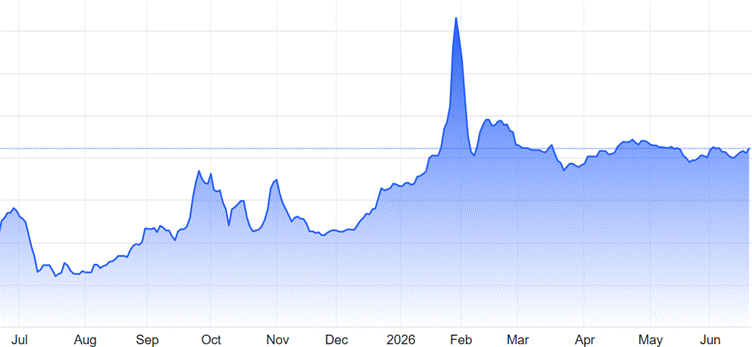
RM: We now have a lot of our energy supply concentrated in the wrong area, when you’re talking about fossil fuels. Obviously, wind and solar are not the answer for baseload power.
And damming more rivers like British Columbia is planning to, that’s not the answer either. For the $18 billion that the Site C dam cost you could have made a bunch of SMRs. You could have put up three 1,200-megawatt nuclear power plants, instead of one dam that generates 1,200.
It just seems like we need to change direction and I think that’s happening.
KB: Yes, I completely agree with what you said there. I think optionality is key when you’re talking about your energy infrastructure. Not enough jurisdictions have taken advantage of what nuclear power can offer as a steady, reliable, clean baseload source of energy.
That’s changing for sure. You see a lot of jurisdictions, a lot of countries are understanding that they better take advantage of this. With all that demand that’s coming down the pipeline, from the supply side, we’ve got to get going and we need capital, we need investment, we need the market to understand that we’re going to have a bit of a supply issue.
That’s already occurring in present day. We need heavy investment and we need to start making great discoveries again. Hopefully Cosa’s on to one ourselves.
RM: Tell us more about the drill program. How many meters, how many holes, where you’re going to drill and why?
KB: It’s 15 drill holes, about 6,000 meters, give or take. It’s by far the largest program to date as a company.
Denison is funding their 30% portion of the budget. Essentially, we’re going to start stepping out in either direction, east and west of where we hit that uranium and adjust on the fly; it’s going to be results-driven. We think we have a good idea, the best places to step out.
But these things change as you step out in different directions. How fortunate are we that our shallowest and easiest project to work is very well located and just happens to be where we’ve had our best result? That’s fantastic for us and our shareholders.
We’re going to turn over every stone on that project to try and find an economic deposit because of all those factors — the uranium, everything else that’s happening there. We have a huge inventory of targets on that project, obviously in and around where we hit the uranium, but there’s still a lot of regional things that are happening that will need to be tested in the near future.
It’s an exciting time for us. This could be our most rewarding and important program as a company.
These things are very rare, and we could be on to something great. Hopefully within these next few holes, these next couple months, we can really update the market on something special.
RM: Why would somebody consider making an investment in Cosa right now?
KB: Honestly, we’re at that inflection point where these next few months or even next year could really change what this company is, and we’ve done a lot of de-risking in the sense that we do have uranium mineralization in amongst great infrastructure at shallow depths, and now we need to start to grow it and hopefully turn it into something that’s economic.
If we do have success here in the next year or so, or even in the next few drill holes, we’re going to be a much different company come this same time next year on the back of a great discovery. These are rare. When you jump on it, it’s amazing if it turns into a significant discovery.
RM: Thank you Keith.
KB: Thanks, Rick.
Richard (Rick) Mills
aheadoftheherd.com

Subscribe to AOTH’s free newsletter
Richard does own shares of Cosa Resources (TSXV:COSA, OTCQB:COSAF).
COSA is a paid advertiser on his site aheadoftheherd.com.
This article is issued on behalf of COSA.
Legal Notice / Disclaimer
Ahead of the Herd newsletter, aheadoftheherd.com, hereafter known as AOTH.Please read the entire Disclaimer carefully before you use this website or read the newsletter. If you do not agree to all the AOTH/Richard Mills Disclaimer, do not access/read this website/newsletter/article, or any of its pages. By reading/using this AOTH/Richard Mills website/newsletter/article, and whether you actually read this Disclaimer, you are deemed to have accepted it.