 RSS Subscribe
Humanoid robots, ground drones, robot attack dogs all part of future warfighting capabilities – Richard Mills
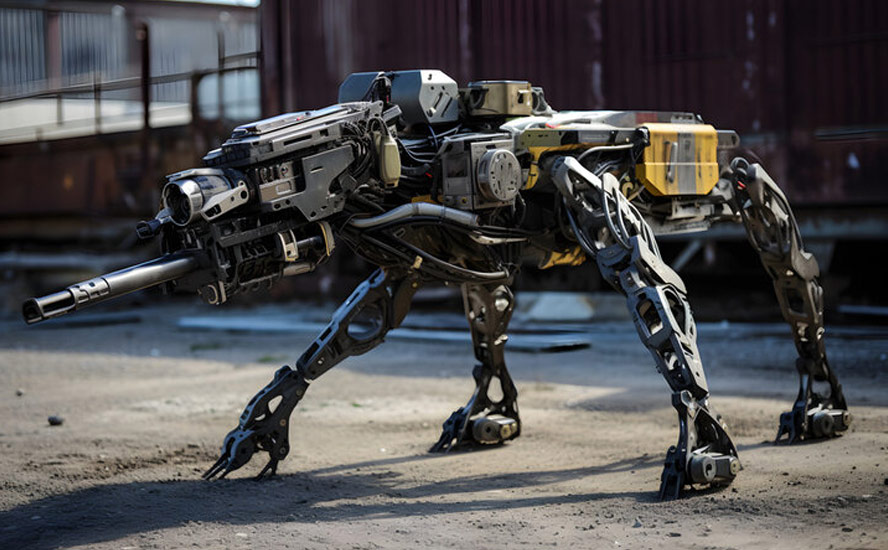
In ‘The Terminator’ series of action films starring Arnold Schwarzenegger, a cybernetic organism (cyborg) is programmed from the future to go back in time and kill the mother of the scientist who leads the fight against Skynet, an artificial intelligence system that will cause a nuclear holocaust.
Terrifying and at times comical (“I’ll be back”, “Make my day”) The Terminator cyborg was among the first presentations of artificial intelligence (AI) to a global audience. The robotic assassin also depicted an extreme scenario of what could happen when “machine learning”, a vital element of AI, runs amok – i.e. when machine intelligence surpasses human intelligence to the point when the machines take over and try to eliminate the humans who created them.

In the sci-fi Netflix series ‘Black Mirror’, three members of a survival group encounter a killer robot dog with no face.
“This dog is completely expressionless, adding a cold and calculating element to its purpose to apparently search and destroy any human it comes across. Part of what makes this killer robot so chilling is perhaps because the technology it employs does not seem that far-fetched compared to what is possible today,” reads a review in Cyperbunk Matrix.
Indeed, the design of robots used in warfighting is already with us and advancing rapidly. What started with aerial drones has progressed to the harder-to-control ground drones which perform a variety of battlefield functions from surveillance to carrying wounded to safety, dystopian dog robots, and finally, robotic warriors that could, and likely will, take the place of their flesh-and-blood human counterparts.
Gun-toting humanoid robots that evoke invincible Terminators are still five to 10 years away, but the technology is advancing to a level that is on the cusp of revolutionizing warfare as we know it.
Ground drones
This week CNN reported that a Ukrainian operation using robots dropped behind enemy lines and “Trojan” armored personnel carriers laden with explosives captured more than 250 Russian troops:
During one assault operation, Ukrainian military managed to airdrop robotic systems equipped with heavy guns more than 10 kilometers (6.2 miles) behind the Russian lines, according to Andriy Biletskyi, the commander of the Third Army Corps.
Controlled from the safety of command centers deep inside Ukraine-held territory, these land drones were then able to attack Russian troops from an unexpected direction.
The skies above the front lines in Ukraine have been swarming with drones for years now, posing a threat to infantry so grave it has forced Ukraine to make ground robots an integral part of its arsenal.
These land drones are much harder to spot and intercept than larger military vehicles. Compared with their aerial counterparts, they can operate in all weather conditions and carry much larger payloads.
But Operation Vivaldi is the first time they are known to have been smuggled behind Russia’s defensive lines.
In another innovation, the Third Army Corps converted old Soviet-era armored personnel carriers into unmanned kamikaze ground vehicles by stuffing them with explosives and sending them towards Russian fortification, prompting Ukraine’s military to refer to them as “Trojan” tanks.
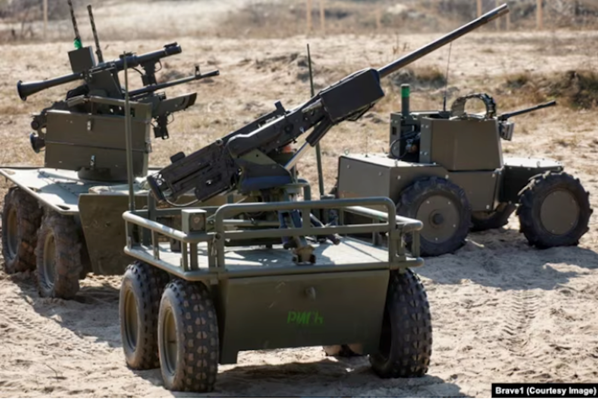
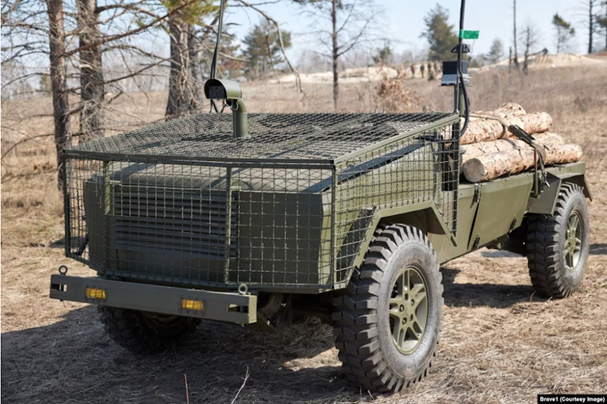
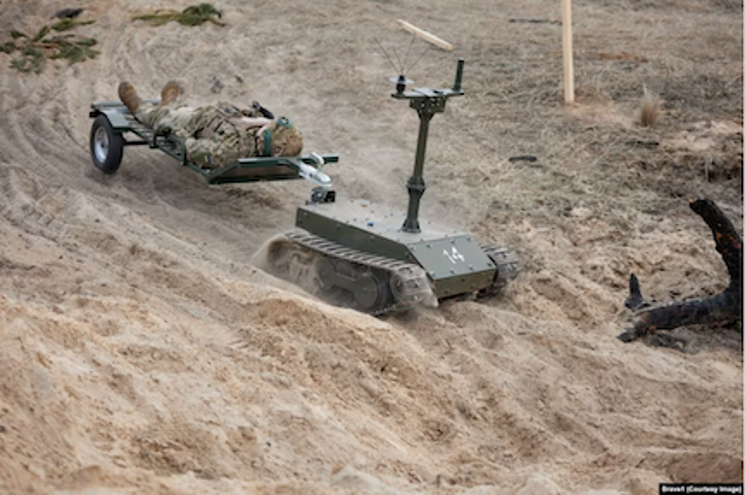
Ukraine uses ground (or land) drones — formally known as Unmanned Ground Vehicles (UGVs)— for dangerous frontline tasks like logistics, medical evacuations and combat assaults.
Soldiers control the land robots from split computer screens showing live footage of what look like flatbed trucks about the size of bumper cars. These are unmanned ground vehicles, battery-operated remote-controlled land robots with cameras.
Ukraine’s defense ministry says the country is making 25,000 ground drones in the first half of this year, more than double produced all of last year when ground drone use began in earnest. (NPR)
A platoon commander tells an NPR reporter how last summer they used ground drones to surround Russian troops in a dugout as aerial strike drones flew overhead.
“At some point they found some piece of cardboard and wrote on it that they wanted to surrender. And the Russians did to the land robot, a first in warfare. It was really the most comical situation,” the commander said, adding that the Russians have started copying Ukraine’s land drones to make their own.
A crude version of today’s land drones was developed during World War II. According to Radio Free Europe/ Radio Liberty, they were first used in combat by the USSR during its invasion of Finland in 1939:
The Soviet “teletanks” were conventional tanks equipped with a radio control system. The vehicles were limited by the human controllers needing to steer the vehicle and aim its weapons from a distance without the aid of modern video feeds. Soviet teletanks were reportedly last used in combat in 1942 during World War II.
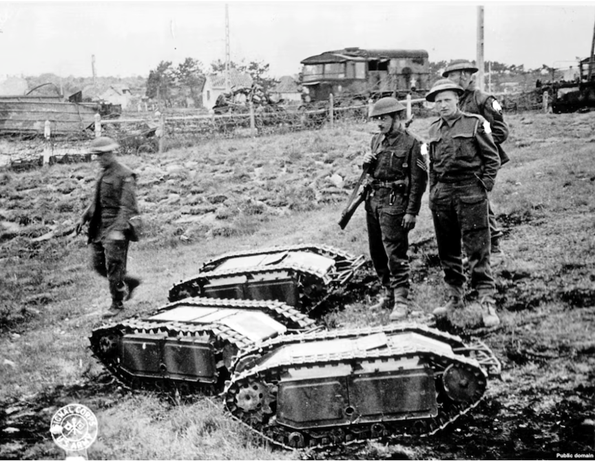
Also, during the war, the German military built a kamikaze ground drone dubbed the Goliath. The bumper-car-sized vehicle was loaded with explosives and controlled through a wire that trailed behind as the Goliath made its way toward enemy positions. Thousands of the “demolition drones” were produced, but they proved slow and cumbersome and were easily stopped by gunfire.
A Telegram post shows two tracked Russian ground drones armed with grenade launchers being destroyed by Ukrainian aerial drones. Other visuals of drone-on-drone destruction feature a ground drone firing volleys of tracer bullets at a Russian position and a wheeled kamikaze drone detonating an explosive device under a bridge in Russian-held territory.

While their use is becoming more widespread, land drones have their limitations. For one, they are slow and cumbersome and easily stopped by gunfire. Michael Boyle, an associate professor at Rutgers University and author of a book on drone warfare, told RFE/RL a major problem is navigating uneven, rough terrain.
Obstacles as simple as a ditch, or coils of barbed wire that a soldier could easily hop over, present an impassable barrier for many ground drones.
Another key factor is cost.
“Developing a ground vehicle that can operate over uneven terrain remotely, and be integrated with other military units, is expensive,” Boyle said.
While kamikaze aerial drones costing a few hundred dollars are routinely sent on one-way missions, ground drones large and advanced enough to navigate pockmarked battlefields “are generally not disposable in the same way,” Boyle said.
Robot attack dogs
“Scouts” act as the eyes and ears of the commander on the battlefield by gathering vital intelligence, tracking enemy movements and assessing terrain. Old war movies like ‘Platoon’ depict these brave individuals who move ahead of the main force to spot and report on enemy positions, vehicle types, weapon systems and troop numbers.
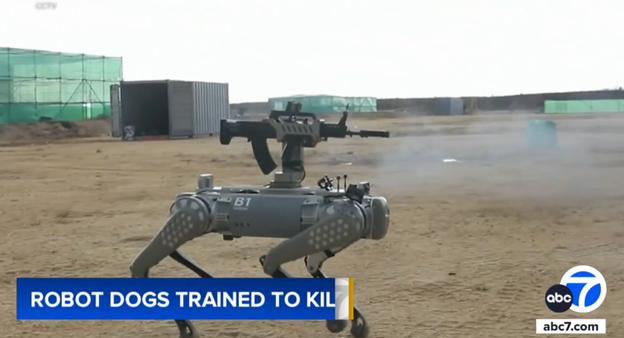
US Army Testing Creepy Robot Dogs for Extreme Combat Operations
Chinas NEW Type of Military Robot Dogs SHOCKED US ARMY
Again, in the Ukraine war, human scouts are being replaced by robot dogs, who are used to navigate mine fields and map enemy trenches. This, though, could only be the beginning. Innovators are experimenting with attaching weapons to the dogs and using AI to allow them to identify and attack their own targets.
The Daily Mail explains described the robot attack dogs and how they are being used by Ukraine’s Cartier Brigade against Russia:
It’s got four legs, each controlled by its own motor with pressure sensors in the paws. These limbs are powered by a computer brain that was trained using artificial intelligence. What that means is it’s very skilled at walking.
It can hop, skip, dance, and stand on its hind legs if you really want it to. But it also has practical skills like climbing over obstacles, lying down, and jumping, which are much more useful on a battlefield. This dog can run at up to 10 miles an hour, helping it to evade enemies.
The main body of the dog houses the battery, which powers the robot, giving it up to four hours of life before it needs to be recharged. There’s a retractable strap, which can secure an object to the dog’s back, and it can comfortably lift eight kilos, though that can be increased to 12 kilos in a pinch. When it’s not carrying cargo, a robotic arm can also be fitted to the top of the dog, allowing it to lift and move objects.
Bluetooth, Wi-Fi and 4G transmitters inside the body allow (the dog to be controlled remotely. There’s also a built-in intercom system, meaning the dog’s controller can speak to anyone nearby, and they can speak back. Up here in the head are a bunch of sensors, cameras and lights, which allow the robot and its controller to sense their surroundings.
The large spinning semicircle on its chin is a LiDAR or laser radar, which allows the robot to accurately map its surroundings. This gives the robot’s controller an incredibly detailed map of anything the dog can see, and helps the robot automatically avoid obstacles…
At the top is an HD camera, which allows whoever is controlling the dog to remotely see where they’re going using an app. This is the primary way the dog finds its way around, and between the camera and the lidar is a torch, which can be turned on and off remotely to allow the dog’s controller to see better.
The dog weighs about 33 pounds, stands about 40 centimeters tall, and, purchased off the shelf, costs about $3,000, making it pretty cheap…
Ukraine is currently locked into a war of attrition against its much bigger neighbor, and the winner will be whichever country can exhaust the other’s resources first.
One of the most important resources is manpower, and Ukraine, as with most things, is suffering a chronic shortage of it. Preserving the lives of its soldiers is therefore paramount, and Kiev’s generals are willing to consider any solution that keeps them out of harm’s way. And that’s where the robots come in.
China’s robot army
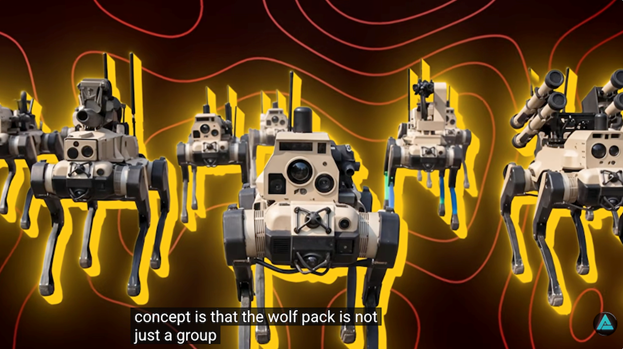
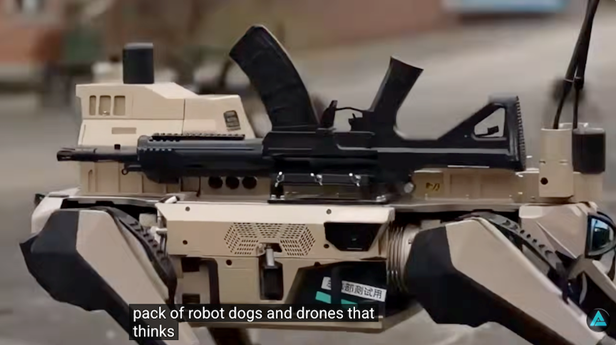
According to AI Revolution, China has just revealed an “autonomous robot war pack” built from dog bots, drones, laser weapons and unmanned boats. The idea is that the “wolf pack” — referring to a World War II naval tactic where German U-boats coordinated in groups to track and mass-attack Allied shipping convoys — is not just a group of robots, but a distributed network with a shared digital brain, with each machine having a specific role:
Shadow is the scout, handling real time situational awareness.
Polar is the heavy lifter, moving logistics and ammunition. And then there is Bloody, the strike element, a robot dog that is (1:33) basically a walking arsenal armed with an automatic rifle, grenade launcher and mini rockets. The new generation is faster and more durable.
They hit around 15 kilometers per hour and carry up to 25 kilograms of payload. The joints are flexible enough to handle rubble and staircases in urban environments, and the control scheme is aggressively simple.
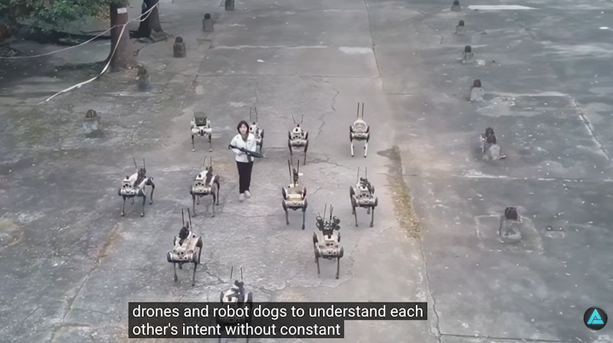
One soldier can run the whole pack using voice commands, a joystick mounted on their rifle or even gestures through a tactical glove.
The wild part is a system called ATLS. Chinese engineers trained a swarm of 96 drones and robot dogs to understand each other’s intent without constant radio communication. That means the network can coordinate attacks even under full signal jamming or GPS denial.
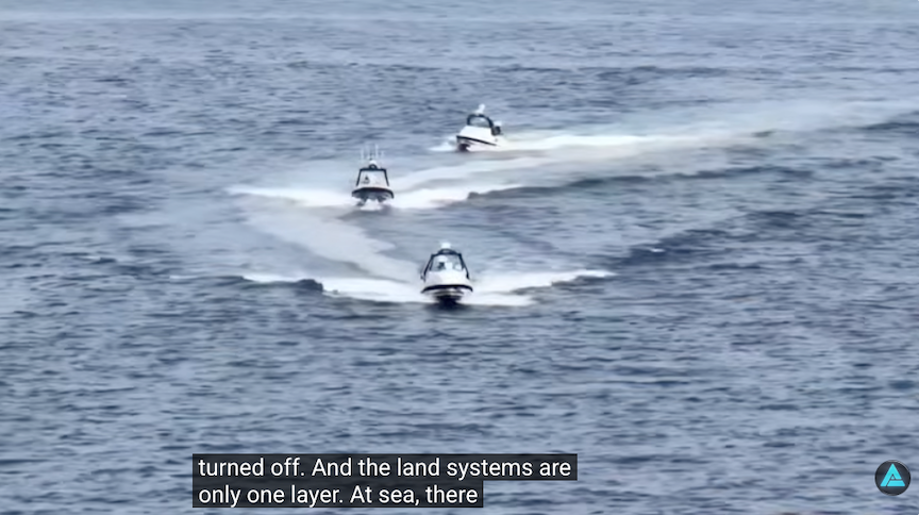
The whole thing is built to operate when the classic tools of electronic warfare are turned off. And the land systems are only one layer. At sea, there are unmanned L30 boats running at 65 kilometers per hour that can autonomously encircle and ram targets.
In the air, there are laser cannons called Guangjian, where one unit blinds drone swarms and another burns out the electronics on the highest priority threats. Algorithms handle the targeting hierarchy. The operator basically gets one button, confirm strike.
Humanoid robots
Warfighting robots are currently transitioning from remote-controlled support and surveillance tools into active battlefield testing.
According to US robotics firm Foundation Future Industries, AI-powered humanoid robots may become weapons as early as 2027. The firm has already tested its Phantom robots in Ukraine.
Euronews quotes CEO Sankaet Pathak saying he expects to begin testing weaponization use cases for its robots “as early as next year,” following the Ukrainian pilot programs.
But Pathak rejects the “Terminator” comparison, arguing that humanoids become useful specifically when a military objective requires precision, avoiding damage to infrastructure and harm to civilians while carrying out a complex mission. He sees the technology filling a gap as ground combat becomes increasingly dangerous for human soldiers.
The robot soldiers “think” using artificial intelligence built by companies’ own world models, which work by learning to watch videos or by using simulation data and other spatial inputs, and then building their own representations of scenes or objects, Euronews explains.
Foundation burst onto the scene in 2026 with its Phantom MK-1 humanoid combat platform, leasing at roughly $100,000 a year. The company, whose investor base includes Eric Trump, has about $10 million in contracts and is aiming at 50,000 units by the end of 2027.
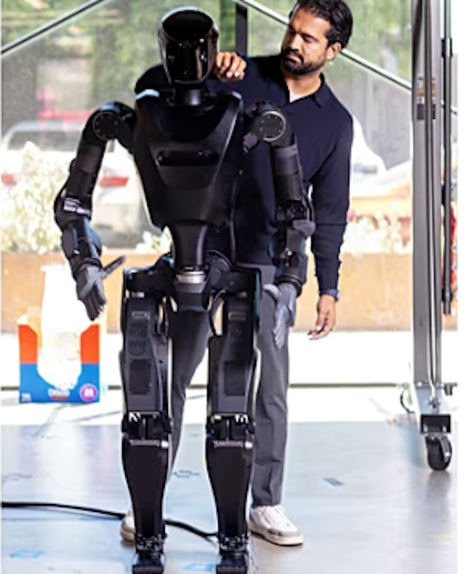

Robozaps Blog makes the following points about Phantom MK-1 and humanoids in general:
- The 5-foot-9, 176-pound Phantom MK-1 is the first affordable combat humanoid. The robot walks at nearly 4 mph, carries over 44 pounds of payload (including weapon mounts), and is designed for modularity — swapping sensor heads, manipulator arms, or armor packages depending on the mission. CEO Sankaet Pathak has publicly stated the company’s goal: make humanoid robots “as common as military trucks.” The Phantom MK-1 is purpose-built for environments too dangerous for soldiers — clearing buildings in urban warfare, traversing minefields, and operating in CBRN (chemical, biological, radiological, nuclear) contaminated zones. Its bipedal form factor allows it to navigate staircases, rubble, and doorways designed for human bodies — a critical advantage over wheeled or tracked robots.
- The Phantom represents the first commercially viable humanoid combat platform. Its bipedal locomotion, modular payload system, and accessible lease pricing make it the benchmark against which all other humanoid military robots will be measured.
- DARPA Robotics Challenge Legacy: While DARPA’s famous robotics challenges (2013-15) focused on disaster response, the technologies developed — bipedal walking, manipulation, autonomous navigation — directly feed into today’s military humanoid programs. Atlas, developed by Boston Dynamics for DARPA, demonstrated capabilities that the Phantom and its competitors are now commercializing.
- Fully autonomous humanoid soldiers are not close: current robots lack general judgment, and human-machine teaming is the realistic model.

The United States, of course, isn’t the only country planning to manufacture and deploy humanoid robots. While China is the most aggressive developer of armed “robot dog” quadrupeds, building on commercial platforms like Unitree’s, the country is actively progressing robots that dance and fight to those with a military function. Earlier this year NBC Bay Areas stated:
At a military parade in Beijing last year, China showed off so-called robot wolves, four-legged machines perched on armored vehicles. And UBTECH, a Chinese-based company, recently released video of what appeared to be more than 100 of its humanoid robots ominously marching. And just this month, Chinese state TV showcased humanoid robots wielding weapons while doing martial arts.
A more recent post by Reuters describes robots at the World Humanoid Robot Games in China jumped, boxed and danced. Some fleet-footed bots ran faster than Usain Bolt over 100 meters. Spectators cheered the machines’ improving capabilities and their meme-worthy stumbles.
Two days after the Games ended, the People’s Liberation Army’s official newspaper drew its own conclusions from the show. The PLA Daily called for researchers to accelerate the transfer of cutting-edge technologies from laboratories to military training grounds for robotic “combatants.”
In China, humanoid robots are being considered for urban warfare. Per Reuters: six “combat robots” – humanoids, robot dogs or unmanned vehicles – would be split up between two assault teams. Working with ground troops, the robots would clear an enemy-occupied building, floor-by-floor and room-by-room.
More ominously, they could play a role in China’s eventual subjugation of Taiwan:
A July 2025 article in PLA Daily argued that humanoid missions could eventually evolve “from supporting combat toward primary combat” and discussed how robots might be authorized to fire on a living target that had been verified by a human.
In December, the PLA Eastern Theater Command released an AI-generated montage that showed military robots, including humanoids and quadrupeds, overwhelming Taiwan’s defenses in a hypothetical future conflict.
Conclusion
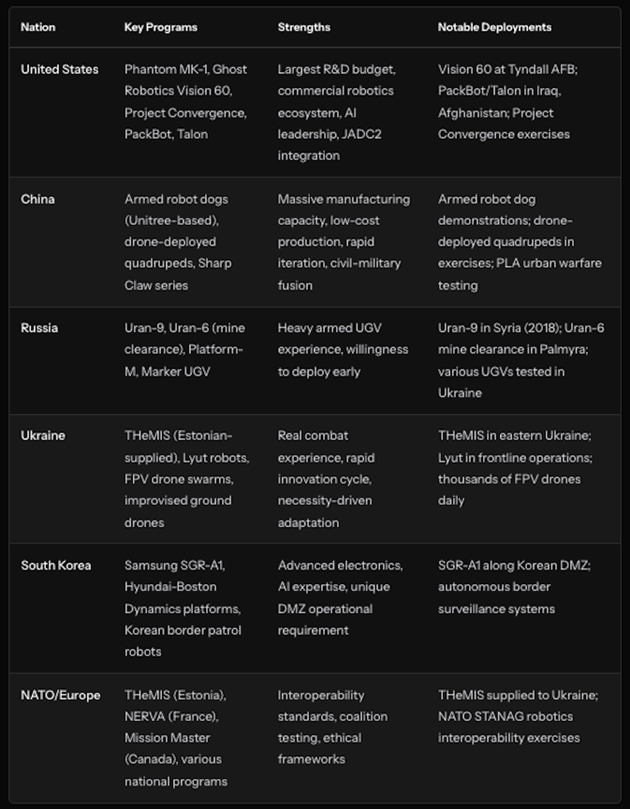
The United States and China are the leading contenders in the artificial intelligence arms race and the stakes couldn’t be higher especially when it comes to military applications.
The Ukraine war has become a training ground for remote-controlled weaponry such as FPV (first-person-view) drone swarms, ground drones, and Lyut combat robots.
The newest and most ambitious category, humanoid combat robots, are designed to operate in environments built for humans — urban terrain, buildings, vehicles and infrastructure.
The question is no longer whether artificial intelligence will enter the battlefield, but how much control humans will retain.
But governments aren’t waiting for fully autonomous humanoids to replace flesh-and-blood combatants.
The Pentagon has officially established the Autonomous Warfare Command, a four-star combatant command dedicated entirely to deploying artificial intelligence, automated drones, and robotic systems across the US military. US Secretary of War, Pete Hegseth, tapped Elon Musk, Anduril founder Palmer Luckey, and Newt Gingrich to lead Project Meridian, a 120-day-initiative to map out the future of autonomous combat. (WION)
Richard (Rick) Mills
aheadoftheherd.com

Legal Notice / Disclaimer
Ahead of the Herd newsletter, aheadoftheherd.com, hereafter known as AOTH.Please read the entire Disclaimer carefully before you use this website or read the newsletter. If you do not agree to all the AOTH/Richard Mills Disclaimer, do not access/read this website/newsletter/article, or any of its pages. By reading/using this AOTH/Richard Mills website/newsletter/article, and whether you actually read this Disclaimer, you are deemed to have accepted it.