 RSS Subscribe
US risks running out of missiles in war with Iran – Richard Mills
202603.05
Last Saturday, Feb. 28, the United States and Israel struck Iran, killing the supreme leader, Ayatollah Ali Khamenei, along with three members of his family and several high-ranking figures in the regime.
Iran retaliated with missile and drone attacks across the region, including targets in Israel and US military assets in Bahrain, Saudi Arabia, Qatar, the United Arab Emirates and Iraq.
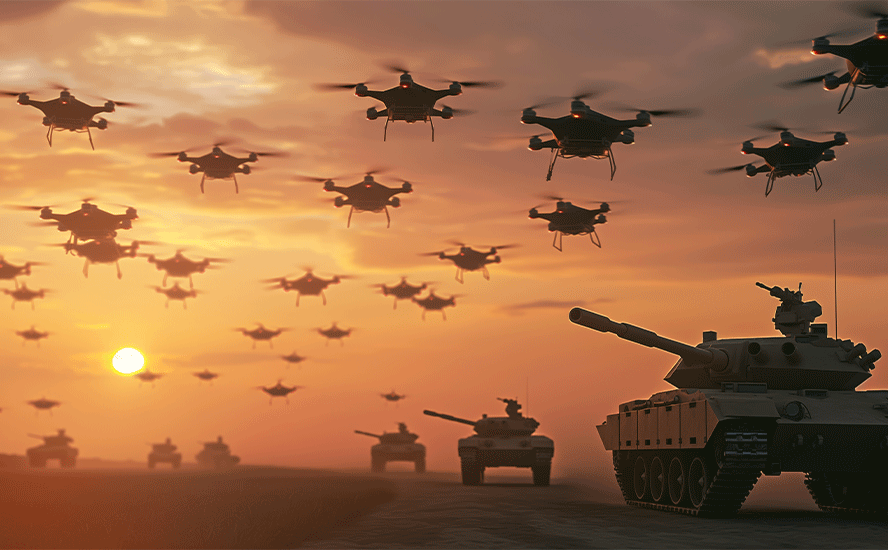
But according to several sources identified by Ahead of the Herd, including leaks from the Pentagon, if war with Iran continues for longer than expected —Trump has said four to five weeks — the inventory of certain US missiles, especially critical interceptor missiles, could run dangerously low.
Aljazeera reported that the Pentagon warned President Trump that an extended military campaign in Iran would carry serious risks, including the high cost of replenishing Washington’s dwindling munitions stockpiles.
The Washington Post reported that General Dan Caine, chairman of the joint chiefs of staff, told Trump that a lack of critical munitions and support from regional allies could hinder efforts to contain a possible Iranian retaliation in the event of an attack by the US.
US munitions stockpiles, including those used in missile defence systems, have been stretched thin by their use in support of allies such as Israel and Ukraine, according to the report.
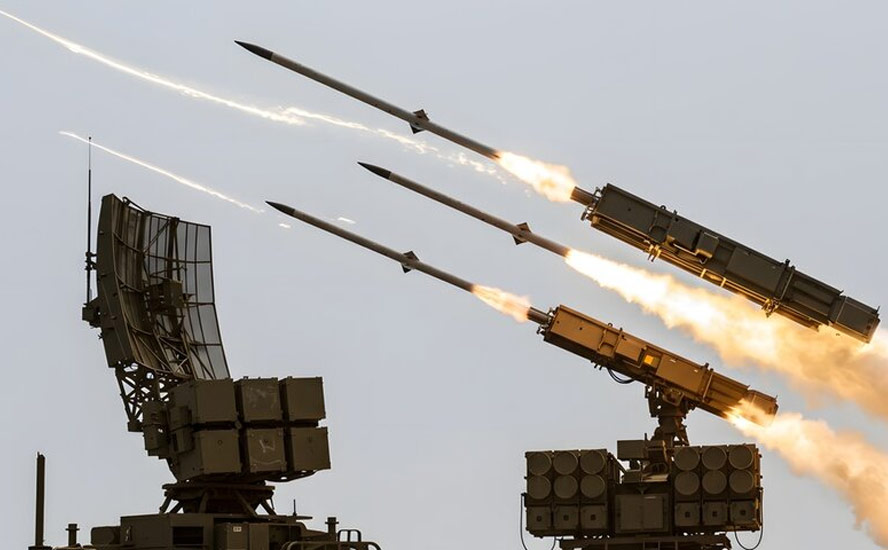
First, a look at what weapons the US is using in its attacks on Iran. According to the US military’s Central Command (CENTCOM), via Aljazeera, it has so far used more than 20 weapons systems across air, land and sea and missile defense forces. Specific weaponry includes:
- B-1 bombers, B-2 stealth bombers, F-35 Lightning II stealth fighters, F-22 Raptor jets, F-15s and EA-18G Growlers.
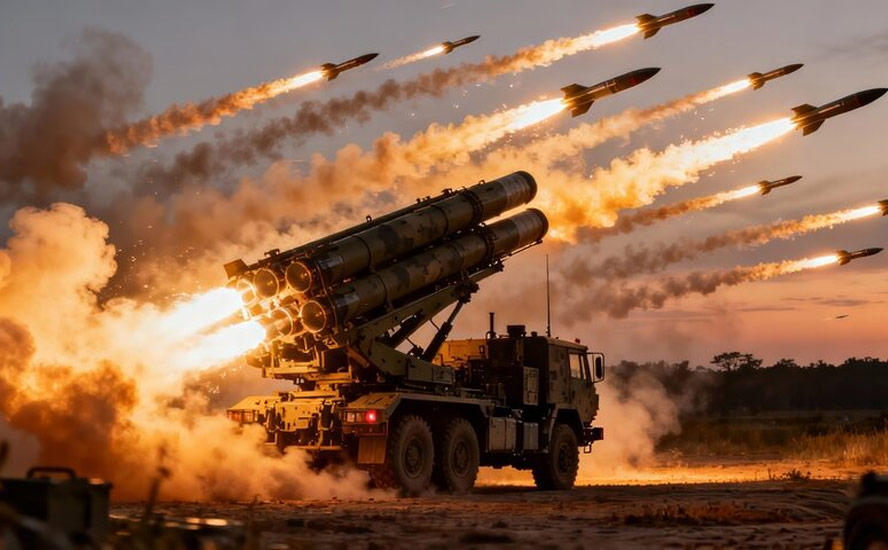
- Drones and long-range strike systems, including the Low-Cost Unmanned Combat Attack System (LUCAS) one-way drones, MQ-9 Reaper drones, M-142 High Mobility Artillery Rocket Systems (HIMARS) and Tomahawk Cruise Missiles.
- Air defence systems such as the Patriot, Terminal High Altitude Area Defense (THAAD) batteries and Airborne Warning and Control System (AWACS) aircraft.
- Two US aircraft carriers, the USS Abraham Lincoln and the USS Gerald R Ford, were in the Middle East when the attack on Iran began.
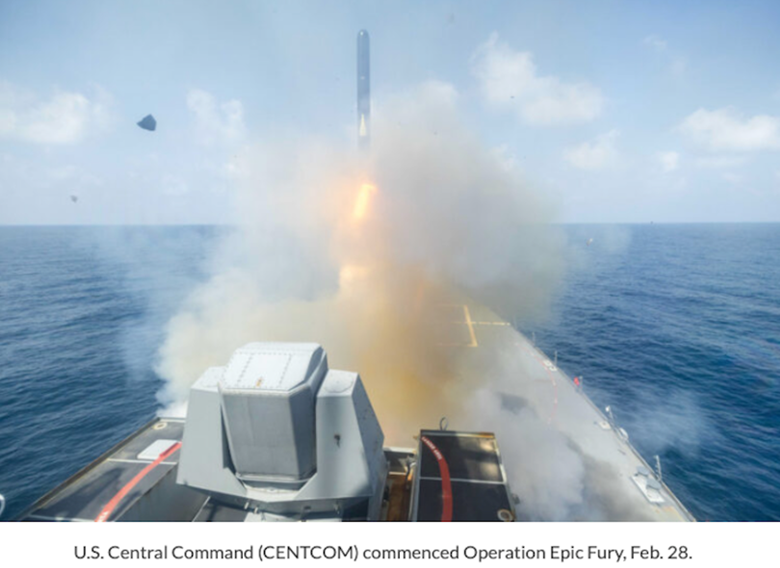
Bloomberg said opening salvos included BGM-109 Tomahawks, slow but accurate cruise missiles with a range of over 1,000 miles designed to hit targets deep in enemy territory.
Hundreds of these missiles have been fired so far, but the US only has about 4,000 remaining; they cost several million dollars apiece and less than 100 are produced per year.
Another concern is the number of Patriot PAC-3 interceptor missiles that have been fired. If the US runs out, it may have to pull more of them from Indo-Pacific Command.
The problem for the US, says Bloomberg, is it is using high-end weapons against a relatively weak enemy, sapping its ability to fight a superpower like China.
Tom Karako of the Center for Strategic and International Studies, said, ““It would be highly desirable if we were able to switch to gravity bombs.”
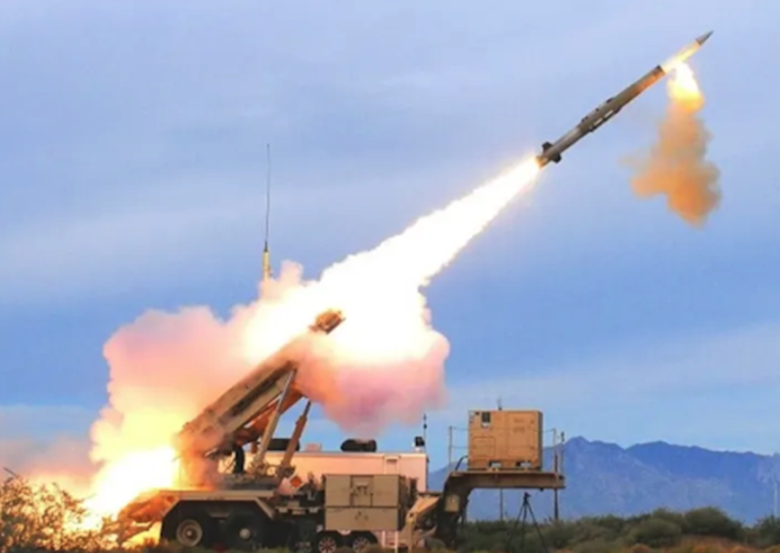
If the war continues, the most likely shortages would be high-end munitions and interceptors like THAAD. Made by Lockheed Martin, THAAD uses radar and interceptor missiles to shoot down short, medium and long-range missiles of distances between 93 and 124 miles. The US has nine THAAD systems around the world.
Also at risk of depletion are Joint Direct Attack Munitions (JDAMs), which are guidance tools that use GPS to turn unguided “dumb” bombs into precision-guided “smart” munitions.
According to Aljazeera,
Experts say high-end missile defence systems are primarily designed to deal with limited, high-intensity attacks from states such as Russia, China or North Korea in mind, rather than from prolonged, large barrages of cheaper missiles.
Over time, finite stockpiles of advanced interceptors will run down at very high cost, analysts say, as each interception can cost hundreds of thousands or even millions of dollars to take down a missile that may only have cost a few thousand dollars to build.
Marca Rubio, the US Secretary of State, said Iran can make many more offensive weapons than the US and its allies can build interceptors to stop them. We’re talking 100 cheap missiles versus six to seven interceptors per month. This doesn’t include the tens of thousands of attack drones that Iran has been building despite sanctions.
Stocks of Standard Missile-3 (SM-3)— an antiballistic missile interceptor launched from warships — are already running low due to slow production, strikes on Yemen’s Houthis, and earlier clashes with Iran, Aljazeera reported. SM-3s are the most expensive of the interceptor missiles, costing about $14 million each.
Christopher Preble, a senior fellow at US think tank Stimson Center told the publication that, at the current pace of operations, the number of interceptors could not continue for more than several weeks.
But Ryan Bohl, a senior Middle East and North Africa analyst at the RANE Network, said historical precedent suggests the conflict may not be indefinite, noting that among past US air campaigns, the longest was 90 days against Serbia in 1999.
If the US were to run low, Preble said the US could move weapons to the Middle East from other deployments but noted there would be concern in removing weapons from the Indo-Pacific theater “in the event of a contingency”, a veiled reference to a Chinese attack on Taiwan. (more on that below)
Kelly Grieco, a senior fellow at the Stimson Center, told CTV News “There is a risk the United States and its partners could run out of interceptors before Iran runs out of missiles, though it is far from certain.”
Grieco estimates at the beginning of the war, Iran had 2,500 ballistic missiles, more than the combined ballistic missile interceptor totals of Israel and the United States.
The Guardian notes Iran and its proxies like Hezbollah have sought to counter the joint US-Israeli offensive with more than 1,000 strikes against targets across a dozen countries spread over 1,200 miles, making the conflict the widest in the Middle East since World War II.
Stacie Pettyjohn, the director of the defense program at the Center for a New American Security in Washington, said the conflict had become “a bit of a salvo competition”.
“The question is who has the deeper magazines of key weapons, and the big unknown is how deep Iran inventories are,” Pettyjohn told the Guardian.
Missile depletion was a problem even before the war with Iran started on the last day of February. According to Responsible Statecraft, Historic levels of air defense missiles were expended by U.S. Navy ships in the Middle East in defense of Israel and in protection of Red Sea shipping since October of 2023.
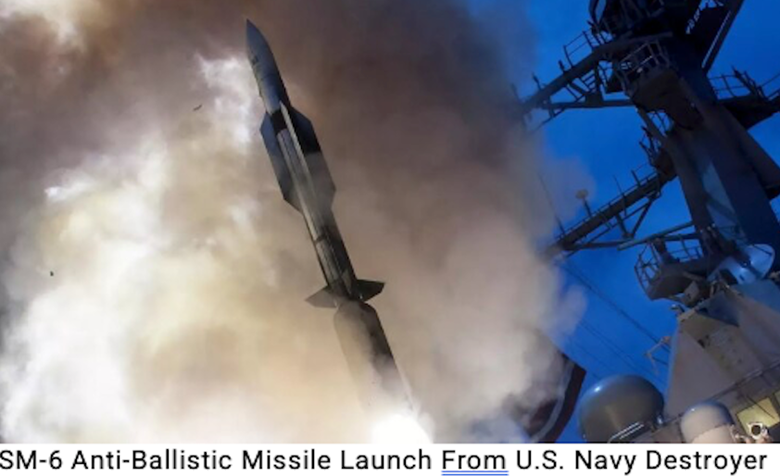
In 2024, Iran attacked Israel twice. To supplement Israel’s ballistic missile defense, 24 missiles were launched from four destroyers — 12 SM-3s and 12 SM-6s.
The article says the Navy launched an estimated 130 SM-3s and 150 SM-6s during the 12-day war between Israel and Iran last June.
Adding in the number of missiles fired for the Red Sea conflict gives a grand total of 268 SM-2s, 159 SM-3s, and 280 SM-6s used in the Middle East from October of 2023 through the end of June 2025.
This is concerning, but more alarming is that production hasn’t kept up with missile deployment. From Jan. 1, 2024, to the end of June 2025, the Pentagon produced 187 SM-6s, 87 SM-3s and zero new SM-2s.
All told with the expenditures in the Red Sea and Israel, we could be looking at a 3% decrease in SM2s, 33% decrease in SM3s, and 17% decrease in SM6s in the U.S. stockpiles since 2023.
The US isn’t the only country at risk of running out of defensive weaponry. The United Arab Emirates stated on Tuesday it is depleting its interceptor missiles, having so far destroyed 161 out 174 ballistic missiles launched at the country. 645 out of 689 Iranian drones and eight cruise missiles were also blasted out of the air.
Arab countries might have burned through 800 PAC-3 or THAAD interceptors in a couple of days. In comparison, America used just 158 Patriot interceptors over six weeks in the first Gulf war, leading The Economist to ask, ‘Are Gulf states running out of missile interceptors’?
In 1991 Saddam Hussein fired 42 missiles at Israel and 46 at Saudi Arabia. “By recent standards, that was a light sprinkling,” the publication jested.
Grieco said Iran knows that a lot of weapons in the Gulf are being burned through, which is why their salvos are not very big.
“It’s death by a thousand cuts, and so much the preferable strategy for the weaker [combatant] in the fight.”
Barron’s notes that part of Iran’s strategy has been to have cheaper drones hit by interceptors before striking with missiles in an attempt to deplete allies’ interceptor inventories.
According to an AI Overview, as of early 2026, the United States faces significant challenges in maintaining sufficient interceptor missile stockpiles for a prolonged, high-intensity war, with analysts warning that high-end supplies could be exhausted within days or weeks of sustained combat. While production is being ramped up, current inventories of key interceptors — such as THAAD and SM-3 — are considered critically low due to recent high usage in the Middle East.
Key points cited by the Center for Strategic and International Studies (CSIS):
- THAAD (Terminal High Altitude Area Defense): Following intense usage in 2025-26, estimates suggest that 20% to 50% of the entire US THAAD inventory may have been expended. Production is slow, with only about 12-25 new interceptors expected per year in some estimates.
- Patriot (PAC-3 MSE): The US Army has requested a massive boost to its stockpile, aiming for 13,773 total missiles in the coming years. However, current annual production is only around 600-650 units (as of 2025-26), with plans to increase this to 2,000 annually over the next seven years. In early 2026, it was reported that the US had only about 25% of the Patriot interceptors needed for its full military plans.
- SM-3: Used for ballistic missile defense, with about 500+ total delivered by the end of 2025. Roughly 20% of the total inventory was used in recent 2025-26 conflicts.
- Ground-Based Interceptors (GBI): 44 interceptors are deployed for national missile defense, designed to counter limited, rogue-state attacks rather than peer-competitor arsenals.
Key takeaways for prolonged war:
- Rapid depletion: High-end interceptors could be depleted in days, with some systems running out after two or three major salvos from a peer competitor.
- Slow replacement: Production rates for high-end missiles (SM-3, THAAD) are slow, taking years to replace what is used in just weeks of combat.
- Supply chain strain: The industrial base is struggling to keep up with demand, despite new, large contracts aimed at expanding production for systems like the Patriot PAC-3 MSE.
- Operational risk: The depletion of these weapons poses a major risk to Pacific deterrence, as resources are diverted to the Middle East.
12-day war: US and its allies unprepared for missile barrage
During the 12-day war between Israel and Iran last June, the US deployed two of its THAAD missile defense systems to Israel.
The United States also bombed three Iranian nuclear facilities.
After the war, Aljazeera said US officials reported that they had to fire more than 150 of these missiles to intercept incoming Iranian missiles, multiple news reports said, accounting for about 25 percent of its THAAD interceptors.
According to US media reports, the US also ran out of large numbers of ship-borne interceptors during the war last year.
Experts cited by CNN believe the US fired at least 80 THAAD interceptors. At $12.7 million a pop, that works out to just over $1 billion spent during the 12-day conflict.
With 25% of US THAAD capacity used during the brief Israel-Iran encounter, an obvious question is whether the United States military is making enough of them, considering all the other hot spots in the world that could flare up into missile-flinging events.
According to Military Watch Magazine, the US Army has also heavily depleted its stockpiles of surface-to-air missiles for the Patriot system, which in July 2025 had fallen to just 25% of the volume deemed necessary by the Pentagon.
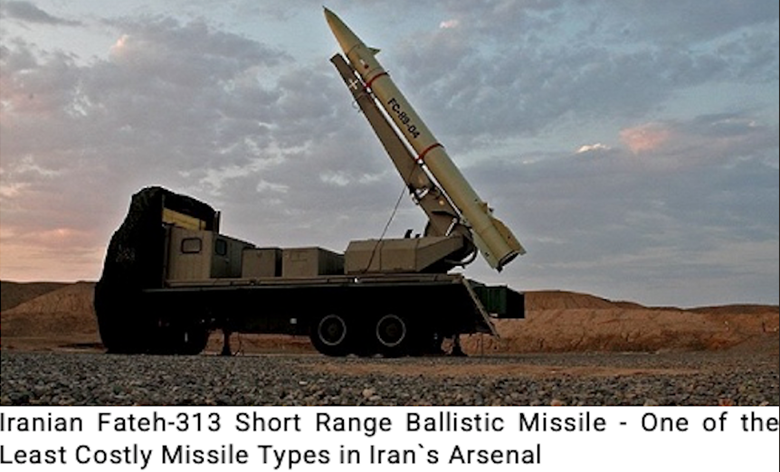
This depletion was assessed by a number of Western sources to have been a primary factor in the Trump administration’s decision to suspend supplies to Ukraine at the time. Each PAC-3 MSE interceptor costs approximately $3.9 million, several times the cost of low value Iranian ballistic missiles like the Fateh-313 which are estimated to cost well under $500,000. This has made it vital for the U.S. Armed Forces to neutralise the bulk of the Iranian missile arsenal on the ground, as intercepting any significant portion of missiles launched would be both unaffordable, and beyond the current capacities of its missile defence arsenal.
Taiwan’s defense at risk
Four former senior US defense officials said the low stockpile problem is most acute in inventories of high-end interceptors that are a key part of deterrence against China, i.e., in the Indo-Pacific where the United States Navy maintains a large presence to protect its allies, including Taiwan, against an encroaching Chinese navy.
The US has THAAD systems in South Korea and in Hawaii, Guam and Wake Island. Taiwan has refused to accept the interceptor missiles. The alternative is to rely on AEGIS, a very expensive system that operates at sea and therefore is not capable of fully protecting US and allied bases in the region. (Asia Times)
“From a narrowly military standpoint, the Chinese are absolutely the winners in that these last almost two years in the Middle East have seen the US expend pretty substantial amounts of capabilities that the American defense industrial base will find pretty hard to replace,” said Sidharth Kaushal, senior research fellow at Royal United Services Institute.
“God forbid there should be a conflict in the Pacific,” added a former senior Biden administration defense official.
This week Asia Times headlined an article ‘China watching as US missile stocks drain over Iran’.
Officials say the munitions drain in Iran may force to US to divert stocks from the Pacific, potentially compromising military readiness against China.
“Regional attrition warfare in the Middle East could erode Pacific deterrence and widen vulnerabilities in a conflict over Taiwan,” the article states.
It makes several points describing how China and Russia are supporting Iran militarily and economically:
- As Silvia Boltuc mentions in a Special Eurasia report this month, Russia and China have progressively supported Iran as its “eyes” by supplying high-tech capabilities, from satellite surveillance to sophisticated missile guidance systems, thus helping Iran avoid operating in isolation.
- For China, Iran is a critical energy source, accounting for 13.4% of its seaborne oil imports last year. Iran’s discounted oil gives China substantial cost savings, helping it compete in its trade war with the US, and is critical to China’s plans against the US over Taiwan.
- She points out that Iran has officially transitioned its military architecture from US GPS to China’s Beidou, with the latter system also providing short message service, allowing Iranian command nodes to communicate even if local networks are down.
- In addition, she notes that Iran has access to China’s encrypted, high-precision military signals that are resistant to Western jamming.
- Boltuc mentions that China uses its fleet of 500+ satellites to support Iran with signals intelligence (SIGINT) and help track US naval movements in the Persian Gulf. Like Russia, Boltuc says China has focused on providing Iran with CM-302 supersonic anti-ship missiles and YLC-8B anti-stealth radar.
- By striking before Russian and Chinese assistance to Iran could be brought to bear, Israel may be using that window of opportunity to decapitate the Iranian regime, with the US aiming for a decisive victory to forestall a looming munitions shortage in the Pacific in a possible war with China over Taiwan. Prolonged hostilities with Iran would only deepen America’s Pacific vulnerability.
As for how the United States military would fare in a war with China over Taiwan,
A January 2026 Heritage Foundation report warns that high-end interceptors such as SM-3, SM-6, Patriot Advanced Capability 3 Missile Segment Enhancement (PAC-3 MSE) and THAAD would likely be exhausted within days of sustained combat, with some systems depleted after just two to three major People’s Liberation Army (PLA) salvoes.
The report says that aggregate US vertical launch system (VLS) inventories at an estimated 17,000 rounds are insufficient for even one full fleet reload, and pier-side rearming creates multi-week gaps.
It adds that replenishment is constrained by throughput limits of an estimated 500 underway replenishment (UNREP) units a day, and 14-21 day transit times, risking systemic failure within 30–60 days.
Bottom line? If you run out of defensive missiles before your opponent runs out of offensive missiles you lose.
Arsenal rebuild underway
In a column written this week Shaun McDougall, senior North American analyst, US defense budget analyst, and military structures of the world analyst at Forecast International, notes that the need for the Pentagon to rebuild its arsenal resulted in an influx of resources from the White House and Congress to expand munitions production:
Specifically, last year’s budget reconciliation bill provided approximately $25 billion for munitions procurement and increased production capacity. Prior to the strikes against Iran, the U.S. also secured deals with Lockheed Martin and RTX with the goal of significantly increasing annual production rates for a range of systems, including Patriot, Tomahawk, SM-3, SM-6, and AIM-120 AMRAAM. As part of this effort, the Pentagon’s FY26 request sought multiyear procurement authority for 13 missile types, with lawmakers ultimately signing off on eight of those.
Efforts are underway to address inventory concerns including:
- Family of Affordable Mass Missiles (FAMM), a low-cost palletized munition
- Lugged Affordable Cruise Missile (LACM), a low-cost missile the service wants to produce in large quantities
- Counter Air Missile Program (CAMP), a program to develop a low-cost, modular weapon capable of high-volume production
The Navy has also outlined a requirement for an affordable air-launched, stand-off, anti-ship missile under its Multi-Mission Affordable Capacity Effector (MACE) program, McDougall states.
Barron’s reports that US defense contractors are aware of the risk of munitions depletion in Iran and are trying to prevent it. According to a recent article,
In January, L3Harris Technologies announced plans to spin its solid rocket motor business into a stand-alone company. The Defense Department is planning to invest $1 billion in an initial public offering to raise funds for production expansion.
What’s more, the Defense Department has agreements with three large missile producers — Lockheed Martin, RTX and Boeing — to triple output over the coming few years.
Lockheed makes Patriot interceptors. Capacity is rising from roughly 600 a year to 2,000-plus. What’s more, in January, the Defense Department and Lockheed announced a plan to quadruple the number of Terminal High Altitude Area Defense, or THAAD, interceptors, to 400 per year from 96.
RTX makes SM-3 interceptors, AMRAAM, advanced medium-range air-to-air missiles, and Tomahawk cruise missiles. Annual AMRAAM capacity is moving to “at least” 1,900. Tomahawk capacity will be 1,000-plus Tomahawk cruise missiles annually. RTX also plans to expand SM-6 interceptor production to more than 500 per year, while increasing SM-3 production.
Boeing can make tens of thousands of JDAMs, joint direct attack munitions, annually.
All these measures are positive steps in addressing the munitions shortfall — though too late to stop depletion in the war with Iran — but the defense contractors are either forgetting or conveniently omitting one thing: the United States relies heavily on China for over 90% of the heavy rare earth processing and magnets used in defense systems, including missiles, with some materials in F-35 fighters and other systems still linked to Chinese supply chains.
American armed forces are totally dependent on the very country that is widely viewed as America’s greatest economic and military threat.
The historical record shows that it should have been the United States that dominates the mining, processing and refining of rare earth elements, not China.
Magnequench has left the building
How the US lost the plot on rare earths
Following the Magnequench debacle, the Chinese filled the void left by US rare earth mining with gusto — establishing the world’s largest rare earth research facility; filing the first rare earth patent in 1983, and over the next 14 years filing more patents than the US which had been working on them since 1950; and acquiring US technology in metals, alloys, magnets and rare earth components.
As of 2025, China accounts for 44% of the world’s rare earths production. The United States is far behind at 15%. (USGS)
It’s easy enough to dig up rare earths; the expertise comes in separating, purifying and refining them.
China is the only country that carries out all these stages, with Australia and the United States selling some of their semi-processed ores back to China to complete the refining! China thus produces 85% of the purified light rare earths used worldwide, and 100% of the heavy rare earths. (Polytechnique Insights)
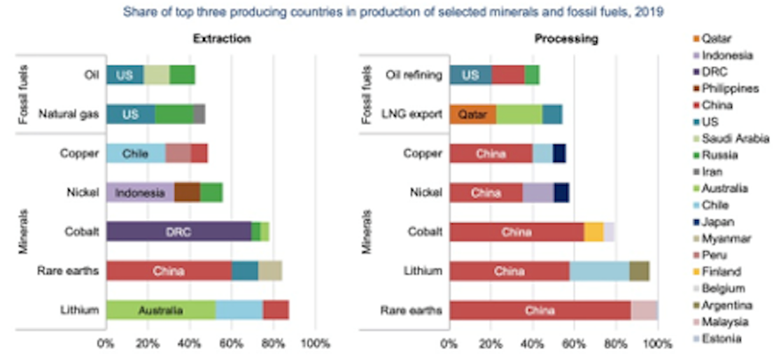
In fact, China has a monopoly on the entire rare earths value chain. But the country has progressively moved from extraction to separation to the manufacture of magnets.
In 2021, China further consolidated its rare earth industry by establishing China Rare Earth Group Co. Ltd, a state-owned enterprise that is a conglomerate of top industry producers to increase its pricing power and production efficiency.
The bottleneck is not in the mining but the processing of rare earths. Techspot notes that “it is the industrial circuitry that converts ore and scrap into high-purity oxides and finished magnets… While the term “rare earth” implies scarcity, the more consequential constraint is a refining and processing system dominated by China.”
Indeed, separating and extracting a single REE takes a great deal of time, effort and expertise. For more read the section on ‘Rare earths 101’ in this 2018 article by AOTH
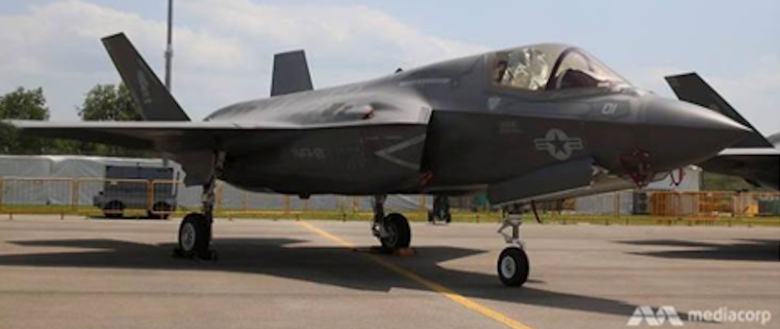
Rare earth elements are present almost everywhere in weapons systems. For example, an American F-35 fighter plane contains more than 400 kg of various materials containing at least one rare earth.
Magnets made from Chinese rare earths are also used in the Joint Strike Fighter, the Pentagon’s answer to a one-size-fits-all warplane.
According to the blog Rare Earth Exchanges,
Rare earth permanent magnets are critical components in modern U.S. military technology due to their exceptional strength and heat-resistant properties. These magnets, primarily neodymium-iron-boron (NdFeB) and samarium-cobalt (SmCo) types, enable a wide range of defense capabilities – from electric motors and actuators in aircraft, to precision-guided munitions and satellite systems.
All branches of the U.S. military (Army, Navy, Air Force, Marine Corps, and Space Force) rely on rare earth magnets in major assets, including fighter jets, naval vessels, armored vehicles, missile systems, and space platforms.
In fact, the Department of Defense (DoD) has noted that approximately 78% of U.S. weapons programs contain components that depend on rare earth magnets.
Rare earth magnets are prized for their high magnetic energy density and thermal stability, which allows them to maintain strength under demanding conditions. These properties make NdFeB and SmCo magnets indispensable in military hardware.
Five examples of their military usage are in aircraft and avionics; unmanned aerial vehicles (UAVs or drones); naval vessels and submarines; ground vehicles and army systems; and missiles, munitions and missile defense.
The US military is an important buyer of permanent magnets. Stealth helicopters even have neodymium magnets in their noise cancellation technology blades.
Aircraft use them in their electric motors and actuators, as do hub-mounted electric traction drives and integrated starter generators. Aircraft electrical systems employ samarium cobalt permanent magnets to generate power.
Rare earths in the cross-hairs of new high-tech arms race
Without rare earths mined and processed in China, America would be unable to manufacture military hardware. The statement “America cannot build a single guided missile without permission from Beijing” is 100% correct.
According to the Heritage Foundation, “…when one considers that virtually no piece of advanced information technology can be fabricated without rare-earth oxides-which, of course, means that no weapons system can be assembled without them.”
While relatively small by market volume REEs are terrific market multipliers — rare earths have an outsized influence as critical components in strategic industries such as electric vehicles, renewable energy, and of course, defense.
The global rare earth elements market size was approximately $3.39 billion in 2023 and is projected to reach over $8.14 billion by 2032, driven primarily by the magnets segment. The value of rare earth oxides consumed in energy-transition applications alone is forecast to rise from $3.8 billion in 2022 to over $36 billion by 2035. (AI Overview)
According to a recent Oilprice.com piece, Over the next five years, nearly $10 trillion will flow through production lines that build fighter jets, missile defense systems, naval vessels, radar networks, satellites, and drones.
All of it depends on one industrial step North America largely abandoned decades ago: the conversion of rare-earth oxide into magnet-grade metal.
The government is certainly aware that Chinese components could find their way into American-made weaponry and have.
Reuters reported in 2014 that the chief US arms buyer allowed two F-35 suppliers, Northrop Grumman Corp and Honeywell, to use Chinese magnets for the $392-billion F-35 Lightning II Joint Strike Fighter radar system, landing gears and other hardware.
In 2022, the Pentagon temporarily halted deliveries of F-35 fighters following the discovery that the raw materials used for a magnet in the lubrication pump in the F-35 was produced in China, states Oilprice. It adds that beginning in 2027, updated Federal Acquisition Regulation provisions prohibit the use of Chinese-origin rare-earth magnet materials in US defense systems, requiring prime contractors to certify their supply chains are compliant.
Rare earth progress
Another recent Oilprice article notes the following:
Most people have heard that China dominates the rare earths market, about 90% of the world’s rare earths are processed there. What they haven’t thought through is what that actually means when the supply gets cut off.
Japan figured this out decades ago and built strategic stockpiles covering two to three years of national consumption. The United States, however, has stockpiled nothing. Neither has Europe.
We’ve been running on just-in-time supply from a country that issues rare earth export licenses on a monthly basis. If Beijing is happy with you this month, you get your allocation. If they’re not, they cut it.
When China briefly restricted exports last year, a Ford plant was forced to shut down almost immediately. When Trump threatened 100% tariffs, China’s response was simple: no more processed rare earths. Trump backed off very quickly.
Now consider the effects on the military side. In 2024, Ukraine produced 1.2 million combat drones, every single magnet in every one of them was manufactured in China. An F-35 carries 435 kilos of rare earths. A next-gen U.S. destroyer needs 4.5 tons. A nuclear submarine needs 1.5 tons.
Without a secure supply of these materials, none of those systems get built, which means China effectively holds a kill switch over Western defense production.
The Mountain Pass mine re-started operations in January 2018.
Up until recently, MP Materials dug up predominantly light rare earth elements from Mountain Pass and sent them to China for processing — leading to accusations that the company was “owned” by China and did nothing to transform the United States from a rare earths miner to a rare earths refiner and permanent magnets producer.
Shenghe Resources, a Chinese company with partial state ownership, holds an 8% stake. Shenghe was the company doing the processing; however this stopped in April 2025, when MP Materials ceased shipping rare earths concentrate to China following China’s imposition of rare earths export controls and retaliatory tariffs.
In January 2025 the company announced it commenced commercial production of neodymium-praseodymium (NdPr) metal and trial production of automotive-grade, sintered neodymium-iron-boron (NdFeB) magnets at its Independence facility in Fort Worth, Texas.
MP has ramped up its capacity to produce rare earth concentrate from its Mountain Pass mine, which it turns into neodymium-praseodymium (NdPr) metal magnets at Independence.
But it’s the NdFeB magnets that are important.
The Independence facility is expected to produce about 1,000 tonnes of NdFeB magnets per year. The facility will supply magnets to General Motors and other manufacturers, sourcing its raw materials from Mountain Pass.
While MP Materials expects to produce 1,000 tonnes of NdFeB magnets, by contrast, China produced an estimated 300,000 tonnes of NdFeB magnets in 2024, up from 280,000 tonnes in 2023.
1,000 tonnes vs 300,000 tonnes means MP Materials only has the capacity to supply 0.003% of China’s NdFeB magnet capacity.
It’s also the kind of rare earths that Mountain Pass is producing that is important. While the open-pit mine in 2024 produced a record-high 45,000 tonne of rare earth oxides in concentrate, and a midstream production record of about 1,300 tonnes of NdPr oxide (needed for the magnets), MP Materials produces virtually no rare earths needed for defense applications.
The Mountain Pass mine primarily produces neodymium-praseodymium (NdPr) oxide, a key component in NdFeB permanent magnets. Other rare earth compounds include lanthanum carbonate and cerium chloride, as well as bastnaesite concentrate and heavy rare earths concentrate. The latter, as far as I can tell, has yet to be incorporated into the Independence permanent magnet facility.
The light rare earth elements are the easiest to extract and separate, whereas heavy rare earths separation is complicated, expensive, and messy, creating environmental degradation unless stringent regulations are put in place.
Yet it is the heavies that are most needed for high-tech and military applications. The rare earth element samarium and the critical metal cobalt create samarium-cobalt permanent magnets that are valued for their resistance to high temperatures and corrosion.
A new player on the scene is REalloys. The company was reportedly awarded a US Department of Defense contract worth up to $1.7 million to fund design of a processing facility for metals used to make magnets for weapons and electronics. (Reuters)
The Oilprice article says in its Ohio facility, REalloys aims to scale up to 18,000 tonnes of heavy rare earths permanent magnets. At that level, REalloys would become the largest producer of refined dysprosium and terbium — which increase a magnet’s performance — outside of China.
The material would be sourced from a rare earths mine in Saskatchewan, where REalloys has a processing agreement with the Saskatchewan Research Council.
Oilprice touts REalloys as a gamechanger for US rare earths refining capability but again, the amounts are small — 18,000 tonnes of magnets annually compared to China’s 300,000 tonnes, or 6%.
It’s all about the missiles
China targeted Magnequench for obtaining the technology to develop its long-range cruise missiles; magnets were, and still are, the basis of China’s missile program.
The Chinese military is literally making thousands of missiles a month and are doing it to protect themselves against their main adversary, the United States. It’s also why China is refusing to allow the export of magnets used in military applications to the United States.
Notably, China has weaponized various minerals over the past few years, including restrictions on gallium, germanium, graphite, antimony, tungsten and rare earths.
According to MSN, the Defense Department relies on magnets for missiles, drones and jet fighters. However, it doesn’t buy enough magnets to sustain a full plant, so it has historically relied on magnet suppliers from Japan and Europe, which in turn rely, in part, on Chinese raw materials.
Anti-ballistic missiles like Israel’s “Iron Dome” use samarium-cobalt and neodymium magnets for various functions within the missile’s guidance and control systems.
Before the US and Israel attacked Iran last Saturday, killing Ayatollah Khamenei and other senior figures in the regime, there were concerns that a direct US strike on Iran could lead to bigger Iranian retaliation against Israel that would drain the US’s global stockpile of missile interceptors to a “horrendous” level, one US official said.
Beijing sought to rebuild Iran’s missile program after Israel attacked its missile and nuclear facilities during the 12-day war last June. On Oct. 31, 2025, Newsweek reported that Iran received from China 2,000 tons of sodium percholate, a missile fuel precursor, enough for 500 ballistic missiles.
Also, an August 2025 report from Israeli media warned of increased military cooperation between Iran and China in the production of surface-to-surface missiles.
China is supplying not only Iran, but Russia with weaponry, the latter indirectly. China is also buying Russian oil, sanctioned by the West. From the U.S.-China Economic and Security Review Commission:
According to a report, several Chinese companies with ties to the Chinese government are supplying Russia with gallium, germanium, and antimony, critical minerals that are used to produce drones and missiles for Russia’s war in Ukraine. China banned the export of these same minerals to the United States in December 2024, citing their military applications.
There’s a reason why China took over the rare earths, and there’s a reason why they’re not giving the US military anything. China has a window right now where they have the upper hand in missiles, and they will for the next 10-15 years, until the United States can develop its own rare earths magnet supply chain that doesn’t rely on China.
Beijing doesn’t want the US to catch up and has made this apparent by denying it the rare earths needed for defense, especially the magnets required for missile manufacturing.
The US still doesn’t have the heavy rare earths, at least not in the quantifies needed.
Companies such as General Electric, Northrup Grumman and Boeing lack the capability to process REE oxides into usable components.
Currently, almost all REEs mined outside of China are shipped there for processing into high-value metals, magnets and alloys. (Supply Chain Brain)
Conclusion
The United States started a war with Iran without a stockpile of rare earths, nor the mineral processing capability in the quantities required for making the magnets for interceptor missiles that allow US and Israeli forces to shoot down incoming Iranian missiles and drones.
It’s incomprehensible that the United States lumbered into a position of near utter dependency on China for rare earth metals — ceding its monopoly to China either through ignorance of the importance of rare earths or allowing itself to become a victim of subterfuge when it let Magnequench go to a company with close ties to former Chinese President Deng Xiaoping.
We may never know who was asleep at the wheel, but we do know that the situation as it stands is untenable and must be corrected.
President Trump has made rare earths a priority through various executive orders in his first and second terms. The US government has taken a 15% stake in MP Materials through a $400 million investment from the Department of Defense.
MP Materials has started refining rare earths at home rather than sending them to China. The other big non Chinese rare earths company, Lynas, continues to refine REEs in Malaysia. The quest for heavy rare earths separation capability has started but remains elusive.
China has a lock on rare earths refining and has the capability, and willingness, to weaponize the 17 elements on the Periodic Table.
Just weeks after the April 2025 restrictions took effect, multiple defense suppliers — including subcontractors for radar and propulsion systems — reported slowdowns and sourcing complications, according to Modern War Institute.
Ford was forced to shut down production for a week. German automakers warned of production lines coming to a standstill, writes blogger Michael Dunne, adding that “The message was abrupt and unmistakable: China holds the supply chain equivalent of nuclear weapons. Without magnets, American and European cars do not get built.”
In the 1980s, the United States dominated the global rare earths industry, epicentered at its Mountain Pass mine in California. General Motors’ Magnequench pioneered magnet manufacturing. As Dunne notes, “The United States controlled both the raw materials and the cutting-edge technology.
The United States can certainly try to catch up, but producing permanent magnets at scale will take up to 15 years. Again, the numbers are stupid. China produces 300,000 tonnes of NdFeB magnets annually. US capacity is projected to reach barely 6,000 tonnes by 2027, less than 2% of Chinese output.
REalloys is a newbie in the rare earths game. The scaled-up magnets output looks promising, but it’s still early days.
China has a chokehold on most critical minerals including rare earths and can exert pressure any time it feels like it. After China imposed export restrictions on seven rare earths in April 2025, Chinese rare earth magnet exports halved from April to May.
The US-China trade deal keeps in place restrictions on military-grade magnets and imposed six-month licensing caps to maintain leverage. (The Dunne Insights Newsletter)
China is seeking to distance itself further from the West by forming a rare earths alliance with developing nations.
The US and Israel are engaged in a “salvo competition” with Iran. The longer the war lasts, more and more of America’s high end defensive missile stockpile is depleted.
The US military has a massive weak spot, the lack of NdFeB and SmCo magnets. For the foreseeable future the US remains dependent on China for the most crucial weaponry needed to wage war against its enemies.
Richard (Rick) Mills
aheadoftheherd.com

Legal Notice / Disclaimer
Ahead of the Herd newsletter, aheadoftheherd.com, hereafter known as AOTH.Please read the entire Disclaimer carefully before you use this website or read the newsletter. If you do not agree to all the AOTH/Richard Mills Disclaimer, do not access/read this website/newsletter/article, or any of its pages. By reading/using this AOTH/Richard Mills website/newsletter/article, and whether you actually read this Disclaimer, you are deemed to have accepted it.