 RSS Subscribe
The Missing Link
2017.02.02
Pollution and climate change are key drivers for the global adoption of clean renewable energy – solar, wind and tidal – but the high cost of solar installations and the lack of economically efficient storage batteries has held back widespread adoption of clean renewable energy.
Climate change
In the past million years, the Earth has experienced a major ice age about every 100,000 years.
This temporary reprieve from the ice we are now experiencing is called an interglacial period – the respite from the cold locker began as the earth started heating up and warming its way out of the Pleistocene Ice Age (began about 1.8 million years ago and lasted until about 11,700 years ago). At one point during the Pleistocene Ice Age vast incredibly thick sheets of ice stretched over Greenland, Canada and parts of the northern United States.
The close of the Pleistocene Ice Age started when a shift in sunlight caused a slight rise in temperature – this raised gas levels over the next few hundred years and the resultant greenhouse effect drove the planet’s temperature higher, which drives a further rise in the gas levels and so on. The exact opposite happens when sunlight weakens, we get a shift from emission to absorption of gases which causes a further fall in temperature… and so forth.
According to NASA’s Goddard Institute for Space Studies (GISS), the average global temperature on Earth has increased by about 0.8° Celsius (1.4° Fahrenheit) since 1880.

Small rises or falls in temperature – more, or less sunlight – causes a rise, or fall, in gas levels. Changing atmospheric CO2 and methane levels physically linked the Northern and Southern hemispheres, warming or cooling the planet as a whole.
Many scientists say it’s very likely that most of the warming since the mid-1900s is because our burning of fossil fuels for energy production and transportation adds heat-trapping greenhouse gases into the air.
Climate models predict that Earth’s average temperature will keep rising.
Consequences
According to science the world is going to continue to get warmer, polar ice caps will melt, so will the Greenland ice sheet and most glaciers. More sunlight will be absorbed by the Earth’s oceans, causing increased evaporation. Water vapor is a greenhouse gas and amplifies twofold the effects of other greenhouse gases. With Earth’s ice gone there will be significantly less sunlight reflected back into space, vast expanses of Arctic tundra will thaw releasing unbelievable amounts of methane, a greenhouse gas twenty times more potent then CO2.
The polar jet stream has already been altered, wide swinging north-south deviations (meanders) have become the norm – deviating far from its normal path and meandering north into Canada, the jet stream brings warm air while dipping far south over Europe, the polar jet stream brings record cold and snow.
Ocean currents will be altered further impacting our climate and sea levels will rise. Freshwater aquifers will suffer from saltwater intrusion, once habitable zones will become uninhabitable.
Because of increased average global temperatures the tropical rain belt will have widened considerably and the subtropical dry zones will have pushed pole-ward, crawling deep into regions such as the American Southwest and southern Australia, which will be increasingly susceptible to prolonged and intense droughts.
A report by the Intergovernmental Panel on Climate Change (IPCC) concluded that climate change will amplify extreme heat, heavy precipitation, and the highest wind speeds of tropical storms. Extreme weather events are going to happen with increasing frequency, the climate for the area you live in is, if it hasn’t started already, going to change. We are all watching and experiencing these events and changes in real time because changes that use to take tens and tens of thousands of years are now happening in decades.
Earth’s average temperature is expected to continue to rise even if the amount of human caused greenhouse gases in the atmosphere decreases. But the rise would be less than if greenhouse gas amounts remain the same or increases.
Solar good news

Vov.com
The average price of a solar module was $76.67/watt in 1977, $4 per watt in 2008, $0.74/watt in 2013 and according to PVinsights $0.49/watt on July 15, 2016.
Oxford University researchers say solar’s share of global electricity will grow from roughly 1.5% today, to as much as 20% by 2027.
The U.S. solar industry expects to have installed 14.5 gigawatts of solar power in 2016, a 94% increase over the record 7.5 gigawatts in 2015.
For the first time, more solar systems came online in 2016 than natural gas power plants – the top source of electricity in the US in 2015 – as measured in megawatts
Solar capacity is irrefutably going up, and prices are collapsing.
Wind good news
Lawrence Berkeley National Laboratory says technological advancements are expected to continue reducing the cost of wind energy. Surveyed experts anticipate minimum wind energy cost reductions of 24% with 30% reductions possible by 2030, and 35% to 41% by 2050 due to larger and more efficient wind turbines, lower capital and operating costs, and other advancements.
The capacity-weighted average installed project costwas $1,690/kW, down $640/kW or 27% from average reported costs in 2009 and 2010.
Efficient storage batteries
You can’t control the supply of solar, or wind. Sometimes it’s cloudy or it’s nighttime, sometimes the wind isn’t blowing. Other times conditions are excellent, the sun is shining and the wind is blowing. There has to be a way of balancing renewable energy output.
“One of the distinctive characteristics of the electric power sector is that the amount of electricity that can be generated is relatively fixed over short periods of time, although demand for electricity fluctuates throughout the day. Developing technology to store electrical energy so it can be available to meet demand whenever needed would represent a major breakthrough in electricity distribution. Helping to try and meet this goal, electricity storage devices can manage the amount of power required to supply customers at times when need is greatest, which is during peak load. These devices can also help make renewable energy, whose power output cannot be controlled by grid operators, smooth and dispatchable.” ENERGY.GOV
Electric vehicles
Electric vehicles (EVs) have far fewer moving parts than Internal Combustion Engine (ICE) gasoline-powered cars – they don’t have mufflers, gas tanks, catalytic converters or ignition systems, there’s also never an oil change or tune-up to worry about getting done.
Electric drives are more efficient then the drives on ICE powered cars. They are able to convert more of the available energy to propel the car therefore using less energy to go the same distance. EVs convert about 59%–62% of electrical energy, ICE vehicles convert about 17%–21% of the energy stored in gasoline to power at the wheels. And applying the brakes in an EV converts what was wasted energy in the form of heat to useful energy in the form of electricity to help recharge the car’s batteries.
But the real story behind all electric vehicles is that they are totally emission free.
If all that sounds too good to be true that’s because it is. EVs face significant battery-related challenges:
- Driving range is typically limited to 60 to 120 miles on a full charge although a few models can go 200 to 300 miles.
- Fully recharging the battery pack can take 4 to 8 hours. Even a “fast charge” to 80% capacity can take 30 min.
- Besides being heavy and taking up a lot of space battery packs are expensive and may need to be replaced one or more times.
The missing link
Unlike other forms of energy, electricity cannot be easily stored in large quantities. The one thing holding EV’s, solar and other renewable energy sources from complete widespread adoption is a lack of energy storage.
The ability to store large amounts of electricity over longer periods of time can be beneficial in the following ways:
- With new more cost-effective energy storage technologies electricity could be captured and dispatched to the grid whenever required
- Brings added stability to the electricity system by smoothing out fluctuations in solar and wind resources output
- Temporarily absorbs surges and excess power flow eases points of congestion in transmission and distribution networks
- Absorbs surplus base load generation when the output is higher than minimum demands
I wrote the following early in 2009;
“Lithium battery technology is absolutely critical to President Obama’s energy plan. Lithium-ion is the leading battery technology and a hugely important first step towards transforming electric cars from a niche curiosity into a major clean energy revolution for the transportation sector.
Lithium batteries could be part of the answer to increasingly expensive oil, energy dependence on foreign suppliers and global warming. Now, with the big push to renewable energy and far less reliance on fossil fuels, a market is starting to develop in the United States for more advanced batteries.”
Electrolytic manganese
The US government has classified manganese as a strategic metal. This is not hard to understand when manganese has no substitute metals in its many steel applications and has itself (EMM) become a substitute for other more expensive metals in certain alloys.
Electrolytic manganese metal (EMM) is a refined manganese product produced through electrolysis of a manganese rich solution. Today there are no domestic suppliers of electrolytic manganese metal (EMM) in North America and China controls 97% of the world trade in EMM.
Various refined forms of manganese such as EMD (electrolytic manganese dioxide) can be made from the same circuits and process as electrolytic manganese metal. EMD is a key ingredient in the production of batteries, including conventional alkaline cells and lithium-ion batteries. The USA is the largest consumer of EMD worldwide.
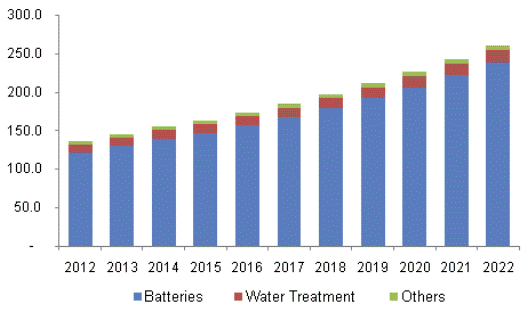
Battery consumption of Electrolytic Manganese Dioxide (EMD) has been predicted to be the fastest growing segment of manganese production with a CAGR of 5.1% from 2015 to 2022. EMD demand will rise in lockstep with the rise in the use rechargeable batteries used to power consumer electronics, electric and hybrid electric vehicles and the energy storage systems that store electricity harvested from clean energy produced by solar, wind and tidal systems.
Grand View Research
Another application for EMD is in electrodes for water treatment plants as it separates out the waste from the water. A growing water treatment industry, particularly in Asia Pacific, is anticipated to drive demand over the foreseeable future.
Both Canada and the United States have numerous and vast iron ore deposits, yet neither country produces manganese.
Fact – Manganese is a strategic mineral essential for the economy and defense of the United States.
Fact – Manganese cannot be sourced in adequate quantities from reliable and secure domestic suppliers.
Fact – There is no substitute for manganese, as a matter of fact manganese has itself become a substitute in certain alloy applications.

Manganese X Energy Corp.
Energy storage is the last vital piece, the still missing third link needed to wean the global economy off fossil fuels and enable widespread adoption of renewable clean energy.
 Manganeseis NOT mined in North America despite being considered a strategic/critical metal by the U.S. (for over a 100 years) and despite being seen as the potential star of new energy storage technology. There is no North American security of supply for this energy critical metal.
Manganese X Energy Corp. (TSXV: MN) (FSE: 9SC2) (OTC: SNCGF) has recognized this and is seeking to create a secure North American source of concentrated manganese ore while striving to achieve green/zero emissions processing.
The company has signed an agreement with Kingston Process Metallurgy Inc. to investigate all options of enhancing manganese for the purposes of Lithium-ion battery use to maximize the added value potential of the Company’s Battery Hill manganese property. Manganese X has also assembled a very strong Technical and Marketing Advisory Board focused on the energy storage market.
Battery Hill
Manganese X Energy Corp.’s Battery Hill property (Globex Mining’s Houlton Woodstock Manganese Property) is approximately 6 km long on a north-south axis and approximately 1.7 km wide, east-west. The property (Exploration Licence 5816) is located beside the hamlet of Jacksonville and 5 km northwest of Woodstock, New Brunswick.
Three main historic manganese carbonate zones plus at least two additional showings identified in historic exploration are located on MN’s Battery Hill property (these are all historical figures and are not 43-101 compliant):
- The Moody Hill zone with the potential to contain an estimated 10,000,000 tons (9,072,000 tonnes)
- The Sharpe Farm zone with the potential to contain 8,000,000 tons (7,257,000 tonnes)
- The Iron Ore Hill zone with the potential to contain 25,000,000 tons (22,680,000 tonnes)
These three zones have a range of grades from 7.5% to 10% Mn carbonate with an overall estimated average grade of 9% Mn carbonate.
Further showings of manganese carbonate have been identified on MN’s Battery Hill property north of the Iron Ore Hill occurrence. The Maple Hill showing is reported to have grades of 6.97% manganese carbonate and the Wakefield showing, at the far northern end of licence 5816, is reported to have yielded 8.86% manganese carbonate in sampling.
Manganese X optioned the Battery Hill property in June, 2016 from project generator, Globex Mining (TSX: GMX). MN may acquire 100% interest in the property from Globex Mining, subject to a 3% Gross Metal Royalty, by:
- Over a two-year period, making $200,000 in cash payments ($100,000 already paid)
- Issuing 4,000,000 post-consolidation shares (2,000,000 obligatory)
- Undertaking an aggregate of at least $1mn in exploration expenditures
- Delivering a Preliminary Economic Assessment to Globex Mining on or before the fourth anniversary of the option agreement
Manganese X is moving quickly. On Dec. 21, the company announced that it completed its initial diamond drill program. The drilling program consisted of 16 holes totaling 3,589 meters, and was completed as an initial test of three primary areas on the property, the Iron Ore Hill, Sharpe Farm and Moody Hill manganese carbonate occurrences. The drill targets were based on the results derived from gravity and magnetometer surveys completed in October, 2016.
A second drill program, for which the company is financed, will be needed to complete a 43-101 compliant resource report.
Conclusion
The main issue with renewable energy is its fleeting nature. When the wind is blowing or the sun is shining, the electricity that is produced must either be used or lost. On the other hand, when it’s cloudy or the wind isn’t blowing, power may not be available to meet demand. Energy storage addresses this problem by capturing excess energy during productive times and releasing it during leaner times.
Widespread adoption of clean renewable energy has been held back because of two major factors: the high cost of solar installations and the lack of economically efficient storage batteries. Solar and wind costs have fallen drastically. Because 52% of battery cost is in raw materials, using manganese can significantly bring down the manufacturing cost of lithium ion batteries – nickel and cobalt are much more expensive then manganese.
China controls the electrolytic manganese metal market. North America currently has zero domestic mines producing manganese.
According to Tesla CEO Elon Musk, energy storage is the last vital piece, the missing link needed to wean the global economy off fossil fuels and enable widespread adoption of renewable clean energy and electric cars.
But to get there we need a long term ‘domestic’ supply chain of manganese – from mine to battery – our supply of EMM and more advanced products such as EMD can no longer be based on the goodwill of China.
Manganese X Energy Corp. (TSX.V – MN) has identified a niche in supplying a strategic and energy critical mineral to help solve the last piece of the puzzle presented by renewable energy’s electrification of transportation and power generation systems.
And for that reason Manganese X Energy Corp., and it’s Battery hill manganese project, should be on all our radar screens. Is MN on your screen?
If not, it should be.
Richard (Rick) Mills
aheadoftheherd.com
Richard lives with his family on a 160 acre ranch in northern British Columbia. He invests in the resource and biotechnology/pharmaceutical sectors and is the owner of aheadoftheherd.com.
***
Legal Notice / Disclaimer
This document is not and should not be construed as an offer to sell or the solicitation of an offer to purchase or subscribe for any investment.
Richard Mills has based this document on information obtained from sources he believes to be reliable but which has not been independently verified.
Richard Mills makes no guarantee, representation or warranty and accepts no responsibility or liability as to its accuracy or completeness. Expressions of opinion are those of Richard Mills only and are subject to change without notice.
Richard Mills assumes no warranty, liability or guarantee for the current relevance, correctness or completeness of any information provided within this Report and will not be held liable for the consequence of reliance upon any opinion or statement contained herein or any omission.
Furthermore, I, Richard Mills, assume no liability for any direct or indirect loss or damage or, in particular, for lost profit, which you may incur as a result of the use and existence of the information provided within this Report.
Richard owns shares of Manganese X Energy Corp. (TSX.V – MN). Manganese X Energy is an advertiser on Richard’s site – aheadoftheherd.com.
Legal Notice / Disclaimer
Ahead of the Herd newsletter, aheadoftheherd.com, hereafter known as AOTH.Please read the entire Disclaimer carefully before you use this website or read the newsletter. If you do not agree to all the AOTH/Richard Mills Disclaimer, do not access/read this website/newsletter/article, or any of its pages. By reading/using this AOTH/Richard Mills website/newsletter/article, and whether you actually read this Disclaimer, you are deemed to have accepted it.