 RSS Subscribe
American Spring – Richard Mills
2026.01.18
The Arab Spring refers to a series of anti-government protests, uprisings and armed rebellions that spread across much of the Arab world in the early 2010s. Largely a response to corruption and economic stagnation, the Arab Spring started over a shortage of bread.
When grain prices spiked in 2007, bread prices in Egypt rose 37%. Chronic unemployment meant more people depended on subsidized bread, but the government didn’t make any more available. This led to social unrest that eventually unseated Egyptian President Mubarek.
The Tunisian uprising started in more dramatic fashion, when a young man running a vegetable stand set himself on fire to protest corruption. Many believe his act of self-immolation was the start of the Arab Spring.
By 2018 the Arab Spring’s momentum had slowed considerably, however the following year, mass protests started happening in other parts of the world. Many were sparked by anger over the economy, rising inequality and high costs of living.
Arguably the same thing could happen in the United States in the coming months. With 38 million people living below the government’s poverty threshold of USD$25,000 for a family of four (nearly 12% of the population) that is a very large group of people that could take to the streets if essential goods keep climbing beyond their reach,
We at AOTH believe this is a distinct possibility given there are so many price pressures likely to keep food, energy, transportation and housing costs pushing higher.
But it’s not just the prices of groceries, rent and electricity that could result in an American Spring.
There’s also anger resulting from extreme partisanship in the United States at the political level, that is filtering down to communities, families and individuals. Has there even been a time when Americans were so divided over politics?
A microcosm of this divide is what’s happening in Minneapolis and could be the match that lights the powder keg. After an ICE agent shot and killed a protester fleeing in her car, Trump vowed a day of “reckoning and retribution” in Minnesota, as the Department of Homeland Security surged thousands more Immigration and Customs Enforcement (ICE) agents to the state this week (Fox News).
The killing of Renee Good sparked nation-wide protests.
Earlier this week, a second shooting occurred in Minneapolis, with a man shot and injured by an ICE agent after he allegedly assaulted the agent.
During the struggle, DHS said two people came out of a nearby apartment and attacked the officer with a snow shovel and a broom handle. After the suspect got loose and joined the attack, the officer fired defensive shots, DHS said, striking the man in the leg.
CNN said Trump has warned he might invoke the centuries-old Insurrection Act “to deploy US troops to Minnesota, as state and federal officials clash over tactics used by immigration agents.”
Broadly speaking there is no middle ground left, politics in the US is democratic socialism versus fascism. Socialists, in the view of right-leaning Americans hold liberal views on hot-button issues of the day such as gay rights, the environment/ climate change, abortion, gun control, immigration, and taxation. A woke agenda mocked and pilloried by the right.
Socialists hold the believe that the GOP is embracing Fascism, an ultranationalist, authoritarian political ideology that glorifies the nation and state above the individual, characterized by a totalitarian government led by a dictator, extreme militarism, suppression of opposition, and severe social/economic control, opposing democracy, liberalism, and communism. It emphasizes national unity, often through exclusionary definitions of who belongs, and uses violence and propaganda to achieve its goals, prioritizing national strength and perceived decline.
The left is equally as hostile to anyone on the right with conservative views on the above issues. This starts with the Trump administration, especially its Project 25 backers who want to reverse the woke agenda.
The left view anyone who backs Trump as supportive of his fascist agenda which includes finding and deporting immigrants using ICE agents toting guns, masked-up and clad in body armor; ruling by Executive Order rather than consulting Congress; involving himself in the crypto market; creating a “plutocracy” where the interest of the wealthy take precedence over the general public (Trump has appointed numerous billionaires and wealthy individuals to top government positions); and corruption, such as spending $400 million on a new ballroom as regular Americans struggle to pay for groceries and fight for their medical.
There is also the feeling that this administration is acting in an authoritarian manner that favors military adventurism abroad (the sovereignty of Venezuela, Colombia, Greenland and Canada have all been threatened), and does not tolerate domestic dissent, especially from the media.
The social democrats or communists — to the right they’re one and the same — scored a recent win in the election of Zohran Mamdani, New York City’s first Muslim, left-wing mayor, who has “pledged to reshape the global finance capital by making the city more affordable for its working-class residents and pushing back against the policies of President Donald Trump,” states Aljazeera.
An AI Overview gives us a good summary of this US-centric divide:
In U.S. politics today, the terms “communist” and “fascist” are often used as rhetorical attacks, especially by the right against Democrats (labeling progressive policies as “communism” or “Marxism”), while Democrats and the left often accuse Donald Trump and his movement of fascist tendencies (authoritarianism, targeting opponents). While genuine communist groups exist (like the CPUSA) focusing on class struggle and opposing capitalism/neoliberalism, they see fascism as a distinct threat to be fought, rather than a shared ideology with the right. The debate highlights differing views on threats to democracy, with conservatives seeing “globalists” as the enemy and progressives fearing authoritarianism.
Here we take a deep dive into the factors that could directly or indirectly cause a major political insurrection in the United States — an American Spring.
Food
The coronavirus pandemic was a trial run for what could happen if there is a shortage of food. The pandemic put tremendous pressure on supply chains, and the prices of many agricultural commodities such as grain, corn and soybeans skyrocketed.
The war in Ukraine, considered “the breadbasket of Europe” for its exceptionally fertile black soil called chernozem, and favorable climate that made it a large exporter of grains (wheat, corn, barley), along with sunflower products, made the food supply situation worse.
According to the UN’s Food and Agriculture Organization (FAO), global food prices rose for nine straight months. Increases in the prices of grains, like corn and soybeans used in animal feed, typically get passed down the supply chain to the cost of meats, including chicken, pork and beef.
Global food price increases are clearly of concern for seniors living on fixed incomes, the poor on social assistance, and the working poor getting by paycheck to paycheck.
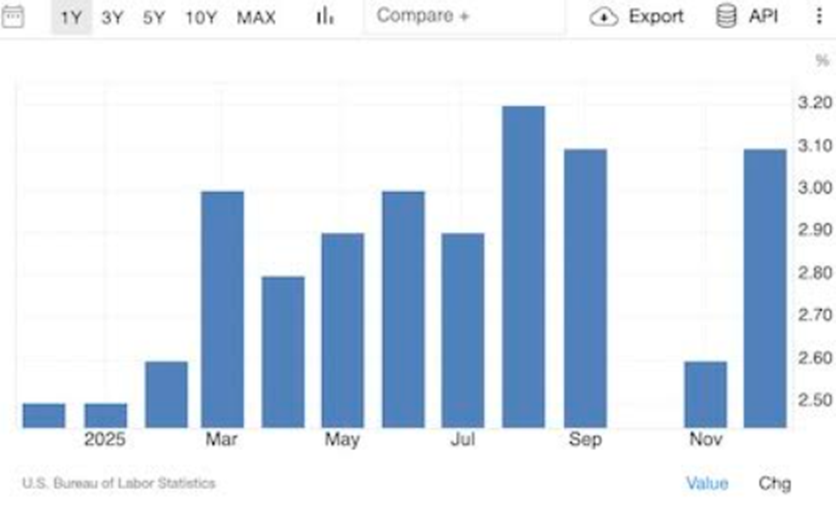
While food prices in the United States have come down from their 2022 peak, they are still elevated. The latest data shows US food inflation surged 0.7% on the month, the biggest rise since 2022, lifting the annual food inflation rate to 3.1% in December.
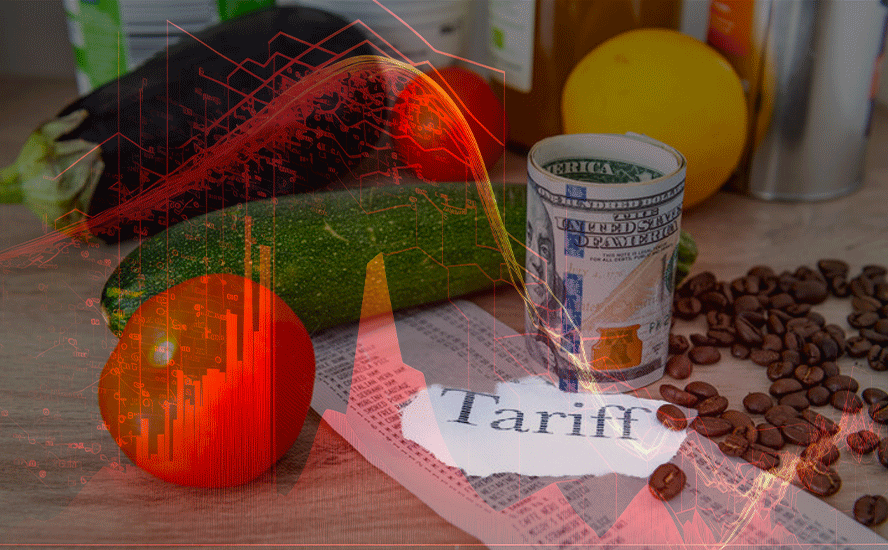
Reuters reported there were notable increases in the prices of fruits and vegetables as well as dairy products. Beef prices, a sore point among Americans, rose 1%, with the cost of steaks rising 17.8% year on year in December, the largest advance in four years. Coffee prices rose 1.9% due to tariffs, and the cost of restaurant food climbed 0.7%. Egg prices fell 8.2%.
But it’s more than just adding a few dollars onto your weekly shop.
Even a shallow understanding of history shows how restricted access to food, and skyrocketing prices of staples like bread, corn and rice, can quickly lead to social unrest. The three basic elements of survival are clean air, fresh water and food. Humans can only last a couple of days without water, and most will starve to death if deprived of food for more than two weeks.
Food inflation has historically been the catalyst for many popular uprisings, from the French Revolution to the (US) Flour Riot of 1837, the Richmond Bread Riot of 1863, and more recently, the Arab Spring. When people can’t afford to eat, when work has dried up and they can no longer feed their families, when housing represents more than two-thirds of income, a point of reckoning is reached.
According to the Center on Budget and Policy Priorities (CBPP), 33.6 million US adults and nearly 14 million children lived in food-insecure households in 2023. That means more than 1 in 8 households had difficulty acquiring food due to lack of resources.
Households with young children are more likely to experience food insecurity. More than 1 in 7 (15.5%) households with infants and toddlers under 3 were food insecure in 2023, compared to 11.9% of households without children and 13.5% of all households, states the CBPP.

Global warming and agriculture
Let me make something very clear, climate change is a misnomer, climate change started 24,000 years ago when the world came out of the cold locker, and the earth started a warming cycle. The earth is still warming and will continue to do so until it isn’t. The proper term we should be using is global warming.
According to Bloomberg, Climate change and associated weather volatility will make it increasingly harder to produce enough food for the world, with the poorest nations typically feeling the hardest blow. In some cases, social and political unrest follows.
A study by Cornell University found that rising global temperatures have prevented a fifth of agricultural output since the 1960s.
This “new normal” of suffocating heat, droughts, freak storms and flooding, is not only causing discomfort and in cases of the most vulnerable, deaths, it is reducing the amount of available food that could lead to the starvation of millions worldwide.
The United Nations Food Program is warning of a “looming catastrophe”, with about 50 million globally on the brink of famine. The group points to climate change as a major contributor to the sharp increase in hunger and emphasizes that food inflation is on the rise as farmers deal with the impacts of extreme weather.
Desertification refers to the process of turning arable land into desert usually as a result of deforestation, drought or harmful agricultural practices. Removing vegetation also takes away nutrients from the soil, making the land unsuitable for farming. According to the UNCCD, around 12 million hectares of productive land become barren every year as a result of desertification and drought.
Global warming accelerates desertification because warmer temperatures dry out once-fertile land, which then makes the area even hotter. Removing plants from the ground also increases greenhouse gas emissions, since they can no longer serve as carbon sinks.
Research shows the human race is far over-extending itself and if reductions aren’t made or productivity doesn’t improve, it will eventually run out of food, rendering the Green Revolution a failure.
A report from the World Resources Institute concludes that feeding the world’s 9.8 billion in 2050 will require clearing most of the world’s remaining forests. The removal of the world’s carbon sinks would of course result in further warming, increasing the risk of crop failure and mass starvation.
Electricity
A December report found energy bills, household electricity, have increased 13% since Trump took office in January 2025. Since 2010, the average price of electricity in the US has risen by 30%, according to the World Resources Institute. It quotes an October study from the Lawrence Berkley National Laboratory and the Brattle Group that says there are many factors driving the increases, including infrastructure impacts from extreme weather like wildfires and hurricanes, grid upgrades needed for modernization and resilience, and volatility of fossil-fuel costs.
Sweltering cities
If Americans can’t afford electricity, they can’t afford to heat their homes in winter or air-condition them in summer.
Heat waves are becoming more common especially in the eastern and southern United States, although the “heat dome” of 2021 affected the Pacific Northwest and Western Canada; 619 Canadians died as temperatures climbed above 40 degrees Celsius.
As usual, the vulnerable were most affected. 98% of the fatalities occurred indoors. Most of the deaths were attributed to seniors, many with mobility issue, stuck in houses or apartments without a/c.
Last year, there were more than 530 suspected heat-related deaths in Maricopa, a county within Phoenix, Arizona. The 2025 death toll is on top of another 3,100 heat-related fatalities over the previous decade.
Heat is the leading weather-related cause of illness and death in the US.
Inflation
Food and beverage prices make up around 14% of the Consumer Price Index. The other seven categories are housing, apparel, transportation, medical care, recreation, education/ communications, and other goods and services.
The latest CPI inflation report on Jan. 13 shows the CPI increased by 0.3% in December. A 0.4% increase in the cost of shelter, which includes rents, was the main driver of the rise in the CPI.
Reuters notes oil prices have begun to tick up again, with U.S. President Donald Trump’s unpredictable and controversial foreign policy agenda raising geopolitical tensions. True, oil prices remain relatively low and may well be capped by a looming oversupply, but the recent uptick is still liable to worry U.S. households nonetheless.
The news outlet quotes New York Fed President John Williams saying he expects inflation to peak close to 3% in the first half of this year, ease in the second half, and return to the central bank’s 2% target next year.
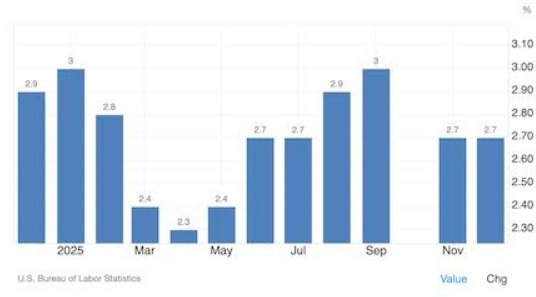
Research by Visual Capitalist shows US inflation has increased 92% over the past 25 years. While CPI inflation has fallen to 3.1%, prices are around 25% higher than they were in 2020.
The infographic shows the cost of many essentials, including hospital services, childcare, medical care, housing, and the cost of food, are rising at a faster rate than overall inflation.
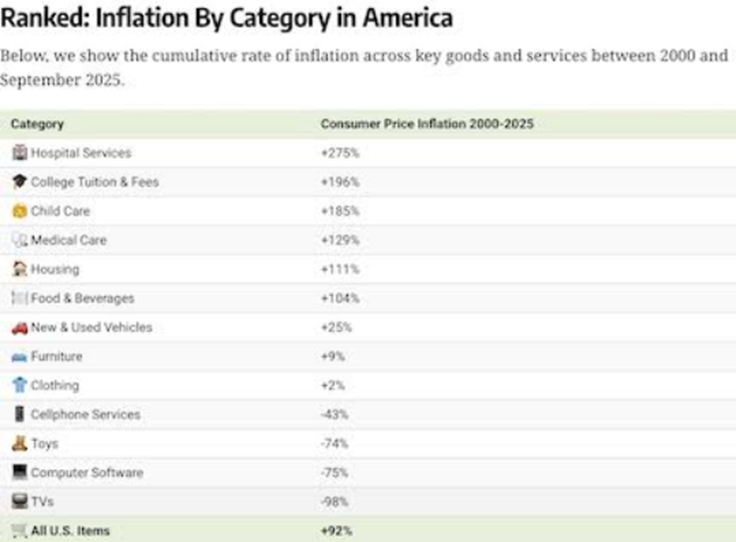
Hospital services costs have risen the most, 275% since 2000. Another top inflation category is college tuition and fees, rising 196% over the same 25-year period. Housing inflation has jumped 111% compared to a 92% increase for all US items.
Some items have become more expensive more slowly, while others have actually dropped in price. New and used vehicle inflation is 25%, while the prices of televisions and software have declined. TVs for example are 98% cheaper than they were in 2000.
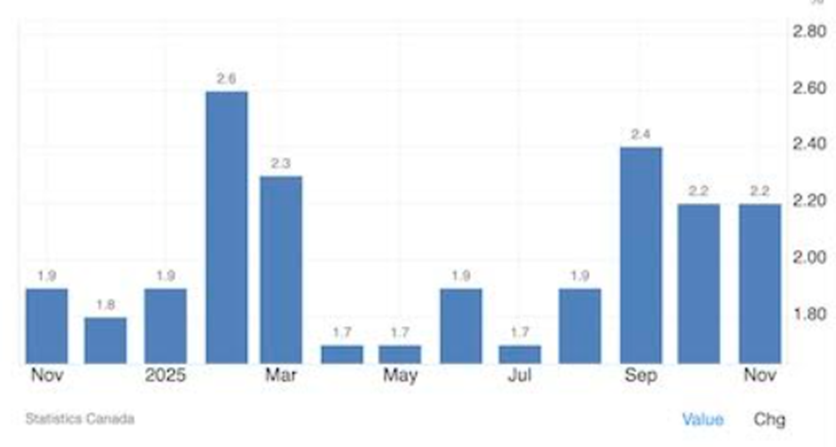
Canadians may be wondering how our inflation is doing. It rose in tandem with US inflation following the pandemic and also dropped as higher interest rates stifled consumer demand. But recent data points to a crisis of unaffordability.
The latest MNP Consumer Debt Index report finds 71% of Canadians are expecting the cost of living to worsen in 2026. More alarmingly, 50% of those polled feel they are $200 or less away from being unable to pay all their bills and debt obligations in a month (Global News)
A recent TransUnion credit report suggested one in five Canadians plan to take on more debt this year to keep up with costs, mostly via credit cards.
And more than half of those polled (51 per cent) said they believed they’ll likely have to go into more debt to cover all their cost of living expenses in the next year.
Dollar decline
Inflation not only raises consumer and producer prices, it devalues the currency, i.e., the US dollar.
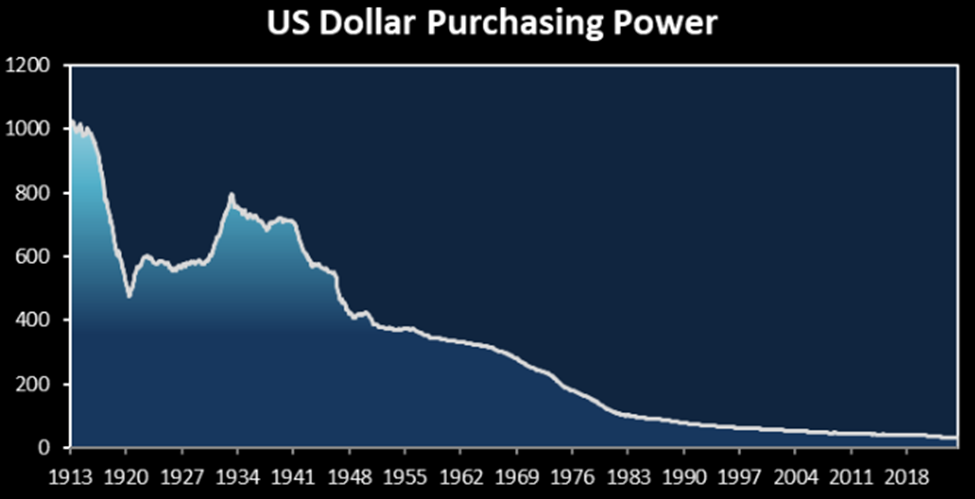
A basket of basic breakfast items—1 loaf of bread, 1 dozen eggs, 1 lb bacon, 1 quart of milk, and 1 lb of coffee—cost roughly $0.60 – $0.80 in 1913. The same basket of goods, in 2025, was estimated to cost between $18.00 – $25.00 or more.
The chart below shows how far the dollar has been devalued since the Fed was created in 1913.
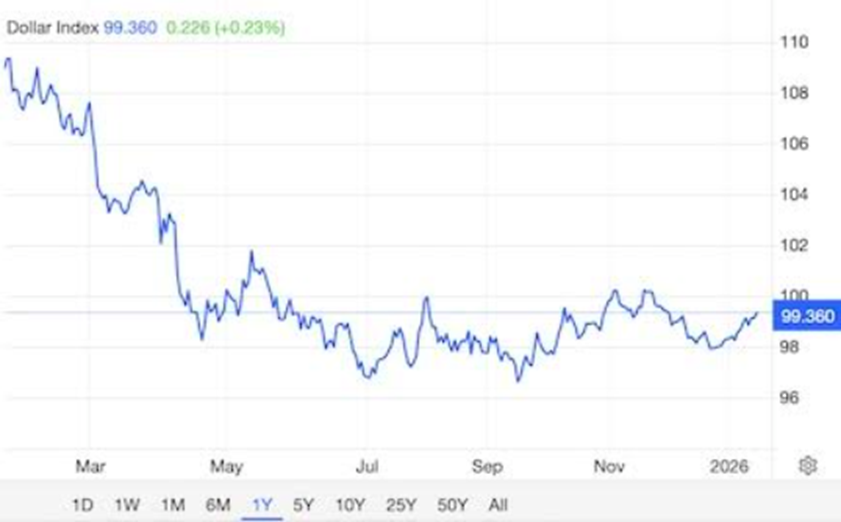
When measured against a basket of currencies, the US Dollar Index has fallen nearly 10% over the past year.
The US dollar is the most important unit of account for international trade the main medium of exchange for settling international transactions and the store of value for central banks.
President Donald Trump has boldly imposed a new era of US economic policy dominated by tariffs trade wars and threats to the sovereignty of nations it has long considered allies.
The president is rewriting the rules of international trade mostly by disregarding them as he pursues an America First agenda.
The cost to the United States of Trump’s trade war and country takeover rhetoric has already cost America its reputation.
Is the US dollar and its status as the world’s most important reserve currency also about to be tossed into the rubbish bin of world history?
A de-dollarization movement that started a few years ago is gathering pace. De-dollarization is being pursued by countries with agendas at odds with the United States, such as Russia, Iran and China.
Since Trump has returned for a second term, his tariffs and trade wars have accelerated the declining dominance of the dollar.
Video — Is the US dollar done?
Commodities
In line with a sinking dollar, the prices of many commodities, which are priced in US dollars, have risen of late. Gold, silver and copper all hit record highs last year for the first time in decades.
While much has been written on the dawn of a new commodities super-cycle, including this post by Kitco News in 2024, heavily referencing my writing at the time, there is evidence to prove that a commodities super-cycle has already begun.
Take the following post by Ole Hansen, head of commodity strategy at Saxo Bank and a frequently quoted commodities and precious metals pundit:
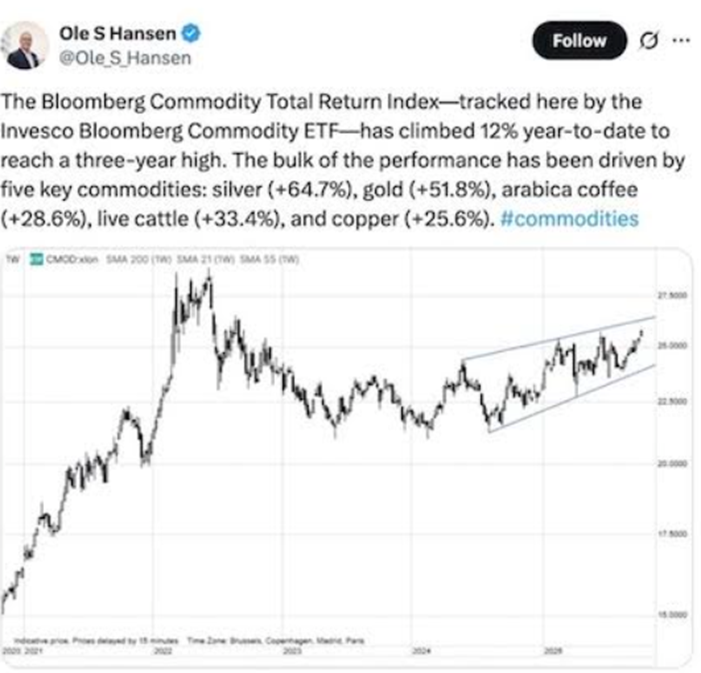
Investopedia says commodity prices are believed to be a leading indicator of inflation through two channels: First, commodity prices respond quickly to general economic shocks such as increases in demand. Second, changes in prices reflect systemic shocks such as hurricanes, which can decrease the supply of agricultural products and subsequently increase supply costs. Growers pass these higher costs onto consumers, who pay more for agricultural products.
Oil is another good example. When the price of oil increases, the cost of manufacturing plastics, synthetic materials or chemical products will also rise and be passed onto consumers
Commodities: the last safe haven standing — Richard Mills
Tariffs blowback
It isn’t only the poor and working poor who are being most affected by inflation and weaker dollar purchasing power. Trump’s tariffs are having negative effects on farmers on both sides of the Canada-US border.
Let’s start with potash. A 10% tariff on Canadian and Mexican potash, imported into the US that doesn’t meet CUSMA rules of origin, was imposed in early 2025.
Later in the year, Trump threatened higher, unspecified tariffs on Canadian potash to grow the US market for the fertilizer ingredient.
The problem is that Canada supplies 80% of US potash imports, with the next biggest producers being Russia and Belarus. Only 10% of US needs are currently supplied domestically.
Last year potash was added to the US critical minerals list.
If Trump follows through on higher potash tariffs, it would mean that higher fertilizer costs would be borne by US farmers.
A $12 billion aid package has already been promised to them to deal with the economic fallout from tariffs. What happens to payments to farmers, and many other groups promised relief, if the Supreme Court says they are illegal and have to be paid back?
The Guardian notes China only recently resumed purchases of American soybeans after shifting to other producers such as Argentina and Brazil after President Xi Jinping struck a deal with the United States in October.
Unfortunately, even if China buys all the soybeans they agreed to buy, and so far, they haven’t lived up to the agreement, they will only purchase 14% of what they bought between ’22 and 2024.
US farmers were effectively frozen out by China due to retaliatory tariffs (20-25%) on US soybean imports. The tariffs made US soybeans uncompetitive against cheaper product from Brazil and Argentina.
“They’ve produced a bumper crop this year, just to find out they have nowhere to sell their harvest thanks to Trump’s trade policies,” Minnesota’s Democratic Governor Tim Walz said.
It’s not the first time a Trump trade plan has hurt soybean farmers: in 2018, a trade war led to significant reductions in soybean exports to China, states the Guardian.
More pain has been inflicted on US (and Canadian) farmers through the imposition of tariffs on farm equipment. The situation is complex, but in a nutshell, for US farm equipment entering Canada, Canada has a 25% surtax on US steel and aluminum products, which increases the cost of equipment and parts.
For Canadian farm equipment entering the US, the US increased tariffs to 35% on many products not originating under CUSMA in August 2025, impacting machinery and parts. A 50% tariff applies to steel and aluminum imports into the US.
The upshot? Farmers face higher prices for seeds, new equipment, fertilizer, herbicides, pesticides, insecticides and replacement parts due to tariffs, affecting farm profitability.
Stock market bubble pop?
Investors might be crowing now about their mega returns that have carried over into 2026 after a banner year in stock markets, but these are only gains on paper until a stock is sold.
According to RBC Wealth Management, “The U.S. equity market delivered its third straight year of double-digit and above-average gains, with the S&P 500 rising 17.9 percent including dividends in 2025, boosting the total return to 100.6 percent since this bull market began in Oct. 2022 through the end of last year.”
But it’s not all puppies and rainbows. Some observers predict a correction in the AI-fueled stock market frenzy, or worse, a popping of the AI bubble. Others say AI is nothing like the dot-com frenzy and let the goods times roll. In short, it’s a subject of considerable debate.
A report released Thursday by Moody’s Ratings says there are warning signs in the current environment.
“These include the strong enthusiasm behind the technology, rapid valuation increases — even among companies recording significant losses — and a degree of FOMO or ‘fear of missing out’ influencing investor behaviour,” it said, via Investment Executive.
If the bubble bursts, the impacts could be significant. The report says it “would ripple across the tech ecosystem, hitting loss-making AI labs, well-established tech firms and ultimately the entire supply chain.”
Retail investors whose retirement savings are invested in US and Canadian stock markets could find themselves facing a sea of red ink — some without a long enough investment horizon to see a recovery could end up selling at big losses.
Smart investors are booking profits as they continue riding the wave.
Geopolitical tensions/ military adventurism
The world is definitely becoming more dangerous with Trump as the commander-in-chief, despite promising voters that his “America First” doctrine would avoid foreign entanglements.
A year into his term, we have seen America bomb Iran; provide military aid to Israel as it decimated the Gaza Strip; abduct the president of Venezuela and his wife, ostensibly to face criminal charges in the US, while vowing to seize control of the country’s vast oil reserves; carry out air strikes against ISIS targets in Nigeria and Somalia; and threaten the sovereignty of Canada, Greenland and Colombia.
Canadians dislike the US administration so much that many have refused to travel there until Trump leaves office. According to Statscan, Canadian return trips by car from the US declined for the 12th straight month. The December 2025 trips were 30.7% less than December 2024. Air travel saw a similar drop, with the number of Canadian return trips from the US at 470,700, declining 18.7% compared to December 2024, per Global News.
A report from Eurasia Group, a political consultancy, identifies what it calls a potential US “political revolution” — driven by U.S. President Donald Trump’s efforts to consolidate power, “capture the machinery of government, and weaponize it against his enemies” — as the most significant threats to global stability this year.
“The Trump administration has a view that they are the masters of the Western Hemisphere, and they can do what they want to whomever they want, whenever they want,” former foreign minister Lloyd Axworthy said, warning that Canada must be prepared for a more aggressive and transactional U.S. approach to national security and geopolitics. (CTV News)
If there is one thing that sums up the Trump administration’s belligerent stance on foreign policy, it’s the renaming of the Defense Department to the Department of War. Who is the US currently at war with?
Adding insult to injury, the name change is likely to cost up to $125 million, and hundreds of millions more if it becomes a legal name, the Congressional Budget Office estimates in an ABC News story.
Conclusion
The recent murder in Minneapolis by an ICE agent and the reaction to it reveals the deep divide in American politics. Watching the video, it is clear that the agent had no cause to discharge his weapon on a busy street during a confrontation with a mouthy motorist.
Despite being a 10-year veteran, the agent had no clear line of sight, and by firing his weapon he put his nearby colleague in danger, along with others on the street. He shot at a moving car, hitting the driver and causing her to jam her foot down on the accelerator until it crashed into another car.
That was the real danger in that situation, that somehow the car would go out of control and hit a pedestrian.
Pro-Trump media like Fox News blamed the victim. They called her a left-wing terrorist, said she was interfering with ICE, and that basically she deserved to die.
The Trump propaganda machine went into full attack mode, and more Americans watch Fox News than any other television news media.
I believe what’s happening in Minneapolis, with hundreds more ICE agents deployed and Trump threatening to implement the Insurrection Act, symbolizes what’s wrong in America and could be the spark that lights the American Spring.
On top of anger over ICE overreach, we have a multitude of factors that could result in a massive political insurrection, perhaps similar to the storming of the Capitol but this time by those on the left.
A crisis of unaffordability is building, based on high food, energy, transportation and housing prices. Inflation is reducing American’s purchasing power and the mighty buck is losing its dominance to other currencies like the euro and the yuan. The BRICS have launched a prototype of a currency backed by gold. The Unit is a gold-anchored digital trade currency designed for cross-border settlement. Its launch coincides with record public anxiety about dollar debasement.
Food inflation has historically been the catalyst for many popular uprisings, from the French Revolution to the (US) Flour Riot of 1837, the Richmond Bread Riot of 1863, and more recently, the Arab Spring.
When people are hungry and their kids are crying, they take to the streets.
Global warming is making it harder to grow food in the quantities required. According to the United Nations’ 2024 World Population Prospects report, the global population is projected to reach 8.5 billion people by the year 2030, 9.7 billion people by 2050, and 10.3 billion people by 2080, where it will remain until 2100.
Global warming accelerates desertification because warmer temperatures dry out once-fertile land, which then makes the area even hotter. Removing plants from the ground also increases greenhouse gas emissions, since they can no longer serve as carbon sinks.
Remember, “the top 20 cm of soil is all that stands between us and extinction.”
Let them eat cake — Richard Mills
2025 was the third hottest year on record, European scientists said, and no relief from the heat is expected in 2026.
Poor Americans unable to afford the necessities of life, including medical care, sweltering in apartments that lack air conditioning, or have it but the tenants can’t afford to pay for it, is, imo, a recipe for disaster.
President Trump has been musing in public about not having a midterm election this November. He’s mentioned two reasons, war, and that ‘his’ economy is doing so well there’s no need. Cancelling or postponing this year’s elections in the US will lead to riots across the US. This will result in the Trump enacting the Insurrectionist Act.
Add in anger towards the uncaring current administration — more interested in invading foreign countries, enriching its friends, and spending millions on ballrooms than taking care of people at home — and you have the perfect conditions for an American Spring.
America is going to burn.
Richard (Rick) Mills
aheadoftheherd.com
Legal Notice / Disclaimer
Ahead of the Herd newsletter, aheadoftheherd.com, hereafter known as AOTH.Please read the entire Disclaimer carefully before you use this website or read the newsletter. If you do not agree to all the AOTH/Richard Mills Disclaimer, do not access/read this website/newsletter/article, or any of its pages. By reading/using this AOTH/Richard Mills website/newsletter/article, and whether you actually read this Disclaimer, you are deemed to have accepted it.