 RSS Subscribe
White Gold reports assays, announces critical minerals spin-out and multiple porphyry-style targets on Pedlar property – Richard Mills
2026.02.27
White Gold (TSXV:WGO, OTCQX:WHGOF, FRA:29W) in November published assays from the first hole of the 2025 drill program at its Golden Saddle deposit, part of the company’s flagship White Gold Project located in Canada’s Yukon Territory.
The 2025 program at Golden Saddle was designed to target three zones of mineralization: the hanging wall, main zone and footwall. At the Arc deposit, drilling was designed to test the down-plunge extent of gold mineralization below 120m vertical, as well as provide material for metallurgical test work programs as contribution towards a Preliminary Economic Assessment (PEA), expected to be published in Q2 of 2026.
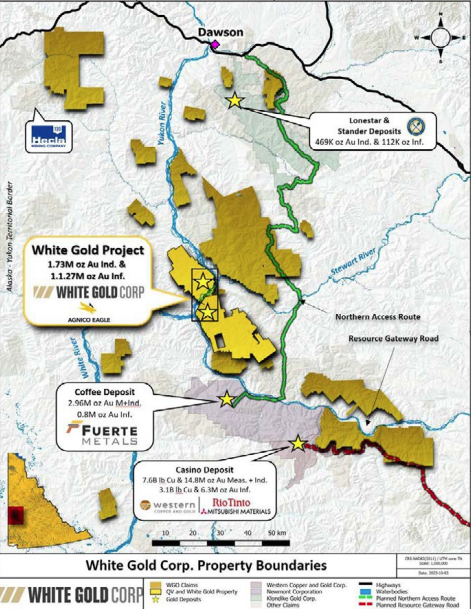

Fuerte Metals (TSXV:FMT), recently announced a PEA/Update on their Coffee Project located at the southern end of WGO’s land package They are looking to now aggressively advance the project to development starting in early 2027. With the camp now starting to be developed by as early as next year, in addition to bringing a lot more attention to the area, this will also benefit White Gold with infrastructure and accelerating permitting pathways.
With WGO having a large and uniquely high grade resource with significant expansion potential in very close proximity to the Coffee, in addition to WGO basically owning the majority of the rest of the camp where numerous other discoveries have been made, and hopefully more to come, this should all bode well for White Gold as the company moves forward with what should be a very active and productive year.
Golden Saddle
According to the Nov. 4 news release,
Hole WHTGS25D0218A successfully intersected the high-grade footwall breccia target, returning 6.89 g/t Au over 2.8 meters, infilling 150-meter gap up-dip and confirming continuity of this mineralized zone parallel and footwall to the Main Zone. The same hole also returned 6.89 g/t Au over 50.2 meters through the main Golden Saddle zone, representing one of the best intervals ever drilled on the property, expanding high grade mineralization within the Main Zone. The hole also intercepted mineralization in the hanging wall returning 0.75 g/t over 3.00 meters, further supporting recent 3D modeling refinements that capture mineralization in the hanging wall more consistently…
The assays from a hole on Golden Saddle and a hole on the Arc deposit were published on Feb. 24.
According to the news release, Hole WHTGS25D0216 successfully intersected high-grade gold mineralization, returning 3.23 g/t Au over 56.10m, expanding the width of the high-grade core by more than 50m to the west at a vertical depth of 350m, and further demonstrating the potential for additional growth of the high-grade core in multiple directions. The same hole also intersected the footwall breccia zone beneath the current pit shell, confirming continuity of key mineralization, lithology, and structural features down plunge and along strike. Furthermore, multiple lenses of gold mineralization were intersected in the shallow hanging wall zone, again further supporting recent 3D modeling refinements that capture this mineralization in the hanging wall more consistently and confirming prospectivity of assaying unsampled historical drill intervals throughout this zone.
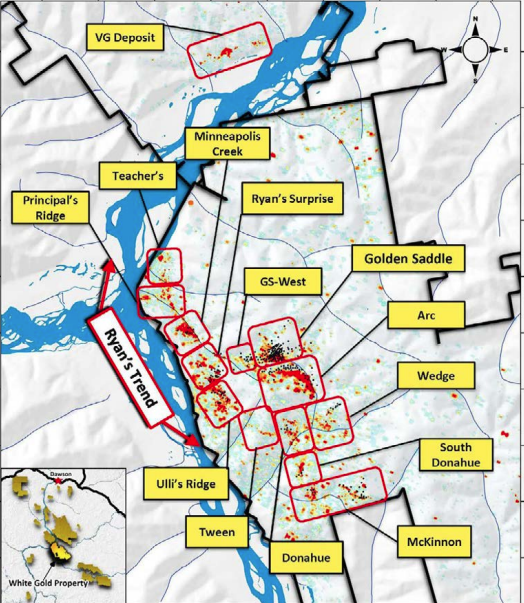
The Golden Saddle deposit is located 95 km south of Dawson City on the White Gold property. The deposit consists of the GS Main, GS Footwall and GS West zones and together the zones define mineralization over a 1,500m strike length and up to 725m down dip.
Currently, the GS Main is the most significant zone in terms of estimated ounces and overall grade, containing approximately 95% of the Indicated ounces within the deposit.
Gold mineralization at Golden Saddle is hosted in a meta-volcanic and meta-intrusive assemblage broadly consisting of felsic orthogneiss, amphibolite, and ultramafic units. Gold generally occurs as micron-scale blebs along fractures or encapsulated by pyrite, and as visible gold (less than 5mm in size) located as free grains in quartz. Mineralization is present in quartz veins and stockwork or breccia with disseminated pyrite.
Drill hole-intersected gold mineralization is spatially co-incident with structures, and structures or faults which are interpreted to be the primary conduits for hydrothermal fluids responsible for gold deposition. The thicknesses of the mineralization and breccia zones are variable from 5m to over 50m, and they pinch and swell along strike. A consistent higher-grade core (>3 g/t Au) occurs within the Main Zone at Golden Saddle. Gold mineralization at the Golden Saddle deposit remains open along strike and at depth and is known to extend beyond the limits of the current resource estimate; however, the mineralization in these areas does not currently meet the criteria to be classified as mineral resources.
Arc
At the Arc deposit, drilling successfully intersected high-grade gold mineralization, including 2.73 g/t Au over 4.35m in WHTAR25D038, as well as multiple other gold intercepts in parallel mineralized panels. Prior to this drilling, Arc mineralization was defined along 1.5 km striking northwest to southeast, and only to an average vertical depth of approximately 120m. These drill results represent the first step in significantly extending Arc mineralization down plunge, which has now been extended by at least 100m, with the zone remaining open for further expansion. These results form part of the company’s fully funded work program supported by strategic partners including Agnico Eagle Mines (TSX:AEM).
The Arc deposit is located approximately 400 meters south of Golden Saddle and consists of two zones, the Arc Main and Arc Footwall zones, both trending E-NE and dipping to the north at approximately 50 degrees. Mineralization at Arc has been defined over 1,200m in strike length and up to 450m down dip, with mineralization open along strike and down dip. Gold mineralization at the Arc deposit is less well understood than at Golden Saddle, which is partially a function of drilling at the Arc deposit being more widely spaced. Gold mineralization is hosted within a meta-sedimentary sequence dominated by banded (graphitic) quartzite and interbedded pelitic biotite schist that is crosscut by numerous felsic to intermediate dikes and sills.
Gold mineralization appears to be focused within breccia and shear zones that have been affected by hydrothermal alteration and sulfide mineralization. Drilling has defined an upper main zone as well as a lower footwall zone of anomalous gold but of lesser tenure than the main upper zone. Mineralization remains open to the east, west and at depth. The occurrence of gold at Arc appears to be associated with disseminated and veined pyrite, arsenopyrite and graphite.
“These results clearly demonstrate that Golden Saddle and Arc deposits remain highly expandable with strong and uniquely high-grade gold continuity. Expanding the Golden Saddle high-grade core and significantly extending the plunge direction at Arc further confirms the geological modelling and validates our strategy of systematically demonstrating resource growth potential,” White Gold’s CEO David D’Onofrio stated in the news release. “With a fully funded 2026 exploration program designed to significantly increase resources and make new discoveries on our district-scale portfolio in the Yukon’s prolific White Gold District, our maiden PEA on track for release in Q2 and several other near term catalysts, we believe that 2026 has the potential to be a transformative year for White Gold Corp.”
Dylan Langille, VP Exploration, added “The 2025 drilling results successfully achieved our stated goals of proving structural targets and validating recent model refinements as we aim to aggressively grow our total gold resources. Today’s announcement demonstrates a significant expansion to the width of the high-grade core by 50m to the west at depth, further validating the potential for additional growth of the high-grade core. As previously released, we also encountered some of the highest grades to date on the project in 2025 (6.89g/t over 50.2m in hole WHTGS25D0218A) providing more evidence of the deposit’s unique high-grade potential. At Arc, this was the first meaningful down-plunge test beneath the current resource envelope, and it successfully intersected strong mineralization as well as several other parallel panels of mineralization. With multiple zones at Golden Saddle, Arc and our other deposits remaining open and underexplored, we look forward to hitting these deposits with a very sizable drill program in the coming months, and the Company’s largest program to date, to further increase the size of the resources and to also drill test other exciting earlier stage targets on our large property package in 2026.”

White Gold Project
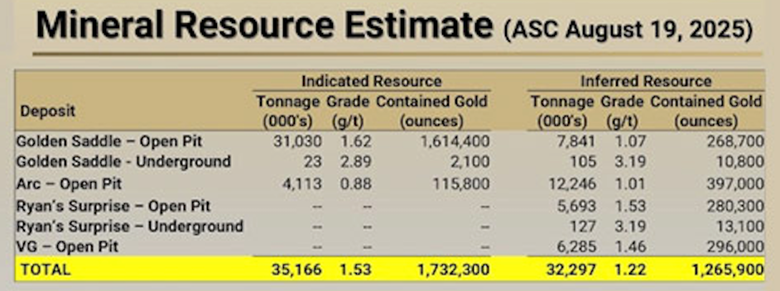
The White Gold Project hosts four near-surface gold deposits, which collectively contain an estimated 1,732,300 ounces in the Indicated category (35.2 million tonnes grading 1.53 grams per tonne gold) and 1,265,900 ounces of gold Inferred (32.2 million tonnes grading 1.22 g/t Au) based on open-pit and underground resource estimates.
The four deposits are Golden Saddle, Arc, Ryan’s Surprise and VG. All four are interpreted to represent structurally controlled orogenic gold systems. Golden Saddle is considered the best near-term opportunity for White Gold to add ounces to its resource base.
White Gold is the largest landholder in the Klondike Gold District of the Yukon, with a portfolio of 15,364 quartz claims across 21 properties, covering approximately 30,000 hectares or 3,000 square kilometers.
This represents about 40% of the Yukon’s White Gold District, which first came to the attention of resource investors during the White Gold area play of 2010, and is emerging as one of the most important new gold camps in Canada, rivaling those such as Val d’Or and the Abitibi.
The Toronto-based company was co-founded by acclaimed prospector Shawn Ryan, whose unique soil sampling technique earned him several awards, including the 1998 Yukon Chamber of Mines Prospector of the Year, and the 2011 PDAC Prospector of the Year.
All of the company’s deposits remain open in multiple directions for further expansion which will be the primary focus of WGO’s upcoming fully funded 2026 exploration program. The drill program is anticipated to be the largest in the company’s history and is being designed with the objective of significantly increasing the size White Gold’s known large high-grade gold resource and making new gold discoveries across its district-scale land package.
Donovan Pollitt appointment
On Feb. 9 White Gold announced the appointment of Donovan Pollitt, a professional engineer and Chartered Financial Analyst (CFA), as a strategic advisor and consultant. A seasoned mining executive with over 20 years of experience in operations, executive management and capital markets, Pollitt currently serves as president of Pollitt Mining, a management consulting firm.
He was previously the CEO of Wesdome Gold Mines, a TSX-listed gold producer. During Pollitt’s approximately 10 years at Wesdome, he was responsible for mine permitting, the operation of three gold mines and raising considerable amounts of capital.
“Donovan is an ideal addition to the growing White Gold team at this exciting moment in the Company’s evolution,” said White Gold’s CEO David D’Onofrio. “His unique skill set which includes both technical and capital markets expertise, and with a proven track record spanning grassroots exploration, development and mine operations, compliments and strengthens our team as we continue to grow our high-grade resource base, make new discoveries on our district scale land package and advance our White Gold Project toward production. We are excited to welcome Donovan’s leadership and deep operational and strategic expertise as we enter our next phase of growth and embark upon what we believe can be a transformative period for White Gold Corp.”
“I’m excited to join White Gold Corp. as a Strategic Advisor at this pivotal moment. We are seeing federal infrastructure investment in Canada we haven’t seen in decades, gold is being remonetized by central banks worldwide, and neighbouring projects like Coffee and Casino are advancing toward production. White Gold’s significant flagship deposit is one of the highest grade undeveloped open-pit deposits in Canada, sitting within a 300,000-hectare district-scale land package that remains extensively under-explored. White Gold has the grade, scale and geology to be central to the Yukon’s development as one of Canada’s next great mining districts,” Pollitt stated.
Critical minerals spinco
In another big piece of news this month, WGO on Feb. 11 announced it is creating a new company to house its non-gold portfolio. The spinout company (spinco) transaction would transfer White Gold’s portfolio of copper, molybdenum, tungsten and other critical mineral properties in west-central Yukon into a standalone vehicle, with shares to be distributed to shareholders.
According to the news release, The proposed transaction will enable the company to focus on advancing its flagship White Gold Project which hosts four near-surface gold deposits, that collectively contain an estimated 1,732,300 ounces of gold in indicated resources (35.2 million tonnes grading 1.53 grams per tonne gold) and 1,265,900 ounces of gold in inferred resources (32.2 million tonnes grading 1.22 g/t Au), with significant expansion potential on the resource itself and in the immediately surrounding area, complimented by a substantial pipeline of gold targets across the Company’s district-scale property portfolio.
The Spin-Out will provide shareholders with direct exposure to a significant portfolio of critical mineral exploration projects… to be efficiently advanced by a dedicated team and resources.
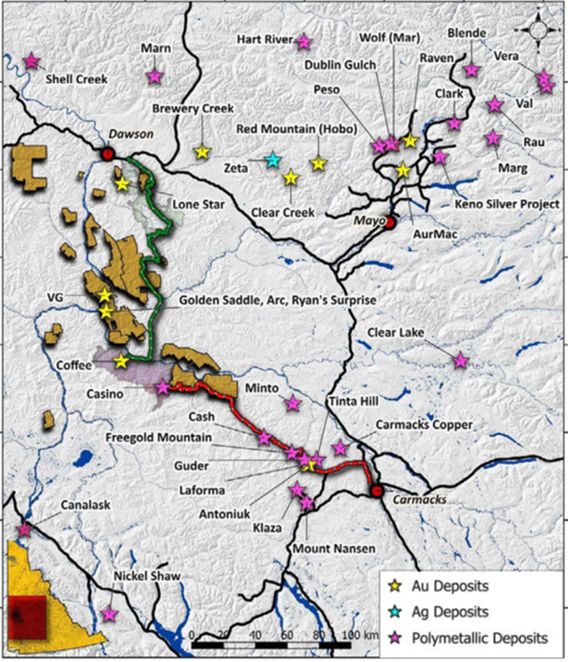
The spin-out portfolio features several major critical mineral targets with potential for copper, molybdenum, tungsten, antimony, zinc, and bismuth. Key targets including Bridget, Isaac, and Masco are situated within the Dawson Range, a prolific east-southeast trending mineral belt that hosts several significant copper-gold porphyry deposits including the Casino deposit — one of the largest undeveloped copper-gold projects in Canada — the Minto mine and the Carmacks Project.
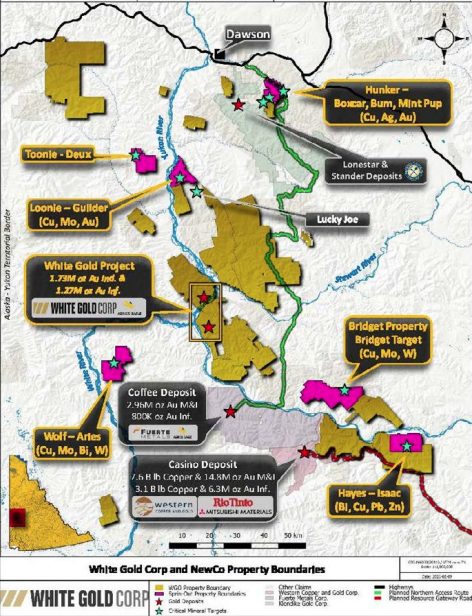
“Over the past several years, White Gold has systematically built one of the most comprehensive regional geochemical and geological datasets in the Yukon, which has clearly highlighted the scale and quality of several copper and critical mineral targets within our portfolio in addition to our highly prospective gold projects. Assets such as Bridget, Isaac, and Wolf exhibit the size, metal zonation, and geophysical signatures typically associated with large, fertile porphyry systems, yet remain largely untested by drilling. Spinning these assets into a dedicated vehicle allows them to be advanced more effectively with the technical focus and disciplined exploration strategy they warrant,” said VP-Ex Dylan Langille.
White Gold Corp’s CEO, David D’Onofrio commented, “The timing of this proposed spin-out aligns exceptionally well with the strong and growing support we are seeing from both the Yukon and federal governments for the responsible development of critical minerals. Recent initiatives focused on advancing critical mineral exploration, improving infrastructure, streamlining permitting, and strengthening collaboration across Western and Northern Canada reinforce Yukon’s position as a globally desirable jurisdiction for discovery and development. By creating a dedicated critical minerals company, we believe we are positioning these assets to directly benefit from this supportive policy environment, while providing shareholders with focused exposure to commodities that are increasingly central to Canada’s long-term economic and supply chain strategies.”
The six properties representing about 15% of White Gold’s current claims, remain largely unevaluated and undrilled, presenting major discovery upside.
Several of the spin-out targets include additional upside potential for antimony and bismuth as secondary metals across orogenic gold, intrusion-related, epithermal and porphyry systems.
An exploration database covering the company’s entire land package, including soil geochemical samples and geophysical testing, has outlined multiple large, high-priority critical mineral anomalies.
Bridget
The Bridget target, the most significant untested porphyry system in the company’s critical mineral portfolio, is comprised of a Mo-Cu porphyry anomaly covering a 3 x 3.5-km area enriched with tungsten, bismuth and silver and is transected by two large northwest trending faults — Big Creek and Sixtymile River. An initial technical report on Bridget will be filed in connection with the spin-out.
In mid-December White Gold announced the results from 2025 gradient and dipole-dipole induced polarization (IP) geophysical surveys at the Bridget target on its 100%-owned Pedlar property in the Yukon.
Pedlar is located 40 km southeast of the flagship White Gold Project.
According to WGO, These results have outlined multiple large-scale geophysical anomalies consistent with porphyry-style mineralization. The combination of strong geophysical responses, favorable structural context, and supporting geochemical evidence makes these targets highly prospective for drill testing in the next phase of exploration.
Speaking to the potential of the Bridget target, Shawn Ryan, White Gold co-founder and chief technical advisor, commented: “The Bridget target has an interesting history, as it was one of four top prospects first identified back in 1972 when Silver Standard Mines conducted an extensive 14,000-plus regional silt survey looking for another Casino deposit. During that campaign, Silver Standard also discovered the Minto copper deposit and ultimately shifted focus there, but Bridget remained one of the most compelling anomalies in the district.
Bridget has been on our radar for decades because it checks all the boxes of a classic porphyry target — large multi-element soil footprint, strong Bismuth-Moly-Copper zonation, favourable host rocks, and now strong geophysical evidence of sulphide-bearing bodies at depth. The 2025 IP survey has now confirmed and expanded upon the responses first observed in 2023, outlining multiple coherent chargeability bodies with clear depth continuity over a broader area. These are exactly the types of signatures we expect when a concealed porphyry system is pushing fluids upward along major crustal structures like the Big Creek and Sixty Mile River fault networks. I look forward to seeing the first diamond drill holes into this exciting target.”
Conclusion
White Gold Corp is spinning out its critical mineral properties into a new company that will allow it to concentrate on its White Gold Project, which has a new mineral resource estimate (August 2025) containing 1,732,300 ounces in the Indicated category and 1,265,900 ounces of gold Inferred. The MRE is based on open-pit and underground areas from the four deposits comprising the White Gold Project: Golden Saddle, Arc, Ryan’s Surprise and VG.
Golden Saddle is considered the best near-term opportunity for White Gold to add ounces to its resource base.
Three holes from WGO’s 2025 drill program at Golden Saddle and Arc have returned assay results. Arguably, the first hole was the best, at 6.89 g/t Au over 2.8 meters.
When I talked to CEO David D’Onofrio in mid-October, he confirmed one focus of the diamond drill program was to drill into the footwall that runs parallel to the Golden Saddle Main Zone. Historical drilling had encountered two pierce points in the footwall, but they were 300 meters apart. None of that material could be incorporated into the existing resource estimate.
VP Exploration Dylan Langille felt that if they could stitch the Footwall Zone together through infill drilling, the zone could be pulled into the resource, potentially adding significantly more gold ounces to the existing resource — and putting White Gold on track to publishing a PEA in the first half of this year.
Potentially, that’s more 4-gram-plus material for a starter pit.
In fact, the plan was to test three targets with each of three holes: the Golden Saddle Main Zone, the Footwall Zone underneath it, and the Hanging Wall Zone above the Main Zone.
The Hanging Wall Zone had been previously identified but it was sparsely included in White Gold’s historical (2024) resource estimate. That’s because there is a lot of unassayed drilling in the hanging wall. In Langille’s review, he discovered about 7,000 meters of historical drilling through the hanging wall was never assayed — opening up another route to adding more ounces.
I should mention the high-grade core of the Golden Saddle deposit. The core is estimated at over 1.1 million ounces, grading almost 3 grams per tonne, which in an open pit is quite a spectacular grade. Raising the cut-off grade to 3 g/t yields over 700,000 ounces at 5 g/t — extraordinary.
There is nothing like it in the Yukon or even across Canada in an open pit. And it remains open to expansion.
As it advances the project forward to a PEA in Q2, the management team at White Gold will get some additional help from Donovan Pollitt, a veteran mining executive with over 20 years of experience including as chief executive of Wesdome Gold Mines. His unique skill set includes both technical and capital markets expertise, with a proven track record spanning grassroots exploration, development and mine operations.
White Gold’s technical team is led by VP Exploration Dylan Langille. Langille has a decade of experience in mineral exploration, with a proven track record in gold discovery and project advancement across Canada’s most prolific gold camps. He was part of the discovery team at Great Bear Resources, which, in one of the greatest junior mining take-outs of the 21st century, was bought by Kinross Gold in February 2022 for USD$1.4 billion, to secure the high-grade Dixie gold project in Red Lake, Ontario.
Langille says he got excited by the White Gold Project when he realized that the foundational 2.3 million ounces had a lot of expansion potential. Over the years WGO had been marketing the deposit as being open along strike and at depth, but not much expansion drilling had been done.
The plan was to test three targets with each of three holes: the Golden Saddle Main Zone, the Footwall Zone underneath it, and the Hanging Wall Zone above the Main Zone.
Hole WHTGS25D0218A not only returned high-grade gold mineralization of 6.89 grams per tonne, but it did so consistently over 53 of 56 meters, traveling through all three zones. An outstanding hole in my judgment and one that confirms the model Langille is working from.
Hole WHTGS25D0216 also successfully intersected high-grade gold mineralization, returning 3.23 g/t Au over 56.10m including 5.31 g/t over 30.50m and 9.34g/t over 12.35 meters.This hole demonstrates a significant expansion to the width of the high-grade core by 50m to the west at depth, further validating the potential for additional growth of the high-grade core and the need to drill test it along plunge.
Over at the Arc deposit, hole WHTAR25D038 intersected 2.73 g/t Au over 4.35m, as well as multiple other gold intercepts in parallel mineralized panels. These drill results represent the first step in significantly extending Arc mineralization down plunge, which has now been extended by at least 100m (past the previous maximum vertical depth of 120m), with the zone remaining open for further expansion.
Three holes drilled into two of the four deposits isn’t going to move the needle on the resource, but they are setting White Gold up for a larger and very important drill program this year. Stay tuned for the details.
White Gold Corp.
TSXV:WGO, OTCQX:WHGOF, FRA:29W
2026.02.26 Share Price: Cdn$2.29
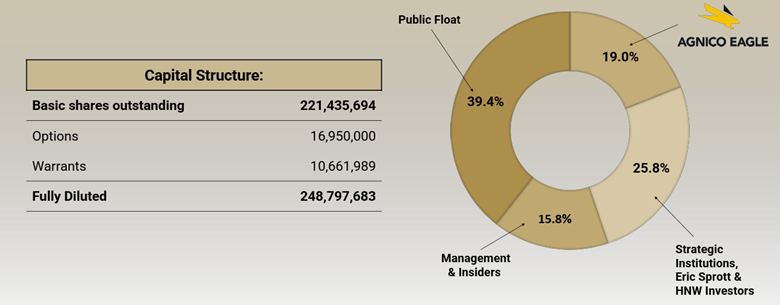
Shares Outstanding: 221.4m
Market Cap: Cdn$507.0m
WGO website
Richard (Rick) Mills
aheadoftheherd.com

Subscribe to AOTH’s free newsletter
Richard does not own shares of White Gold Corp. (TSXV:WGO). WGO is a paid advertiser on his site aheadoftheherd.com This article is issued on behalf of WGO
Legal Notice / Disclaimer
Ahead of the Herd newsletter, aheadoftheherd.com, hereafter known as AOTH.Please read the entire Disclaimer carefully before you use this website or read the newsletter. If you do not agree to all the AOTH/Richard Mills Disclaimer, do not access/read this website/newsletter/article, or any of its pages. By reading/using this AOTH/Richard Mills website/newsletter/article, and whether you actually read this Disclaimer, you are deemed to have accepted it.