 RSS Subscribe
Under the Spotlight – Simon Ridgway CEO Rackla Metals
2026.01.21
Rick Mills, Editor/ Publisher, Ahead of the Herd:
Simon, Grad had a geochemical signature typical of a Reduced Intrusion-Related Gold System, a RIRGS. But in the end, the drill results disappointed.
You just put out a report, and you give us a pretty complete rundown on what you think happened.
Can you just give us the nitty gritty of it, kind of explain what happened at Grad?
Simon Ridgway, CEO, Rackla Metals:
Well, to be honest, I’m not quite sure from a geological standpoint why we missed. What I do know is, we went into the property and made this discovery of the BiTe Zone in the cliff face, right? I mean, this was not surface enrichment.
We’re knocking rock off the cliff face and getting multi-gram results over a broad area along the cliff face; we went back in there three times.
The first results came back very strong numbers. We jumped back in again, took some more samples, extended it along strike, got further strong results again. I went in on third trip, did sampling myself, got good numbers and did a run of talus at the break in slope of the cliff. We came back with a lot of gold in the talus.
We looked at how best to approach this target, and it seemed to me, and I still believe so, the best way was just to get in there with the drill and drill it.
Working on that steep cliff face sampling for a season didn’t make any sense, just the cost of helicopter time and the very short season, the target warranted drilling so that’s what we did.
We went in and drilled four and a half thousand meters, we tested that target really well, cutting the veins within the intrusive, and we got nothing. We also did a lot of surface sampling elsewhere all over the mountain, using mountaineers on ropes and getting on the very ridge top which we couldn’t get to that first year.
We did a lot of sampling over the whole mountainside as that southern part of that North Nahanni intrusive was cut with veining, which we believed from our sampling was carrying the gold, typical of these systems.
So, we did a big program, did a lot of drilling but got no results. All of the holes, even those with intense veining they didn’t hit, no gold! So, what went on? We did a study using ioGAS program, it’s a specialized geochemistry software program, once all results were in at the end of the year. And it showed that BiTe Zone had a very particular geochemical signature, not just with the gold.
The aluminum and the other basic elements were just being wiped out completely, so was it a different intrusive? Like a dike or sill coming in there, and that’s what we did all the sampling on initially? Was it a structural zone or trap with major fluid flow or flooding? We don’t know but it’s one of the two. it’s very different geochemistry than the rest of the mountain where we sampled and where we drilled.
There are a couple of zones that have similar geochemistry, look similar that we need to go back and investigate. But is there a still a target at Grad to drill at the present? No. I’m having a hard time seeing the room for a large RIRG-style deposit there.
If it’s in the middle of the mountain, how would we mine that anyway? There’s still some zones that need to be looked at, but we gave it a significant test with all the drilling.
It’s really hard to understand how after the first three or four visits, we made that discovery and did all our sampling on that particular zone. And that was the only place on the mountain that had gold. It’s kind of hard to believe we missed, but clearly it happened.
RM: You’ve said before you have to go back and make sure you didn’t miss anything.
You did a lot of work in other areas; you’ve got the expansion of the claims on the Ogre. You staked the Calypso and you staked the Lened properties.
Maybe we could just go over each of those. So, we know we’re going to go back to Grad, do a little bit of work, clean it up a bit. What else?
Let’s take a look at the Calypso; it’s 13 kilometers to the west of Grad.
I’m assuming you’ll be looking at it when you’re at Grad. It’s got some interesting stuff. You’ve got a stream sediment, gold-bismuth anomaly, lots of narrow sheeted quartz veins.
You did some sampling and photogrammetry. What do you think about that one?
SR: It’s a good target, I think. We’ve got some good veining, and we’ve got good bismuth-gold in the veining. We had up to 10 grams in chip channel sampling across those veins, from the photography we did. We have probably about five, six-man days on the property. This is one of a number of regional discoveries we made, where the first results came in, we got good results. We went back and dressed it up a little bit more, did a bit more work on it.
It needs drilling, I think we’re going to have to put some holes into the Calypso. But before then, we will do further sampling along the strike of those veins, confirm that it’s not just the one or two samples that we took.
So, we’ll extend the mineralization there, do further mapping. And then I do believe it’s going to warrant drilling. Because again, the talus samples came back with some good numbers above where we had the veining. So, there’s room above that also when it goes into the sediments. I think it’s a reasonable target.
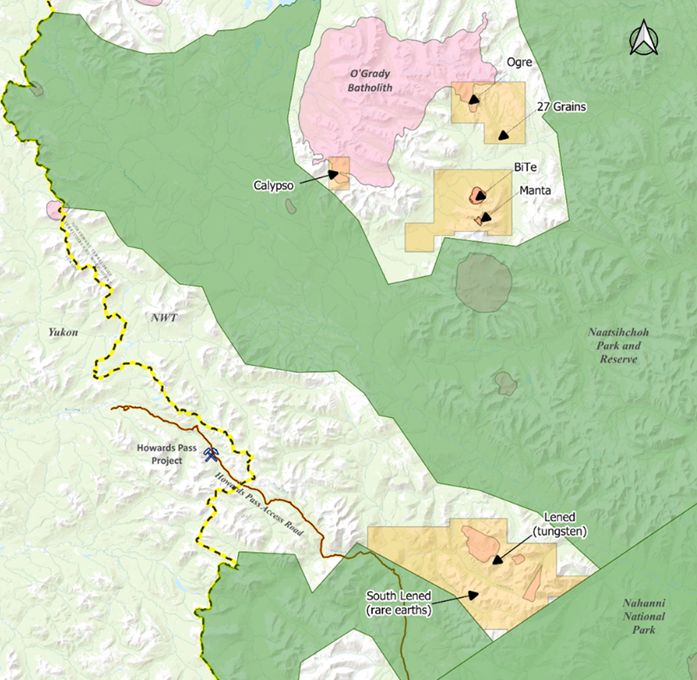
The Ogre to the north, we found that anomaly in 2024, then we made the discovery of BiTe, and we kind of ignored it and focused on that because it seemed a better target.
We did further work there. We didn’t get a whole lot of great rock samples that came in, but we did get a whole lot of gold in the sediments and the talus there. So that certainly needs follow-up work, develop a target there.
There is not a drill target at the moment, but it certainly warrants further work on the ground. And the same to the south of the North Nahanni Pluton, which is the BiTe Zone. That’s what we call it, NNP, North Nahanni Pluton.
To the south, we made a discovery of another small intrusive body there that was never mapped by the government. And we got some very high-grade numbers from there in skarn. We sampled the intrusive, there’s quite a bit of veining in the intrusive, as there was at the Grad, but that didn’t give us any numbers, but the skarnification of the sediments gave us some high numbers in a few places, multi-ounce results.
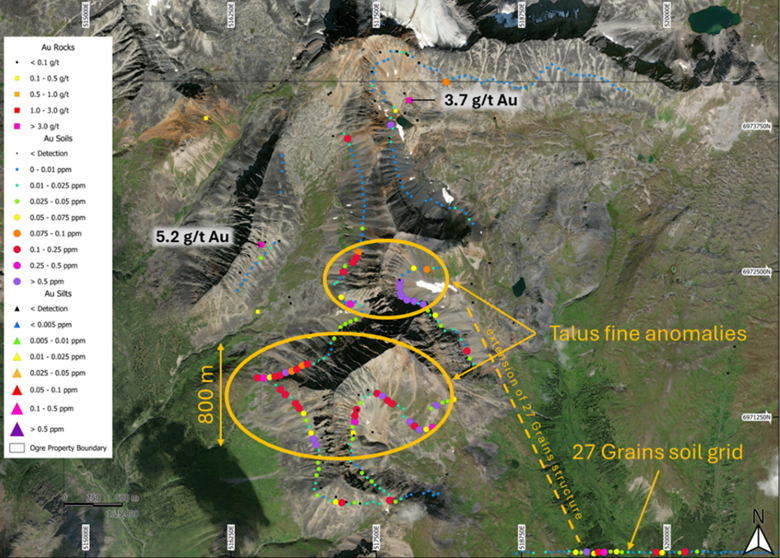
So, we need to see if we can connect those areas, right? There were two areas a few hundred meters apart. Both of those areas gave us very high-grade results. We need to go back in and do further mapping there.
Not a drill target yet, but hopefully we can develop one with those kinds of results in the sediments.
RM: Okay, the 27 Grains target?
SR: The 27 Grains project is a stream-sediment pan sampling program done by the government; they did heavy mineral sampling years ago. We went back in and confirmed there is gold in the stream there, but that leads up to the Ogre.
We believe that gold’s coming from the Ogre target. We extended the claims down there. There is some claim dispute there that’s going on, not with the Ogre, because we staked that back in ‘24.
But as we were drilling at the very end of the season last year, while we were still drilling at Grad, someone came in and staked all around our properties.
We believe they over staked some of the ground we had to the south of Ogre, but they put the dates on their quotes. They put two hours before ours. Well, we would have seen that helicopter. So, we’re contesting that. But the main Ogre target itself we have, and I believe that the grains, the gold grains in the streams, we call 27 Grains. I believe we’ll get that, but let’s see.
RM: Reading all this, there’s a lot of boots-on-the-groundwork at different areas, some drill testing.
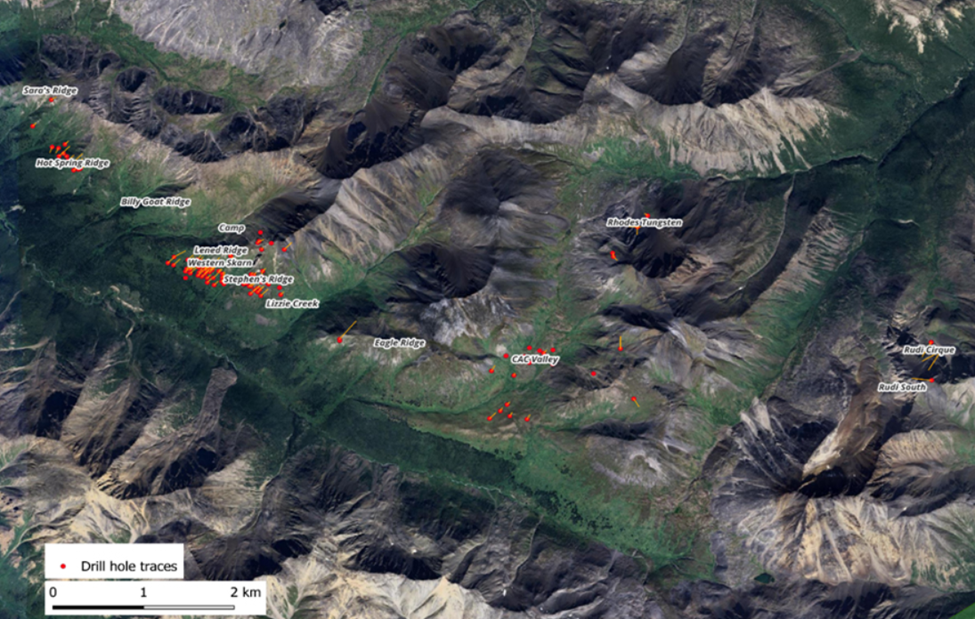
But the one that you seem to be dialing your focus on is the Lened tungsten-gold occurrence. There’s quite a bit of writing on it in the report and there’s a nice picture that you can click on to view the full size of it. You’ve got the history of this. You’ve some work to do, but it looks like you could have a resource by the end of the year that’s 43-101 compliant. Why don’t you tell us about Lened.
SR: Yeah, we went into the Lened last year and did some stream sediment sampling around the intrusive bodies there, looking for gold associated with the tungsten.
The resource that was there based upon the old assessment reports we had read claimed it was just under a million tons of under 1% tungsten (historical, non 43-101 compliant).
Ron Berdahl, the father of Scott Berdahl CEO of Snowline Gold, a renown Yukon prospector for many years, had gathered all of the data from
Union Carbide who drilled this in the late ‘70s, early ‘80s. He had about nine boxes of data, all of the work that they did. So, we’ve sent that in to get it all digitized.
But as we reviewed a couple of the later reports, we found they had done a feasibility study on about 3 million tons of 1.27% tungsten; some copper in there also. Surprised us. They continued drilling after that, another 70 or 80 drill holes post-that study. Some important things about this deposit, there are two things. One, its still open and some of it looks open pit, the deposit follows the dip slope of the hill.
We’ve got a couple of cross sections that show that, and we’ll be reporting more on this as we get all the digitized data put together. But right now, there’s a resource of about 3 million tons of pretty high-grade material (historical, non 43-101 compliant and not to be relied upon for investment).
It’s located about four kilometers from the Howard’s Pass access Road, and that road leads right to the Cantung mine site. So, we have been talking to the government about Cantung. They’ve been talking about reclaiming it for the last several years.
There is a resource at Cantung of about 6 to 7 million tons at just over 0.8% tungsten, I believe (historical, non 43-101 compliant and not to be relied upon for investment). Anyway, we’re in discussions with the federal and the territorial government on that. But the Lened itself is looking very interesting. A lot of drilling was done post that resource so we will get it all together and relogged. The resource is high grade. It’s four to five kilometers from a road that leads right to a mine site. Of course, permits and permissions etc all that needs to be looked at.
So, we’ll see where it goes, but I’m excited about the target. All of the core is still on site and its appears we can rescue it, boxes are labelled although it’s kind of tumbled over. And we’ve got all the data.
RM: And your second important thing?
SR: I’m not an expert on rare earths, don’t know a lot about them, but we got some very strong geochem from the stream at the base of the hill that hosts the tungsten deposit. The streams that drain the tungsten don’t have high rare-earth numbers, but the ridge behind it does, very strong rare earth geochemistry. We don’t know what it relates to. We’ll find out when we go back there this spring, but it looks very interesting.
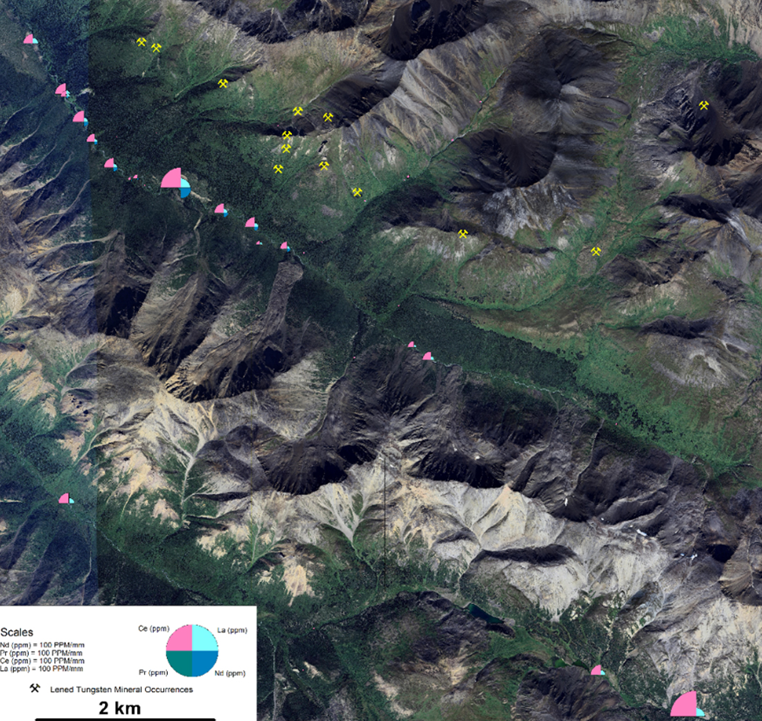
We also found gold geochem from the streams draining the tungsten, up to 7 grams in the stream. So, there is some gold in the system there too.
That’s initially what we went in for thinking there was gold. There’s three intrusive bodies in the hillside that are separated. These are tungsten-sweet intrusives, but they can host gold deposits too. They have a tungsten deposit up in the Yukon where there have been gold deposits in the Clear Creek area.
RM: Lened’s in the NWT, that’s important.
SR: Yes, about 50 km north of the Cantung tungsten deposit which has been in production several times over the last 50 years.
The tungsten price fluctuated a lot, mostly due to China flooding the market with tungsten when mines elsewhere open up. Like I said, there is still a resource there and mining equipment. Obviously, the equipment needs to be evaluated, I do think it can be put back in production again like it has been done in the past. It last produced in 2014.
RM: There’s a little town there, there’s a mill, processing. The important point I think about this is that your metal from Cantung, unlike in so many places where people arm-wave about going into, this metal is not stranded.
SR: Yeah, the road from Watson Lake goes right into the Cantung mine site and that road extends north to Howard’s Pass, where we had our camp last year. The Lened deposit is probably 5 kilometers from the road.
This is a world-class tungsten district. The federal government understands that there should be a tungsten mine there.
I think Western governments are beginning to realize that they can’t have the price manipulated so much by the Chinese. We need to produce our own critical resources.
RM: It’s a very important critical metal.
SR: I think we’ll see that there’s going to be some price protection for the tungsten mines that are in production in the West in the future.
RM: I wouldn’t be surprised if we saw some action from the federal government.
Also, not only is the metal not stranded, but something that’s important here is the NWT currently gets royalties from two diamond mines. One will be closed here pretty quick. And the other one’s closing in a few years. I think the loss of those royalties will be a highly motivating factor within the territorial government of the NWT, and Canada’s federal government to get something else going on.
I think they’re going to be receptive to your plan.
SR: So far discussions have been good, we will see. To see all the core there and having all the data, and to see that study. There’s some very high-grade intercepts in the drilling we’ve seen so far. So, to get all that data back and be able to go and relog a lot of that core, it’s going to be a pretty exciting summer.
We’re well-financed. We’ve got $10 million in the treasury, mostly hard money. So, let’s see how we go with these other gold targets and also the tungsten target and the rare earths.
The Lened area has really seen no exploration at all except for the work that was done by Union Carbine for that six-year period.
There’s a lot to do there.
RM: You received results of several ounces per ton from the Manta property.
SR: Yes, in the skarn zone. Several over one ounce for sure in a number of samples. We’ve got two separate zones that we need to try and tie them together. We focused on the intrusive for the most part.
We were so excited all summer about veins in these intrusives, because it looked like we had a Snowline Gold. And then, when we got the results back from the Manta target, the results we had in the sediments, these were chip channels, not just grabs. And they were coming back with very high-grade numbers.
So, we need to follow that up and find out what it leads to.
But I’m excited by the Lened, Rick. It looks like the more data we get, the more we like what we’re seeing. So that’s always a good sign.
RM: Why invest in Rackla at this point, besides the share price being 11 cents and money in the bank?
SR: And some very good targets, right? I mean the Grad was an exceptional target. So, it made these targets look moderate, but when you look back at the work we’ve done over the last two or three years, these targets would have got us pretty excited in the first place. The strength of the Grad anomaly distracted us for a season, we’ll say.
RM: Well, it did, but you worked up the target. I was in favor of the drill program. I was just surprised as anybody that it didn’t intersect some gold. I mean, it looked like it was right there for us.
SR: It looked like it was there for us. I think the program we did was the right program. I think our approach was the right way. We killed the target. That’s just the way it is with exploration sometimes.
RM: Well, you’d have been in there this year and got the same results. So, you saved us a year, now we can move on and we’ve got $10 million in the bank to do it. We’re a little down, but we’re not out, and that’s the big thing.
SR: Right. No, not at all.
RM: Thank you, Simon.
SR: Okay. Thank you.
Richard (Rick) Mills
aheadoftheherd.com
Subscribe to AOTH’s free newsletter
Richard does not own shares of Rackla Metals (TSX.V:RAK). RAK is a paid advertiser on his site aheadoftheherd.com This article is issued on behalf of RAK
Legal Notice / Disclaimer
Ahead of the Herd newsletter, aheadoftheherd.com, hereafter known as AOTH.Please read the entire Disclaimer carefully before you use this website or read the newsletter. If you do not agree to all the AOTH/Richard Mills Disclaimer, do not access/read this website/newsletter/article, or any of its pages. By reading/using this AOTH/Richard Mills website/newsletter/article, and whether you actually read this Disclaimer, you are deemed to have accepted it.