 RSS Subscribe
Under the Spotlight Part II – Malcolm Dorsey CEO Torr Metals
2026.01.23
Rick Mills, Editor/ Publisher, Ahead of the Herd:
Malcolm, tell us how you developed this Bertha North target. What led you up there?
Malcolm Dorsey, CEO, Torr Metals:
What led me up into this area was, number one, from a broader view, there’s a really strong northwest-trending magnetic anomaly in that area.
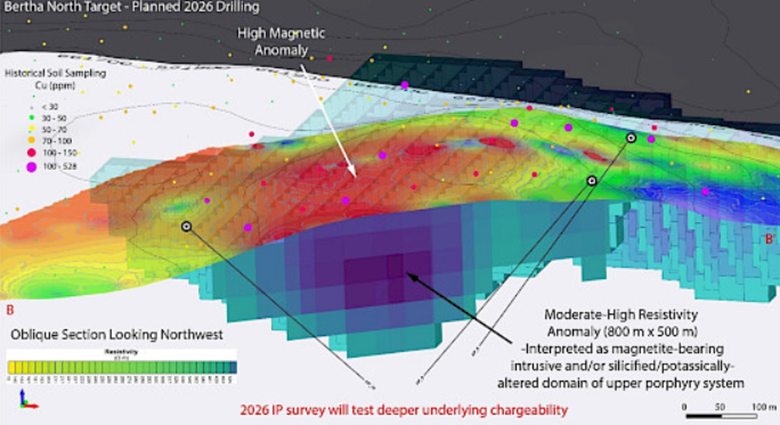
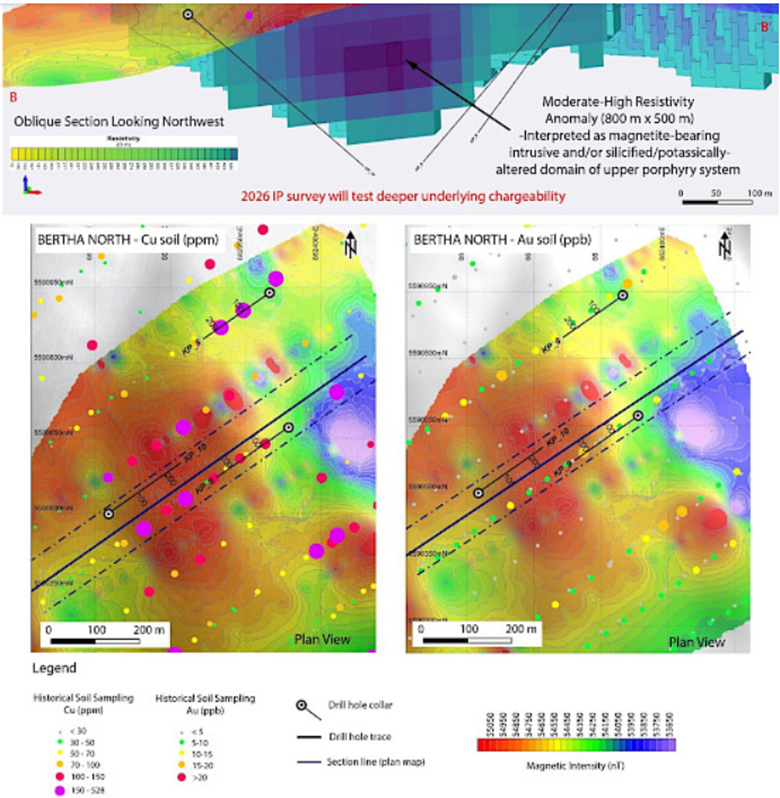
And right on the margins of it was this historical soil anomaly that was already 800 by 500 meters in dimension, good strongly anomalous values within it of copper and gold.
But that was all the information from any historical work. I knew that there is a magnetic high associated with it, but there’s been no ground surveys that covered the area. Of course we wanted to follow that up.
When we did the IP survey within the Bertha area, we covered this area as towards the Bertha North target as it did have a soil anomaly. I wanted to see is there a coincidental geophysical anomaly that would support why there is a soil anomaly there, what came out of it was that we recognized the resistivity.
And we did see just a clip of the top portion of an underlying chargeability anomaly. And that was because we had focused our deeper IP over around the Bertha South/ Bertha occurrences. But with that, we were able to see enough of the subsurface picture at Bertha North to warrant follow up.
Bertha North has always been part of a phase two drill plan. But what we need to do here prior to drilling is to follow up with IP in conjunction with the expansion of IP to the northeast of the Bertha Zone. We’ll run some deeper IP up in this area so that we can get some depth penetration up to about 600 meters to see exactly what’s happening with that chargeability in the subsurface.
RM: One thing I noticed was the vector that we got from our drill program was to the northeast, yet you’re saying the Bertha North is northwest. Is there something that has changed to the north, like structural controls?
MD: Yeah, and that’s why we do need to run the IP as well to get a better idea of the subsurface geometry. With what we can see in the resistivity, the resistivity does appear to be north-northeast trending.
In terms of the chargeability, we need to get that deeper penetration IP to get a handle on what the geometry of that could be. We are seeing similar structural controls, and I think what you are seeing is the development here of, it’s not just a single anomaly at Bertha, but we actually sit within a clustered multi-centered porphyry district.
RM: Well, at Ahead of the Herd we’ve been saying since before the last financing we were hunting district scale potential.
MD: Yes, and Kolos is developing into more of a district-scale story, especially as you loop in the Sonic Zone. You’re talking about a 10-kilometer corridor of copper and gold occurrences, most of which have never been really explored. So, this adds two if not three targets with Sonic.
It’s great that within the Bertha area we now have two porphyry centers. They do appear to be structurally linked at least with the regional structures, although Bertha North does look to be an independent second porphyry center and importantly as well both are permitted within the same permit. This I think makes that second phase of drilling structurally stronger.
It will also improve how majors view the land position, having the fact that you have this cluster of targets covered by the same permit area.
RM: That’s a lot of potential copper and gold mineralization concentrated in one area. Having multiple porphyry centers in a single land package is going to be extremely important to demonstrate. And that’s exactly how new porphyry camp’s mature.
The nice thing about it for a major is that they can have a mining plan, open pit or pits with a central processing area. It’s flexible because you could be mining from one, two, three or four different pits at the same time.
And for investors at this stage, they have multiple shots at a win.
MD: The fact that we’ve now been able to establish a third independent porphyry cluster center but it’s the same intrusive and structural corridor as Bertha, it really does materially strengthen the interpretation of having these multiple areas of fertile alkalic systems and this is why a major would care about that.
It’s because you’ve defined that you’ve got these clusters across a very large land package, so it reduces that single-target risk, introduces like you mentioned dual optionality.
So, with that we’ve got strong vectors to follow up on at Bertha and then phase two drill targeting will not just target Bertha but we’re also looking towards Bertha North, as they’re part of that same porphyry center.
RM: If you knew that there was a sniff of intrusive on the north easterly part of the original IP, why didn’t we go back and just check that out before we drilled?
MD: It was a very busy year for the industry, the IP time we had available we maxed out and they had to move on to other contracts and commitments. It was always our intent to drill what was the surface mineralization in outcrop that’s coincident with an IP anomaly and then take a breather.
From that we’d see what the results are, what it tells us in terms of geometry, scale, structural controls and then we’ll be able to return with additional IP and phase two drilling. We’re still following along that same track, the same plan, that hasn’t changed.
RM: I think sometimes when you look at these things, when you see soils and then right underneath an IP anomaly and sometimes occasionally the anomaly is a little offset, but when you see surface soils like you did and then you see what could be quite a heat source underneath it, like the IP anomaly, 100% of the time that’s a drill program, right, you’ve got to drill that.
MD: It’s got to be a drill target when you have coincident geochemistry together with the IP anomaly. It also depends on what your target is, so the Bertha North area certainly looks a lot more like a typical alkalic porphyry system in the geophysics, so you’re seeing this resistive, a likely intrusive unit with a silicified cap.
Under the Spotlight Part I – Malcolm Dorsey, CEO Torr Metals
Part of that silicified cap you could end up perhaps with some potassic alteration within it, as the resistivity itself is more of a moderate resistivity so that’s similar to what we see over on our Kirby Zone target, and we know at Kirby what’s exhibited there at surface is actually a potassically altered biotite-phase diorite that hosts the copper and gold mineralization. So, we’re looking at a similar situation potentially to that and then the underlying chargeability certainly speaks to the potential of sulfides at depth.
RM: Since you mentioned it, let’s get into Kirby more.
MD: Kirby is an interesting target in terms of it does have in outcrop about 0.5% copper, 4.24 grams per tonne gold. We did find additional gold as well about a kilometer distance, so over a kilometer there’s one to four grams per tonne gold in multiple rock grab samples.
These rock grab samples are selective by nature and may not be representative of the mineralization on the Kirby target or Kolos Project.
It does seem to be enhanced in gold content, exposed at surface, the fact that there’s biotite phase potassic alteration would speak to a deeper-level exposure, possibly the hypogene zone of the porphyry system so Kirby also presents a very compelling target.
RM: And Lodi?
MD: Lodi, when you look at the signature it’s very similar to Kirby. You can see it popping up just about to the surface, it seems to be a lot of mineralization within brecciated volcanic host rock as well, so it looks to be linked to the Kirby Zone but potentially a second porphyry center as well.
RM: Let’s visit Sonic. I know we’re waiting for a release on soils that were done last year, but what have we got at Sonic and what is, it if, any relationship to Bertha, or Kirby and Lodi?
MD: If we take a lens and we really zoom out into the broader regional context, a key exploration tool that is used is something called Bouguer Gravity. It gives you an idea where these large intrusive complexes are concentrated and with that, we see an anomaly around the Kirby and Lodi area.
It’s concentrated along that fundamental north-south trending Fanta Fault that cuts through the middle of the Kolos Project, but as you follow along that fault to the north it intersects this large northwest structure that parallels the Iron Mask Batholith.
Along that northwest corridor is where we have the concentration of Bertha to the northwest, Sonic to the southeast so it’s all structurally linked on these large crustal-scale features but with Sonic and Bertha they certainly are linked to the same intrusive complex.
You can see that within this gravity geophysical signature, so they’re structurally linked as a large intrusive complex.
When we look at Sonic it’s multi-phase intrusives that are exposed at surface, highly prospective widespread alteration envelopes.
Mostly you see a lot of albite alteration as well as silica albite dikes, several of them, the largest one being up to 12 meters in width, so what that speaks to is a very long-lived intrusive center at Sonic, you’ve got these late-stage burps essentially of silica that come up and form these albite silica dikes.
It speaks to that longevity, it speaks to the fertility of the Sonic Zone, the fact that you have multi-phase widespread albite alteration with overprinting of biotite phase potassic alteration, together with those soil anomalies.
Of course, we’re waiting on the soil results from over 1,500 soils that we took in the late fall of 2025, looking towards expanding the Sonic Zone, so yeah Sonic is one of those intrusives, looks to be a porphyry cluster-style system, already we’re looking to expand that together with Kirby and Lodi as a separate porphyry cluster zone.
And then we’ve got Bertha as the third, so we have three significant zones here where we get multi-centered porphyry clusters. We’re very excited by the exploration upside of any of these zones as they’ve all been undrilled outside of the inaugural drilling that we did at Bertha at the end of 2025.
RM: I’d like to make it clear to our readers that while you are going to put out Sonic soils we are definitely concentrating on Bertha, both the north and the south, and so what are we going to do there for the first part of this year?
MD: For first part of the year as you said, and I’m sure in this conversation people are recognizing that there’s a lot here to take in across the whole project area, but we need to focus and think where’s our priority? And the priority is the Bertha Zone.
We need to start with the IP geophysics that will test the expansion potential to the northeast of the Bertha Zone where we focused our drilling. That drilling confirmed Bertha as the peripheral expression of a large alkalic porphyry system with a very extensive supergene-style mineralization alteration within it.
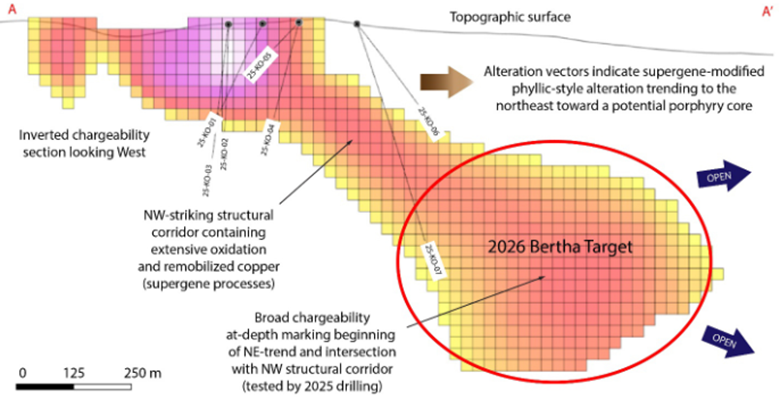
It also defined those drawn vectors going towards the northeast, so we need to expand on that with IP, see where it leads us. And then at the same time we’ll run that IP to get deeper penetration at the ‘new’ Bertha North target.
We need to see what the geometry of the underlying chargeability anomaly is, and that will set the stage for our phase two drill program, so we’ll follow the IP with drilling and altogether I would say this produces basically two high-quality shots on two vectored porphyry systems.
RM: Did you want to say anything else, Malcolm?
MD: I’d say for Torr the storyline really hasn’t changed. Even the Bertha area now we’ve shown is no longer a single-target story, which is kind of THE story across the entire Kolos Project.
So, we’ve got a multi-porphyry-centered copper-gold district, we own it. We have multiple shots on goal, two of those shots we’ll be doing in the Bertha area with follow-up drilling, we’re fully financed for another 6,000 meters of drilling here, so we’re in a great position early-stage to test out what we’ve learned from the first round of drilling, and really test out the potential that we see here and the conviction that we have on the Bertha area.
RM: Thanks for your time, Malcolm.
MD: Thanks Rick.
Richard (Rick) Mills
aheadoftheherd.com
Subscribe to AOTH’s free newsletter
This interview contains forward-looking statements, including statements regarding future exploration plans, geophysical surveys, drilling programs, financing and potential mineralization. Forward-looking statements are subject to risks and uncertainties that may cause actual results to differ materially. Readers are cautioned not to place undue reliance on such statements.
Richard owns shares of Torr Metals (TSX.V:TMET). TMET is a paid advertiser on his site aheadoftheherd.com This article is issued on behalf of TMET
Legal Notice / Disclaimer
Ahead of the Herd newsletter, aheadoftheherd.com, hereafter known as AOTH.Please read the entire Disclaimer carefully before you use this website or read the newsletter. If you do not agree to all the AOTH/Richard Mills Disclaimer, do not access/read this website/newsletter/article, or any of its pages. By reading/using this AOTH/Richard Mills website/newsletter/article, and whether you actually read this Disclaimer, you are deemed to have accepted it.