 RSS Subscribe
Under the Spotlight Part I – Malcolm Dorsey, CEO Torr Metals
2026.01.22
Rick Mills, Editor/ Publisher, Ahead of the Herd:
It’s been six weeks since our last news release, December 4th. We have talked since then, but I want to go back to that news release because you just put out news.
We had our first ever drilling program on the Bertha IP chargeability target. And it was designed to evaluate the strike, down dip, and down plunge continuity of the Bertha supergene system. I think that we go back and we look at two things. Evaluate the strike, down dip, and down plunge continuity.
Talk about that. And then the second one is the goal of the first-ever drill program was to evaluate the geological context and assess the potential scale of the supergene system. We weren’t really worried about the economics until we got the assays.
So, let’s talk about the success of the project that was designed to evaluate the strike, down dip, and down plunge continuity of the supergene situation.
Malcolm Dorsey, CEO, Torr Metals:
What we had found was there’s a few small windows of surface mineralization in outcrop when you look at the Bertha and Bertha South occurrences. But it was looking at the features within that and seeing the structural controls, seeing a picrite boundary as well, which we’ve discussed is a really important redox boundary feature for concentration of copper mineralization, with some analogous comparables that can be made to a New Afton-type system as well due to the importance of the picrite unit there.
So that was the idea with this drill program was we found the mineralization, we worked it out at the surface, we did IP geophysics to follow up on to see if there was a large anomaly that had association with that surface mineralization. And there was, that we defined this past August.
So, then it was the first-ever drill program and it’s important to remember that this is a drill program. It’s inaugural, the first one to test this target and going into a large blind porphyry target and it essentially did exactly what it was designed to do.
We wanted to confirm that there was a large hydrothermal copper system. We defined the structural framework, and we demonstrated in this news release that copper mineralization, alteration intensity, sulfides as well as some gold vectoring are all pointing us to where the potential source to this mineralization could be.
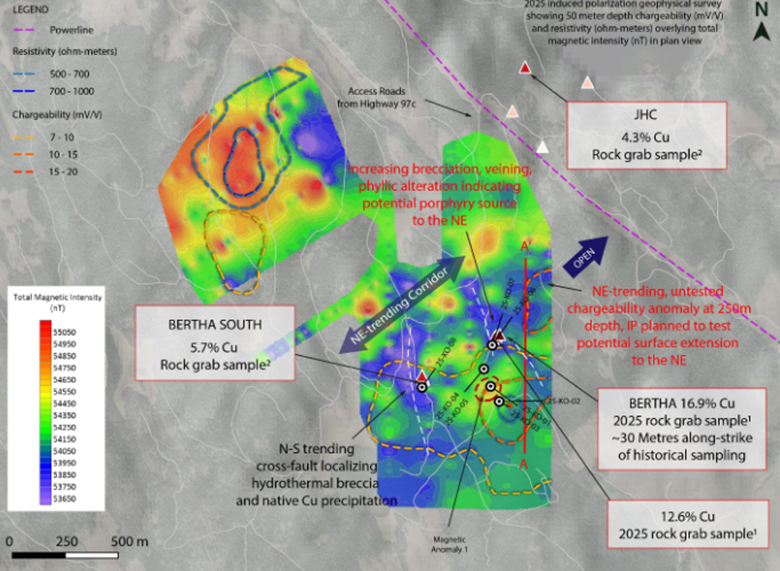
So, out of that we’ve shown that this is a really large laterally extensive hydrothermal copper system. It follows what we tested, a northwest structural corridor that seemed to be controlling some of the mineralization from the chargeability anomaly over towards the Bertha South occurrence.
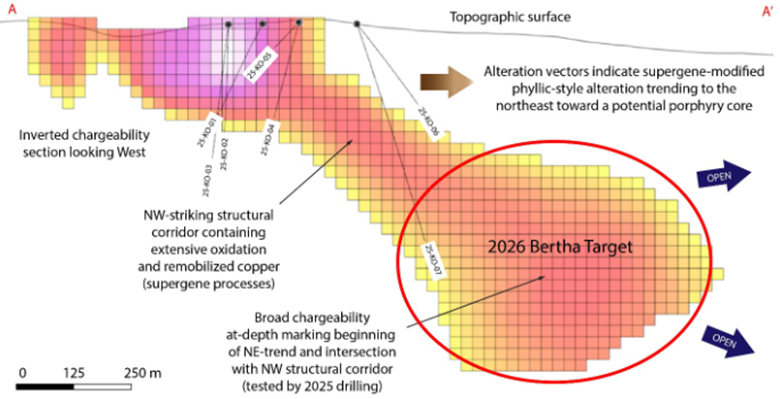
And from that now we’ve got a really good constraint on the structural controls and really what the environment is that we have started to test.
This is the first time that we get to see what actually is going on in the subsurface due to the fact that there is late volcanic cover overlying it. There’s till cover as well. So really you have to drill to have an idea of what your looking at.
RM: When you evaluate the results what strikes you as most important to moving the project forward?
MD: We needed to have an idea of what the geological context is. And then you can start addressing, well where do we need to go? I think what’s really important here, especially when we’re looking at the geology, is the convergence.
It’s all about the convergence that we’re looking for, the structure, alteration, sulfides, copper distribution, gold appearance, geophysical anomalies. Where are they? How do they interact? And where are they all pointing to?
So, when I’m looking at where all those different factors are pointing to, it’s indicating that we need to look a little more towards the north.
RM: We are in the wrong part of the system but your saying we do have a pathway, a vector?
MD: Correct, what we found here is really a secondary mineralizing pathway that we drilled with this first phase of drilling. We now know more than we knew before, which is good. That’s how these systems work with them being so large.
What we’ve defined is that this northwest structure that we were testing is more of a secondary or leakage pathway. With that, the alteration, everything is pointing towards hotter, more magmatically derived fluids as we go towards the northeast, especially holes 6 and 7. So with that as well, we can follow that picrite down. So, it was trending to the northwest where we focused our 2025 drilling.
Now we can see it goes towards the northeast, and we can see that the dip of it also steepens quite a bit as it goes to the northeast. And that is actually coincident with this buried chargeability anomaly that we were able to detect right at the limits of our IP grid. But all that is aligning together to really showcase we’re perhaps zoning in here on the primary mineralizing corridor, which will be the focus of 2026 drilling.
RM: Okay. So, the deepest hole drilled towards the northeast, 25-K0-07, intersected the first structurally controlled gold mineralization reported from the Bertha area. How important is that?
MD: That’s extremely important. When you’re looking for the cores of the system, especially when you end up in the periphery of it, which you almost always do when you’re drilling these large porphyry systems, that’s where we’ve ended up, in that peripheral hydrothermally structurally controlled copper mineralization.
In this case, mineralization that has undergone supergene weathering processes. But part of vectoring towards a potential core is those copper-gold ratios. That’s significant as we’re seeing the controls to that gold system and values as well.
In terms of ratios, they’re increasing. Generally, you get higher gold content going towards the core of a system. With that, we’re also seeing a very strong association with hydrothermal magnetite.
Basically, everywhere where we got those native copper lenses or occurrences, we had over 68 altogether throughout all the drilling. But every time they occurred, there’s generally a spike in the magnetics as well.
Magnetite does not travel far from the core of a porphyry. So, the fact that we’re getting a strong association with magnetite in these vein systems, together with increasing gold ratio as you go towards the northeast and hole 7, all speaks towards potentially vectoring here towards more of the core of the porphyry system.
RM: Okay. You’ve got a large hydrothermal copper system confirmed and open to the northeast. You’ve got structural framework defining primary and secondary mineralizing pathways. Alteration vectoring towards a hotter potential source to the northeast. Fully funded phase 2 drill program planned. You are planning on going back, the program is up to 6,000 meters. That hasn’t changed on these assay results.
If anything, it seems to have convinced you further.
MD: Looking at the results, we got some very large, probably anomalous copper mineralization that is concentrated along the picrite boundary when you’re looking along that northwest structural corridor.
So, seeing that strong association, the fact that picrite boundary is concentrating mineralization, we just have to find where the economic values are concentrated.
Having that, combined with the other structural and alteration relationships that we’d be looking for with the geophysics — and the fact that it remains open to the northeast with a very enticing target there at the limits of the IP grid — all speaks to needing to return here.
We are fully funded for up to 6,000 meters of more drilling. This will allow us to really effectively focus and test this area.
RM: Assay results, even though uneconomic are not the tell all here, in fact the second drill program has been derisked more then the initial one.
MD: Essentially the risk profile is much different now. Before drilling, we were looking to confirm whether or not this was a real porphyry system. I would say we have done that at this point. We’ve confirmed that it’s a very large scale to the hydrothermal alteration and mineralization. Even if you’re following that northwest structural corridor, over 350 meters of strike can still extend down to 580 meters of vertical depth that you are getting anomalous copper mineralization. So, this is a big system.
But now with the drilling that we’ve done, we really know where we need to focus in the next round. And with that in this news release, we’re outlining where the next target is going to be.
I do see a lot of value in returning as well prior to drilling extending the IP survey. This will really allow us to see where this buried chargeability anomaly could come to surface, whether or not it strengthens further to the north. And then that will allow us to be the most effective, make sure that we drill the best target of the next phase here in phase two.
RM: Of course, you’re always looking for economic grade. But with that, it’s early-stage exploration. If we had done this drilling and we had found no coherent alteration, no structural controls, no geophysical alignments, and no directional signal, then I would have to be very concerned coming out of this.
MD: Probability of success I’d say today is meaningfully higher than it was before this program with the drilling that we’ve done.
This northwest structural corridor is essentially offsetting. It develops after the primary structural control, which at this point, I’d say, is northeast. And what it does is basically the copper mineralization that’s within that primary orientation starts to bleed out, leak into the secondary structural feature.
So, the fact that it still produced a very large geophysical chargeability anomaly, that is coincident with large-scale alteration and anomalous copper mineralization, I think does speak to the potential size of the primary control, which looks to be towards the northeast.
So now what we need to do is test that primary control, especially now that we’ve defined already a target towards the northeast. I think that will be the test of the potential source of this copper mineralization. So closer towards the heat engine is what we’re looking for, whereas today’s values are indicative of being further away, but still within the periphery of this large-scale porphyry system.
RM: So, these results actually have value in that they point to a system that is structurally controlled. They vector us to the potential heat source of the system. And we’re going to go in, we’re going to do some survey work, and then we’re going to drill up to 6,000 meters to test the primary source of the mineralization.
MD: Yes. And those are questions that had to be answered with the first phase of drilling. You have to drill in order to get the answers.
I think we’ve got the answers now and a better idea today of where we need to go and focus. And it is, even with these values, they’re anomalous. They are lower in value and certainly sub-economic. But the important features that stand out is the repeatability of it.
So, you’re getting this broadly anomalous envelope pretty much in every single hole from holes 1 to 7. And you’re getting a nice coherent package that has a reason for being there. It’s concentrated along this picrite boundary.
Something like that is very common if you’re looking around a New Afton-style system. If you’re not right into the heat engine, then you’re going to be getting these low sub-economic anomalous copper values. So, it’s leading us towards the source. And that’s really where the next phase of drilling is going to focus.
RM: Let’s talk about the pictures of core in the news release, the kind of mineralization is telling.
MD: Certainly. There are some features that are very interesting. It’s important to note that you are getting native copper not just within vein systems, but you’re also getting it as a replacement mineral within the core itself. We’re replacing these mafic minerals.
You’re getting two different styles of mineralization. It’s disseminated within the host rock, as well as concentrated within vein systems. When we look at those vein systems, we see a lot of epidote alteration and carbonate alteration associated with them.
That is very important for indicating that these are hotter, more acidic fluids that are driving this hydrothermal mineralization. That heat has to be coming from somewhere. We think that it’s towards the northeast.
I did want to point out the hydrothermal breccia that occurs in holes 6 and 7. You see that within the photos E and F.
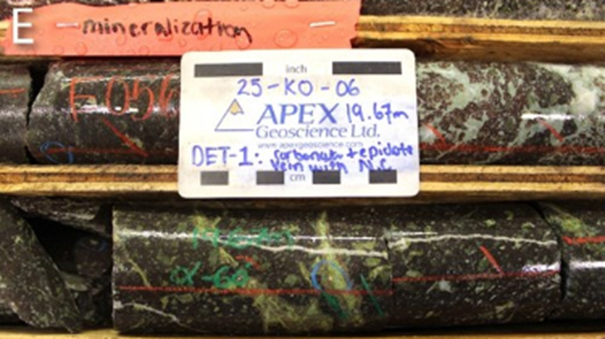
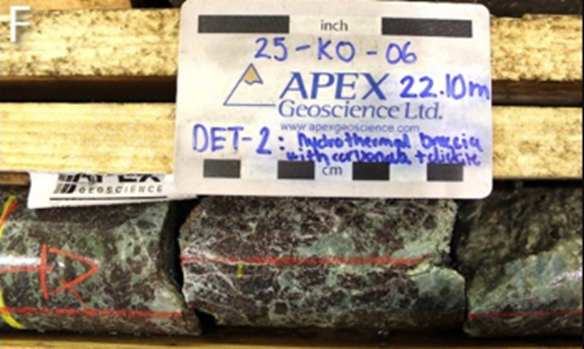
RM: I’ll throw those pics up
MD: You can see they show a very fertile system. You’re seeing various styles of alteration. There’s carbonate cement, epidote, and this brecciation, so you’re talking about a lot of pressure, higher temperatures that were causing this brecciation. But I find the dickite is the most interesting because I think this is supergene processed dickite.
What that means is it’s lower-temperature weathering that’s occurred after, but it’s important because when you see this concentration of carbonate alteration of this dickite and kaolinite clays, especially the dickite and kaolinite clays coming from the breakdown of sericite.
Now, sericite, together with pyrite mineralization, which we do see some relic features of pyrite mineralization here, is more indicative of a phyllic-style alteration envelope. So that’s also why I think we’re getting closer to the source as we go to the northeast because as we go from the southwest, you’re more in the propolytic, which is further outside the bore of a porphyry.
But as you get towards phyllic and the sericite, you’re getting closer. You’re getting quite a bit closer to the core of the porphyry. So that’s part of the vector, the alteration vectors.
You get a concentration of that. We look up around the New Afton area, you get concentrations of this supergene weathering of phyllic envelopes. In many cases, it’s thought that it was that sericite breakdown into kaolinite and dickite that you really see within the upper portions of the supergene zone at something like New Afton.
So, it’s an important feature to see. Actually, those photos E and F, hole 6 and 7, I’m quite excited by.
RM: This is what you believe is secondary mineralization, not the primary. If we hit the primary, what kind of a difference would we see between these secondary cores and potentially the cores we’re going to be drilling in the spring?
MD: I would expect to see more of a shift in the lithology. We’re still looking for that picrite boundary, so that will still be a marker horizon for us to follow. But what we’re looking for is more intrusion, so not just dikes that are taking advantage of this later northwest structural corridor.
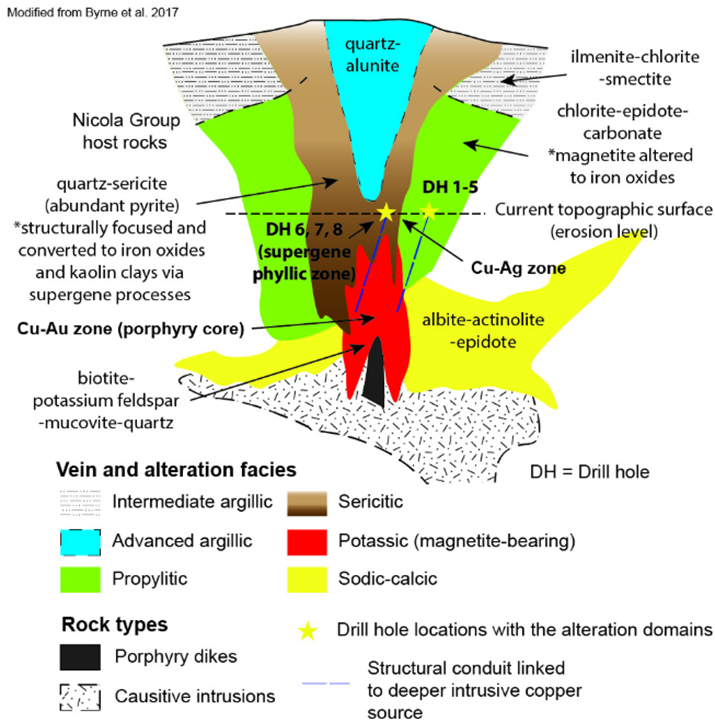
We’ll be looking for more concentration of the potential intrusive source as well. So, in the next round of drilling, we want to see more intrusive units. We want to see still this native copper if we’re within this supergene upper zone.
But ideally, as we drill a little bit deeper, we should start to see some relict chalcopyrite mineralization showing up. We should be seeing that chalcocite within a potential mesogene zone. So, we’ll be looking for that type of lithology, that type of mineralization.
I expect that we won’t see boronite until we start getting much deeper. But greater concentration of intrusives, variation of not just native copper, but maybe some relict chalcopyrite. And then, as well, some greater vein concentration, such as what we see this brecciation within holes 6 and 7.
RM: Okay. So why should investors be patient and just let this play out over the next three or four months?
MD: Well, we’ll be looking to mobilize here fairly quickly, it’s been a very mild winter. It’s already going to be heading into February here. We’re looking to get up there as soon as we can. I would anticipate March to start an IP program to expand.
And then we’ll be looking to drill in our Phase II program, mobilize for that right after. So, I’d say it’s not going to be several months. It’ll be only a few months here, within two months, that we’ll certainly be looking to do some work in the field, starting the second round.
Now we’re going to enter into a second round of drilling with a better idea of what style of alteration, host rock, and mineralization that we need to vector into better zones.
And I think we’ve got an excellent target as we look up towards the northeast.
RM: Between now and then have got we news on other projects?
MD: There’ll be some further news. There is additional work that we’ve done within the Bertha area. We’ll have additional news on Bertha.
With that as well, we did quite a bit of surface work up in the Sonic Zone, which is to the east. And then in the background as well here, there’s a little bit that we’re doing on the Filion project. That is not a main focus at this time.
But we’re certainly staying busy, plenty going on in the background, and plenty to look forward to here, I think, over the near term.
RM: Let’s make it clear. Going back to Bertha is the main target.
MD: Absolutely. Bertha is the main target. We didn’t hit into the core of the system, but we’re certainly on the periphery of a very large system, and even though it was discrete values, you are looking at some concentrate veins there that did produce some interesting values up into the 0.3%, 0.4% copper.
So, it is certainly showing that there is copper there. There is the potential for higher-grade copper, I think, as you vector more towards the center of the system. We just have to continue the exploration.
We’re on the hunt, and we’ve certainly gotten a taste, but we need to follow it up and see where the source is.
RM: This is a vector story at this point. It’s not just a bunch of geology but seeing that convergence of all of it coming together, certainly all pointing in one direction, it certainly, I would say, increases the odds potentially at the next hole.
It’s pretty much up to you if you want to end it here or add something, Malcolm.
MD: I think we’ve done a good review of it of what we’re looking at within this.
Like I talked about at the beginning there, was the fact that we drilled into a large blind porphyry target. It basically confirmed everything that we would be looking for within the periphery of a large hydrothermal magmatic porphyry system. So, seeing that there are trends we can follow, that we can vector onto a follow-up target, I think is extremely important.
And really this is just the start of the story with only 2,700 meters of drilling done. Certainly, as you talked about, Rick, like a lot of these systems require more drilling before you end up within the heart of them. But I think we’re well on our way with a good idea of where we need to focus on next.
RM: Thanks for your time.
MD: All right. Sounds good.
Richard (Rick) Mills
aheadoftheherd.com

Subscribe to AOTH’s free newsletter
This interview contains forward-looking statements, including statements regarding future exploration plans, geophysical surveys, drilling programs, financing and potential mineralization. Forward-looking statements are subject to risks and uncertainties that may cause actual results to differ materially. Readers are cautioned not to place undue reliance on such statements.
Richard owns shares of Torr Metals (TSX.V:TMET). TMET is a paid advertiser on his site aheadoftheherd.com This article is issued on behalf of TMET
Legal Notice / Disclaimer
Ahead of the Herd newsletter, aheadoftheherd.com, hereafter known as AOTH.Please read the entire Disclaimer carefully before you use this website or read the newsletter. If you do not agree to all the AOTH/Richard Mills Disclaimer, do not access/read this website/newsletter/article, or any of its pages. By reading/using this AOTH/Richard Mills website/newsletter/article, and whether you actually read this Disclaimer, you are deemed to have accepted it.