 RSS Subscribe
Under the Spotlight – Jason Weber CEO Silver North Resources
2026.02.09
Rick Mills, Editor/ Publisher, Ahead of the Herd:
Jason, we have the silver price crashing, and a lot of people are asking what is going on?
Jason Weber, CEO, Silver North:
Well, it’s funny. Probably around $100 silver I said $75 would feel like where it should go back to. We went on to $118 and now we’re back to $75 twice in the last seven days. As far as I’m concerned nothing’s changed, but there’s a whole lot of people out there that are panicking right now.
RM: Do you think people were worried about industrial demand or oversupply or the fact that Warsh was a hawk and he got appointed as Fed chair?
JW: You know in the grand scheme of things I just chalk it up to climbing a wall of worry in a bull market.
I went by Vancouver Bullion and Currency Exchange in Metrotown mall the other day, and the lineup was probably 50 people deep.
RM: Are they buyers or sellers?
JW: I didn’t ask anybody in line but I’m guessing they’re buying and I’m guessing some of those people are thinking, “There’s a $25 discount on silver right now.” And it’s Lunar New Year, there’s buying around that so it’s a busy time of year for buying and then this correction happens.
RM: It gives us a good read on sentiment.
JW: Yeah, people are taking notice, I’m actually mad at myself because there were some buying opportunities this week that I missed.
RM: Rick Rule said he was selling silver. And then when I talked to Quinton Hennigh last week, he said he was selling silver. But what they were doing was selling the metals. They weren’t selling silver stocks.
They were selling the metals because in a bull market what moves first is the metals, it was time to get into producers.
Because here’s the thing, doesn’t matter whether it’s copper, silver or gold, but especially silver, the miners’ bottom line, the margins never caught up to the price of metals. So, what they did was they sold their metals and they moved into the miners who were not even showing a $70 silver price, yet.
They sold the metals to move into the miners because the miners margin/ share price was lagging catching up to the price of the metals. Well, the funny thing is the miners’ bottom line hasn’t been hurt. It never even caught up to $50 silver.
The silver miners-to-silver ratio is currently at one of its lowest levels in history, some producers are operating at sub-$15/oz costs.
JW: They only had maybe one quarter of production where it was actually at elevated spot prices.
You’re stealing the talk that I’m presenting tomorrow at 2:10 at Michael Campbell’s World Outlook Financial Conference.
RM: Ah no, but we agree on this.
JW: The title of my talk is “More Room to Grow: Silver Investing in 2026 and Beyond.” This week a year ago, I presented to this same audience and said, “Here are the reasons why I think silver is going to move.” So, this year, now that it has moved, now what? Is it over?
Not a chance because like you say we didn’t even get two quarters of production of silver above $40 an ounce, right? There’s no reflection of the performance of these miners. Like you say $80, $70, $60, it doesn’t matter, the quarterly results haven’t had a chance to reflect these much higher silver prices.
And especially the highly leveraged producers where, if your all-in-sustaining costs are $4 below the spot price and all of a sudden, your AISC are $25 below, that’s a ton of profit right off the top. This is what I am looking for as the producers report Q4 results.
To me it’s all about supply. It’s all about the fact that there’s so few pure-play silver explorers and producers and like you said, copper as well. We’re just not making up that shortfall. And industrial demand is only going up. Worst case it stays where it is. I just don’t see a short term scenario where it drops – how does it drop?
We’re down a path right now with AI, with green energy movement, all the internet-of-things, it (silver demand) cannot drop that quickly. All of our latest technological advances are silver-intensive. So, tell me how that’s changed in the last month? And you want to talk about the threat of war and social and economic uncertainty? Well, that’s a double whammy for silver because it’s a supply issue and it’s a monetary hedge in unstable times.
RM: Yes, 30% of silver’s yearly production comes from mining copper, and the market for copper is in trouble.
Everything that we’re doing, everything that’s driving the global economy right now uses immense amounts of silver. And you’re right, are we going to keep moving forward, or are we going to be like the Red Queen running faster and faster just to stay in place. Where are we going to find the silver?
JW: The other side of it, this panic, or these corrections, it’s tough to compare a correction today to a correction in the ‘70s where today you have electronic trading, so it happens instantly. Corrections that might have taken a week, two weeks to work through we’re doing that in a day, just because of the availability of information and computer trading; it all can happen instantly, so I think that when we have these big drops you’re like, “Oh, we’ve never seen a percentage drop like this.” I think it’s so much easier to facilitate that now. That’s the other factor that plays into these big drops that we’re seeing.
RM: I think gold’s going to $5,000 and I think silver’s going to be $85. I think we’re going to settle in there for a nice period. What is your thinking here?
JW: I hadn’t thought about it on the gold side where it would settle in. Maybe I thought under $5,000 but I don’t have strong feelings on it. Silver, I thought high $70s, low $80s.
RM: You’ve got an amazing project up in the Keno Hill area, right beside one of the major silver producers in the world, Hecla Mining (NYSE:HL). And you’re advancing your project to the point where you’ve been able to raise a significant amount of money.
Why don’t you tell us about your plans for Haldane and Silver North moving forward this year.
JW: Despite what’s happened in the markets it’s still the same plan for us going forward and that’s a comprehensive drill program that will start as early as we can get on the ground up there after the snow melt.
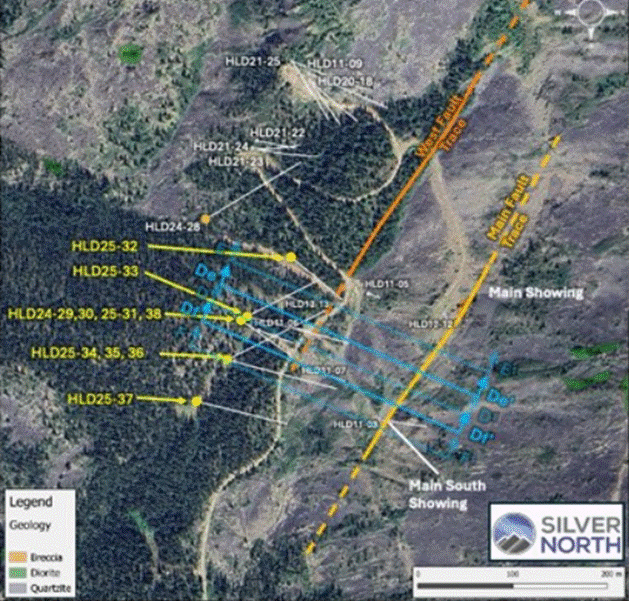
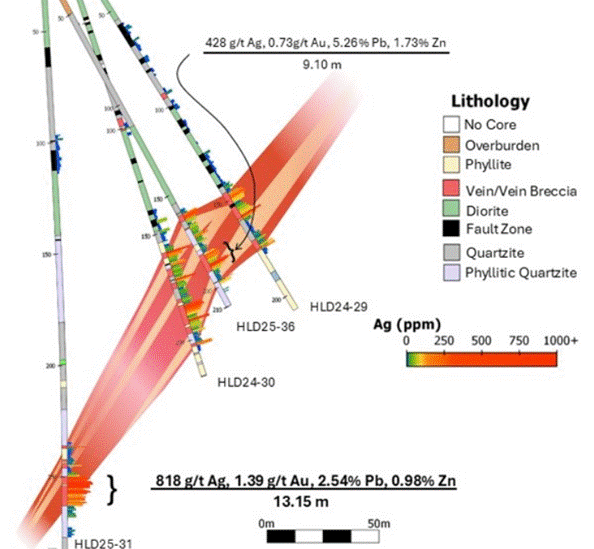
Two drill rigs going all summer into the fall for a 5-7,000-meter drill program to basically wrap our arms around what the Main Fault discovery could be at Haldane, which is the discovery we made in 2024 and then added another eight holes into it in 2025 that led to our best hole ever drilled on the property.
This progress gives us the confidence that we’re on to something at the Main Fault that could be an average size or bigger Keno Hill-style silver deposit, somewhere in the 20- to 30-million ounce range.
For us the driving force is to wrap our arms around what the Main Fault could be as quickly as possible. The second driver is that it’s always better to put out good results in a strong market, but it’s also the availability of capital.
Also, these strong silver prices mean our neighbor Hecla is in a better spot financially when they’re producing at $70, $80, $90 silver, or whatever it’s going to settle out at and there’s a there’s a time period there where we can “make hay.” We feel that time is now.
So that’s the plan for this year, but that is the same plan we’ve had since December. The financing we are closing next week gives us the ability to go do that same program size, and maybe even a little bigger in the following year. So that sets us up very nicely going forward here in the next couple years.
RM: You mentioned at the Main Fault we’re going to put two drills on that in an earlier talk and that’s about all you can fit on there reasonably. So, we’re going to have two drills working. Any other areas going to be looked at?
JW: Yeah, for sure. Big Horn, which was the target we drilled in 2019, where we discovered new Keno style veins. It’s 3 kilometers away from the Main and West Fault areas, never had any drilling before this was found by good old-fashioned soil geochemistry.
I think of it as 80% of the drilling at Main Fault and 20% at Big Horn and maybe another target.
I leave those parameters open like that because we are going to be flying an airborne EM and mag survey here in late March or early April that would then be used to inform and refine our targeting for that summer drilling. So, if there’s something that looks like we have to test it with a drill we can include that in plans as well for the coming summer.
RM: Tell us about your Tim CRD mineralization project down by Coeur Mining.
JW: Yes, that is the style of mineralization that we’re exploring for. We’re about 19 kilometers northwest of Coeur’s Silvertip mine.
They’ve done a really good job growing the resource because they’ve not only been spending the last few years brownfield exploring at and around the mine but also looking at the regional picture, the whole carbonate replacement deposit mineralization style district.
They’re approaching it from that perspective, looking at the whole district, which is where our Tim property comes in, as it’s in the same host rocks, a little higher in the stratigraphy but there’s a favorable horizon in there that the Tim seems to occupy that that they’ve focused on. In the work that they’ve done they’ve identified what they think clearly are indications that there is a CRD process that was underway in these rocks.
So that’s the story at Tim. We’ve seen those indications of CRD processes active here. We have high-grade silver in trenches on surface. We don’t yet in drilling, but the indications are there, combined with other geological observations that all point to the same answer.
RM: Coeur is your partner on the project.
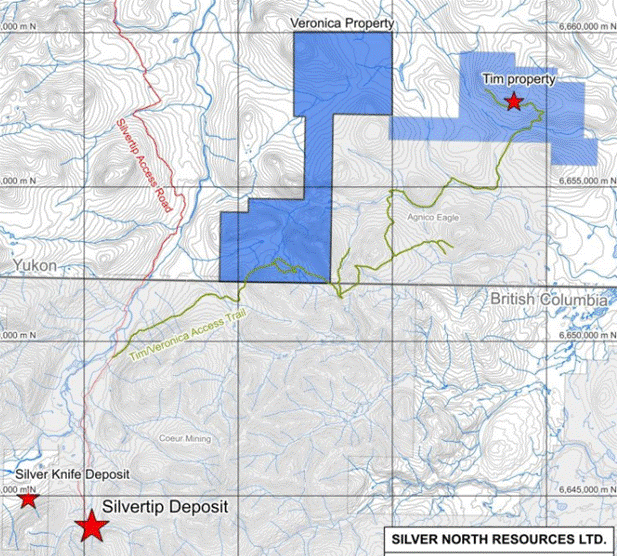
JW: They’re funding right through to a feasibility study essentially to earn 80% of the project. It just makes sense to have those guys as a partner, they’re the experts in this district on these deposits and they can put their crews, who’ve amassed all this knowledge both at Silvertip and in the rest of the district, to work at Tim. The plan is for a small drill program there this year to test some specific targets.
Right next door, we’ve acquired another project called Veronica. Initial indications are that it’s actually closer to the same stratigraphic level as Silvertip. So, another exciting CRD target in this district.
We are really happy with the way this project went last year. We spent $100,000 and came up with new silver-bearing showings. We found high grade silver-lead mineralization in float and followed that up with finding similar mineralization in outcrop, indicating to us that there was potentially a CRD system active here as well. We are planning in the neighborhood of $500,000 in exploration this year which will again be geophysics surveys and then more groundwork to refine drill targets.
We’ve got a one kilometer by one kilometer soil geochemical anomaly defined by anomalous lead and silver values. It’s open to the east towards our Tim project and there’s some good work to be done to get that target to the drill stage.
RM: Just saying, when you look at the CRD geological model you’re looking at a model responsible for a lot of the world’s major discoveries.
Newmont’s Penasquito mine in Mexico, the Resolution copper joint venture in Arizona, and of course the big one of them all — the hub and spoke model — is Bingham Canyon, aka the Kennecott copper mine.
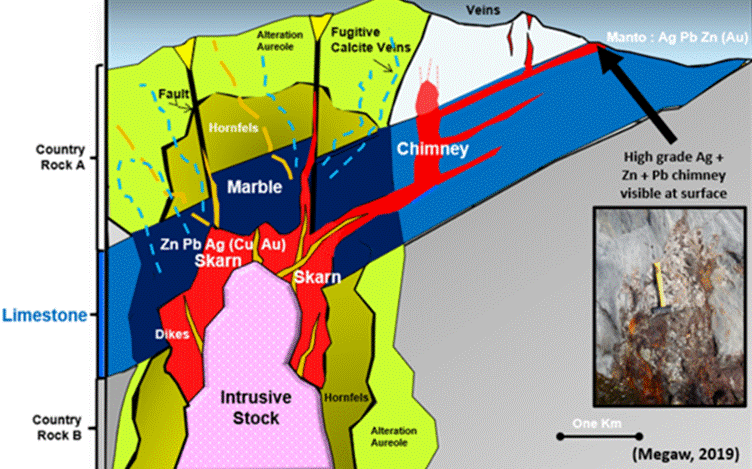
And it just makes things a little bit simpler, I think, to work on them knowing you have grounded, proven models.
JW: You can have the right rocks and processes that can produce one of the biggest porphyry deposits in the world, as well as skarns and epithermal deposits, and they’re all found proximal to each other and the recognition of the CRD is what ties it all together.
RM: It’s definitely worth chasing, thanks for your time, Jason.
JW: Thanks Rick.
Richard (Rick) Mills
aheadoftheherd.com
Subscribe to AOTH’s free newsletter
Richard owns shares of Silver North Resource (TSX.V:SNAG). SNAG is a paid advertiser on his site aheadoftheherd.com This article is issued on behalf of SNAG
Legal Notice / Disclaimer
Ahead of the Herd newsletter, aheadoftheherd.com, hereafter known as AOTH.Please read the entire Disclaimer carefully before you use this website or read the newsletter. If you do not agree to all the AOTH/Richard Mills Disclaimer, do not access/read this website/newsletter/article, or any of its pages. By reading/using this AOTH/Richard Mills website/newsletter/article, and whether you actually read this Disclaimer, you are deemed to have accepted it.