 RSS Subscribe
Torr Metals expands Sonic copper-gold soil anomaly to ~8 km2 – Richard Mills
2026.02.05
Torr Metals (TSXV:TMET) has expanded the mineralization at its Kolos Copper-Gold Project in south-central British Columbia.
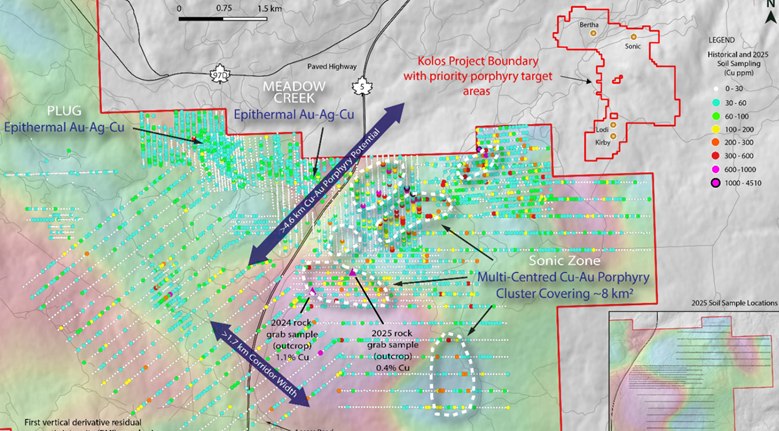
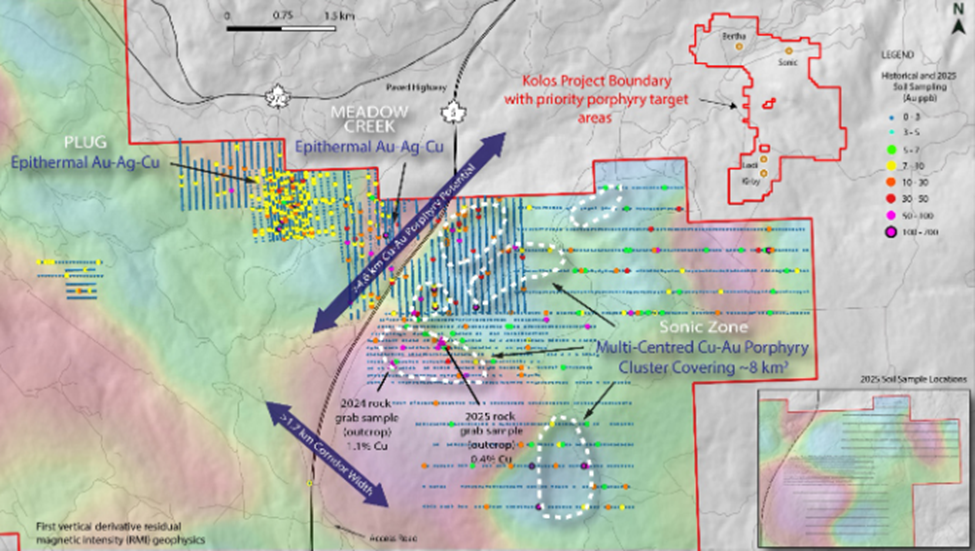
Results from a geochemical program completed in late 2025 from the undrilled Sonic Zone have nearly doubled the anomalous footprint from 4.5 square kilometers to about 8 square kilometers.
A total of 1,572 samples were collected from Sonic, located adjacent to Highway 5, part of Torr’s 100%-owned 275 km² land position within the 332 km² Kolos Copper–Gold Project.
The program successfully confirmed historically reported grades, returning up to 3,090 parts per million (ppm) copper and 420 parts per billion (ppb) gold.
According to the Edmonton-based company, the results outline a large, structurally controlled mineralized corridor measuring 4.6 km in length and up to 1.7 km in width.
“These results underscore the scale and upside exploration potential of the Sonic Zone as a large, undrilled copper-gold system,” said Malcolm Dorsey, president and CEO of Torr Metals, in the Feb. 3 news release. “Nearly doubling the anomalous soil footprint to approximately 8.0 km² is a major step forward and materially reinforces Sonic as a high-priority target within the Kolos Project. With excellent access, permitting underway, and an induced polarization (IP) geophysical survey planned in 2026 to refine drill targets, we are advancing Sonic toward drill readiness; while maintaining our near-term focus on our fully funded Phase II drill program of up to 6,000 metres, beginning with follow-up drilling at our Bertha and Bertha North targets located 9.5 km to the west.”
Among the highlights:
- Structural Controls and High-Grade Copper in Outcrop: Mineralization is controlled by two dominant structural trends; a northwest-oriented trend along the margins of a strong high-magnetic anomaly to the south, where select 2024–25 Torr rock grab samples returned up to 1.1% Cu, and a north to northeast trend within adjoining low-magnetic anomalies to the north and east (Figure 1, Figure 2).
High-Level Porphyry Exposure and Fertility Indicators: Several late-stage aplite-silica dikes up to 12 meters wide, strong epidote alteration, patchy feldspathization, and albite overprinting potassic biotite support a long-lived, multi-phase intrusive complex consistent with a high-level alkalic Cu–Au porphyry system. Increasing stockwork veining and porphyry-style alteration and mineralization are now further substantiated by large-scale soil anomalism (Figure 3).
Excellent Access and Along-Trend of Major Porphyry Deposit: With direct road access to Highway 5, the Sonic Zone is along-trend of the Ajax Cu-Au porphyry deposit, located approximately 24 km along trend to the north-northeast. Permitting for drilling at the Sonic Zone is underway.
Strong Soil Geochemical Results and Ongoing Assays: Of 1,572 soil samples collected, 139 returned greater than 100 ppm Cu, including 20 greater than 300 ppm Cu, while 48 samples returned greater than 10 ppb Au, including 20 greater than 30 ppb Au.
Kolos Copper-Gold Project
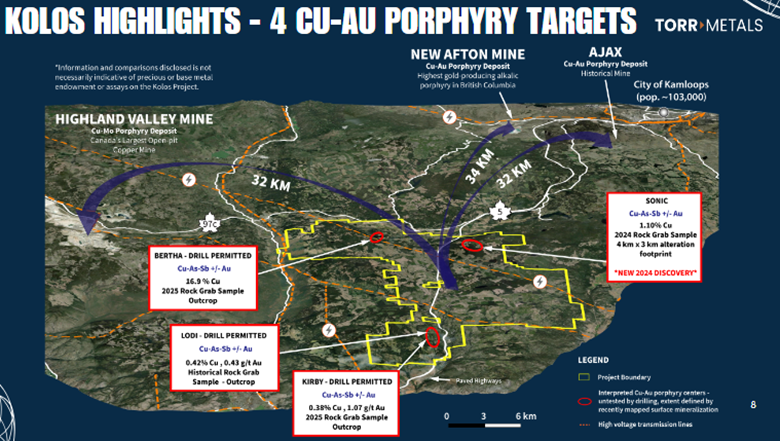
The 332-square-kilometer Kolos Copper-Gold Project contains Nicola Belt geology along trend and with similar attributes to alkaline and calc-alkaline copper ± gold ± molybdenum porphyry mines at Copper Mountain, Highland Valley, and New Afton.
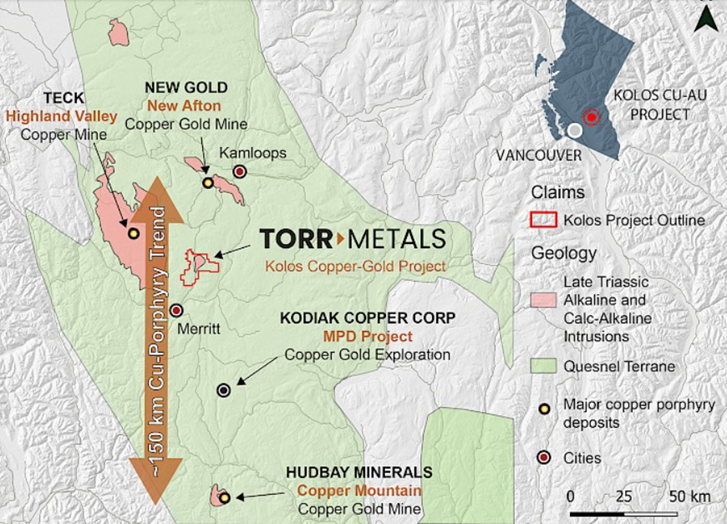
The project is adjacent to Highway 5, the Coquihalla Highway, with year-round access and operation potential via forestry service roads and substantial infrastructure provided by the city of Merritt located 23 km to the south. The project contains 16 historical copper and gold occurrences; the majority never drill-tested including the main target areas.
Through its own exploration, Torr has vectored four main copper-gold porphyry targets; three of them, so far, permitted for drilling.
The project lies within the Quesnel Terrane, a prolific porphyry belt in British Columbia that is host to major deposits and long-lived mines that within the region largely consist of Late Triassic calc-alkaline and alkaline intrusions, including Highland Valley (30 km to the northwest), New Afton (30 km to the north), and Copper Mountain (106 km to the south) deposits.
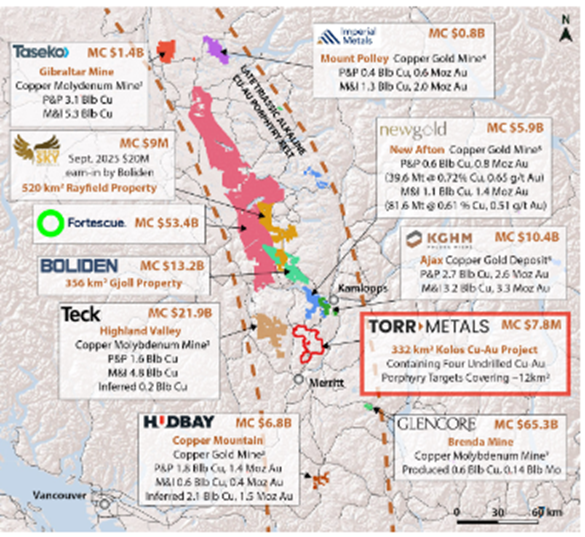
As shown on the map below, there are at least nine major or mid-tier mining companies operating within the Late Triassic-Alkaline Cu-Au Porphyry Belt, including Taseko (Gibraltar mine), Boliden (Gjoll project), AngloTeck (Highland Valley mine), Hudbay Minerals (Copper Mountain mine), Imperial Metals (Mount Polley mine), Coeur (New Afton mine), KGHM (Ajax project), and Glencore’s shuttered Brenda mine.
In September 2023 Torr Metals announced the staking of the Kolos Copper-Gold Project totaling 13,957 hectares. The news release mentions the six copper and gold occurrences with the highlighted grades, and the initiation of a 2023 field program composed of up to 2,300 soil samples as well as rock sampling, with a focus on testing potential extensions to historical geochemical anomalies.
The field program was completed that November, and Torr announced that it collected 47 rock and 3,348 soil samples, within about a 48 km² area. The program included the first-ever surface geochemical and ZTEM airborne geophysical surveys conducted over known historical copper-gold occurrences that have never been drill-tested.
Sonic Zone discovery
In August 2024 Torr Metals made a discovery that confirmed the exploration methodology.
Final assay results from a total of 33 rock grab samples collected during 2024 reconnaissance programs revealed additional high-grade rock grab assays within the Kirby, Rea and Clapperton zones, as well as a new copper-gold discovery in the northern portion of the project that Torr termed the Sonic Zone.
Initial rock grab samples from the Sonic Zone revealed anomalous copper and gold values in outcrop within a 1,000- by 2,000-meter footprint of strong magmatic-hydrothermal alteration that aligns with the margins of a high magnetic geophysical signature, identified as a potential source for a monzodiorite intrusion.
The discovery reinforced Torr’s exploration model and suggested the potential for another large-scale cluster of anomalies comparable in scale to the already established Kirby, Lodi, Ace and Rea targets to the south.
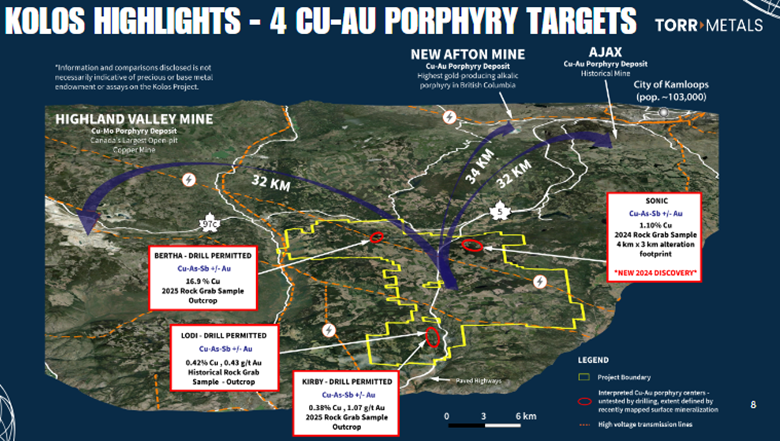
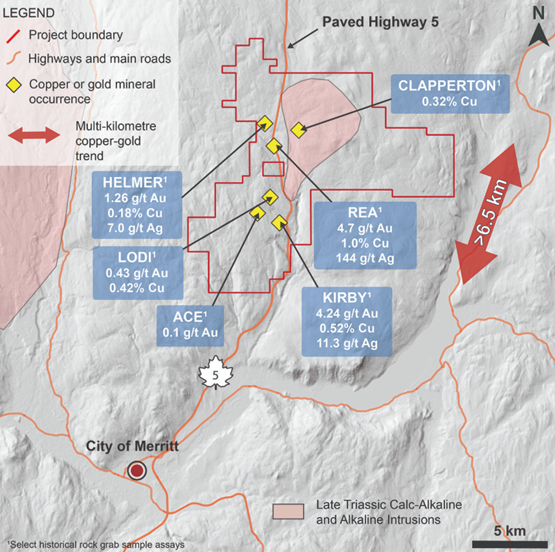
In total, Torr has identified four undrilled targets at Kolos — Sonic, Bertha, Kirby and Lodi — with surface geochemical anomalies covering, with the latest news release, a combined 15.5 square kilometers.
Rick Mills, Editor/ Publisher, Ahead of the Herd:
I’m looking at Sonic results, a large, structurally controlled mineralized corridor, 4.6km in length and up to 1.7 kilometers width.
That’s a massive-size system with, you almost doubled the anomalous soil footprint from the 4.5 it was to 8.0 square km. How big is that compared to other porphyry imprints in the area and how big is it?
Malcom Dorsey, CEO, Torr Metals:
I think in terms of comparing it to other like anomalism’s within the area, this distribution is very comparable to what Kodiak Copper (TSXV:KDK) was first working with. It’s larger than the anomaly that we first defined in 2023 and 2024 around the Kirby and Lodi occurrences, that was about six square kilometers of similar values up to about 1,200 ppm copper and 720 ppb gold. But Sonic is also unique just in terms of its exposure.
It was really a surprise the first time when we went up there. We knew of the historical soil anomaly that was just off further to the north. And what we were initially looking at was this high magnetic anomaly, which occurs right where the north-south trend in Fanta Fault, which is a significant control, we believe, on the porphyry distribution regionally, but right where it starts to deviate off towards the northeast.
So, you have major structural intersections here in the Sonic area and where it deviates off towards the northeast, if you follow that trend, you’ll end up at Ajax, about 24 kilometers to the northeast.
It’s interesting just looking at those features, looking at the fact that this is structurally complex. You’ve got three major intersecting structures, obvious long-lived magmatic activity, and that was really confirmed when we went up there for the first time in 2024 after staking the area, and right away just started seeing abundant outcrop on both sides of the forestry road that never been sampled.
We were the first ones to sample some of that outcrop, and it came back up to 1.1% copper in outcrop in veins that hosted chalcopyrite mineralization together with magnetite, which speaks to proximity to a potential source to this porphyry-style mineralization.
RM: You’ve got a piece here on high-level porphyry exposure and fertility indicators. Could you get into that a little bit more, please?
MD: When we look at Sonic it’s multi-phase intrusives that are exposed at surface, highly prospective widespread alteration envelopes.
Mostly you see a lot of albite alteration as well as silica albite dikes, several of them, the largest one being up to 12 meters in width, so what that speaks to is a very long-lived intrusive center at Sonic, you’ve got these late-stage burps essentially of silica that come up and form these albite silica dikes.
It speaks to that longevity, it speaks to the fertility of the Sonic Zone, the fact that you have multi-phase widespread albite alteration with overprinting of biotite phase potassic alteration, together with those soil anomalies.
Another thing that I really like to see in terms of fertility is the abundance of veining. So, we’re seeing strong stockwork veining, larger-scale single-sheeted veins. That really speaks to there is a lot of hydrothermal activity here.
We see several different phases of intrusives, everything from monzonites to diorites to porphyritic intrusives, which really speaks to a multi-phase intrusive complex. All that just points to very long-lived magmatic activity and strong fertility.
As well, you’ve got that fundamental north-south trending Fanta Fault that cuts through the middle of the Kolos Project, but as you follow along that fault to the north it intersects this large northwest structure that parallels the Iron Mask Batholith.
Along that northwest corridor is where we have the concentration of Bertha to the northwest, Sonic to the southeast so it’s all structurally linked on these large crustal-scale features but with Sonic and Bertha they certainly are linked to the same intrusive complex. You’ve already got this structural groundwork that really prepares the ground ahead of time for these intrusives to come up that exploit these weaknesses.
So. it’s a great concentrator of all these different features in this area. In terms of the high-level porphyry exposure, that’s kind of revealed both in the geochemistry of the soils as well as the style of the alteration that you see. So. what we have mostly is in the soils, we have all the pathfinder elements, but you get more enhanced arsenic and antimony in relation to the copper and gold mineralization.
This would suggest that you’ve got a little more of that upper-level porphyry exposure, especially together with the fact that you’ve got several late-stage aplite silica dikes, the largest of which is almost 12 meters wide. Those are late stage, so they’re really silica pulses that come up late in the process. But the fact that there’s a number of them together with the style of the alteration being largely albite-dominated, over-printing a potassium-phase biotite alteration, speaks to this being more upper-level porphyry exposure.
RM: I’m looking at these pictures, A, B, C, D, E, and F, give us a brief description of each.
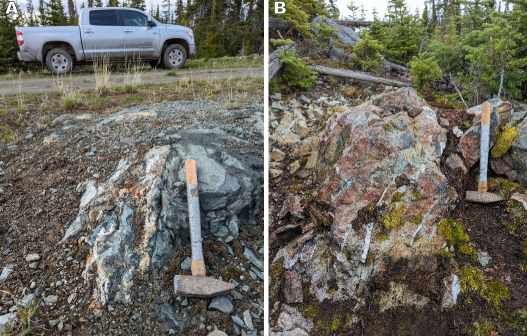
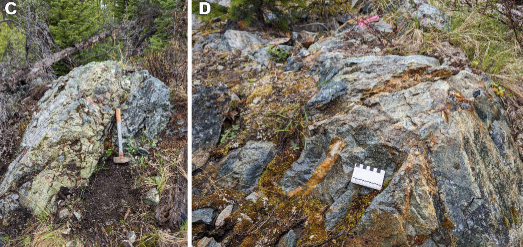
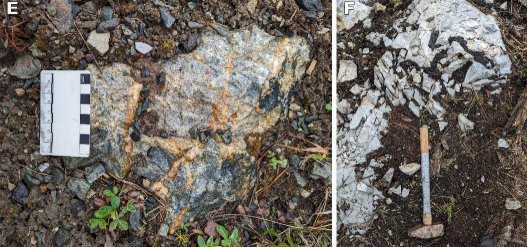
MD: If you look at B, it’s a monzodiorite intrusive.
Some of those white quartz veins that you see are dilational, so they’re late-stage quartz veins with some localized feldspar potassic alteration. But you see overall within the rock outcrop this patchy felspathic alteration within it. So that actually is typical in the region of the Cherry Creek unit.
So Cherry Creek is thought to be an integral intrusion to mineralization that’s seen both at New Afton as well as at Ajax. So, it’s significant to see something that looks that distinctive. And then if you look towards C, you get this very pervasive, strong epidote with localized potassic alteration.
And that’s associated with this monsodiorite intrusive within Nicola volcanic. That amount of epidote really speaks to how hot and acidic these fluids were that were coming up. Those are the type of fluids that you would expect to be carrying some of this mineralization.
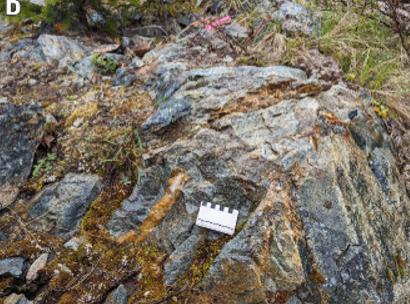
And then some of the other photos, D and E, really showcases the stockwork veining within some of the intrusive host rock itself. So, these are the types of veins that ran 0.4% up to 1.1% copper. And there is some gold content to them as well, about 0.05 grams per tonne gold.
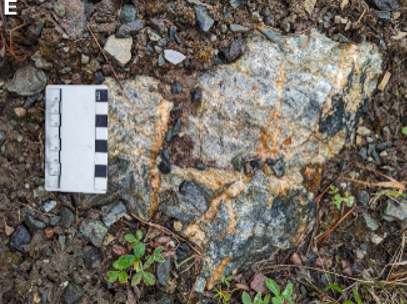
So really what you need to define now with further mapping is which styles and stages of veins would be more the gold host. But that’s all future work that we’re going to be conducting within the area. What it does show is the concentration of veining.
And that is what you want to see when you’re looking for the fertility of these porphyry systems, is concentration of the veining hosting the mineralization. And that’s what we see here.
RM: I’m kind of impressed with D and E, looks like you dropped something on it, and it splashed everywhere.
MD: Yes, you can see there’s a couple different orientations. So that’s part of, especially during this next season as well, we’ll be better constraining which veins are the type that we, and which orientations are the principal orientations. Although we do have an idea of that already from mapping that has been done together with the orientation of the soil anomalism, there seems to be a strong control that’s northwest trending, and then it meets up and trends towards the northeast.
So, you see that along the margins of that high magnetic anomaly, that northeast trend kind of deviates away from the high magnetic anomaly. But those would be the two principal orientations as well that we would expect to see, and that you actually see at the Ajax deposit to the north as well.
RM: You’ve got to be quite excited, we’ve got Bertha and we’ve got a vector to drill that. And now we’re looking at this Sonic and there’s a lot of outcrop. The outcrop’s heavily mineralized in some areas. And you’ve got all these indications of porphyry.
So how do you plan where to put a drill hole on something like Sonic? It’s just so darn big, 8 square kilometers. What studies are, what more do we have to do before you can say, I’m going to put a drill hole here?
MD: The soils certainly give us strong vectors towards where the potential cores could be, especially when you’re looking for the gold-copper ratios within the soil. They especially concentrate along the margins of that high magnetic anomaly.
But the next step here is to run some IP, which we do have planned to conduct here in 2026. So that IP will give us a much better constraint, especially with this type of system. There’s a number of copper anomalies, as I outlined in the map.
So, it’s really a cluster porphyry system. But as with every cluster porphyry system, you have to find out essentially where the main zone, the central zone is to the porphyry. So, where’s the core? And that is really going to be defined by doing the IP.
That’ll give us a better idea on where that main core could exist. And it’ll give us the geophysical vectors as well to combine together with what we’ve observed at surface, as well as the soil and rock sampling.
RM: And what this is all leading to is very exciting two-drill programs of up to 6,000 meters. It’s going to be an interesting year for TMET having two drill programs going.
MD: And that’s where we have this optionality as well. Like the Kolos Project, it’s really a multi-target porphyry district, and those targets have never been drilled. And then, of course, when you look at something like Sonic, so an 8-square-kilometer soil anomaly right adjacent to Highway 5. So, the fact that we’re really the first ones to define the potential in that area is significant as well. And something that we’re looking forward to testing here in 2026.
At this point we’ve defined not just the Kirby and Lodi areas, but Sonic, and now Bertha and Bertha North. All these areas have large-scale geochemical anomalies associated with them, together with large-scale geophysics. So certainly, all the indicators are there that these could be some very significant porphyry systems, and they’ve not yet been tested.
So, we’re really the first movers in this area and we’re fully funded for another 6,000 meters of drilling. We have plenty of targets, plenty of space to move into, and plenty is still left that we need to follow up on from the first phase of drilling. And that’s really it as well, is that’s the first round of drilling on any one of these targets.
And it’s with that first round of drilling that you really get a better constraint on what are the controls, what are the features that you need to look for, and how can you more effectively and better target them moving forward. So, this not just better informs us in terms of the Bertha area, but also our other target areas as well. Without any drilling previously into those areas, you need some insight, and that insight is provided by that first inaugural drill program.
RM: Let’s just do a quick comparison between Bertha and Sonic.
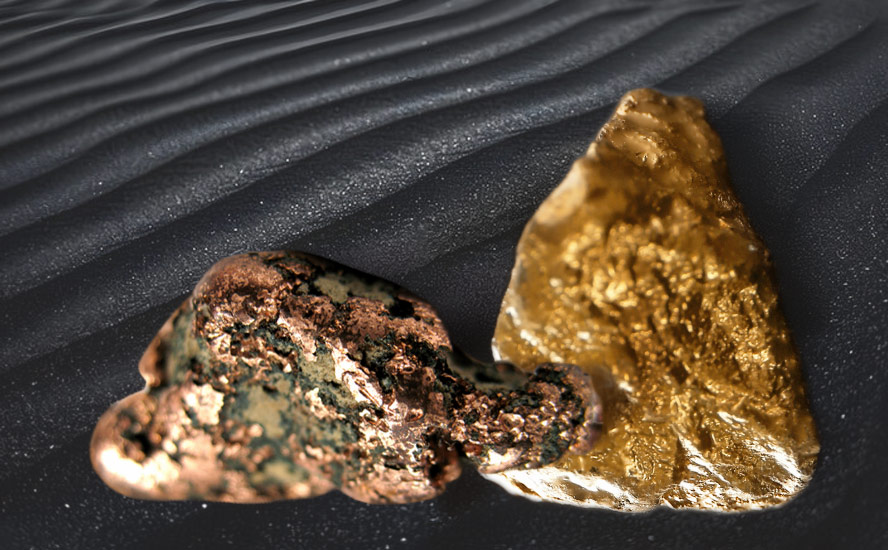
MD: In terms of the difference, I would say within the Bertha area there’s certainly supergene-style alteration and mineralization up onto native copper. So that is unique, different from the Sonic area, whereas the Sonic area is much more dominated by intrusive activity. You’re looking at these multi-phase intrusive complexes at Sonic.
When you’re looking geologically, that’s what you have up towards the Ajax deposit as well, is the porphyry is hosted within the intrusive units, whereas if you look towards something like a New Afton-style system, there’s mineralization within some of the source intrusives, but the majority of the mineralization has ended up with the adjacent brecciated fragmental volcanics of the Nicola Group. So slightly different porphyry settings, different host rocks, and that’s what we see as well between the Bertha and the Sonic area.
RM: When we talk style of mineralization we talk about Bertha as Afton/New Afton style, when we talk Sonic it’s an Ajax style of mineralization.
MD: Yeah, all of this is just pointing out geological comparisons to a certain style of alteration or mineralization.
So, with geology, it’s an evolving process, one where you have to keep going up there, you have to keep looking at the rocks, keep thinking about what comparisons can be made and what’s the significance of that. I think as we’ve looked at it further, especially when you’re looking at New Afton as the preservation of a large supergene system that overlies a hypogene core, that’s not really what we’re seeing at this point within the Sonic area. But we do see some strong comparisons that showcase potentially something that’s a little more like an Ajax-style system, which is also more typical of most BC porphyries, being this intrusive-hosted, in this case, widespread albite alteration, which is interesting as well as you have that up towards Ajax.
RM: There are different styles of mineralization in these porphyries. And because these porphyries are already established, they’re already mined, when you talk about an Afton-style or an Ajax-style, you’re not talking about 500 million tons or 30 million tons of 2% copper.
What you’re talking about is the style of mineralization because it’s an easy way for people, more technical people, to understand what we’re talking about on the style of mineralization.
What it’s saying is we have mineralization that is similar to the type of mineralization that was found at Ajax.
MD: That’s key when you’re doing early-stage exploration, especially in areas that have been underexplored, you’re finding whatever evidence at the surface or in your geochemical profiles, and you need to look around on a regional basis to be able to say, well, what is this? Where else do we see this style of mineralization? Because you need to start building an exploration model. That model does have to be based on something that is regionally comparable or that can help inform your model.
So that’s really all it is, is that, well, we see similar styles of alteration or mineralization at Sonic as is seen towards the Ajax area. And same thing with us being in the Bertha area. We’re seeing abundant native copper.
We’re seeing a large supergene-style alteration mineralizing system. That’s more, you see that within the New Afton-style system as well. So, it’s looking around so that that can better inform the exploration model and maybe help lead you to where you need to vector towards.
Conclusion
Torr Metals is poised to drill 6,000 meters at two drill targets: Bertha and Sonic. It’s important to say that the priority is Bertha. An initial 2,733-meter drill program at Bertha successfully confirmed the presence of a large, structurally-controlled hydrothermal copper-gold-silver system and, importantly, defined coherent geological and geophysical vectors toward a high-priority, untested copper–gold target to the northeast.
Drilling delineated broad zones of anomalous copper mineralization spatially associated with hydrothermal magnetite, brecciation, and strong northwest-striking and north-south trending structural controls. These zones are flanked by 68 discrete native copper occurrences that locally define higher-grade intervals and are closely associated with hydrothermal magnetite-epidote veining, collectively defining a laterally extensive hydrothermal copper system spanning greater than 350m in strike and 580m vertical depth.
According to Dorsey, this year’s field program will start with geophysics to test the expansion potential to the northeast of the Bertha Zone where Torr focused its initial drilling. That drilling confirmed Bertha as the peripheral expression of a large alkalic porphyry system with a very extensive supergene-style mineralization alteration within it.
“It also defined those drawn vectors going towards the northeast, so we need to expand on that with IP, see where it leads us. And then at the same time we’ll run that IP to get deeper penetration at the “new” Bertha North target,” he told me in January.
“We need to see what the geometry of the underlying chargeability anomaly is, and that will set the stage for our phase two drill program, so we’ll follow the IP with drilling and altogether I would say this produces basically two high-quality shots on two vectored porphyry systems.”
At Sonic, the just-released soil sample results give Torr strong vectors towards where the potential cores could be; we know they concentrate along the margins of a high magnetic anomaly.
The next step is to run some IP, which will give the technical team a much better constraint within this type of cluster porphyry system.
“That’ll give us a better idea on where that main core could exist. And it’ll give us the geophysical vectors to combine together with what we’ve observed at surface, as well as the soil and rock sampling,” Dorsey said.
A drill permit for Sonic is expected soon.
2026 is shaping up to be a very interesting year for Torr Metals.
Torr Metals
TSXV:TMET
2026.02.03 Share Price: Cdn$0.17
Shares Outstanding: 31.8m
Market Cap: Cdn$14.2m
TMET website
Richard (Rick) Mills
aheadoftheherd.com
Subscribe to AOTH’s free newsletter
Richard does not own shares of Torr Metals (TSXV:TMET). TMET is a paid advertiser on his site aheadoftheherd.com This article is issued on behalf of TMET.
Legal Notice / Disclaimer
Ahead of the Herd newsletter, aheadoftheherd.com, hereafter known as AOTH.Please read the entire Disclaimer carefully before you use this website or read the newsletter. If you do not agree to all the AOTH/Richard Mills Disclaimer, do not access/read this website/newsletter/article, or any of its pages. By reading/using this AOTH/Richard Mills website/newsletter/article, and whether you actually read this Disclaimer, you are deemed to have accepted it.