
 RSS Subscribe
Silver North releases 2024 results of Tim CRD earn-in project – Richard Mills
2025.05.28
Silver North Resources Ltd. (TSXV:SNAG, OTCQB:TARSF) on Monday published results of the 2024 drill campaign executed and funded by Coeur Silvertip Holdings, Ltd., a subsidiary of Coeur Mining, Inc. (NYSE:CDE).
Silver North is working with partner Coeur Mining to develop the Tim property, located on the Yukon side of the Yukon-British Columbia border.
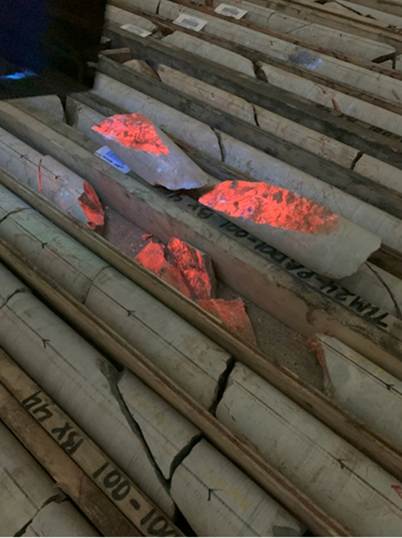
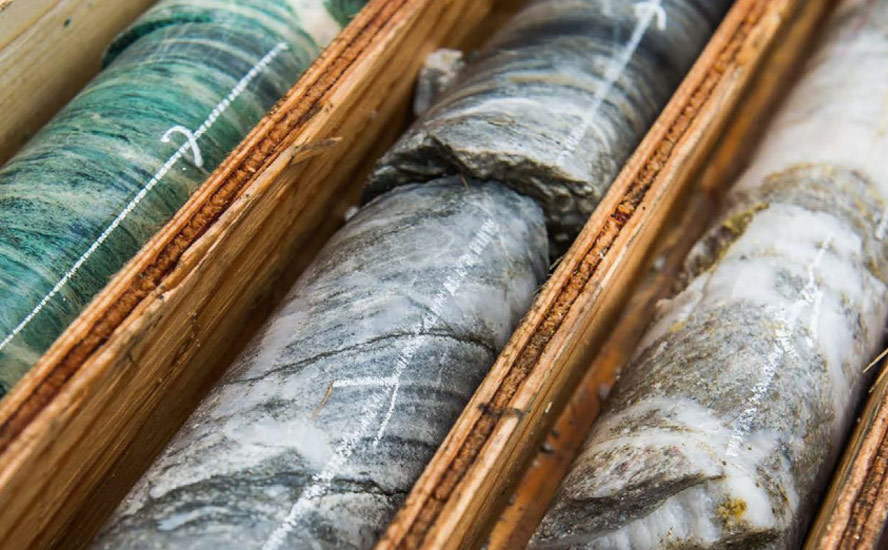
As outlined in Silver North’s Aug. 19, 2024 update, drill core observations from the first three holes of the program include diagnostic features that are commonly associated with significant CRD mineralization and have been observed at Coeur’s Silvertip deposits. Such characteristics include fugitive calcite veining that fluoresces in UV (ultraviolet) light, displaying the classic barbeque (pink and orange fluorescence) and recrystallization of the host limestones. (shown in the below photo)
Both Coeur and Silver North view Tim as a high-priority exploration target as it exhibits similar geological characteristics to Coeur’s Silvertip project.
CRD deposits
Carbonate replacement deposits (CRD) are some of the most interesting assemblages of mineralization found in the mining world today.
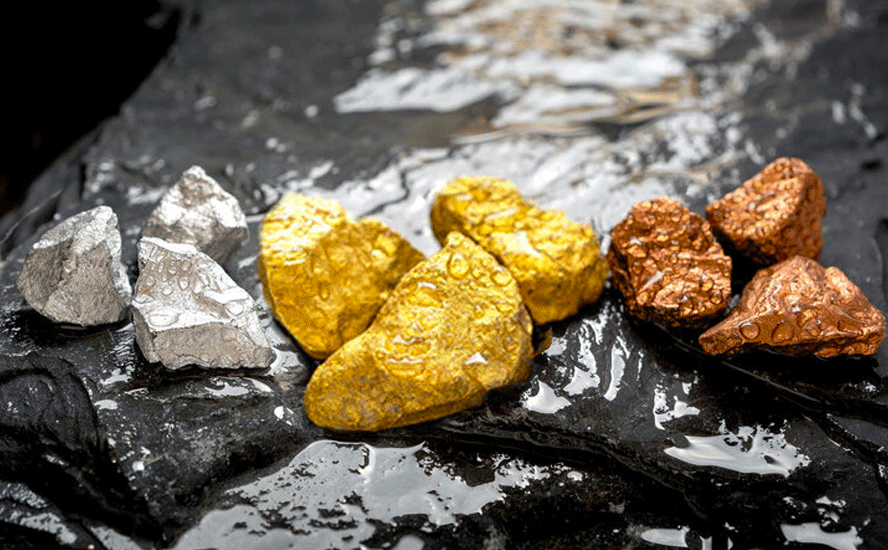
CRDs are large orebodies that extend over long distances, and they typically have mine lives lasting for decades, containing significant amounts of metals, including copper, gold, silver, lead, manganese and zinc.
These deposits are also known as temperature carbonate-hosted gold-lead-zinc deposits because their formation requires high temperatures over 250 degrees C. The orebody is formed by the replacement of sedimentary, usually carbonate rock, by minerals-laden solutions found near porphyry intrusion.
This replacement process results in the formation of deposits that are remarkably similar in terms of their mineralogy (how the minerals are spread throughout the deposit) as well as in the formation of crystals.
Often with CRDs, the surface expressions are few and far between, and maybe a cm or two thick.
Unlike vein-hosted deposits, CRDs typically manifest as continuous deposits of interconnected bedding parallel sulfide replacement deposits called mantos and crosscutting structurally controlled sulfide pipes called chimneys. The scale of CRD systems can potentially extend for a number of kilometers around their source, typically a mineralized porphyry system.
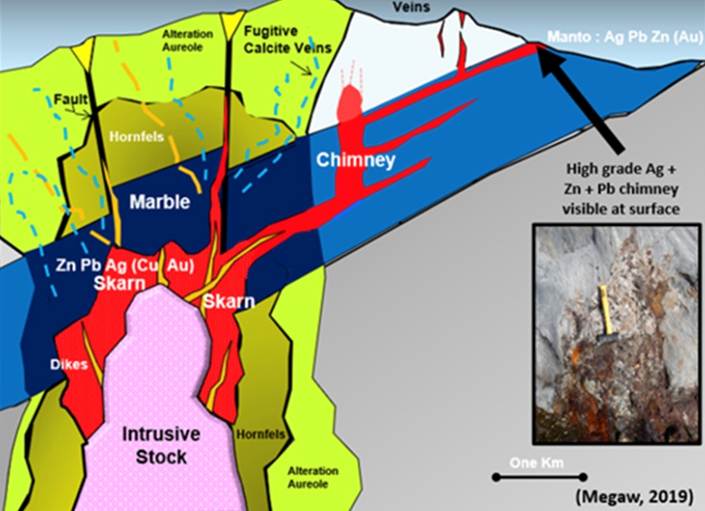
The above generic CRD deposit model schematic shows how these deposits form. Note the porphyry intrusive in pink, surrounded by skarns in red, which reach upward like long fingers, forming high-grade chimney structures that are visible at surface along with the outcropping veins.
Examples of CRD discoveries based on this model include:
- Bingham Canyon in Utah, a long-running open-pit mine that extracts a huge porphyry copper deposit containing 17 million tonnes of copper, 23 million ounces of gold, 190Moz of silver and 850 million pounds of molybdenum.
- MAG Silver’s Cinco de Mayo property in Chihuahua state, Mexico; Arizona Mining’s Taylor deposit which South 32 bought for $1.8 billion.
- RC Consortium’s Resolution Copper deposit estimated to contain enough copper to produce 40 billion pounds over 40 years.
- Newmont’s Penasquito mine in Mexico, which is the fifth largest silver mine in the world @ 17.8 million ounces of gold and 1.08 billion ounces of silver.
Besides their common formation, all CRD deposits are polymetallic, meaning they have various metals in them including precious (gold, silver) and base metals (copper, lead, zinc). The mineralization may extend up to seven or eight kilometers from the intrusive stock, the porphyry, and the mineralogy changes as you move out from the core.
They are especially important for mining because of their large scale and high grades, containing between 10 and 150 million tons of economically mineable minerals. Moreover, they can be closely related and proximal to large porphyry systems.
The porphyry intrusive is the heat source, and the source of the multiple pulses of mineralized fluids. The first pulse goes into the carbonate, into the limestone and it prepares the limestone by fracturing it and then subsequent pulses come in. The deeper you go the richer it gets.
Unlike deposits types found at surface, which are typically mined in open pits occupying a large environmental footprint, CRDs environmental footprints are much smaller because it’s high-grade underground mining.
One of the largest CRD-porphyry deposits in the world, Kennecott’s Bingham Canyon copper mine in Utah is a “hub and spoke” configuration.

As shown in the schematic above, Bingham’s “hub” is the porphyry copper zone in red, with the “spokes” extending out 1.5 km, to a series of Pb-Zn-Ag mantos, and a copper skarn zone.
Unlike vein-hosted deposits, CRDs typically manifest as continuous sulfide bodies over multi-kilometer-scales that broaden with depth and demonstrate continuity back to the source.
While it’s way too early to be comparing SNAG’s Tim property to Bingham Canyon, it is instructive to understand these deposits and know just how big and rich they can be.
These deposits are polymetallic, which simply implies that they have various metals in them such as copper, gold, silver, lead, manganese and zinc. The mineralogy changes depend on the distance from the intrusive rock.
CRDs are epigenetic, meaning they are produced on or near the Earth’s surface, usually through a very similar process (called “replacement process”, hence the name). In turn, it creates remarkably similar deposits in terms of their mineralogy and the form of the specimens and crystals, regardless of where they are in the world.
For instance, a sample of CRD deposit found in China would have a similar mixture of minerals as it would in Mexico.
The similarities in mineralization are so closely related that it helps create a geologic link between the deposits and highlights a clear proximity to large porphyry systems.
Many CRDs today are characterized by high grades (up to 1,500 g/t Ag, 25% Pb and Zn, and 5% Cu), bulk tonnage (up to 150Mt), low mining costs and minimal environmental footprint.
Evidently, the CRD geological model has been responsible for many of the world’s major discoveries, such as Newmont’s Peñasquito mine in Mexico and the Resolution Copper joint venture in Arizona held by Rio Tinto and BHP.
CRD deposits have incredible potential. MAG Silver went to a $2 billion-market cap on their Cinco de Mayo project. South 32 bought the Taylor CRD from Arizona Mining for $1.3 billion. The Resolution Copper deposit is estimated to produce 30 billion pounds of copper over a 40-year mine life.
Silver North (TSXV:SNAG)
Silver North has made significant new silver discoveries in the famous Keno Hill District in the Yukon. The company is ideally positioned to further prove out and expand these discoveries, a stage of the mining development curve traditionally associated with the largest potential value increases.
Silver North’s primary assets are its 100% owned Haldane Silver Project (next to Hecla Mining’s Keno Hill Mine project) and the Tim Silver Project (under option to Coeur Mining, Inc.).
GDR option agreement
Along with Haldane and Tim, Silver North now has access to three claims groups in the Silvertip-Midway District known as the GDR project. One of these groups, called Veronica, is adjacent to Tim.
In May 2024, Silver North announced an option agreement with the three prospectors who own the GDR project.
Under the terms, Silver North will make a series of cash payments totaling $102,000 over four years, and staged share payments totaling 1,560,000 shares over four years, to earn a 100% interest in the project. The deal is subject to a net smelter return (NSR) royalty of 2.4% — 0.9% of which can be purchased for $2 million.
According to Silver North, the GDR project claims cover geology prospective for carbonate replacement deposits similar to that being explored at Tim and at Coeur’s nearby Silvertip mine project.
“The GDR acquisition represents a strategic move to acquire additional ground prospective for high grade CRD silver mineralization in this under-explored district,” SNAG CEO Jason Weber stated. “Despite the early-stage nature of these properties, all three have favorable characteristics for CRD mineralization. In particular, the Veronica claim group has a strong, unexplained multi-element soil geochemical anomaly just west of our Tim property. This complements the Tim property nicely and gives Silver North access to more of the prospective stratigraphy in this district.”
The three properties comprising the GDR project (Veronica, MR and MFW) are road and trail accessible with potential for high-grade Ag-Zn-Pb CRD mineralization similar to the nearby Silvertip mine project owned by Coeur. The claims have Ag-Pb-Zn showings and multi-element soil geochemical anomalies underlain by Paleozoic limestone, in a similar geological setting to CRD mineralization at Silvertip.
Veronica is 11 km north of Silvertip and within 2 km of Silver North’s Tim project. MR and MFW are a further 20 km and 27 km north.
At Veronica a multi-element soil anomaly has been defined over a 450 by 450m area and is open to the east, with values that range from 0.3-31.1 ppm Ag, 60-3,100 ppm Pb, and 50-612 ppm Zn. This new anomaly has not been trenched, drilled or explained by prospecting, and presents a compelling target for exploration follow-up. Limestone and quartzite outcrop in the area.
Importantly, according to the news release, the Veronica claim group partially lies within the area of interest surrounding the Tim property, and as such, Silver North is obligated to offer the Veronica for inclusion within the Tim option agreement between Silver North and Coeur. If Coeur agrees to include the Veronica claims, it will reimburse one half of Silver North’s acquisition costs.
2024 drill program and 2025 plans
At Tim, Silver North has an option agreement with Coeur Mining, which can earn 80% ownership in the project by spending $3.5 million on exploration over five years, making $575,000 cash payments and completing a feasibility study within eight years.
Coeur’s Silvertip silver-lead-zinc project, situated 19 kilometers south in BC, is also a CRD deposit; in fact, it is one of the highest-grade silver-lead-zinc operations in the world.
Coeur funded a 2,250-meter drill program at Tim, designed to test the potential for CRD-style mineralization along almost 2 km of strike length.
Previous work identified silver mineralization in trenches dating back to the 1980s. A 2022 program conducted by Coeur to verify previous trench sampling returned 468.1 g/t silver, 21.1% lead, and 0.3% zinc over 4 meters from one re-opened trench. Another, located approximately 200 meters along strike, returned 265 g/t silver, 6.7% lead and 0.9% zinc over 8.8m.
The 2024 program successfully confirmed the presence of a Carbonate Replacement Deposit (CRD) style system at Tim. The program also confirmed the presence of permissive host rocks such as the Rosella Formation Limestones, which in the vicinity of the Wolf Fault, are overlain by phyllites and argillites of the Kechika Group, providing a promising environment for deposit formation.
The presence of a CRD system is evidenced by diagnostic features noted at Silvertip and elsewhere in the world, including fugitive calcite veining that fluoresces in UV light (displaying the classic “barbeque” pink and orange fluorescence), re-crystallization of the host limestones, disseminated pyrite-sphalerite and galena sulfide and derived oxide mineralization, and massive pyrrhotite with scheelite mineralization (an important tungsten-bearing mineral). The best drill intercept from the 2024 program returned 3.39m of 52.8 g/t silver, 0.28 g/t gold, 0.11% lead and 0.27% zinc within the Wolf Fault, a significant associated splay.
“We are grateful to have Coeur executing and funding exploration and we believe it is a significant advantage to Silver North’s shareholders to have their team executing and funding exploration on the property,” said Silver’s North’s President and CEO Jason Weber, in the May 26 news release.
“Because Coeur is applying a minerals-systems approach to exploration at Tim, they can be encouraged by geological observations in trenches and in drill core, even absent of high-grade silver and base metals intersections. We are excited that Coeur plans to conduct follow-up drilling at Tim utilizing the 2024 drilling and geophysical data to vector towards what they believe are potentially the most productive parts of the Tim CRD system.”
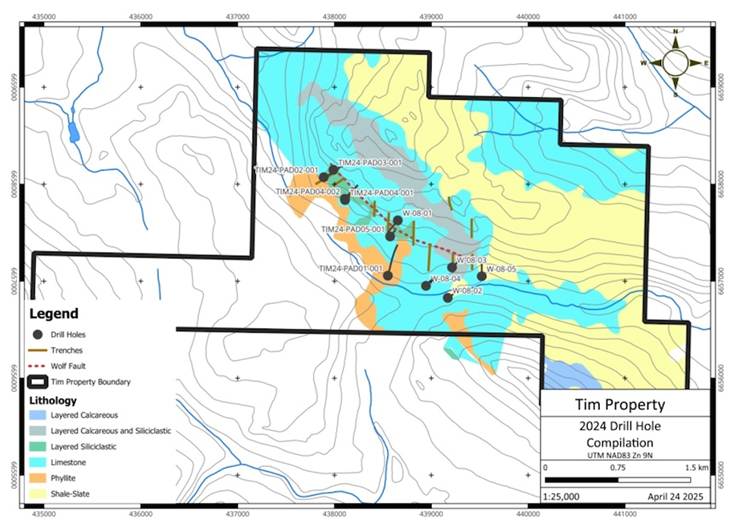
Coeur completed 2,250 meters of drilling in six holes, largely testing the Wolf Fault along approximately 1,000 meters of strike length within prospective stratigraphy. Drilling targeted structurally-hosted “chimney”-style mineralization potentially hosted within the Wolf Fault and splays of it, as well as stratigraphically controlled “manto” mineralization along conducive stratigraphic horizons.

Five of the six holes were successful in testing the Wolf Fault or splays of it, with one hole abandoned prior to reaching target depth due to excessive overburden. Intersections of the fault and its potential splays range in width from approximately 0.5 to >6.0 meters and were commonly noted to be anomalous in silver, lead, zinc and pathfinder elements. Two holes intersected massive sulfide mineralization in the fault and/or splay. TIM24-Pad01-001 intersected a massive pyrrhotite interval with blebs of scheelite and anomalous silver, gold, lead, zinc, as well as bismuth, tellurium and tungsten results that were over-limits at the upper 200 parts per million (ppm) bound.
TIM24-Pad03-001 intersected the Wolf Fault from 36.00 to 38.46 meters downhole, at the start of recoverable core. As such, the intersection is heavily oxidized. While the strongest mineralization in the intersection, albeit heavily oxidized from 38.14 to 38.46 meters was recovered, little or no sulfide mineralization was remaining.
Detailed planning of the 2025 follow-up program is underway. The 2024 program was conducted under the direction of Coeur’s exploration team based at the Silvertip site, under the terms of the option. The Tim property is track-accessible through 25 kilometers of 4×4 access off the Silvertip site road.
Conclusion
Between Haldane, its Tim carbonate replacement deposit (CRD) on the BC-Yukon border, and its GDR option in the Silvertip-Midway District, Silver North offers strong discovery/ development potential.
Silver North Resources
TSXV:SNAG, OTCQB:TARSF
Cdn$0.16 2025.05.26
Shares Outstanding 43.3m
Market cap Cdn$9.8m
SNAG website
Richard (Rick) Mills
aheadoftheherd.com

Subscribe to AOTH’s free newsletter
Richard does not own shares of Silver North Resources (TSXV:SNAG). SNAG is a paid advertiser on his site aheadoftheherd.com. This article is issued on behalf of SNAG
Legal Notice / Disclaimer
Ahead of the Herd newsletter, aheadoftheherd.com, hereafter known as AOTH.Please read the entire Disclaimer carefully before you use this website or read the newsletter. If you do not agree to all the AOTH/Richard Mills Disclaimer, do not access/read this website/newsletter/article, or any of its pages. By reading/using this AOTH/Richard Mills website/newsletter/article, and whether you actually read this Disclaimer, you are deemed to have accepted it.















#SilverNorthResourcesLtd. $SNAG #Silver #CRD #Carbonatereplacementdeposit