 RSS Subscribe
More results from Kodiak Copper’s extremely successful 2025 drill program at MPD – Richard Mills
2025.09.03
Kodiak Copper’s MPD project has all the hallmarks of a major copper/gold porphyry system with the potential, in my opinion, to become a world-class mine.
MPD project
The project is a 344-square-kilometer land package near several operating mines in the southern Quesnel Terrane, British Columbia’s primary copper-gold producing belt. MPD is between the towns of Merritt and Princeton, with year-round accessibility and excellent infrastructure nearby.
2025 drill program
On June 18 Kodiak Copper announced its fully-funded 2025 exploration program at MPD will involve drilling approximately 5,500 meters at West, Adit and South. A total of 39 drill holes were proposed.
The program has focused on near-surface infill and confirmation drill holes at the West, Adit, and South zones using a combination of diamond and reverse circulation (RC) drilling.
Drilling was designed to support the resource estimation on these three zones, which will be completed following receipt of final assay results in late Q3. Together with the resource estimate for the first four mineralized zones (Gate, Ketchan, Man and Dillard), this will complete the initial resource estimate for the MPD project.
Drilling from two drill rigs included the twinning of select historical drill holes as well as improving coverage in areas with lower drill density.
Maiden resource
On June 24 Kodiak reported the first part of the maiden resource comprising four of the seven zones: Gate, Man, Dillard and Ketchan.
The highlight was an indicated resource of 56.4 million tonnes grading 0.42% copper-equivalent (CuEq) containing 385 million pounds of copper and 0.25 million ounces of gold.
In the inferred category, the four zones comprise 240.7Mt grading 0.33% CuEq, containing 1.291 billion pounds of copper and 0.96Moz of gold.
According to KDK, the mineral resource estimate (MRE) was defined using open-pit design shells to constrain the resource models and a cut-off grade of 0.2% CuEq.
Mineralization remains open for expansion within and beyond the pit shells, in multiple directions and at depth.
The higher-grade, near surface mineralization identified at West, Adit and South zones has the potential to make an important contribution to the full MRE, KDK states.
The NI 43-101-complieant mineral resource estimate for the first four zones was filed on SEDAR on Aug. 12.
First batch of results
On Aug. 21 Kodiak Copper reported the first results from its 2025 drill program at MPD. Assays from 22 RC holes at the South Zone totaling 2,746 meters were presented.
According to KDK, the drilling confirmed surface copper-gold mineralization over a 950-meter strike length. The zone remains open in multiple directions and at depth, with all 2025 drill holes ending in mineralization.
South Zone highlights:
- RC-AXE-25-010 intersected 0.39% Cu, 0.10 g/t Au and 1.63 g/t Ag (0.46% CuEq) over 111.3 meters from 1.5m to 112.8m, including a higher-grade interval of 0.51% Cu, 0.13 g/t Au and 2.24 g/t Ag (0.62% CuEq) over 59.4 meters from 1.5m to 60.9m.
- RC-AXE-25-016 intersected 0.27 % Cu, 0.05g/t Au and 2.54 g/t Ag (0.33% CuEq) over 96 meters from 4.6m to 100.6m.
- RC-AXE-25-006 intersected 0.26 % Cu, 0.06g/t Au and 0.99 g/t Ag (0.30% CuEq) over 147.8 meters from 4.6m to 152.4m, including 0.37% Cu, 0.09 g/t Au and 1.34 g/t Ag (0.44% CuEq) over 51.8 meters from 61m to 112.8m.
Drilling at the South Zone confirmed historic drilling results and improved the geological confidence in areas of lower drill density. The South Zone consists of altered and mineralized volcanic rocks and altered, coarse-grained monzonite porphyry stocks. Mineralization is predominantly copper with lesser gold and minor molybdenum. The South Zone, in combination with the historical Adit and Mid Zones, correlates well with a 2.3-kilometer-long copper-in-soil anomaly and related Induced Polarization chargeability responses and these zones are interpreted to form a single, large system. The Mid Zone is now considered to be an extension of the South Zone.
Kodiak Copper also said on Aug. 12 that 2025 drilling was successfully completed on time and on budget, with 31 RC drill holes and 13 diamond drill holes for a total of 44 holes and 5,003 meters.
Second batch of results
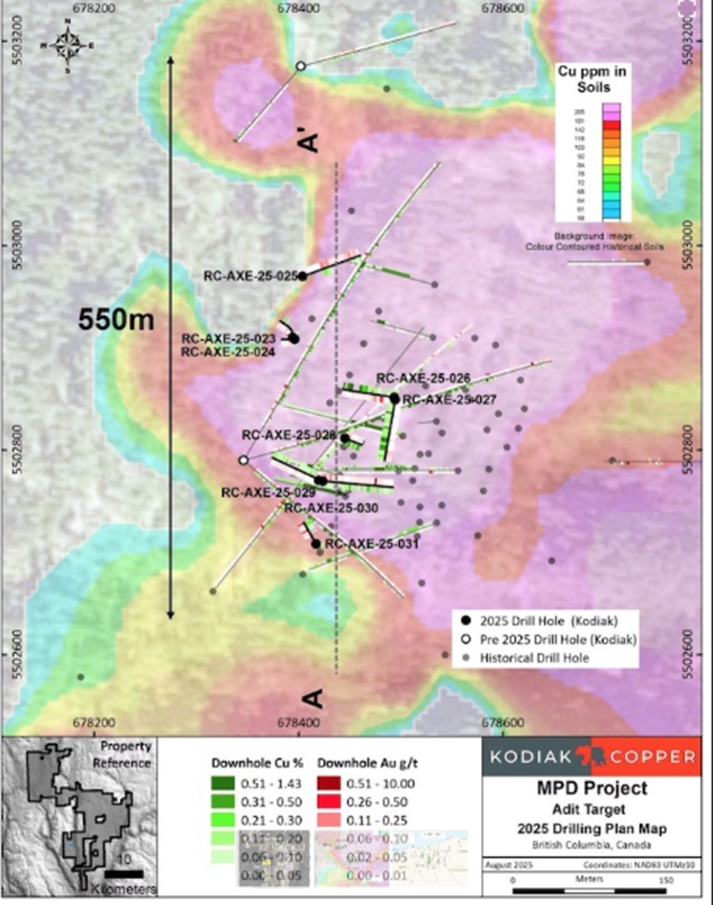
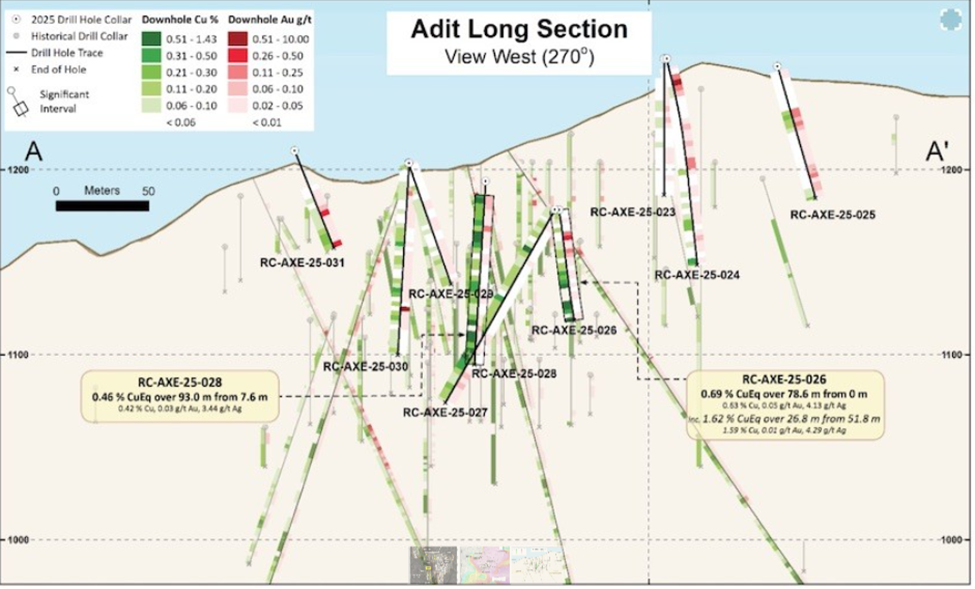
In KDK’s second batch of drill results, the Adit Zone was featured, with assays from nine RC holes totaling 850 meters.
Kodiak Copper said the results confirm shallow, high-grade mineralization.
Adit Zone highlights:
- RC-AXE-25-026 intersected 0.63% Cu, 0.05 g/t Au and 4.13 g/t Ag (0.69% CuEq) over 78.6 meters from 0m to 78.6m, including a higher-grade interval of 1.59% Cu, 0.01 g/t Au and 4.29 g/t Ag (1.62% CuEq) over 26.8 meters from 51.8m to the end of hole at 78.6m.
- RC-AXE-25-028 intersected 0.42% Cu, 0.03 g/t Au and 3.44 g/t Ag (0.46% CuEq) over 93 meters from 7.6m to 100.6m, ending in mineralization.
According to the company, drilling at the Adit Zone has intersected mineralization over a strike length of approximately 550 meters and the zone remains open in multiple directions.
It notes that past drilling at Adit encountered mineralization to a depth of 350 meters.
Like at the South Zone, most 2025 holes ended in mineralization.
According to KDK, the drill hole data will support a resource estimate for the Adit Zone as part of the initial resource estimate for MPD, planned for release in Q4.
Final results from the 2025 drill program are expected in late Q3.
“The Adit Zone continues to deliver excellent grades close to surface as we advance and grow the MPD project,” said Kodiak Copper’s President and CEO Claudia Tornquist, in the Sept. 2 news release. “With our drilling to date, we were able to significantly extend the historic mineralized envelope at the Adit Zone and it is still open in multiple directions with the potential for further growth. This year’s program was designed to infill and confirm shallow mineralization with short holes, an objective we successfully accomplished.”
Adit is a diorite porphyry system characterized by supergene enrichment and copper oxide mineralization in the upper 100 metres transitioning to sulphide mineralization at depth. Local faulting and fracturing near surface contributed to challenging ground conditions and five of the drill holes reported herein did not reach their planned depth. The Adit Zone is interpreted to be part of a larger system that includes the historical South and Mid Zones. The system correlates well with a 2.3-kilometer-long copper-in-soil anomaly and related induced polarization chargeability responses.

Conclusion
On June 24 Kodiak reported the first part of the maiden resource comprising four of the seven zones: Gate, Man, Dillard and Ketchan.
The 2025 drill program has focused on near-surface infill and confirmation drill holes at the West, Adit, and South zones using a combination of diamond and reverse circulation (RC) drilling.
A total of 44 holes and 5,003 meters was completed in mid-August.
Drilling was designed to support the resource estimation on these three mineralized zones, which will be completed following receipt of final assay results in late Q3. Together with the resource estimate for the first four mineralized zones (Gate, Ketchan, Man and Dillard), this will complete the initial resource estimate for the MPD project — expected in Q4.
Another important aspect of the MPD story is its potential upside.
While the company has identified multiple zones, it remains committing to continued exploration to further grow the project, both through zone expansion and the testing of new targets.
The company has published a partial initial resource estimate that comprises four of the seven mineralized zones: Gate, Ketchan, Man and Dillard. Between the indicated and inferred categories, the resource amounts to 1.676 billion pounds of copper and 1.21 million ounces of gold.
The 2025 drill program of 5,003 meters in 44 drill holes was designed to support the resource estimation on the remaining three zones — West, Adit and South. This is expected shortly, following receipt of final assay results.
Given the positive copper market fundamentals, I think there will be a rerating of Kodiak’s market cap based on: the amount of copper in the ground; the fact that there are three additional zones to be included in the MRE; and that there is more drilling planned on the significant extensions of the zones that have, and will have, initial resources.
Kodiak says, and I agree, that the maiden resource estimate on all seven zones when it’s released will be a catalyst to close the valuation gap to more advanced peers.
Kodiak’s share price rose 18% on Sept. 2 to $0.77/sh. Year to date, the stock has surged 113.8%, confirming its position as a top AOTH junior copper company pick.
Kodiak Copper
TSXV:KDK, OTCQB:KDKCF, Frankfurt:5DD1
Cdn$0.77 2025.09.02
Shares Outstanding 85.8m
Market Cap Cdn$66m
KDK website
Richard (Rick) Mills
aheadoftheherd.com

Subscribe to AOTH’s free newsletter
Richard does not own shares of Kodiak Copper (TSXV:KDK). KDK is a paid advertiser on his site aheadoftheherd.com This article is issued on behalf of KDK
Legal Notice / Disclaimer
Ahead of the Herd newsletter, aheadoftheherd.com, hereafter known as AOTH.Please read the entire Disclaimer carefully before you use this website or read the newsletter. If you do not agree to all the AOTH/Richard Mills Disclaimer, do not access/read this website/newsletter/article, or any of its pages. By reading/using this AOTH/Richard Mills website/newsletter/article, and whether you actually read this Disclaimer, you are deemed to have accepted it.