 RSS Subscribe
Funding the Canadian North – Richard Mills

2026.04.02
Canada’s three northern territories represent ~40% of Canada’s landmass, but less than 0.1% of its population, or approximately 135,000 residents. That’s the size of a small city in southern Canada.
The desolation and far-flung nature of the Yukon, Northwest Territories and Nunavut — and we can add sparsely populated northern BC — has always presented huge development challenges.
These include a restricted transportation infrastructure, limited energy resources, and the significant expenses involved in operating within remote Arctic and sub-Arctic regions.
Policymakers however are increasingly viewing the North as central to Canada’s strategy of securing critical minerals essential to modern technologies and energy systems, while reducing reliance on foreign suppliers of raw and processed minerals, especially from China.
When this is combined with its strategic positioning as the first line of defense against an attack by a polar neighbor, we see the north becoming high priority for the federal government, with tens of billions worth of new infrastructure promised for Arctic defense and natural resource extraction including energy (oil, gas, power) and mining.
Here’s the Prime Minister’s Office explaining its northern strategy:
Canada’s North is going through a period of profound change. The world is becoming more dangerous and divided. The assumptions that shaped decades of Canadian defence and security are being upended. Climate change is causing our Arctic region to warm nearly three times faster than the global average, a shift that great powers are actively looking to exploit.
For decades, previous Canadian governments have taken measures to build and secure the North. But these lacked the scale and the breadth of strategy that this vast region demands. Canada’s new government has the ambition and capacity to do this, and Prime Minister Carney is acting with our Territorial and Indigenous partners to seize the opportunity. We are moving forward with a comprehensive plan backed by over $40 billion, including more than $35 billion in federal investments to defend, build, and transform Canada’s Northern and Arctic region, and major projects that represent around $10 billion in investment.
Canada is moving from reliance to resilience. We will no longer depend on any one nation, and instead build a stronger, more independent country. With this new plan, Canada is taking full responsibility for defending our Arctic sovereignty. We will boldly develop the critical minerals, clean energy, and trade corridors – the full economic potential – of the region.
In this article we break down the northern infrastructure funding commitments by what is being funded and where.
Let’s start with the big announcement in March, when the Carney government unveiled a $35 billion defense investment plan and submitted new projects for consideration to the Major Projects Office — an organization created to coordinate financing and regulatory approvals for projects designated by the Government of Canada as being in the “national interest”.
Defense
The bulk of the $35B is going towards defense.
In supporting NATO allies and NORAD continental defense, the PMO says it is investing $32 billion at forward operating locations in Yellowknife, Inuvik, and Iqaluit, and at Deployed Operating Base 5 Wing Goose Bay, in Labrador.
The idea is to enable the Canadian Armed Forces to defend the Arctic without the help of allies, i.e., the United States.
“This includes infrastructure upgrades such as airfield upgrades; new or repurposed hangars; ammunition and fuel facilities; and buildings and equipment for accommodations, warehousing, IT, and general support.”
There will also be two new Northern Operational Support Hubs (NOSH) at Whitehorse and Resolute, and two new Northern Operational Support Nodes (NOSN) at Cambridge Bay and Rankin Inlet, backed by an investment of $2.67 billion.
CBC News noted the inclusion of Whitehorse in the Northern Operational Support Hubs integrates a network that already includes Yellowknife, Inuvik and Iqaluit.
According to a backgrounder document prepared by the federal government ahead of the announcement, the support hub program establishes a network of sites for the Canadian Armed Forces, allowing them to have a greater year-round presence in the North.
The document says the new hubs in Whitehorse and Resolute, Nunavut, will include airstrips, logistics facilities, pre-positioned equipment and supplies for operations ranging from natural disasters to search and rescue.
Ottawa previously announced $2.67 billion over 20 years to establish the network.
An additional $294 million will be plowed into Arctic airports, including building a runway overlay and modernizing Rankin Inlet Airport and upgrading Nunavik Airport.
“This will ensure larger aircraft can land, connecting Northern communities to the rest of the country year-round to enable faster, more convenient, and lower-cost travel for both the military and civilians.”
Four infrastructure projects are being expedited through the Major Projects Office, each addressing bottlenecks to resource development:
- Mackenzie Valley Highway
- Grays Bay road and port
- Arctic Economic and Security Corridor
- Taltson Hydro Expansion
Electricity
The Taltson Hydro Expansion Project will add 60 megawatts to the existing hydro system, doubling the NWT’s hydro capacity and connecting the North and South Slave electrical grids via a 320-km transmission line.
According to Discovery Alert,
The Taltson Hydro Expansion addresses a critical constraint for northern mining operations through expanded generating capacity beyond the current 78 megawatts. Mining industry testimony before Parliament specifically identified power availability as limiting domestic mineral processing capacity, particularly for energy-intensive refining operations required to convert raw materials into defence-grade specifications.
Cory Strang, CEO of the Northwest Territories Power Corp., reportedly said the 60-megawatt hydro facility and the transmission lines to connect the Northwest Territories’ two current power grids will cost “billions” but provide options for mines and customers that aren’t available with the current facility, which was built in the ’60s.
Eight of the territory’s 33 communities are currently on one of two power grids while the others each run on their own “micro grid.”
Strang said when individual grids go down, the territory is forced to rely on diesel.
Representatives from all three territories say the need to improve their aging electricity grids has reached a critical level requiring billions of dollars from the federal government.
A Canadian Press story this week sub-headed ‘Northern Canada facing power struggles’ describes how Whitehorse nearly required rolling blackouts while temperatures neared -50 degrees Celsius.
Demand hit 90% of what could be generated, and this was outside of peak hours.
In the end, the blackouts weren’t required, but [Ted] Laking said the experience was a sign of problems on the horizon.
The power deficiencies could not only plunge thousands of residential customers into darkness and bitter cold, but without immediate investment in new generation and transmission infrastructure, several mine development projects in the Yukon “will either be delayed or rendered uneconomic due to lack of affordable, reliable power.”
So says a letter penned by Laking to the federal energy minister, adding that to keep up with demand, Yukon officials estimate an additional $1.025 billion is required.
Challenges include high costs due to stretched-out supply chains, and a shortage of labor.
At the top of Yukon’s wish list is an estimated half a million dollars to build two new thermal power centers, plus the required infrastructure in Whitehorse, which would offer up to 150 megawatts through a mix of LNG and diesel. If built, the centers would meet Yukon’s projected power needs over the next five to 10 years.
Other needs include improving hydroelectric facilities built in the 1960s, and a hydro expansion in Atlin, BC (only road-accessible from the Yukon) that would feed into the Yukon grid.
In Nunavut, the territory has requested almost a billion dollars ($987 million) from the federal government to build six new scalable, modular hybrid power plants that would continue to run on diesel but have the ability to integrate renewable energy “when and where it is available.”
Canadian Press notes each of Nunavut’s 25 communities is powered on its own diesel-run system. The systems are designed to last 40 years but 10 have already exceeded that. If one of these plants malfunctions, the community it serves enters a state of emergency due to the extreme cold weather.
The Iqaluit Nukkiksautiit Hydro Project is another northern electricity generation project that has been referred to the Major Projects Office.
The proposed 15-to-30-megawatt hydroelectric facility 60 kilometers outside of Iqaluit could potentially remove the need for diesel generation from the city completely, according to CP.
Electricity projects are also planned for northern British Columbia.
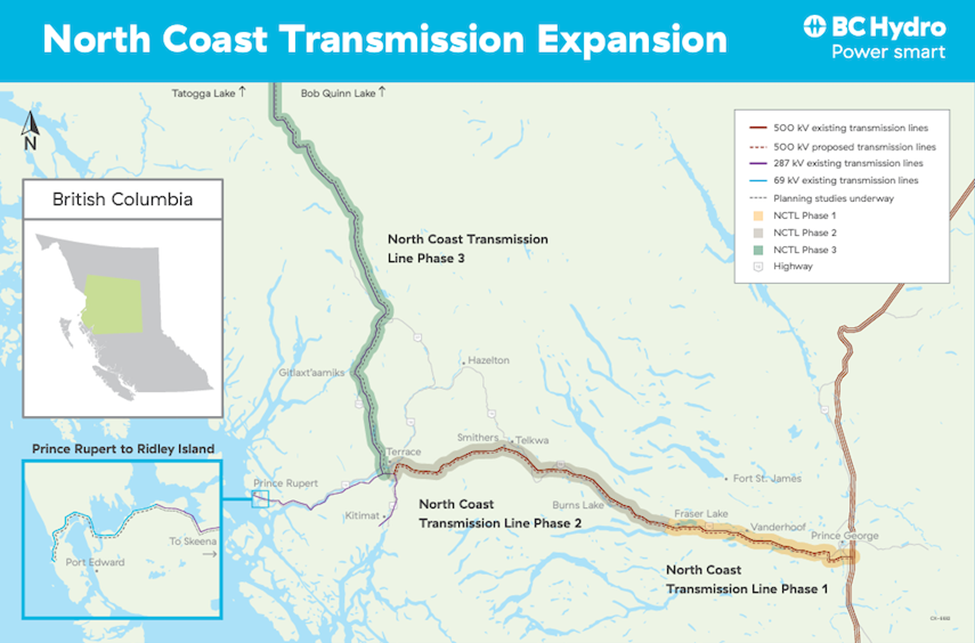
The North Coast Transmission Line is a $6-billion BC Hydro project to build new 500 kV transmission lines from Prince George to Terrace, twinning the existing line to meet growing electricity demand in northwestern BC. The 450-km project will boost capacity for industry, with construction starting in 2026 using repurposed Site C worker camp modular units. (AI Overview)
NCTL is designed to power industrial projects like the Ksi Lisims LNG facility and mining in the Golden Triangle.
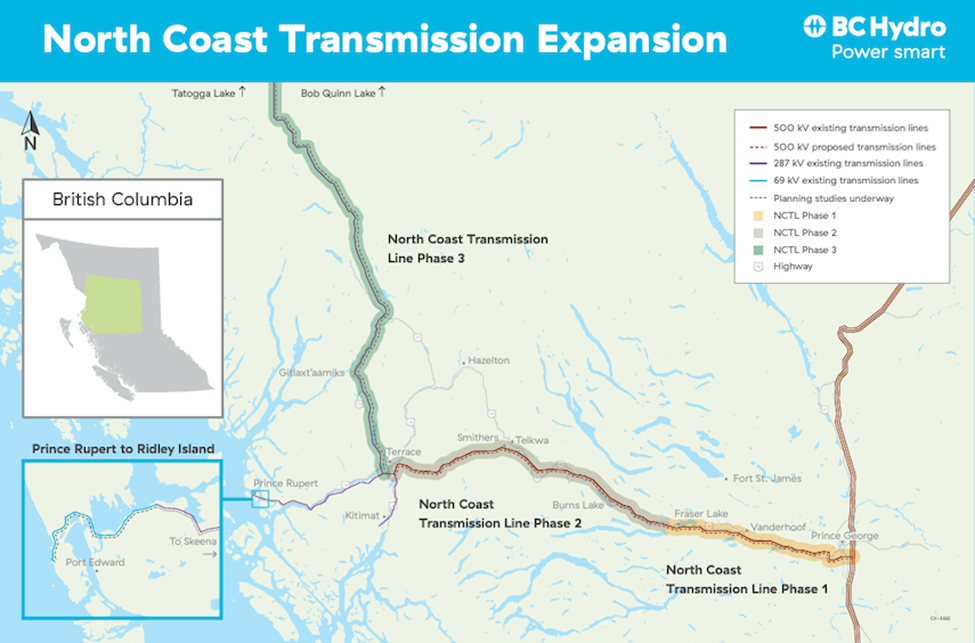
Source: BC Energy Regulator
The Yukon-B.C. Grid Connect Project is a proposed high-voltage transmission line connecting the Yukon’s isolated electrical grid to the North American grid through BC at Bob Quinn Lake. The 765-800-km transmission line will increase the Yukon’s energy security and provide clean power to communities in Canada’s Northwest corridor.
According to the Yukon government, Grid Connect, costing roughly $2B, will electrify six diesel-only communities; enable up to 2,000 MW of new renewable energy; and deliver clean power to critical minerals development.
Energy
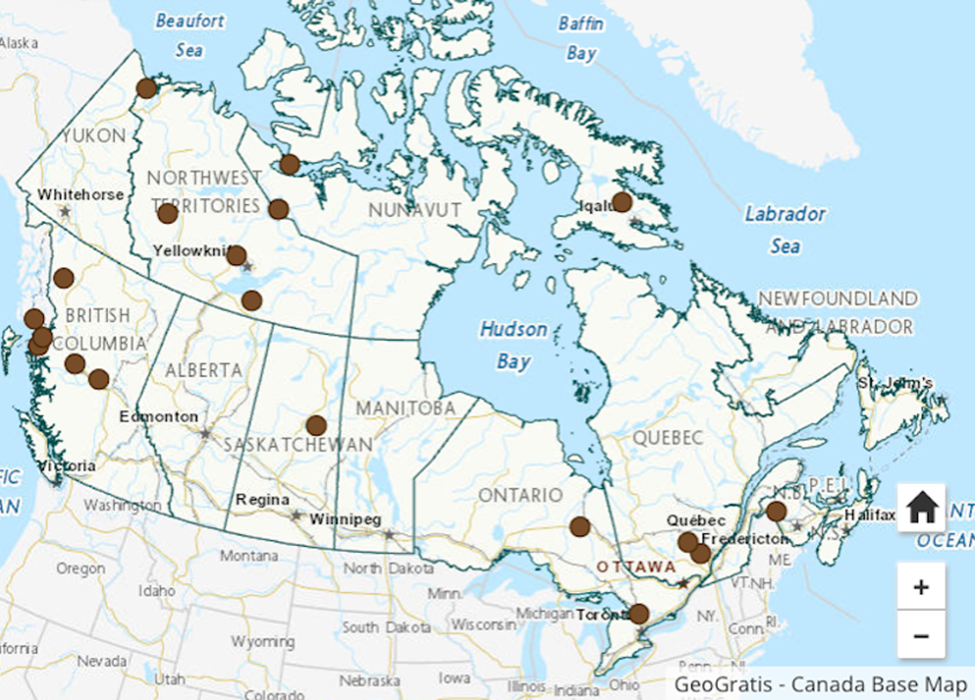
According to the Major Projects Office page, there are currently 15 projects being fast-tracked due to their national importance. We have already mentioned six in the above sections on transportation and electricity. Of the remaining nine, two are LNG, five are mining (more on that below), and then there’s the Darlingon New Nuclear Project in Ontario and the Contrecoeur Terminal Container Project in Quebec.
LNG Canada Phase 2 is a proposed expansion designed to double the export capacity of the Kitimat, BC facility to 28 million tonnes per annum by adding two new processing trains. This expansion is moving closer to a Final Investment Decision, with initial engineering contracts awarded in early 2026 and potential construction starting around 2027-2028, aiming for early 2030s operation. (AI Overview)
Ksi Lisims is a proposed floating natural gas liquefaction and export facility destined for the north coast of British Columbia. The project is a partnership between the Nisg̱a’a Nation, Western LNG, and Rockies LNG. If completed, Ksi Lisims would become Canada’s second-largest LNG facility behind LNG Canada.
The project referral also includes the 800-kilometer Prince Rupert Gas Transmission Project to supply feed gas for liquefaction, and a 95-km transmission line to supply electricity to the facility. Ksi Lisims LNG proposes to construct and operate up to two floating liquid natural gas structures which together would export up to 22.4 billion cubic meters per year of natural gas.
Two more BC LNG projects in development are worth mentioning: the Woodfibre LNG project in Squamish, revised upward from $1.6 billion to $6.9B; and Cedar LNG, a project budgeted at $4.6B. Both Woodfibre LNG and Cedar LNG are expected to be operational by 2028.
According to Natural Resources Canada (NRCan), as of September 2024:
- There are 340 energy projects in the 2024 inventory with a combined capital value of $510.0B, down from 343 projects in 2023, but representing a $3.7B increase in capital value.
- British Columbia (42.9%) and Alberta (28.5%) account for almost three quarters of the total value of major energy projects, followed by Ontario and Quebec with 13.6% and 7.5%, respectively.
- The Trans Mountain Pipeline Expansion Project (TMX) in British Columbia and Alberta ($34.0B), and the TransCanada Coastal GasLink Pipeline Project in Dawson Creek, British Columbia ($14.5B), are both completed and in production.
- Growth in Canadian crude oil production is being driven by TMX, where 590,000 barrels per day of new capacity has been added. New oil sands projects will need to come online to fill the pipeline. For example, Mildred Lake ($3.3B) and Blackrod ($2.9B).
Transportation
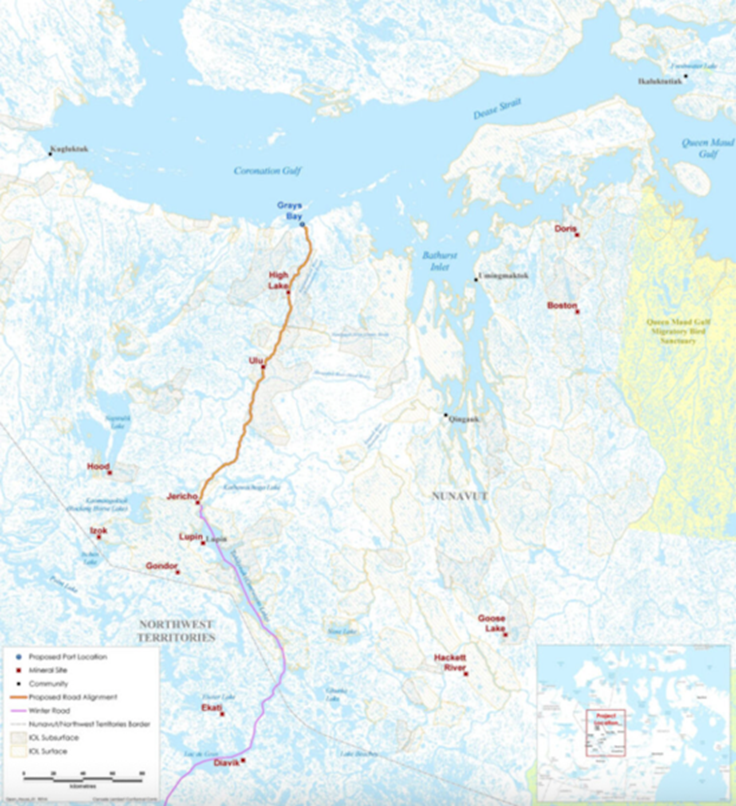
The Arctic Economic and Security Corridor is a proposed $1 billion+ Canadian infrastructure project designed to link the Northwest Territories (NWT) to the Nunavut coast via a 230- to 400-km all-weather road and a new deep-water port at Grays Bay. It aims to foster critical and precious mineral development (copper, zinc, gold), enhance northern sovereignty, and provide dual-use (commercial and military) infrastructure against rising Arctic security threats, with potential construction starting by 2030. (AI Overview). The Mackenzie Valley Highway is an all-weather corridor enabling year-round access to previously seasonal mining operations. The project is the third in the NWT referred to the Major Projects Office (remember the other two are the Arctic Economic and Security Corridor and the Taltson Hydro Expansion Project.)
Discovery Alert notes,
Current seasonal access limitations restrict many northern deposits to 150-180 operational days annually, with winter road access dependent on weather conditions and ice road stability. Consequently, the Mackenzie Valley Highway would eliminate these constraints, enabling 300+ operational days for critical mineral extraction projects.
Construction on the 800-kilometer highway connecting Yellowknife to Inuvik is expected to start this summer.
According to Prime Minister Carney, quoted by CBC News on March 12, the first stretch of highway will run from Wrigley to Norman Wells, while the second stretch will extend the road to Inuvik.
The Grays Bay Road and Port is a proposed all-season road of approximately 230 km from the Nunavut border to a deepwater port and airfield at Grays Bay, on the Arctic Ocean. The project includes a deepwater export terminal for minerals and an airstrip, which will both have dual-use civilian and military potential.
“The Grays Bay Road and Port and the Arctic Economic and Security Corridor will connect Nunavut to the national highway system via the Northwest Territories and become Canada’s first overland connection to a deepwater port on the Arctic Ocean,” states the PMO.
“Together, these projects will connect strategic mineral deposits to national road networks and tidewater – linking Canada’s North to new global markets and ensuring reliable access to Canadian minerals.”
Discovery Alert notes,
The Grays Bay Port facility creates Arctic shipping capacity for mineral exports that currently require transportation through southern Canadian ports, adding thousands of kilometres to shipping routes. Deep-water port infrastructure enables direct resource exports whilst positioning Canadian operations for Arctic shipping route development as climate conditions permit expanded northern navigation seasons.
Mining
In 2017, a study found that that the infrastructure deficit across the territories and northern areas of the provinces has been inhibiting sustainable mining development, despite the significant mineral potential that exists in these regions. The study found that it costs up to six times more to explore, and more than double to build a mine in northern Canada compared to southern regions of the country. (Mining Association of Canada).
That year, the federal and Yukon government announced over $360 million in combined funding, to be directed towards improving road access in in two mineral-rich areas of the territory: the Dawson Range in Central Yukon and the Nahanni Range road in southeastern Yukon. Two MAC members have projects in the region: the Coffee project — acquired by Fuerte Metals (TSXV:FMT) from Newmont Mining (NYSE:NEM) in 2025 — and Western Copper and Gold’s (TSX:WRN) Casino project.
Fast forward to 2024, and the press release from NRCan first mentioned in the section on Energy. There are 138 mining projects in the 2024 inventory with a combined value of $117.1 billion. Two points about these projects:
- 67 would process or extract critical minerals worth $72.4B in potential investment.
- Of these critical minerals mining projects, 36 projects valued at $41.7B would extract or process copper, nickel or lithium — three key components of EV batteries.
The highest-valued projects include Seabridge Gold’s (TSX:SEA) Kerr-Sulphurets-Mitchell (KSM) Project in British Columbia ($8.4B) and Stage 1 of BHP’s (NYSE:BHP) Jansen Potash Project in Saskatchewan ($7.5B).
In terms of new mining projects, the highest valued are Stage 2 of the Jansen Potash project ($6.4B) and Newmont and Anglo Teck’s (NYSE:TECK) Galore Creek copper and gold mine in British Columbia ($5.2B).
As for why mining companies are positioning for northern access now, Discovery Alert notes that Parliamentary testimony on March 11, 2026, established that Canada’s limited domestic refining capacity for critical minerals constitutes a national defence vulnerability…
Why Canada and the United States need more smelters and refineries — Richard Mills
China controls approximately 70-75% of rare earth element refining capacity despite producing only 30-40% of primary REE minerals worldwide…
Also in 2024, the Canadian government said $40 million is to be put towards prefeasibility activities to advance the above-mentioned Yukon-B.C. Grid Connect Project.
One more important development is an increased spirit of cooperation among provincial and territorial governments around critical minerals.
In January, according to a BC government press release, BC, Alberta, Saskatchewan, Manitoba, Yukon, Northwest Territories and Nunavut have jointly agreed to work together to accelerate development, enhance supply-chain resilience, diversify export markets and strengthen the position of Canada’s west as a preferred global supplier of responsibly sourced critical minerals.
The seven governments signed a memorandum of understanding which aims to unlock Canada’s potential as a global leader in critical minerals by leveraging regional strengths and aligning infrastructure investments.
“Western Canada is rich in critical minerals like lithium, cobalt, nickel, copper and rare earths, which are crucial for clean energy, advanced technology and defence applications,” said Jagrup Brar, BC’s minister of mining and critical minerals. “There’s a generational opportunity beneath our feet. Together, we can advance a robust critical mineral value chain in Western and Northern Canada that accesses new export markets, increases trade opportunities, creates jobs and brings in investment across the region.”
In March, ministers responsible for mining at the three territories met ahead of the annual PDAC conference in Toronto to coordinate a more unified approach to developing the North’s critical minerals.
As reported by Mining News North, ministers emphasized that unlocking the North’s mineral wealth depends on overcoming longstanding barriers that have slowed development across the region – chief among them limited transportation networks, constrained energy systems, and the high costs associated with operating in remote Arctic and sub-Arctic environments.
“The North has the critical minerals our allies need, but development only happens if we get the fundamentals right. This includes reliable winter power, infrastructure, clear consistent regulation, and respect for Indigenous rights,” said Ted Laking, Yukon’s minister of energy, mines and resources. “By working together as territories, we can share expertise, strengthen oversight and make the North a more competitive place to invest.”…
Among the measures discussed were expanded federal exploration tax credits tailored specifically for northern conditions, including renewed calls for a dedicated North of 60 Tax Credit to offset the higher costs of exploration in remote regions…
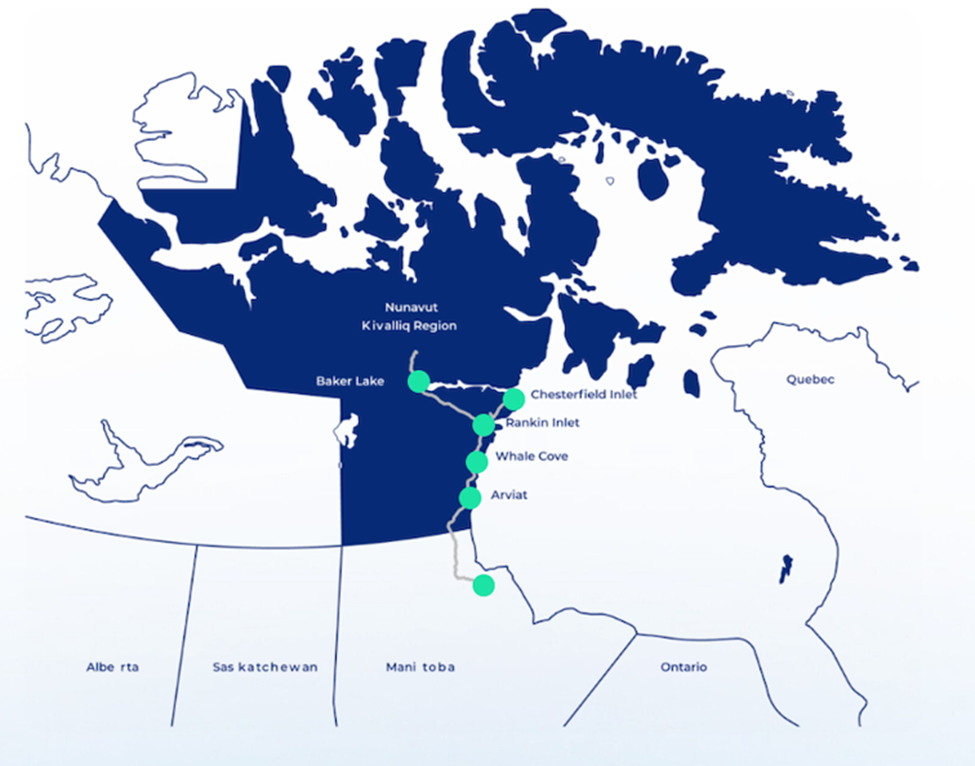
Cited as the kind of nation-building project territorial ministers say is needed to unlock critical minerals potential, the Kivalliq Hydro-Fibre Linkproposes a 1,200-kilometer transmission and fiber corridor from northern Manitoba into central Nunavut.
Conclusion
The Canadian North has for too long been ignored by Ottawa.
Vast in landmass but low in population, the three territories have for decades been underrepresented politically and the national government has been content to let resource development occur there by private corporations under the watchful eye of local First Nations.
Based on recent government announcements and policy direction, the federal government’s approach to energy infrastructure in 2025-26 reflects a deliberate shift away from dependency and toward energy independence and diversified market access.
Critical minerals is a buzz word these days, and with Canada hosting so many minerals critical to its economy and national security, Carney has made them a key priority.
Canada is reportedly moving closer to deploying around CAD$3.5 billion in investments and programs to accelerate development of critical minerals deposits. For more details read Canada on the right track with middle power strategy — Richard Mills
This includes upgrades to the Northwest Transmission Line in northern British Columbia that will help power Newmont/ Imperial Metals’ Red Chris copper-gold mine expansion.
Carney in November added the NWTL to his list of projects of national importance; the $6 billion line will now be fast-tracked by the Major Projects Office. It is expected to take between eight and 10 years to construct. Early work is being financed through a $140 million loan to BC Hydro from the Canada Infrastructure Bank.
Upgrading the NWTL, and $50 million towards improving BC Hydro’s transmission system to provide more electricity to Anglo Teck’s copper operations, are part of $165 million in investments being announced by the government to speed up planning, development and processing capacity of mines.
One-third of the 15 infrastructure projects currently referred to the Major Projects Office involve mining.
Let’s remember one thing about all politicians: talk is cheap. But if Carney and his government put their money where their mouth is, they could be onto something big.
I recently posted an article by Bloomberg titled ‘Canada’s Far North Poised for Economic Turnaround, Premier Says’. That’s Premier R.J. Simpson of the Northwest Territories. The article’s opening paragraph serves as a good conclusion to this article:
Amid US President Donald Trump’s threats to take Greenland, melting polar ice caps opening up new shipping routes, a desire by North Atlantic Treaty Organization countries to secure the Arctic and a growing appetite for a broad range of critical minerals, places such as the Northwest Territories [and the Yukon, Nunavut and northern British Columbia — Rick] are getting a surge of attention.
Richard (Rick) Mills
aheadoftheherd.com

Legal Notice / Disclaimer
Ahead of the Herd newsletter, aheadoftheherd.com, hereafter known as AOTH.Please read the entire Disclaimer carefully before you use this website or read the newsletter. If you do not agree to all the AOTH/Richard Mills Disclaimer, do not access/read this website/newsletter/article, or any of its pages. By reading/using this AOTH/Richard Mills website/newsletter/article, and whether you actually read this Disclaimer, you are deemed to have accepted it.