 RSS Subscribe
Expanded LNG tanker traffic will mean more pollution, no more whales – Richard Mills
2025.11.13
On Oct. 25, a humpback whale was found dead and floating in the water off Keats Island in Howe Sound near Vancouver.
The cetacean was confirmed to be the same animal struck by a whale watching tour boat.
Eight days earlier, a high-speed ferry struck a humpback whale near Vancouver in English Bay, also near Vancouver. The humpback calf was seen with a deep gash near its dorsal fin, according to CBC News.
Another CBC story on Nov. 10 said the Department of Fisheries and Oceans (DFO) is investigating the third whale death off BC’s coast within weeks.
The 21-year-old humpback was discovered Nov. 8 off Lasqueti Island in the Georgia Strait near the Sunshine Coast.
The article says there could be up to 400 humpback whales spending time in the area during the fall, raising the risk of encounters with large commercial vessels.
Caitlin Birdsall, executive director of the Marine Education and Research Society, says there has been an increase in reported ship strikes recently because they involved vessels whose crew “are well aware of the legal requirement to report” and who also had passengers on board to “hold them accountable.”
She says whales hit by vessels might not die right away, but instead “succumb to injuries many weeks or months” later.
Others get entangled in fishing gear and drown. An embedded DFO video shows a humpback whale being freed from nearly 137 meters (450 feet) of fishing rope in the Strait of Georgia.
LNG expansion
The recent spate of whale strikes raises concerns in light of a report from environmental think tank Maritime Beyond Methane, that details the environmental consequences of the expansion of liquefied natural gas production in British Columbia.
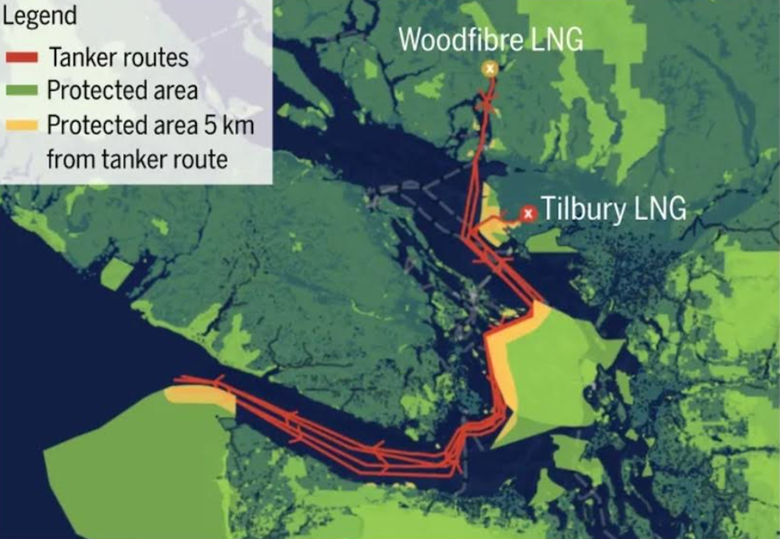
The report via the Vancouver Sun says the expansion could add 200 LNG tankers a year in the coming decade, increasing the risk of pollution to already busy shipping lanes in the Georgia and Juan de Fuca straits:
Plans for two gas plants — an expansion of Tilbury LNG in Delta and construction of Woodfibre LNG near Squamish — would increase LNG production capacity from less than 100,000 tonnes a year in 2015 to nearly six million tonnes by 2035…
“We’re seeing a 60-fold expansion planned from just these two projects,” said ocean and climate consultant Curtis Kunitz-Martin, who wrote the report. “We’re seeing this in one region. What does that also mean for the projects in Northern B.C.?”
Kunitz-Martin is referring to the Phase 2 expansion of LNG Canada, which recently started Phase 1 production out of Kitimat, condensing natural gas fracked from gas fields in northeastern BC, then loading it into tankers bound for markets in Asia, and two other LNG projects in the works: Cedar LNG, a partnership between Pembina Pipeline and the Haisla Nation to develop a proposed floating LNG facility in Kitimat; and Ksi Lisims LNG, another proposed floating LNG export facility located on a site owned by the Nisga’a Nation near the community of Gingolx on Pearse Island, northwest BC.
LNG Canada Phase 2 will add two more liquefaction trains, increasing the plant’s total capacity to 28 million tonnes per year.
Despite opposition to it, the Coastal GasLink pipeline is operational, sending natural gas 670 km from Dawson Creek to the LNG Canada facility in Kitimat.
The pipeline has a 10% equity stake set aside for 16 First Nations communities through a partnership with TC Energy.
It’s puzzling why BC First Nations have embraced LNG, when they were so vigorously opposed to an oil pipeline from Alberta to the BC coast through their territories, and the twinning of the TMX pipeline that now runs from Alberta to Burnaby, a suburb of Vancouver.
Perhaps they have bought the BC government’s nonsense that liquefied natural gas is cleaner than oil. It isn’t.
Among the arguments by opponents of the Kinder Morgan Pipeline Project, later renamed the Trans Mountain Expansion Project, were that risks to endangered orcas (there are currently only 73 southern-resident killer whales remaining) were ignored when the project was approved by the federal government in 2017.
One First Nation claimed that “the noise pollution alone is enough to make the song of the southern resident killer whales go silent by wiping out this endangered species.”
The BC government agreed and also opposed Trans Mountain due to the threat of an oil spill; continually reminding the public that the pipeline would mean a seven-fold increase in tanker traffic.
“Today’s announcement by the federal government does not reduce the risk of a diluted bitumen spill and the impact it would have on B.C.’s economy or environment. It does not change the course the province of British Columbia has been on since it has been sworn in in July 2017,” then BC Premier John Horgan said on hearing the feds would buy the pipeline from Kinder Morgan for $4.5 billion. “I will continue to do my best to protect B.C.’s interests ensuring our coasts, our water, our land are kept pristine.”
The hypocrisy of the BC NDP’s position became apparent in the fall of 2018 when it welcomed a final investment decision by Shell and its partners to go ahead with LNG Canada in Kitimat – after a CAD$5.3 billion tax break by BC’s NDP. The FID announced on Sept. 30 came a month after the Federal Court of Appeal quashed approval of the Trans Mountain pipeline.
Why did LNG Canada go ahead while the Trans Mountain pipeline expansion was tied up in the courts? You only have to follow the money to find out why. Horgan’s NDP government approved the $10.7 billion Site C dam — project costs later ballooned to $16B — knowing full well that it would be needed to power LNG Canada and future LNG plants.
The two-faced nature of BC’s provincial politicians — on the one hand rejecting Kinder Morgan’s oil pipeline but then embracing LNG Canada – would be explainable if there was some good science behind LNG versus oil. But there’s not. In fact, the evidence suggests strongly that LNG is worse for the environment and even more of a risk to the dwindling orca population.
We reported in 2018 that LNG will bring more marine traffic to BC’s waters than Trans Mountain, about 350 LNG tankers per year compared to 300 oil tankers.
BC’s killer whales v LNG — Richard Mills
The Vancouver Sun article says that the expansion of LNG in BC could add 200 LNG tankers a year over the coming decade.
Despite its benefits — the Conference Board of Canada estimates the industry will create 71,000 jobs annually and by 2064 over $200 billion in wages could flow from LNG development, with tax and royalty payments of $2 billion a year — Kunitz-Martin said the increase in LNG tanker traffic increases the risks to public health and the marine ecosystem.
Risks to humans:
- Methane gas escapes from storage containers and from ship engines during transit. The methane reacts with other chemicals to create ground-level ozone.
- More than 800,000 people in BC and Washington State live within 10 kilometers of the approved tanker routes.
Risks to marine life:
- Some tanker routes pass through waters designated or proposed as critical habitat for marine life, including orcas, humpback whales and salmon. The report found that more than 1,000 kilometers of tanker routes pass through federally designated critical habitat areas.
- Noise pollution from LNG facilities can significantly disrupt nearby wildlife, interfering with feeding, mating and migration patterns that can impact hundreds of species, including whales, fish, crabs, shellfish and zooplanktons, according to the report. (read more in section below)
- “Wastewater discharges from vessels, including from onboard Exhaust Gas Cleaning Systems (scrubbers) can contain harmful pathogens, organic matter and chemical residues which can contaminate fish and seafood,” the report notes.
There are also concerns over LNG as a marine pollutant — not from tankers carrying LNG cargoes, but ships that are run by highly polluting bunker fuel.
It was recently reported that major maritime nations like Greece and Denmark want to replace bunker fuel with cleaner LNG, because from 2028, ship operators will face penalties based on their use of excessively polluting fuels.
The problem is that Under the new framework, emissions will be measured on a full life-cycle basis, not just what comes out of the ship’s funnels. This means greenhouse gases released during the production, processing and transport of a fuel will also be counted – lowering the perceived benefit of switching to LNG.
The life-cycle provision is pitting Europe against China and the US which oppose it. Euractiv reports the Danes are leading the push for stricter standards and greater use of low-carbon methane fuels. Under EU regulations, average carbon emissions associated with maritime fuel used in Europe must fall by 6% by 2030 and 80% by mid-century.
Echolocation
It has long been suspected that engine noise from freighters, cruise ships and other large vessels disturbs cetaceans, the family of marine mammals that includes whales, porpoises and dolphins. Researchers found that male humpback whales swimming close to freighters stop “singing” to attract females. They also noticed that the noise from the ships impacted the ability of the whales to navigate and to identify food. Cetaceans use a process known as echolocation (bio-sonar) to navigate and locate prey in the often dark or deep ocean waters. The process involves emitting a series of clicks, or “click trains,” that travel through the water and bounce off objects. The returning echoes provide the whale with detailed information about the object’s location, size, shape, and even the species of fish.
A similar study was done with killer whales, up the US West Coast as far as Puget Sound.
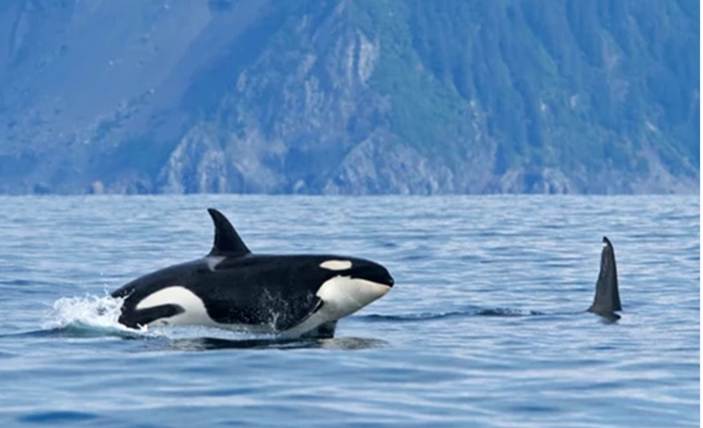
Noise from the loudest ships was found to be 173 underwater decibels, which equates to around 111 dB in air — around the same level as a loud rock concert. Other research shows that whales spend between 70 and 84 per cent of their time foraging in the absence of ships and boats to meet their daily energy needs. As noise levels increase, the whales were less likely to start foraging and more likely to stop the activity.

Note that as the oceans warm due to climate change they become more acidic due to increased CO2 absorption — this change in ocean acidity will allow sounds to travel up to 70% farther underwater. This will increase the amount of noise, further affecting the behavior of marine mammals like killer whales, including their ability to mate.
A July report from conservation groups says that orcas off BC’s coast face a “high probability of extinction” if conditions don’t change:
There is an “urgent need for more robust actions” to save the southern resident killer whales from extinction, says the report released by the David Suzuki Foundation and Raincoast Conservation Foundation on [July 7]…
The report makes a series of 26 science-based recommendations, including limiting fisheries to help the whale access their main prey, chinook salmon, along with eliminating toxic chemicals that build up in their food chains and adopting enforceable underwater noise standards.
Dirty LNG
We all need to remember, extracting natural gas through hydraulic fracturing, transporting it to a terminal, and then super-cooling it for transport in tankers, is not clean energy; in fact, it’s dirtier than coal.
To turn it into liquid form, the gas must be cooled to 163 degrees below zero. To do that requires a great deal of power, with massive compression units running 24/7. Where does that power come from? In most cases, the same fracked natural gas is used to run the compression units, which defeats the purpose of LNG as “clean”.
Only about 20% of LNG Canada Phase 1’s power needs are met by hydroelectricity, much of it coming from the Site C dam. The rest is powered by natural gas-fired turbines.
The BC government estimates LNG Canada in its first phase will emit 4 megatonnes of greenhouse gases per year (a megatonne is 1 million tonnes). Emissions from the first and second phase would represent nearly three-quarters of the province’s legislated target for greenhouse gas emissions in 2050, set at 13 megatonnes/yr.
Opponents say the project will blow the NDP’s goal of cutting GHGs by 40% by 2030 and 80% by 2050, out of the water.
At the 2021 COP26 climate conference, over 100 countries including the United States and the EU signed a pledge to limit methane emissions by 30% compared with 2020 levels.
Natural gas is mostly methane (CH4), a potent greenhouse gas that is over 25 times more efficient than carbon dioxide at trapping heat in the atmosphere over a 100-year period. The Global Methane Pledge from COP26 acknowledges that methane is one of the most potent greenhouse gases, responsible for a third of current warming from human activities.
Most methane leaks come from flaring excess NG instead of putting it into a pipeline. The journal ‘Nature’ published a study saying that the US oil and gas industry emits 13 million tonnes of methane a year, which is 60% higher than the EPA’s estimate.
In fact, we have a relatively recent example of what can happen when natural gas pipeline infrastructure is damaged. CNBC reported in 2022 that unexplained (most believe it to be sabotage) gas leaks along two underwater pipelines connecting Russia to Germany, sent huge volumes of methane into the atmosphere.
(Neither pipeline was pumping gas at the time of the leaks but both lines were still pressurized.)
Video footage from Denmark’s armed forces showed the gas leak creating a surface disturbance of roughly a kilometer in diameter.
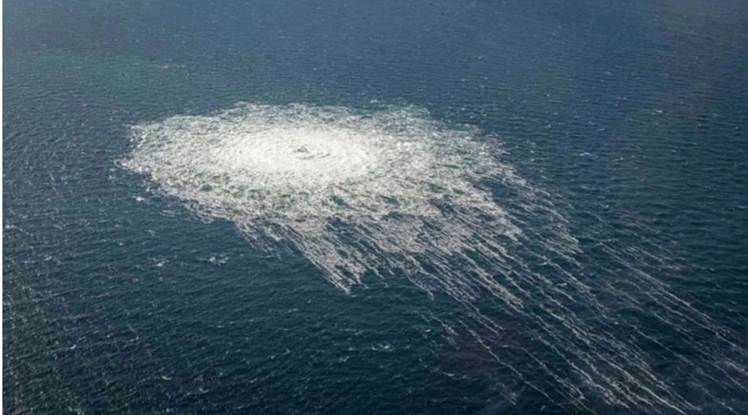
Environmental campaigners argue the incident shows the risk of sabotage or an accident makes fossil fuel infrastructure a “ticking time bomb”.
While I’m not usually supportive of that group, in this case I would agree. It’s estimated the climate impact of the leaks is equivalent to around 7.5 million tonnes of carbon. The fact that this is only a fraction of the ~570 million tons of methane emitted globally, illustrates the magnitude of the problem.
An Imperial College London lecturer quoted by CNBC says that even if only one of the two leaking Nord Stream pipes were to release all its contents, it would likely be twice as much methane as the 2015 Aliso Canyon leak in California, the largest known release of methane in US history.
An LNG tanker accident could cause significant damage through fire, thermal radiation, and potential explosions, leading to structural failure of the vessel, extensive injuries, and property damage over a wide area. A large spill is likely to result in a severe pool fire with thermal radiation that could cause injuries to people up to a mile away. The intense heat would also severely weaken the ship’s structure, potentially leading to its sinking. An LNG tanker explosion could have severe consequences for human life if it occurred in or near a populated area. The principal danger is formation of a large methane vapor cloud that can ignite and produce intense thermal radiation (fireball or pool fire) and, in confined contexts, a vapor cloud deflagration that can cause significant local structural damage. (AI Overview)
How do we get the natural gas for LNG? We frack it. Most of the conventional natural gas formations in British Columbia have already been depleted. What’s left is “tight gas” trapped in shale rock formations, primarily the Montney in northeastern BC. According to the BC Oil and Gas Commission, only 22% of BC’s remaining natural gas reserves are conventional; the rest are unconventional, which involves fracking.
As use of fracking technology has increased worries are growing about its impact on our fresh water supply.
Fracking just one well can use 2 to 8 million gallons of water with the major components being water (90%), sand or proppants (8-9.5%), and chemicals (0.5-2%). One 4-million-gallon fracturing operation would use from 80 to 330 tons of chemicals and each well will be fracked numerous times. Many of these chemicals have been linked to cancer, developmental defects, hormone disruption, and other conditions. The water gets contaminated after the fracking process and is disposed of in tailings ponds or is injected into deep underground reservoirs.
Cracked wells and rock movement frequently leak fracking fluid and gases into nearby groundwater supplies. Fracturing fluid leak-off (loss of fracturing fluid from the fracture channel into the surrounding permeable rock) can exceed 70% of injected volume.
Methane concentrations are 17 times higher in drinking-water wells near fracturing sites than in normal wells. Hydraulic fracturing increases the permeability of shale beds, creating new flow paths and enhancing natural flow paths for gas leakage into aquifers.
Fracking has also caused benzene poisoning among pregnant women in northeastern BC – natural gas country – and is known to cause earthquakes.
In other cases, it has depleted water supplies and deprived other users of necessary irrigation or drinking water. The need for so much fresh water in the fracking process has resulted in the construction of at least 90 unlicensed dams in northeastern BC, some of which may be unsafe.
Fracking water gluttons
Much of northeastern BC is in severe or extreme drought, which has dried up rivers, stressed reservoirs and forced local governments to restrict water use, states CBC News, adding that the Peace Region’s snowpack was only 76% of normal last spring, and 65% in 2024. Earlier melts and hotter, drier summers are leaving little moisture to recharge rivers or groundwater.
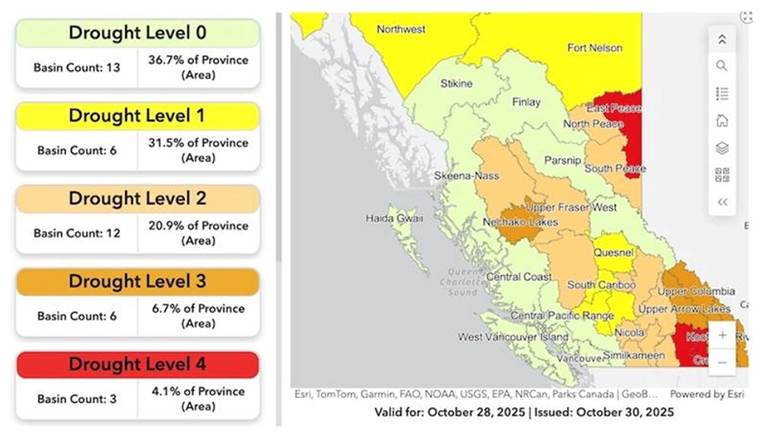
Water levels along the Kiskatinaw River, the only source of water for the nearby town of Dawson Creek, are at historical lows, prompting local officials to declare a state of emergency. They want the province to fast-track a $100-million pipeline to pipe water from the Peace River more than 50 kilometers away. The officials are seeking access to 10 million cubic meters of water per year, The Tyee reported in October.
Advocacy groups say provincial policy continues to undervalue its water resources as the province pushes to expand major projects, from mining to LNG to AI data centers.
As drought grips northeastern BC, oil & gas companies pay a pittance for frack water — Richard Mills
BC’s industrial water users pay just $2.25 per million liters, the lowest in Canada and far below the $54 to $79 charged in other provinces.
In the CBC News story, Minister of Energy and Climate Solutions Adrian Dix defended the province’s policies, stating that “Every licence is reviewed and controlled. Streamflow levels are very important. That’s what the B.C. Energy Regulator does in every case. In other words, puts the environment and human health first.”
Dix, the former health minister, added that BC’s water management framework remains “the most rigorous” in North America, developed from scientific advice provided by an expert panel in 2018.
Despite this, northeastern BC residents and organizations like Stand.earth and the BC Watershed Security Coalition are calling on the provincial government to dramatically increase water rental rates to be on par with other provinces.
According to The Tyee:
Stand.earth would [also] like the government to “require the treatment and increased reuse of fracking wastewater,” which would help to lower the vast amounts of fresh water now being used in the fracking process.
Currently, the industry’s treatment of its toxic wastewater, which is laden with heavy metals, is highly saline and may contain normally occurring radioactive compounds as well, is essentially no treatment at all but holding it for reuse or pumping it underground for permanent disposal.
At AOTH, we know that fracking comes at huge costs — environmental and human.
BC’s LNG boondoggle continues to lack critics — Richard Mills
Because of the drought local residents say black sand is showing up in their wells, crop yields are thinning, trees are dying prematurely and weeds like Canada thistle have exploded. Winter winds at times blow more dust instead of snow, the CBC describes.
And industry demand for water in the region is definitely on the rise.
According to public filings from the B.C. Energy Regulator, withdrawals by oil and gas companies have nearly tripled in recent years, from 3.6 million cubic meters in 2017 to just over 9 million in 2024. From the CBC:
Roughly half that water went to fracking, with the rest used for pipeline commissioning, dust control, equipment washing and other work “where much of the water is returned to the water cycle,” the regulator said… about 68 per cent of water used for fracking in B.C. is now reused wastewater.
This is extremely misleading. The water used for fracking is not recycled; in most cases it is pumped, untreated, underground, forever.
The FracFocus database referenced by The Tyee shows that the total water pumped (at 9,000lb psi) underground at fracked wells in BC in 2024 was 11.7 million cubic meters, about 30% more than what the BCER reported in its annual water use summary for last year. (The BCER report only covers water withdrawn under short-term permits and longer-term water licenses issued by the BCER to fracking companies). The Tyee states:
The additional 30 per cent may include water purchased from landowners and private companies as well as “flowback” or “recycled” wastewater that is highly toxic and is captured by oil and gas companies at well bore heads following fracking.
As reported previously by The Tyee, energy analyst David Hughes has warned that advancements in fracking technology mean that companies are drilling much longer wells.
The length of horizontal well bores in the Montney formation, which underlies Dawson Creek, Fort St. John and other Peace River communities, is now 2.7 kilometers on average.
“Water injection intensity has increased 45 per cent to an average of 8,346 litres per metre and an average well now consumes 23.1 million litres, a 10-fold increase since 2010,” Hughes concludes.
Allan Chapman, a former hydrologist with the oil and gas commission, in 2021 presented data documenting the steady rise in frack water use per well year over year, from less than 3,000 cubic meters per well in 2008 to almost 20,000 in 2021.
From 2021 to 2024, the average water use per well increased by 20% to almost 24,000 cubic meters.
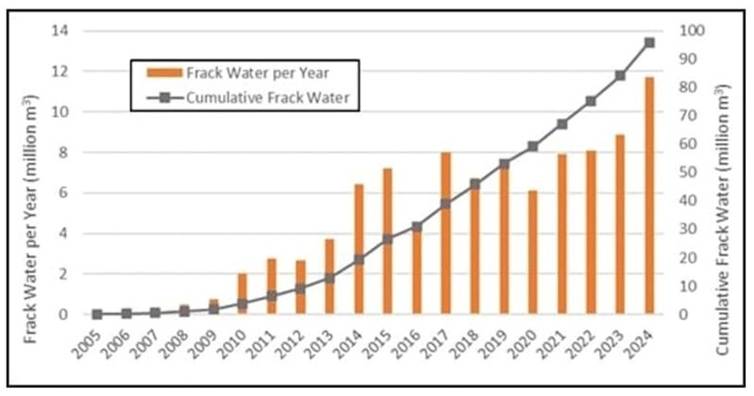
A report released last month concludes that water use by the region’s fracking industry shot up a record 50% last year.
According to the Tyee, Hughes suggests a possible doubling of well drilling and fracking in the coming few years to feed LNG Canada, with an annual water demand double or triple its current level.
Conclusion
The expansion of LNG in British Columbia is part of a global trend to install liquefied natural gas as a so-called “bridge fuel” between fossil fuels and renewable energies.
The Globe and Mail just reported that A wave of liquefied natural gas development is set to double global supplies by the end of the decade, with around 300 billion cubic metres of new annual export capacity scheduled to come online, according to a new analysis from the International Energy Agency.
Along with LNG Canada Phases 1 and 2, several liquefied natural gas facilities are under construction or in the final stages of development in British Columbia. The other major projects include the Woodfibre LNG project near Squamish, which is slated to begin operations in 2027. The Cedar LNG project in Kitimat, a floating facility with significant indigenous ownership, is in the early stages of construction, targeting late 2028 for operations, and the Ksi Lisims LNG project near the northern tip of Pearse Island is in the environmental and community engagement phase.
Despite claims by the operators of current and future BC LNG facilities that they are “clean and green”, the reality is they are anything but.
We already know that LNG Canada in just the first phase of production will result in 36.4 million tonnes of emissions, which is more than half of British Columbia’s current annual emissions.
Cedar LNG would produce quite a bit less, just 7.8Mt, but as The Sierra Club calculates, that is still more than the 6.5Mt generated annually by the city of Vancouver.
Most importantly, the new rules continue to ignore the additional emissions related to fracking, pipelines, shipping and re-gasification, including the leakage of methane, a greenhouse gas that is 86 times more powerful than CO2 over a 20-year period.
According to two reliable sources, methane from the production of natural gas makes LNG about as bad a greenhouse gas emitter as coal, and that when it comes to lifecycle GHG emissions, LNG sometimes emits more than coal.
Contrary to the industry’s message, there is also no evidence that LNG exports would reduce coal use around the world. A 2023 report found that China is building six times more coal plants than other countries. This massive increase in the use of coal is happening despite China’s state-owned enterprise PetroChina holding a 15% ownership stake in the LNG Canada joint venture.
The BC government is enabling this travesty by practically giving away the water the industry uses for fracking, which pollutes the air and water and causes earthquakes; a ridiculously low $2.25 per million liters, the lowest in Canada.
The profitability of BC’s LNG projects, particularly the flagship LNG Canada project, is a subject of intense debate, with various reports suggesting they face significant financial risks due to high production costs and volatile global markets, while proponents argue they will yield long-term profits. At it’s very best, BC’s LNG projects will manage, despite being late to the LNG game and facing fierce competition, to squeak out a profit and provide revenue to the provincial government. The NDP says LNG Canada will bring in CAD$22 billion to BC’s coffers over 40 years.
Studies from organizations like the International Institute for Sustainable Development (IISD) and the Institute for Energy Economics and Financial Analysis (IEEFA) indicate that Canadian LNG projects have substantially higher production costs compared to competitors like Qatar and the U.S. Gulf Coast. Many analyses argue that without substantial government subsidies (including tax breaks and discounted electricity prices), projects would struggle to compete, effectively shifting a portion of the financial risk onto the public. And new analyst reports suggest the global LNG market is expected to be oversupplied in the coming years as lackluster demand growth and a glut of new production comes online, which could depress prices and make BC the late entrant into a crowded market.
Yet BC residents were told USD$10 million worth of gas per day would flow through the pipeline. That’s USD$3.65B a year. Over 40 years US$146.3B. The Site C dam was horribly over budget at $16 billion, and it flooded good farmland in northeastern BC. Then add CAD$5.3B in tax breaks for the LNG Canada project.
Sounds like a pretty shitty deal for British Columbians. Subtract a minimum CAD$15.3B from CAD$22B and there’s not a hell of a lot of new money. And that’s just the financial side; the environmental side is an even bigger loser for British Columbians. BCers don’t get the electricity, instead we get polluted water and air, and we get dead killer whales and other dead cetaceans.
Isn’t it about time we recognized the LNG industry for the environmental and economic disaster it has become, and start calling out the politicians for their part in supporting it?
Richard (Rick) Mills
aheadoftheherd.com

Legal Notice / Disclaimer
Ahead of the Herd newsletter, aheadoftheherd.com, hereafter known as AOTH.Please read the entire Disclaimer carefully before you use this website or read the newsletter. If you do not agree to all the AOTH/Richard Mills Disclaimer, do not access/read this website/newsletter/article, or any of its pages. By reading/using this AOTH/Richard Mills website/newsletter/article, and whether you actually read this Disclaimer, you are deemed to have accepted it.