 RSS Subscribe
Cassiar Gold Project: Bulk tonnage in the north + high-grade veins in the south – Richard Mills

2026.02.25
Cassiar Gold’s (TSXV:GLDC; OTCQX:CGLCF) flagship project of the same name is a large orogenic gold property located in the Cassiar Mining District of northern British Columbia. The project has substantial upside potential for both bulk-tonnage resources in the Cassiar North area, and high-grade gold targets in the Cassiar South area.
The company’s 2025 drill program comprised 7,308 meters over 20 drill holes and concluded in early October.
Newcoast drill results
On Jan. 23 Cassiar Gold reported assay results from the Newcoast prospect, sited 2 km southeast of the Taurus deposit near the Stewart-Cassiar Highway.
Newcoast hosts several gold-bearing quartz veins and mineralized showings over 4 km in east-west lateral extent which has previously been subject to limited field work and sparse, widely spaced drilling, including nine holes completed during recent drill programs.
The drill results reported the news release are from 11 holes totaling 5,243 meters, which tested the ongoing expansion potential and continuity of an extensive network of alteration, quartz veining and sulfide mineralization identified and extended in previous programs, and evaluated new prospective chargeability anomalies identified in 2024 induced polarization survey results.
The news release says the results identified a new higher-grade, visible gold-bearing structure, and significantly extended known mineralization at the Newcoast prospect. “These drill holes demonstrate potential for ongoing expansion of mineralization along key structural trends and identification of new mineralized areas with visible gold-bearing veins within extensive untested areas.”
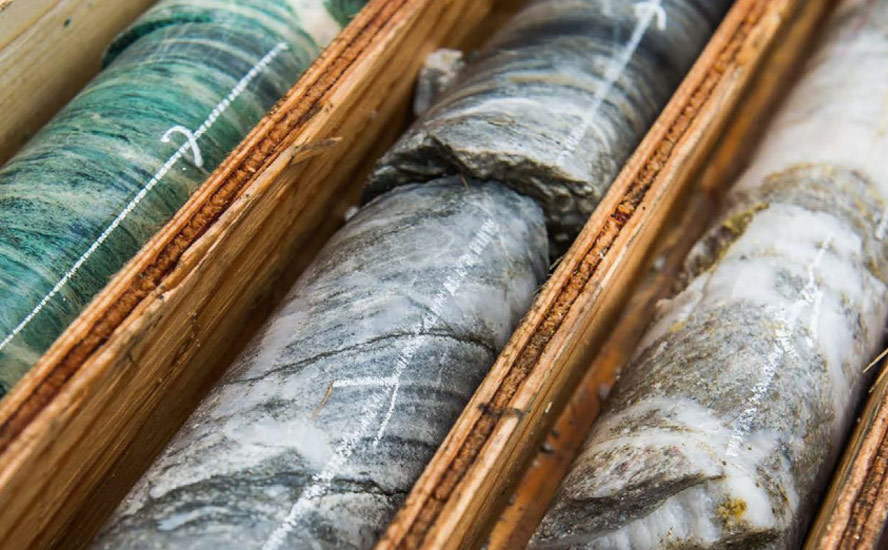
All drill holes at Newcoast encountered broad intercepts of mineralization above 0.4 grams per tonnes gold in 2025 and successfully expanded an extensive, sparsely tested mineralized zone initially encountered during the 2023 drill program. A higher-grade intercept with visible gold was encountered in a newly identified mineralized structure while targeting discrete, previously untested chargeability anomalies along the Newcoast target corridor.
Among the key intercepts:
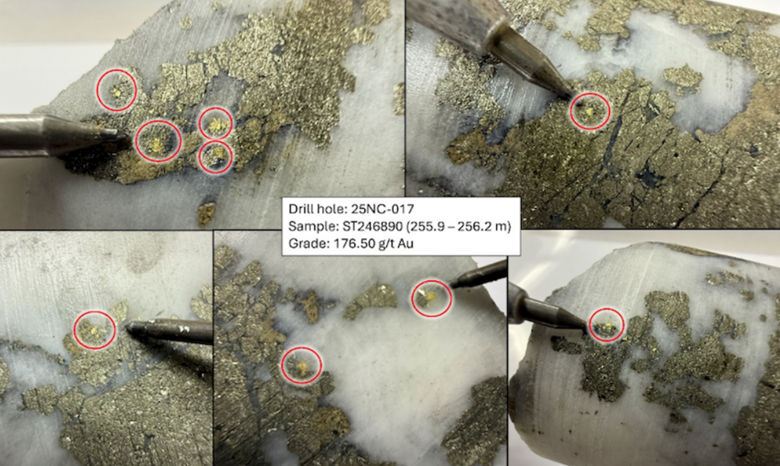
- Drill hole 25NC-017 identified an area of new quartz veining with visible gold, returning: 15.7m of 3.80 g/t Au from 249.1m downhole, including 176.50 g/t Au over 0.3m.
- Drill hole 25NC-019 returned 22.5m of 3.52 g/t Au from 420.9m downhole, including 42.41 g/t Au over 1.6m, with 51.68 g/t Au over 1.2m.
- Drill hole 25NC-010 intercepted 89.2m of 0.71 g/t Au from 217.3m downhole, including 43.5m of 1.12 g/t Au with 0.4m of 5.59 g/t Au.
- Drill hole 25NC-013 returned 167.5m of 0.42 g/t Au from 499.4m downhole.
“We are pleased with the final results of the 2025 drill program. Intercepts at Newcoast further validate our belief that the Cassiar Gold property continues to offer considerable untapped regional potential,” said Cassiar Gold’s President and CEO Marco Roque. “From a business perspective, as we continue to advance our priority exploration targets, we are looking forward to broadening our focus in 2026 to highlight our project’s unique advantages amid record gold prices, including established infrastructure and valuable optionality from past-producing high-grade mines.”
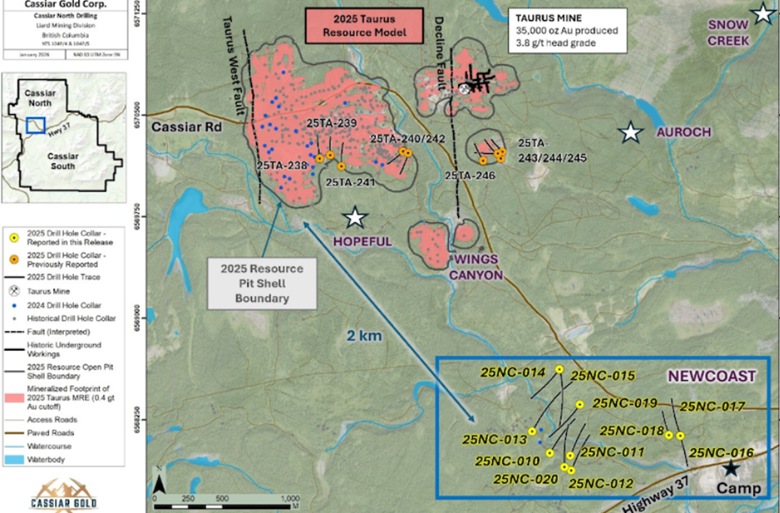
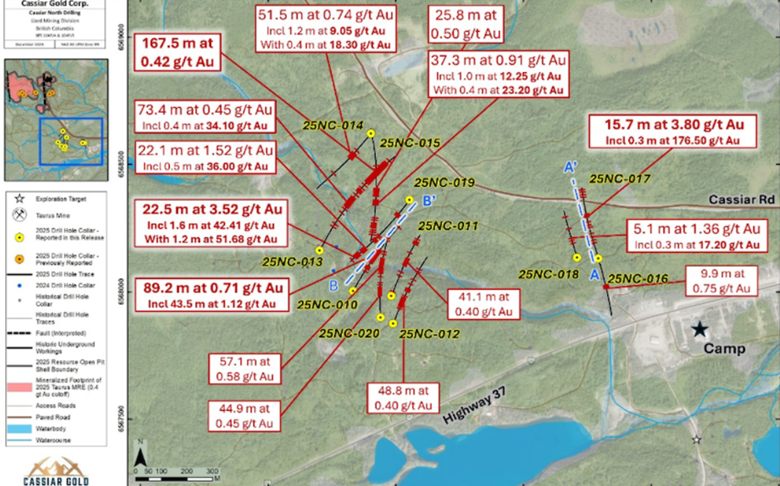
Drill holes 25NC-016, 017 and 018 identified a new series of quartz veins with visible gold and mineralized alteration halo, highlighting an ongoing potential for additional discovery along northeast trending lineaments in the Newcoast target corridor. Results included:
- 25NC-017 encountered multiple specks of visible gold, returning 176.50 g/t Au over 0.3m, within 15.7m of 3.80 g/t Au from 249.1m downhole.
- 25NC-018 intercepted 17.20 g/t Au over 0.3m, within 5.1 m of 1.36 g/t Au from 112.7m downhole.
Drill hole 25NC-010 returned 89.2m of 0.71 g/t Au from 217.3m downhole, including 43.5m of 1.12 g/t Au.
Drill hole 25NC-019 intercepted 22.1m of 1.52 g/t Au from 377.1m downhole, including 0.5m of 36 g/t Au; and 22.5m of 3.52 g/t Au from 420.9m downhole, including 42.41 g/t Au over 1.6m, with 51.68 g/t Au over 1.2m.
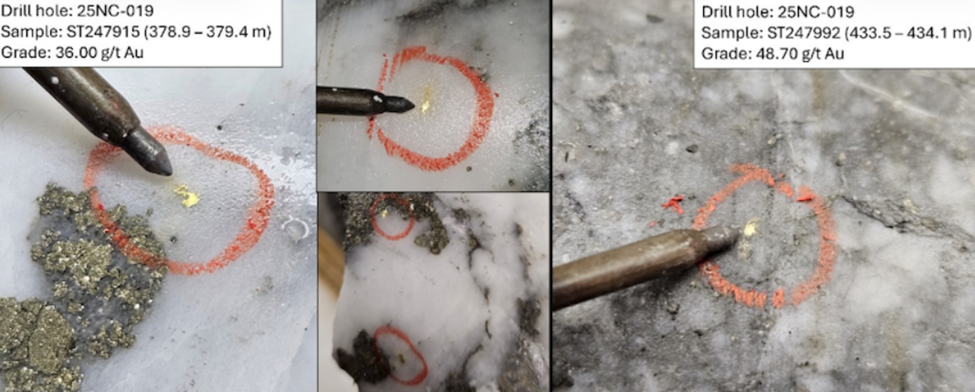
The first 9 holes
Cassiar Gold on Dec. 3 announced results from the 2025 exploration program at the Taurus deposit. According to Cassiar, the results expand mineralization near surface and beyond the extent of the current resource block model.
Cassiar Gold hits jewelry-box grades at Taurus — Richard Mills
The drill results reported in the Dec. 3 news release are from nine drill holes totaling 2,066m, which tested the outer margins of the known extents of the Taurus deposit. Drilling was distributed across a 1.3-kilometer corridor of the deposit footprint to evaluate the expansion potential of mineralization beyond the block model with step-outs ranging from 30m up to 110m.
The program also followed up recently identified quartz veins hosting higher-grade gold mineralization along key controlling structural trends.
Several higher-grade sample intervals were intersected internal to broader mineralized intercepts.
These extend the distribution of near-surface mineralization south, east, and west of previous drilling along an extensive east-northeast striking corridor of sheeted extensional vein sets within an associated prospective, gold-bearing carbonate-pyrite alteration halo.
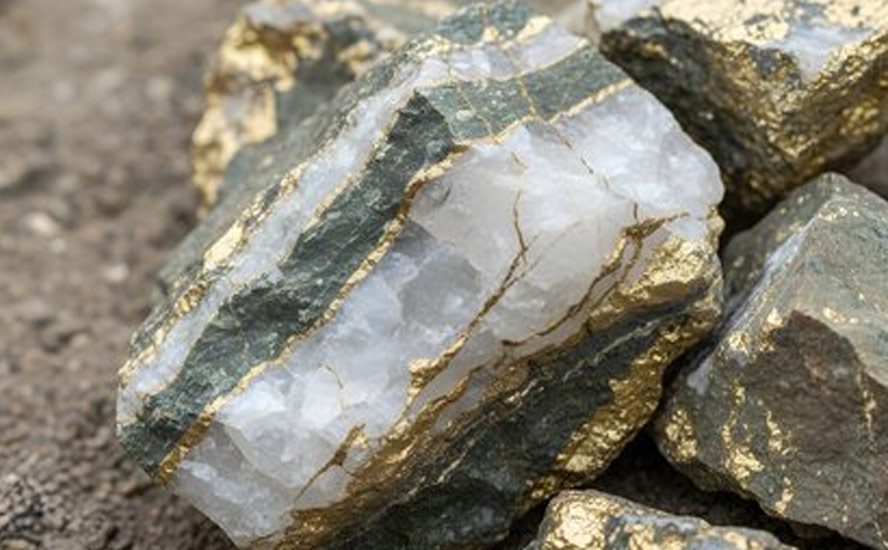
The highlight intercept was from drill hole 25TA-245, which encountered multiple quartz veins with visible gold, returning 13.4m of 13.4 g/t Au from 28.2m downhole, including 56.10 g/t Au over 0.3m and 210.71 g/t Au over 0.8m, with 0.4m of 369.00 g/t Au.
The drilling was outside the pit-constrained resource, so it therefore has potential to add ounces in the next resource update. There is a Preliminary Economic Estimate (PEA) due out late in the second quarter of 2026.
More importantly, the intercept is from 28 meters down hole — very close to surface and open-pittable. And remember, the 210 grams per tonne over 0.8m is the higher-grade portion of the more continuous 13.4 g/t over 13.4m. That is also a very good grade for an open pit.
Taurus deposit and resource
The Cassiar North project area hosts the Taurus deposit as well as multiple similar bulk-tonnage-style regional targets including Newcoast, Auroch, Hopeful, Snow Creek, and Lucky.
At Taurus, mineralization consists primarily of basalt-hosted low-sulfide gold-bearing veins, which have well-defined alteration envelopes of quartz-sericite-iron carbonate and pyrite. Shear veins, extensional veins, thrust-filling veins, as well as vein arrays and breccia zones all occur, but shear veins are the most economically significant in terms of gold mineralization.
The deposit remains open in most directions laterally and at depth, providing the potential for significant expansion of the resource and additional discoveries through further exploration.
There is an updated (June 2025) pit-constrained Mineral Resource Estimate (MRE) defined for the Taurus gold deposit, reported above a 0.4 g/t Au cutoff and USD$2,400/oz gold price comprising:
- Indicated Mineral Resource: 8.8 Mt at 1.43 g/t Au for 410,000 ounces
- Inferred Mineral Resource: 63.2 Mt at 0.95 g/t Au for 1.93 million ounces
The current mineral resource estimate comprises just over a one-square-kilometer footprint of the 590 km2 property. Mineralization outcrops in places and extends from surface to a maximum pit depth of 307m, with 48% of the resource occurring within 50m of surface, 81% occurring within 100m of surface, and 91% occurring within 150m of surface.
Apart from the high grades, CEO Marco Roque said what is also exciting is the fact that the new MRE has better-defined, higher-grade domains than the previous (2022) MRE. Cassiar Gold targeted those domains in the drill program, and they intercepted what they were expecting to find — higher-grade extensions of the known high-grade corridors.
Metallurgical work for the Taurus deposit is currently underway and results are pending.
Historical exploration
Historical drilling totals 277,000 meters. Since becoming the operator in 2020, Cassiar Gold has drilled +69,000 meters. The new pit-constrained MRE for the Taurus deposit area and supporting technical report for the property incorporate results from 46,389m of diamond drilling completed across the property since the previous MRE in 2022.
36,000m of drilling was done at Cassiar North between 2022 and 2024, with 31,237m into the Taurus deposit area.
The deposit has seen past production of 35,000 oz at a recovered grade of 3.8 g/t Au at the Taurus underground mine from 1981-88.
Recent exploration began in 2019 when Margaux Resources (the predecessor to Cassiar Gold) conducted geological mapping and prospecting of both new and known gold prospects on the property.
Although the property has an extensive exploration history, much of the historical work has targeted high-grade veins, and not the bulk-tonnage potential. To that end, geological mapping, chip and grab sampling, as well as resampling of one historical drill hole core, were done on numerous prospects in both the Taurus and the Table Mountain areas. Rock samples were simple grab samples, while chips were taken across veins and alteration areas.
In 2020, Cassiar Gold completed a 5,000-meter drill program which successfully extended mineralization between past drill holes to confirm continuity of mineralization. In 2021, Cassiar completed another drill program consisting of 15 holes totaling 4,098m which was aimed at defining and/or confirming higher-grade mineralized areas where historical drilling was widely spaced. Results were encouraging.
At the Cassiar South project area, there are many known veins with only minimal drilling. Several underground mines operated from 1997-2007. They collectively produced >315,000 oz gold extracted from high-grade quartz vein mineralization (four vein systems and 15 portals) with grades of 10-20 g/t Au. The most recent production was in 2007 from the Main mine.
There is significant exploration upside with a 15-km prospective strike length.
18,000 meters of drilling conducted in 2021-23:
- Identified extensions of known mineralization near existing infrastructure
- Interpreted offset vein segment of the past-producing Bain vein system
- Identified gold-bearing quartz veins adjacent to known vein systems
- Confirmed continuity of high-grade mineralization at the East Bain Vein
Roadside mine
Highway 37 bisects the Cassiar Gold Project, and there are 160 km of access roads throughout the property. The project also has a fully owned and permitted 300 tonnes-per-day mill and a 48-person camp with power and water access. A 1.2-kilomter airstrip is 5 km from the Taurus deposit. The area features ideal topography and access for open-pit-mine infrastructure, with paved roads and grid power. There are also 17 historical portals, 25 km of underground workings, four tailings facilities and a core shack.
The project is surrounded by existing significant gold deposits and mines, including Galore Creek (Anglo Teck), Eskay Creek (Skeena Resources) KSM (Seabridge Gold), Silvertip (Coeur Mining), Tatogga, Red Chris and Brucejack.
There are two mine permits on the property and one exploration permit.
In a recent video interview, Cassiar Gold Chairman Steve Letwin compared Cassiar’s project with the Cote deposit he led the development of, while President and CEO of IAMGOLD.
Letwin successfully grew Cote — acquired through the purchase of Trelawney Mining and Exploration — from about 1.5 million ounces to upwards of 25Moz in a difficult gold market.
Simultaneously, IAMGOLD’s market capitalization skyrocketed from about $1 billion to $15 billion, with the stock price racing from $1.70/share to its current ~29/sh.
Both projects, says Letwin, are “roadside mines”, with Cote easily accessible from Highway 144 North in Ontario, and Cassiar Gold bisected by Highway 37 in northern British Columbia.
“You literally come off the highway and you’re in the deposit,” Letwin told The Gold Newsletter’s Kai Hoffman.
He explained that with infrastructure already in place at Cote, such as roads built by forestry companies, IAMGOLD could raise money for drilling to prove out the resource, which benefited shareholders.
Same with Cassiar Gold, which had about $100 million in infrastructure put in between 2008 and 2009. The key point about infrastructure, says Letwin, is it accelerates the path to cash flow, which is what shareholders really want — a return on their investment.
“That’s what I like about Cassiar. Near-term cash flow, a pathway to NPV (net present value) that shareholders can see, to me is a two-thumbs-up kind of opportunity.”
Letwin is Cassiar’s largest independent shareholder, holding close to 7 million shares.
High-grade optionality
Remember at the top, I said the Cassiar Gold Projecthas substantial upside potential for both bulk-tonnage resources in the Cassiar North area, and high-grade gold targets in the Cassiar South area.
Let’s call Cassiar South GLDC’s high-grade optionality.
At Cassiar North, the company already has a substantial resource of 2.3Moz over 1 g/t at surface. That’s the Taurus deposit, and there are several outlying bulk tonnage targets, including Newcoast. The Taurus deposit is open laterally and at depth, meaning it is expandable.
According to CEO Marco Roque, Cassiar Gold believes it can reach over 5 million ounces by developing the bulk tonnage targets at Cassiar North.
The drill results at Newcoast had broad intercepts ranging from 70 to 170 meters. There were also some narrow, high-grade intercepts of 40-50 g/t over smaller widths in narrow, high-grade veins. The highlight was 15.7 meters @ 3.8 g/t in a sparsely drilled part of the property.
The company still sees a lot of potential at Cassiar North, and it hasn’t lost focus on its 5Moz goal. The Newcoast target’s footprint is about 4 km by 800 meters wide — about three times larger than Taurus.
“We see a lot of gold at surface. We’re obviously seeing a lot of gold in the drilling. It’s indicating what we thought would be a pretty big mineralized system there.
“It’s still early days, but it’s providing more and further indications that we might have another Taurus at Newcoast,” Roque said during another recent video with The Gold Newsletter’s Kai Hoffman.
Indeed, the bulk tonnage area at Taurus and the surrounding targets, including Newcoast, Cassiar Gold sees as a company-maker.
But Roque says GLDC also has “a very exciting high-grade mine system that we see as a near-term development optionality as well.” This is Cassiar South, which hosts high-grade veins that could provide a shorter timeline to cash flow than Cassiar North, which, though much larger, will take longer to build out — an estimated five to six years.
The grades from the four underground mines were between 10 and 20 grams per tonne. On average, the veins are 3 meters thick and there is over 300,000 ounces of historical production.
Cassiar Gold over the years has hit some juicy intercepts at Cassiar South, such as 4.8 meters @35 g/t, and 2.2m @ 32 g/t.
Cassiar has a mine permit covering most of the Taurus deposit, but it has also has another mine permit covering 20 km of high-grade veins at Cassiar South, plus supporting infrastructure including a 300 tonne per day (tpd) mill.
Without economic studies, Roque estimates about $25 million of capex could see Cassiar Gold getting the mill restarted at Cassiar South.
“At 20 grams per tonne, that mill could be spitting out 60,000 ounces a year. At 10 g/t, it’s 30,000 ounces a year,” Roque said in the video.
“In Canadian dollars, that’s anywhere between $200 million and $400 million of revenue per year.”
He noted the mill needs refurbishing and that Cassiar Gold would have to do a bit more exploration at Cassiar South “to increase our runway.”
But with a 9-kilometer strike length running north to south, he suggested that every 400 to 600 meters there is the potential for a parallel vein system that, with the right grades, could each carry 150,000 ounces, or more.
Asked what the one thing is investors don’t understand about the Cassiar Gold Project, Roque said it’s the fact that it’s really two projects.
“The bulk tonnage is a project that is comparable to many other exploration companies you see in British Columbia or the Yukon,” he told Kai Hoffman. “What’s quite unique is the optionality that the South provides, together with the fully permitted mill and the grades that you see there. You don’t see that kind of 15 gram per tonnes grades every day.
“Those two projects put together are extremely valuable.”
Catalysts
The company is preparing to initiate an assessment of unmined higher-grade mineralization associated with past-producing small-scale vein systems at the Cassiar South project area, which could potentially be processed at the existing milling facility.
In addition, Cassiar plans to evaluate previous testing programs at the historical tailings management facility at Cassiar South. The evaluation will support further metallurgical testing to establish gold recovery.
Other catalysts are the PEA, due out in late Q2, which will focus on Taurus but may include the Cassiar South veins. Note that last year’s resource on Taurus was based on $2,400 gold. With gold more than double that now, an updated resource would make the PEA considerably more economic.
Metallurgical studies on Taurus are coming out this quarter.
Roque said the company is looking at a 10,000 to 25,000-meter drill program in 2026, split between the bulk tonnage targets in the north and the high-grade veins in the south.
Conclusion
Cassiar Gold is a Canadian gold explorer focused on its flagship project of the same name in northern British Columbia. It has a massive 59,000-hectare district with five past-producing mines. It comes with paved roads, power, water, mine permits, and a fully owned and permitted mill.
The management team has a track record discovering, permitting, building, operating, and selling multi-billion-dollar gold mines. Insider ownership is 14% and institutional ownership is 29%, including Delbrook, US Global, Sprott, Ixios, Myrmikan, EMA, Commodity Discovery Fund and Terra Capital.
The 2025 drill program consisted of 7,308 meters of expansion drilling at Cassiar North. Taurus and Newcoast were the targets. Remarkably, of 20 holes drilled, the drills hit mineralization in all 20. In fact, over the past five years, the success rate is 99%. Out of almost 300 drill holes drilled, only a couple missed. Which is an incredible hit ratio for an early-stage junior and shows the extent of mineralization over the Cassiar Gold Project.
Results delivered notable extensions at bulk tonnage targets, for example 13.53 g/t over 13.4m, including visible gold intervals.
So far, Cassiar Gold has drilled under 0.3% of the land package, presenting a huge opportunity for expansion.
There is a foundational pit-constrained mineral resource estimate at the Taurus deposit, updated in 2025 using $2,400 gold. The resource is a combined 2.34 million ounces at 1.01 grams per tonne gold from surface, comprising 410,000 oz @ 1.43 g/t Au (Indicated) and 1,930,000oz @ 0.95 g/t Au (Inferred).
It represents just over one square kilometer of the 590 km2 land package, with 91% of the resource within 150 meters of surface, open for expansion laterally and at depth.
There are two existing mine permits on the property, enabling Cassiar to develop the bulk-tonnage targets at Cassiar North and the high-grade underground veins at Cassiar South simultaneously.
Having existing infrastructure is a major advantage. It allows Cassiar to plow any existing and new money into the ground rather than spending it on roads, power lines, a milling facility and the like.
The Cassiar Gold Project is bisected by Highway 37, making it a “roadside mine” in the words of Chairman Steve Letwin — a rarity in Canada where most mine properties are in far-flung locations requiring massive capex to make them accessible.
There are two near-term catalysts: metallurgical studies on the Taurus deposit and a PEA, which we should see by the end of the second quarter. The new PEA would set out the economics of a proposed mine based on a higher gold price than the 2025 resource estimate used. The PEA is likely to contain both the bulk tonnage targets at Cassiar North and the high-grade underground veins at Cassiar South.
The latter provides high-grade optionality and a quicker path to cash flow than Cassiar North, which is much larger scale but could take up to six years to develop. There are 315,000 ounces of historical production at Cassiar South, with head grades of 10-20 g/t, which have been extended and remain open.
The company has $6.4 million in the treasury as of September 2025.
Its $22.80 per ounce enterprise value is the lowest among its peers, with over $16 billion in contained metal.
Considering the amount of gold in the ground, Cassiar Gold imo is highly undervalued. It is also tightly held. They only have 147 million shares outstanding and a market cap of just $50 million, as of Feb. 19.
Cassiar Gold’s future seems bright.
Cassiar Gold Corp.
TSXV:GLDC, OTCQX:CGLCF
2026.02.19 Share Price: Cdn$0.425
Shares Outstanding: 146.6m
Market Cap: Cdn$61.1m
GLDC website
Richard (Rick) Mills
aheadoftheherd.com

Subscribe to AOTH’s free newsletter
Richard does not own shares of Cassiar Gold Corp. (TSXV:GLDC). GLDC is a paid advertiser on his site aheadoftheherd.com This article is issued on behalf of GLDC
Legal Notice / Disclaimer
Ahead of the Herd newsletter, aheadoftheherd.com, hereafter known as AOTH.Please read the entire Disclaimer carefully before you use this website or read the newsletter. If you do not agree to all the AOTH/Richard Mills Disclaimer, do not access/read this website/newsletter/article, or any of its pages. By reading/using this AOTH/Richard Mills website/newsletter/article, and whether you actually read this Disclaimer, you are deemed to have accepted it.