 RSS Subscribe
Ahead of the Herd and Under the Spotlight – Claudia Tornquist CEO Kodiak Copper

2025.09.20
Rick Mills, Editor/ Publisher, Ahead of the Herd:
Claudia, tell us about Beaver Creek, Colorado, the 2025 Precious Metal Summit, and your experiences and the reception you got. I heard it was very busy, a very good show this year.
Claudia Tornquist, President and CEO, Kodiak Copper: (TSX.V:KDK)
Yes, it was a very good show. A lot of interest, lots of meetings. I think our story at the moment tells very easily because we obviously have some important milestones this year. A catalyst was the resource, a maiden resource after six years of drilling and consolidation and the first part of it was already well-received and so now obviously the expectations for the second part are there, and it will be similarly an important catalyst, and I believe will also be well-received.
From an investment perspective we are still a very good opportunity in that our share price is still low, our market cap is low compared to our peers that are a little bit more advanced, which trade at much higher valuations. We started catching up I’m confident we will continue to catch up as it becomes clearer with the resource that we have a project that has economic potential and that is comparable to other successful BC projects and mines.
As this becomes more and more evident and sinks in with investors, we expect to see further momentum in our share price, and we’ll be able to catch up with those peers that have already a resource or maybe have already a PEA.
RM: Why don’t you give us a brief rundown on each of your projects, MPD and the Mohave?
CT: Well, MPD is our copper-gold porphyry project in southern British Columbia, which has been our main focus over the last six years of exploration, almost seven years.
We consolidated a property from multiple smaller claim packages over the course of these years and have a lot of historic exploration on the property, in total 66,000 meters was drilled, and that exploration was done by multiple companies over the span of decades and nobody really ever had the critical mass, even though people had good drill results, exploration results, nobody had the critical mass to make the project work.
By consolidating the district and putting it all together, that’s what we created with Kodiak. At the same time over those six years, we also drilled a lot, we have drilled a total of 90,000 meters and with that we now have outlined seven substantial mineralized zones that will all be part of our maiden resource that we’re bringing out this year.
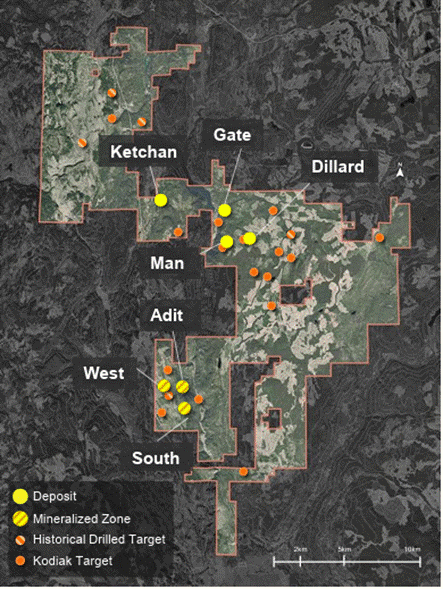
RM: And you’ve already published a partial resource, an initial resource for MPD.
CT: Yes, that was the first four zones, which we had ready to go in the spring, so the maiden resource estimate for those four zones came out in June. On the remaining three zones we drilled a little bit more this summer and are doing the resource estimation work as we speak, and the resource estimate for the remaining three zones will come in the fourth quarter, so that’s when we will have the full resource estimate, the maiden resource estimate for the entire project.
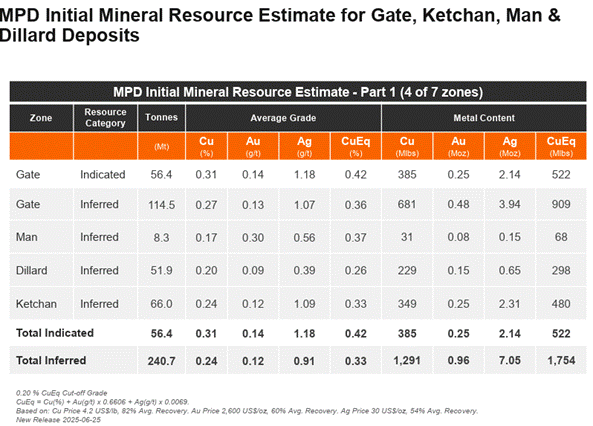
RM: Excellent, and Mohave?
CT: Mohave is also a copper porphyry exploration project and like MPD, it’s in a great area, Arizona, obviously that’s copper country, so it has great infrastructure and it’s near a big mine, Freeport’s (NYSE:FCX) Bagdad mine. It is exploration stage, has some historic exploration, some interesting sniffs, and interesting results, but it needs more drilling.
In the downturn we didn’t do much with the project, but now the situation is very different, there’s a whole lot more interest in US copper projects, and so we are considering how to take this project forward and we’ll do so in the coming months.
RM: You recently did a financing, what do you plan on using the proceeds from the financing for?
CT: It will be primarily, as in the past, be spent on our MPD project in British Columbia.
RM: You’ve got the financing, you’re going to move forward, you definitely have the experience, and you’ve got a good team around you.
Tell us about the depth and experience of your team.
CT: Well, we have a lot of porphyry experience on the team. Our technical team is headed up by Chris Taylor of Great Bear fame, and Chris is often thought of as a gold guy because Great Bear which was a great gold discovery.
But Chris’ background is in copper porphyries. He started his geology career as a geologist for Imperial Metals (TSX:III) exploring for copper porphyries in British Columbia and other parts of North America. He’s intimately familiar with porphyries in BC, so that’s obviously a great bonus.
Then we have Dave Skelton, who’s a very experienced exploration geologist with our VP Exploration, in the business for 35 years. And we also were able to bring on as advisors two former employees from Copper Mountain, the mine next door to our MPD Project. Peter Holbek, who was the VP Exploration for Copper Mountain for many years, and Mike Westendorf, who was the chief metallurgist for Copper Mountain.
Both of their experience obviously for us is invaluable.
RM: You’ve got some experience in the mining industry as well. Tell us a little bit about your background.
CT: My background is more the financial/ commercial/ business side of things. I’ve been in resources for now almost 25 years and was for almost 10 of those with Rio Tinto, doing things like business evaluation, M&A, business development, so more the commercial-type roles.
So, I have a very good understanding of what a large company is looking for in terms of projects and how they work with juniors and so on.
RM: You’ve got a well-rounded team, very experienced in all aspects of the business. Can you give us some peer comparisons to your company?
CT: In my mind, the closest comparables to Kodiak and peer companies that are a little bit more advanced are Faraday Copper (TSX:FDY) and North Isle Copper and Gold (TSXV:NCX).
Both of those are PEA-stage copper porphyries BC and Arizona, respectively. If you look at their valuations, they are at this time at about $350 million, so a whole lot more than Kodiak.
Another good comparable is a company called GT Gold, which was taken over by Newmont (TSX:NGT) in 2022.
They were taken over at a valuation of almost half a billion dollars, so also a whole lot more than Kodiak’s current market cap. That’s what I meant when I said before, we have started catching up, but there’s still a big valuation gap to our more advanced peers.
And that’s obviously for an investor at this time an opportunity because we are still cheap but have now some nice momentum and a very good chance to catch up in terms of valuation. It puts us in a good position to generate great returns for our shareholders.
RM: Do you see positive things happening for copper projects in British Columbia with the Anglo/Tech merger?
CT: Well, I think the merger is good for the industry in general. Very often, big mergers are also a trigger for more M&A and that’s obviously good for the entire sector. I think this merger also just highlights how important copper is. It was all about copper and creating a large copper company and reaping big synergies between their copper operations. It just highlights the importance of copper going forward.
RM: Yes, copper has been pretty much a critical metal for awhile now. And we’ve got a lot of copper in KDK, and your Mohave looks promising.
Are you having any problems working in the US with this trade dispute and all the back and forth? Is there any difficulty with crossing the border or working in the US now, Claudia?
CT: We haven’t had any issues; in fact, it’s quite the opposite. Our advisor in Arizona tells us that at the moment the permitting times at the BLM are really quick and that it’s actually easy to get projects moving and to get working. So, certainly favourable circumstances to move a project forward. A lot of support for domestic exploration and domestic critical minerals.
RM: Do you think somebody’s going to come in and start to consolidate perhaps some of the projects and the juniors in the southern Quesnel Terrane? It seems like with the interest in copper, that this would be a natural place for majors to move, to be looking at. There’s already some in the area and mid-tiers. Do you think there’s a chance they’re going to consolidate some of this district?
CT: What I can certainly say from my own experience is that there’s a lot of interest from the majors for good copper projects. They’re all looking for the next good big copper project. So, I wouldn’t be surprised to see more acquisitions coming.
And what you see typically in the industry, particularly for porphyry projects, is that the juniors do most of the exploration. The majors look at what the juniors are doing and if they like what they see, if the junior has de-risked the project and shown a certain size potential, then the major comes in and writes a big check. I would certainly expect to see more of that as we move in the cycle.
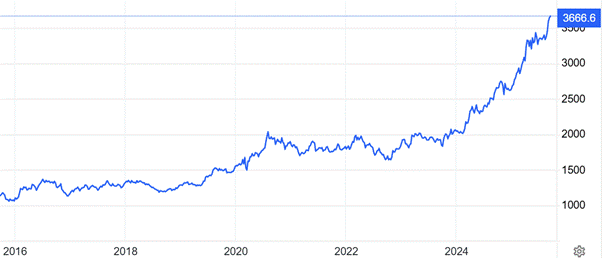
RM: It’s not just copper producers, either. With the price of gold, gold companies have to be looking at these copper-gold porphyries as well. At $3,600 gold, half a gram of gold is almost $60, $60 as a by-product on a BC porphyry. That pays for mining and some.
CT: It does. Gold companies are also these days looking at copper projects and probably 10 years ago they wouldn’t have. But that really has changed. We have a lot of gold companies, or traditional gold-only companies now also looking at copper-gold opportunities.
And our project in southern British Columbia, MPD, is an alkalic porphyry system, so copper with gold, and actually quite good gold by-product values. That makes it attractive, not only to copper companies but also to gold players.
RM: Give us your plans to advance both projects. What are you going to be doing here over the next six months to a year to advance these projects to the point where a major could look at it and say, “Wow, that’s enough to make a difference to our bottom line.” Take them one at a time and tell us what you’re going to do.
CT: For MPD, obviously the next big milestone and catalyst is the full maiden resource. And beyond that, if you look at the maiden resource and at the project, there’s still a lot of room to grow. The resource in itself will most certainly grow, I have no doubt, because all of the zones are still open and most in multiple directions.
So, with some further drilling, and we have some really obvious targets there, I am confident we will be able to increase the size of the resource.
In addition, we have multiple untested targets on the property, around 20 at current count, which offer the potential for new discoveries and further mineralized zones. You should see more drilling from us, leading to a bigger resource at some point. The logical next step from there is a PEA, but we haven’t committed to a specific timeframe for that yet.
So, for sure, there will be more drilling, we’ll also do more metallurgy, and we’ll take it from there.
The Mohave project is at an earlier stage. We have not done a drill program yet, but are now considering doing some work, which would probably be a smaller initial drill program, and we’ll announce those plans as and when we are ready to go.
RM: You’ve got 86 million shares outstanding, and really what is a minuscule market cap of $64 million. Now, I believe it’s undervalued considering how much copper and possible by-product mining there’s going to be here. I’ve been around copper porphyries for a very long time, and I’ve never seen a company with so many meters drilled, so much inventory, and yet you’ve only got 86 million shares outstanding.
How did you manage to do that? Usually by this stage, juniors have blown out their share structures, and they’re not even worth considering, but you’ve got an amazing amount of room in your market cap to move.
CT: Well, we are very mindful of avoiding dilution for our shareholders and we were able to raise capital at opportune times.
That means we still have a quite tight share structure and have room to grow.
RM: We’re in the right copper market now to move forward. It’s been recognized as a critical metal, working in both the US and Canada. If you were talking to an investor, could you summarize the reasons to look at purchasing Kodiak Copper shares? I’d like you to sum it up, why an investor should be looking seriously at Kodiak Copper.
CT: Well, I would put first and foremost the team, with a proven track record of generating really good shareholder returns, and with well rounded technical, as well as capital markets experience. That’s, I think, an important point.
And then our projects, both of them, but mostly MPD, which really underwrites our market cap, is a project in a prime location that we have successfully explored and de-risked, and now brought to a major milestone, the maiden resource.
And thirdly, we are, at this stage, still very undervalued and have a lot of room to catch up, and that’s the opportunity really for investors in terms of share price and market cap, compared to our more advanced peers.
So, if people are looking for promising projects, operated by a solid management team, and that’s still, at this time, cheap, then that’s what Kodiak is, and that’s a recipe for excellent returns for our shareholders.

RM: I was looking at your last 2-3 years of drill assays and I noticed that it’s all in near-surface drilling that you’re getting these hits.
You mentioned that the deposits look to be open in multiple directions, including at depth.
In January 2020 Dunnedin, the former Kodiak, released news from drilling the Gate Zone in 2019, higher grade intervals included:
74.9 metres of 0.54% CuEq (0.43% copper and 0.11 g/t gold) from 297.0 metres to 371.9 metres and another hole returned 102.0 metres of 0.68% CuEq (0.53% copper and 0.16 g/t gold) from 404.9 metres to 507.0 metres.
I have a quote from that news release, “With our first drill program at MPD we have drilled the best hole on the property to date and discovered the higher grade Gate Zone where we intercepted 102 metres of 0.68% copper equivalent. This is an impressive intercept, keeping in mind that neighbouring producers mine ore with grades between 0.25-0.30% copper.” Claudia Tornquist, President and CEO of Dunnedin
In September of 2020 Kodiak released the following news, A 282 metre section of strongly mineralized and altered drill core from drill hole MPD-20-004(drilled to 785 metres and partially reported herein) was prioritised and rushed through assay, returning 0.70% copper, 0.49 g/t gold and 2.64 g/t silver (1.16% CuEq*) over282 metres from 263 to 545 metres.
The central section of the MPD-20-004 interval included 1.41% copper, 1.46 g/t gold and 5.56 g/t silver (2.75% CuEq*) over 45.7 metres from 380.0 to 425.7 metres.
Chairman Chris Taylor said “As compelling as our 2019 discovery of the Gate Zone was, it now appears we had only grazed the margins of a much stronger copper-gold zone which we have now successfully targeted. Our new results include discovery of a central high-grade copper-gold zone within the wider copper-gold mineralized envelope of the Gate Zone. These drill results are among the strongest that have been reported from this well-established copper mining district in southern British Columbia.”
CT: Well, over the time that we’ve explored MPD, if you look back, our initial years of drilling were holes down to a kilometer or so, quite deep, because our aim was to demonstrate that the project’s mineralized zones are much larger than what was shown through historical exploration.
So, we expanded them, we stepped out and expanded them in various directions, but also importantly showed that they extended to much greater depths than previously thought.
RM: Then your focus had to change.
CT: Yes, in the last two-three years in particular, our focus was on adding more shallow mineralization, and in particular, high-grade shallow mineralization, because that’s important as we work towards a resource, because that’s the sort of mineralization that could make the initial economics of a mine.
This year’s program in particular was really focused on infill drilling, confirmation drilling of some of the zones that do have this shallow, near-surface high-grade mineralization.
All of our deposits, the four we have so far are open pit, and if you look at the drill results from previous years at the three zones that are yet to come, then it’s pretty clear that those will also be open pits.
Identifying substantial amounts of near-surface mineralization with good grades, that’s key for a successful resource, and then a PEA. So that’s what our more recent work was really about.
We didn’t drill any deep holes this year, and last year, no thousand-meter holes. I’m sure there will be more deep drilling in the future, because there is potential at depth at all of the zones, but that’s a longer-term concern and not a priority now. In the near-term, it’s near-surface, high-grade.
RM: So, you’re looking to potentially, well into the future, possibly to replicate something like a New Afton Mine? Is there also potential to eventually go underground at the Copper Mountain Mine?
CT: Well, both of those are alkalic porphyry systems, just as MPD is, and both started out with open pits. Copper Mountain still is an open pit, but New Afton is now underground, fully underground, and Copper Mountain, they drilled some deeper holes and have clearly shown potential at depth. And I wouldn’t be surprised if sometime in the future, you’d have some underground mining there as well.
RM: You’ve managed to consolidate a lot of ground that was obviously prospective, and it’s proved up. You’ve managed to put out an initial resource, and you’ve kept your share count ridiculously low for this stage of a project.
Thank you for your time, Claudia, we appreciate it.
CT: Likewise, thank you. It’s been a pleasure.
Richard (Rick) Mills
aheadoftheherd.com
Subscribe to AOTH’s free newsletter
Richard does not own shares of Kodiak Copper (TSX.V:KDK). KDK is a paid advertiser on his site aheadoftheherd.com This article is issued on behalf of KDK.
Legal Notice / Disclaimer
Ahead of the Herd newsletter, aheadoftheherd.com, hereafter known as AOTH.Please read the entire Disclaimer carefully before you use this website or read the newsletter. If you do not agree to all the AOTH/Richard Mills Disclaimer, do not access/read this website/newsletter/article, or any of its pages. By reading/using this AOTH/Richard Mills website/newsletter/article, and whether you actually read this Disclaimer, you are deemed to have accepted it.