 RSS Subscribe
Under the Spotlight – Marc Blythe Founder, President, CEO & Director Au Gold Corp
2026.04.01
Rick Mills, Editor/ Publisher, Ahead of the Herd:
Marc, can you introduce yourself, give us a brief background on what you’ve been doing, what your qualifications are and what’s motivating you?
Marc Blythe – Founder & CEO, Au Gold Corp (TSX.V:AUGC):
Yes, my grandparents met on a gold field in New Zealand in the 1930s in the Depression era and that’s kind of how my family got into the gold mining business.
And than my parents were involved with gold prospecting, so I got dragged around the gold fields of New Zealand and then some of the Australian ones in the 1980s when my parents moved to Australia and they were part of the early rush of metal detecting. They made a comfortable living doing that for about eight years when it was easy pickings. Many prospectors continue to metal detect today as hobbyists and fulltime jobs especially given the current gold prices.
I ended up in a place called Kalgoorlie in Western Australia where I finished high school, studied mining engineering and then went out and worked for mostly bigger companies. I started out with companies like Western Mining and ended up working for Newcrest and then Placer Dome.
In the early 2000s I was with Placer Dome and had some success. I found out I was quite good at the economic part of the business where project feasibility was involved, where you take your technical expertise and merge it with your financial experience.
I was lucky enough to have a couple of mines that I led the feasibility studies on get built and make money. That got noticed by Placer Dome’s people in Vancouver, so my wife and I moved there in 2004.
When Placer Dome got bought out by Barrick, it’s office was in Toronto. I couldn’t sell that to my wife, so I thought, I had better get interested in exploration.
From 2006 onwards my life has had a lot of mineral exploration exposure including running a junior explorer and also doing a lot of diligence work helping financial groups assess advanced mining projects.
So, finance providers, M&A, that kind of thing. I got involved in some pretty decent-sized deals along the way. The most recent one is
Mandalay Resources and Alkane Resources (T.V:ALK).
I was leading the diligence for a company called Mandalay and they were looking for ways to grow their business and ended up landing on Alkane. So, Alkane ended up becoming the surviving company. The two companies merged.
I led the technical diligence for all the searches that Mandalay did including on the Alkane projects. Before that I had success with a company called Nevsun Resources. I was part of the team that sold Nevsun to Zijin Mining for $1.8 billion.
After the Nevsun deal, I ended up with a lot of spare time and started a private company which is now Au Gold. I took it public in 2020 with a Low Sulphidation Epithermal gold project just south of Merritt, BC near Westhaven Gold. We drilled two of six targets in 2022 and got some decent results, but the market was not receptive.
So, we put the company on ice for a few years all the while looking for quality gold prospects to add to Au Gold. The search broadened back to my roots in Australia where I found the Havelock Project and I’m super excited about it.
RM: Two of the stronger points in your CEO toolbox is that one, your due diligence is obviously strong and two, your effectiveness at economic consideration.
MB: I know what the end product is that the exploration geologists need to deliver because I’ve been through the feasibility process. I’m looking at the end product from the finish, looking backwards to the start, at what we’re trying to find.
RM: It’s a unique approach.
MB: I’ve been involved at a really pivotal level in at least four mines and probably more. Four brand new mines. Two of those were in Australia, one in Mexico. That company is now named Torex Gold Resources (T:TXG).
I’ve been involved with the front end of mining and mine development for many years.
RM: Why Australia? Why the Victoria goldfields? You’ve taken 50 years of all those experiences and success, and you’re right back to where your family began prospecting in Australia.
MB: Victoria has produced over 80 million ounces of gold since the discoveries in the 1850s. A lot of that gold was alluvial gold, placer gold and nuggets. And up to about 2015, Victoria had a reputation of being not particularly mining orientated. The amount of mining was quite small there so the government hadn’t really paid it much attention.
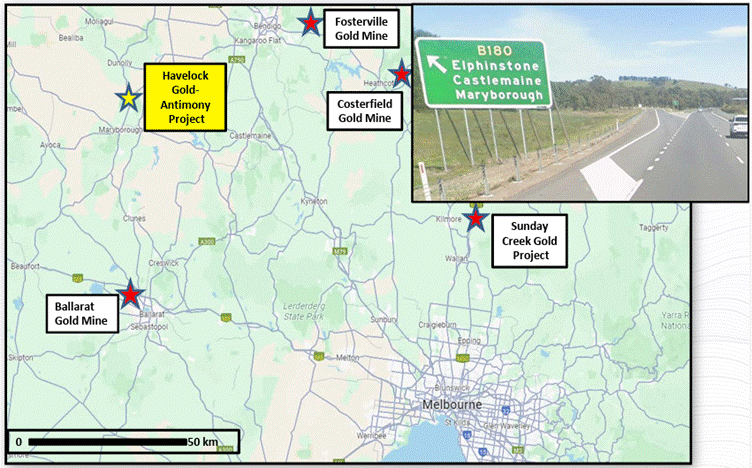
The deposits were generally regarded as small but high grade. The Fosterville mine, which had been in operation for a number of years, expanded its exploration model with the help of some Canadian geologists and they drilled some deep targets discovering the Eagle and Swan zones which produced extremely high grade gold intercepts. I think Fosterville was the highest-grade gold mine in the world for a number of years. It’s definitely in the top five even today. Also of note is the association with antimony in the upper portion of the deposit.
That mine, I think they’re talking about potentially being 12 million ounces by the time it’s all said and done. I think they’re still having exploration success as well. So, Fosterville has really put Victoria on the map in terms of being a place to explore for high-grade hard rock gold deposit discovery.
Fosterville is owned by Agnico Eagle, one of the larger gold producers. Next door to Fosterville is the Costerfield mine, which is owned now by Alkane. It’s a small mine at 50,000 ounces a year, but it it’s one of the Western world’s largest antimony producers.
More recently, a company called Southern Cross Gold, which was part of Mawson Gold, had great exploration success at Sunday Creek, about another 45 minutes down the road from Costerfield.
They don’t have a resource yet, but the market cap of that company is over $2 billion. Also of note is that the Sunday Creek project has an association with antimony.
RM: Why don’t you tell us about Havelock.
MB: When I went to Victoria in 2024 as part of the diligence for Mandalay merging with Alkane, I managed to arrange a visit to both Costerfield and Southern Cross.
The CEO of Southern Cross Gold is Mike Hudson, fantastic guy, very generous and allowed me to go for a property tour. So, I went and visited the two operations. I didn’t really think much more of it. Over Christmas that year, I started thinking, “I wonder what else is in Victoria that hasn’t really been discovered or worked on.”
I started researching and found there were various places in Victoria that had both gold and antimony historically documented. I came across a reference from 1899 where there were known antimony occurrences in the state of Victoria.
A bunch of them are under the city of Melbourne now so, nobody’s going to do anything with them. I started looking at some of the other occurrences and came across one at Havelock which is situated near the town of Maryborough.
Interestingly enough, I used to live in Maryborough, so this setting was quite familiar and ticks a lot of boxes.
Unlike other areas in Victoria, the local region has seen a lot of small-scale mining in the past. Unfortunately, it’s current economy is a little depressed. They had a lot of industry at one point in time but some of that industry has left the area.
So, I thought this is a place that you would be welcome to come and explore with the majority of a community that understands gold exploration at some level. I’ve made subsequent trips there and felt that out a bit. I think that’s a reasonable kind of thesis.
RM: Your Havelock project consists of two parallel trends, the Shaw McFarlane Trend and the Leviathan-Mariner’s Trend.
MB: The Leviathan-Mariner’s Trend has some level of modern exploration and much more substantial historic mining on it than the Shaw-McFarlane Trend. There was diamond drilling there in 2022 by the previous operator and previous reverse circulation drilling by several other operators as well. That surprised me a little bit because it’s about half the grade of the Shaw-McFarlane Trend which workings are also quite well documented.
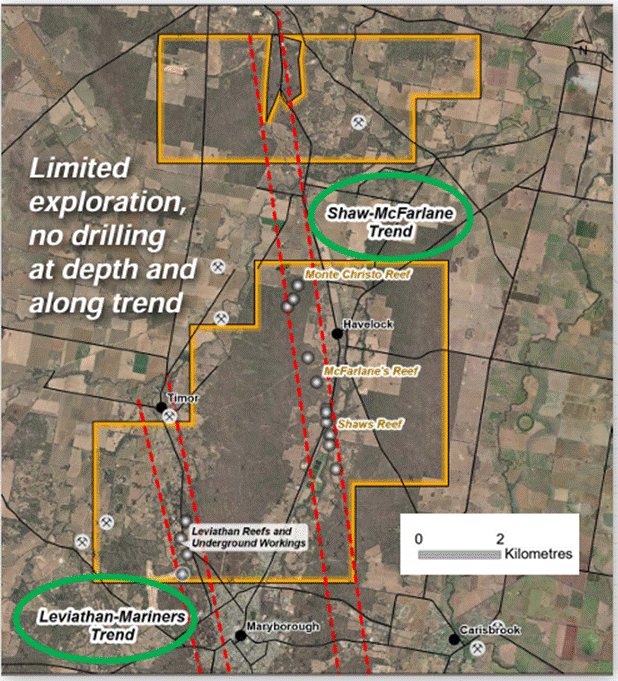
At the Shaw-McFarlane Trend, what we’re looking for is potentially very near surface and hasn’t had as much historic mining. In addition, there’s potentially double the grade of the Leviathan-Mariner’s Trend which averages roughly 13 g/t. Along the Shaw McFarlane Trend, the average gold grades from the main workings are approximately 23 grams/ton. High-grade zones are historically reported up to over 10 ounces per tonne in places.
That grade disparity was something that really attracted us to the Shaw-McFarlane Trend. And the other thing about the Shaw-McFarlane Trend is some of these mineralized reefs are very near surface and haven’t had any real modern exploration.
RM: Where there’s been the OGs, the old guys working, they certainly did not have modern methods of exploration. And the second thing was they couldn’t handle water coming in faster than a certain amount.
So, a lot of the times they didn’t get to any depth. Is that going to be a factor here, do you think?
MB: Oh, definitely. There’s records of some of these mines on the Shaw-McFarlane Trend having difficult water conditions and that had an impact on when they decided to stop mining. I think the deepest mine on the Shaw-McFarlane Trend is only 500 feet. We’re less than 170 meters deep or somewhere in that realm, which is actually very shallow by modern-day standards especially considering the depths other company’s are finding high-grade gold in similar reef systems along the belt are in excess of 1,000 m.
And then when you look at what the pumping technologies were, one of the things that’s described in the old records is something called a whim. I went off looking to try and figure out what is a whim, and it’s basically two buckets on a rope and you’ve got like a horse at the top to spin a wheel to pull the buckets up and down the shaft to remove the water. And you think about that, only later in the 1800s, like getting up closer to 1900 and in the bigger mines did you see any steam-powered pumping, for example.
When you look at where technology is today, the amounts of water are probably fairly trivial for modern pumping with electricity.
RM: Some epizonal deposits are known to extend to depths of a kilometer or more and get higher grade as you get deeper.
MB: That’s the theory. The existing mines are finding good to exceptional grades at greater depths. And if anything, the antimony seems to occur near the top of these deposits.
RM: On the Shaw-McFarlane Trend, you’ve got the McFarlane shaft and the Dam target. What was really intriguing about those pieces of the trend and are they connected?
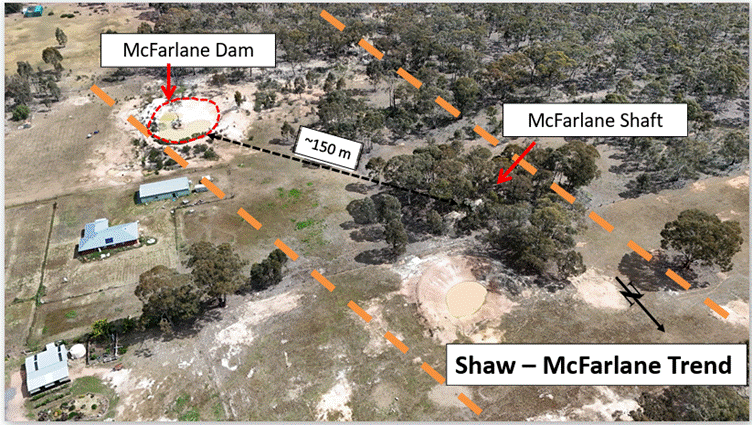
MB: That’s a good question. Our understanding of this particular area and how the two sites are geometrically and structurally connected is at an early stage. We currently know from the historical records there are multiple gold-bearing veins developed within the 9 km long trend and across a structural zone that’s over 1000 m wide.
Really I think it’s about the structural architecture along the trend and across the trend. By that I mean the way the rocks are folded and faulted and how that has allowed the mineralization to develop in those rocks. That’s the structural architecture or setting.
The rocks are intensely folded, and faulting is observed mostly at a small scales in the vicinity of old workings. But, again, looking back at some of the historical documentation, we found a map from 1881 that shows two different orientations of gold-bearing reefs running through this area.
Often your mind tries to simplify things to a single orientation where these deposits are nice and tabular. But the reality is they are going to be geometrically complex and highly variable. They may be on different orientations. That could be the main structural trend in the district, but then you often have subsidiary structural trends that can also host mineralization.
RM: You just came back from the project. What’s going on down there right now? And what are you going to do over the next couple months, what can we expect to hear from the project?
MB: We’re going to have a fairly steady stream of news from our activities down there reporting on the inspection and sampling along a number of trends.
We’re very focused on the Shaw-McFarlane Trend and we’re working very hard to create a good impression in the community and obtain the various permissions to access and work on some of the private lands. That’s an activity that’s on-going right now. We’re also working on designing the first phase diamond drill program which we are planning for the second half of 2026.
I should also mention the company spent several days assessing another trend on the Havelock property east of the Shaw-McFarlane Trend known as the Oxonian Trend.
RM: Tell us about the Oxonian Trend.
MB: It’s a multi-kilometer northerly trend of old workings along the eastern portion of the property. The previous operator had sampled vein material close to shallow historical workings intermittently along 3 kilometers of the trend. Samples ranged from below detection limit to 26.3 grams per tonne gold.
There’s been very little follow-up of the high-grade samples there which is why we spent a few days conducting work along the 3 km trend to identify future drill targets.
We’ll add some more detail on the Oxonian in the next few weeks, just to let people know what it’s all about.
RM: OK. Is it all going to be diamond drilling?
MB: I would say so at this point. As I mentioned before, previous operators hadn’t really paid enough attention to the structural setting on the property.
And that is actually quite critical. I think diamond drilling is the best bang for your buck to gather necessary structural information to provide vectors to potential mineralization. So, I would say we’re positively predisposed to using diamond drilling as opposed to reverse circulation drilling, which is more common in Australia.
RM: How far is the treasury going to go when it comes to doing the rest of this exploration and getting to the point where we want to go diamond drilling? Do you have enough to do the exploration and consolidate all the data and the studies and pick our drill targets and drill? Or are you going to have to finance somewhere in here?
MB: Great question, Rick. We’re pretty frugal. We just sip in terms of the G&A. And obviously, once you get to spend the money on the ground, things go a bit more quickly. But we’ve talked to a range of people in Victoria, they’re advising us that diamond drilling down there is actually relatively inexpensive.
The range of dollar values we’ve been told to budget is in the $300 to $350 Australian per meter range, all in for everything, including supervision assays and the drilling itself.
RM: Last time I had to change Canadian to Australian, I got a little bit of love on the foreign exchange.
MB: I was just doing my expenses yesterday and some of the transfers went each way, so it must be pretty close to parity right now.
RM: Anything you’d like to add Marc before we close this off?
MB: We’ve just kicked off here, but we’re going to be doing a lot more.
I think we’re doing a good job with our community outreach and private landowners there. People we’ve encountered thus far have been friendly and welcoming.
You’ll hear a lot more about us in terms of press releases. We’ll probably be attending some conferences in the near future. I’m hoping that some other people will be interested in talking to us.
And the other thing I would say is management insiders really do have a substantial stake in the company. I’ve got 7 million shares, which I think is like 13, 14%. Close insiders, we’re probably 20, 25% of the company.
RM: Thanks Marc.
Richard (Rick) Mills
aheadoftheherd.com
Subscribe to AOTH’s free newsletter
Richard owns shares of Au Gold (TSXV:AUGC). AUGC is a paid advertiser on his site aheadoftheherd.com This article is issued on behalf of AUGC
Legal Notice / Disclaimer
Ahead of the Herd newsletter, aheadoftheherd.com, hereafter known as AOTH.Please read the entire Disclaimer carefully before you use this website or read the newsletter. If you do not agree to all the AOTH/Richard Mills Disclaimer, do not access/read this website/newsletter/article, or any of its pages. By reading/using this AOTH/Richard Mills website/newsletter/article, and whether you actually read this Disclaimer, you are deemed to have accepted it.