 RSS Subscribe
Canada on the right track with middle power strategy – Richard Mills
2026.03.07
Canada is a middle power. What exactly does that mean?
Wikipedia’s definition is “a sovereign state that, while not a superpower or a dominant global leader, holds significant influence, economic clout, and diplomatic sway on the international stage. Positioned between great powers and smaller nations, they often act as coalition-builders, mediators, and champions of multilateralism (the principle of participation by three or more parties, especially by the governments of different countries – Rick).”
An AI Overview goes further in stating that middle powers have enough capacity to influence events, but not to unilaterally control them. They often seek to avoid exclusive alignment with any single superpower, leveraging their position for independent foreign policy.
Examples of middle powers include Canada, Australia, South Korea, Brazil, Indonesia and Turkey.
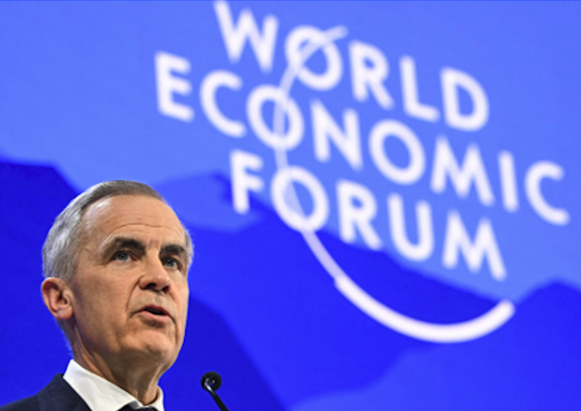
The term came up recently during a widely regarded speech by Canadian Prime Minister Mark Carney at the World Economic Forum in Davos, Switzerland.
The speech was viewed by millions of Canadians — many favorably — so it’s worth parsing some of what Carney said. To read it in full, click here
In 1978, the Czech dissident Václav Havel, later president, wrote an essay called The Power of the Powerless. And in it, he asked a simple question: How did the communist system sustain itself?
And his answer began with a greengrocer. Every morning, this shopkeeper places a sign in his window: “Workers of the world, unite!” He doesn’t believe it. No one does. But he places the sign anyway to avoid trouble, to signal compliance, to get along. And because every shopkeeper on every street does the same, the system persists.
Friends, it is time for companies and countries to take their signs down.
For decades, countries like Canada prospered under what we called the rules-based international order. We joined its institutions, we praised its principles, we benefited from its predictability. And because of that we could pursue values-based foreign policies under its protection.
We knew the story of the international rules-based order was partially false. That the strongest would exempt themselves when convenient. That trade rules were enforced asymmetrically. And we knew that international law applied with varying rigour depending on the identity of the accused or the victim.
This fiction was useful. And American hegemony, in particular, helped provide public goods: open sea lanes, a stable financial system, collective security and support for frameworks for resolving disputes.
So, we placed the sign in the window. We participated in the rituals. And we largely avoided calling out the gaps between rhetoric and reality.
This bargain no longer works…
Canada was amongst the first to hear the wake-up call, leading us to fundamentally shift our strategic posture.
Canadians know that our old, comfortable assumptions — that our geography and alliance memberships automatically conferred prosperity and security — that assumption is no longer valid.
So, we’re engaging broadly, strategically, with open eyes. We actively take on the world as it is, not wait around for a world we wish to be.
We are building that strength at home…
Middle powers must act together because if we’re not at the table, we’re on the menu…
So, Canada has what the world wants. We are an energy superpower. We hold vast reserves of critical minerals. We have the most educated population in the world. Our pension funds are amongst the world’s largest and most sophisticated investors. In other words, we have capital, talent, we also have a government with the immense fiscal capacity to act decisively.
We are taking the sign out of the window.
We know the old order is not coming back. We shouldn’t mourn it. Nostalgia is not a strategy.
But we believe that from the fracture, we can build something better, stronger, more just.
This is the task of the middle powers. The countries that have the most to lose from a world of fortresses and the most to gain from genuine co-operation.
The powerful have their power. But we have something too — the capacity to stop pretending, to name reality, to build our strength at home and to act together.
That is Canada’s path. We choose it openly and confidently.
And it is a path wide open to any country willing to take it with us.
Let me be clear: I am not a Liberal. But I can also say with certainty that there is no other federal politician in Canada, or for that matter elsewhere, at this moment in time, who could have written and delivered a speech like that.
Carney is a central banker, and while that doesn’t give him political experience or street cred, it means he has a firm grasp of economics and the economic challenges facing the country. He likely has a lengthy database of contacts he can draw upon and is doing so in spearheading Canada’s shift from reliance on the United States as our largest trading partner and some would say, former friend, to something beyond bilateralism — a sort of middle way that Carney is calling “the task of the middle powers. The countries that have the most to lose from a world of fortresses and the most to gain from genuine co-operation.”
What are the elements of this shift? At AOTH, we’ve broken it down into five sections: removing interprovincial trade barriers; building new energy, electricity and port infrastructure; critical mineral partnerships; new alliances; and focus on defence.
Removing interprovincial trade barriers
Let’s start with what is happening at home.
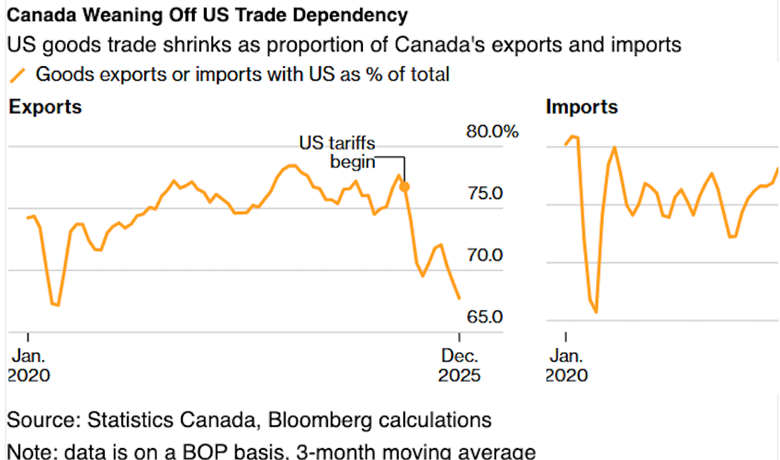
When the federal government started grappling with US tariffs levied at Canada about a year ago, it began looking for alternative trade arrangements, specifically how it could facilitate freer trade.
A long-suffering problem was/is the folly of interprovincial trade barriers.
It’s estimated that these barriers cost the Canadian economy up to $245 billion annually. Studies suggested that removing these barriers could increase Canadian GDP by 7%, or roughly $210 billion.
Sectors most impacted by differing provincial regulations include transportation, alcohol, agriculture and professional licensing.
In November 2025 the Canadian government announced it is “building one Canadian economy instead of thirteen by removing federal barriers to internal trade and labour mobility.”
According to the new Free Trade and Labour Mobility in Canada Act, which went into effect on Jan. 1, and its associated regulations:
- A good produced, used or distributed in line with the requirements of a province or territory will be recognized as meeting comparable federal requirements.
- A service provided in line with the requirements of a province or territory will be recognized as meeting comparable federal requirements.
- A worker licensed or certified by a province or territory will be able to work in a comparable occupation in federal jurisdiction.
Stakeholders including Restaurants Canada applauded the progress in reducing internal trade barriers but expressed concern that critical food and alcohol products were excluded from the Mutual Recognition Agreement, hindering efforts to lower costs for restaurants.
Small and medium-sized enterprises face potential challenges in adapting to new federal standards, including necessary infrastructure changes, as noted in discussions around Bill C-5, the 2025 One Canadian Economy Act. (AI Overview)
Building new infrastructure
Canada is fast-tracking a set of nation-building projects through the Major Projects Office, centered on critical minerals, energy transition, and infrastructure — ranging from LNG Canada Phase 2 and Ksi Lisims LNG to the Crawford Nickel project, Darlington New Nuclear, and Ontario–Québec high-speed rail.
Port of Churchill expansion
Another priority project is expanding the Port of Churchill. Backers say the central Canadian port could become a hub for new global commodity trade, cutting reliance on the US.
The Globe and Mail recently reported that operator Arctic Gateway Group has signed an agreement with the Port of Antwerp-Bruges, one of the world’s largest cargo-shipping facilities, to collaborate on design and business development as well as future trade as the northern Manitoba site plans a multibillion-dollar expansion.
Under the agreement, Arctic Gateway Group, which runs the Churchill port and the railway that feeds it, and the Belgian Port of Antwerp-Bruges will co-operate on drafting plans for port and intermodal facilities at Churchill and identify new and expanded cargo types between Western Canada and Europe. Critical minerals, energy products, fertilizer feedstock, containers and agricultural commodities are priority areas, the companies said on Tuesday…
Chris Avery, AGG’s chief executive officer, said the agreement will help Churchill achieve its main objective of diversifying trade for Canadian commodities, and doing so in partnership with the second-largest port in the European Union. Antwerp moves nearly 300 million tonnes of cargo a year.
The facility on the coast of Hudson Bay however needs major upgrades and ice-breaking capabilities; Churchill currently only operates four months of the year. AGG has partnered with Fednav, a Canadian shipping company, to study year-round shipping.
National Energy Corridor
Meanwhile, Ontario has initiated an interprovincial and territorial partnership to build new transmission infrastructure that will help to meet the country’s growing demand for power.
According to a March 4 news release, the agreement will bring together British Columbia, Alberta, Saskatchewan, Manitoba, New Brunswick, Prince Edward Island, Nova Scotia, Yukon and the Northwest Territories to advance new electricity transmission projects across Canada.
Provincial and territorial energy ministers agreed that expanding electricity transmission between jurisdictions is essential to meeting rising demand, strengthening energy security and unlocking the value of Canada’s clean energy resources. The agreement marks a major nation-building milestone, breaking down longstanding barriers between provincial grids and enabling a more connected, resilient and self-reliant energy system, the news release continues.
It adds that Canada’s grids were built for a different era — designed within provincial borders, rather than a modern economy. According to the North American Electricity Reliability Corporation (NERC) several jurisdictions across North America are currently labeled an elevated risk, requiring more power. Rapid population growth, major industrial expansion, critical mineral development and electrification are driving unprecedented demand for power, while limited interprovincial connections prevent regions from sharing reliable, clean electricity efficiently. Without action, these constraints will lead to higher costs, slower project development, and missed economic opportunities at a time when Canada must strengthen its energy security and global competitiveness.
New pipelines
Based on recent government announcements and policy direction, the federal government’s approach to energy infrastructure in 2025-26 reflects a deliberate shift away from dependency and toward energy independence and diversified market access.
Key pipelines under consideration based on an AI Overview include:
- West Coast Oil Pipeline: The Canadian and Alberta governments are working on an MOU to advance a major oil pipeline from Alberta to the British Columbia coast. This project is considered a key initiative for strengthening national energy independence and accessing Asian markets.
- Pathways Alliance Carbon Capture and Storage Project: While not a traditional oil pipeline, the federal government is considering this major project, which would involve transporting captured CO2 as part of the decarbonization of the oil sands.
- LNG Canada Phase 2: The government is considering supporting the expansion of the existing LNG facility in Kitimat to increase export capacity.
Despite being a top oil producer, the world’s fourth largest, Canada still imports a significant amount of crude. The above projects would help to boost exports and reduce reliance on imports — 75% of which comes from the United States. Other key suppliers include Nigeria, Saudi Arabia and Colombia.
To wit, Canada imports oil for eastern Canadian refineries lacking pipeline access to Western Canadian (primarily Alberta) supply.
A glaring example of the problem came to light this week, when it was discovered that an LNG tanker from Australia is set to deliver a cargo to an LNG import terminal in Saint John, New Brunswick.
Resource Works asks: “Is it not ridiculous that we are importing the super chilled fuel into a country that sits on vast natural gas resources and has spent years debating how, or whether, to move more of them to tidewater.” Then answers:
“Instead of moving Canadian gas a few provinces east, a ship is hauling LNG across oceans and around continents to keep lights on and furnaces running in a Canadian winter. A river should have no need to import water, and Canada should have no need to import natural gas. It is all a reminder that geography does not build infrastructure, and that indecision has a price tag.”
New alliances
In his Davos speech, Carney mentioned his government has signed 12 trade and security deals, concluded new strategic partnerships with China and Qatar, and is negotiating free trade pacts with India, ASEAN, Thailand, the Philippines, and Mercosur.
The one with China is worth elucidating. According to a Jan. 16 press release, Central to this new partnership is an agreement to collaborate in energy, clean technology, and climate competitiveness.
To help deliver the full potential of these partnerships, and build up our domestic manufacturing sector, Canada will allow up to 49,000 Chinese electric vehicles (EV) into the Canadian market, with the most-favoured-nation tariff rate of 6.1%. This amount corresponds to volumes in the year prior to recent trade frictions on these imports (2023-2024), representing less than 3% of the Canadian market for new vehicles sold in Canada. It is expected that within three years, this agreement will drive considerable new Chinese joint-venture investment in Canada with trusted partners to protect and create new auto manufacturing careers for Canadian workers and ensure a robust build-out of Canada’s EV supply chain. With this agreement, it is also anticipated that, in five years, more than 50% of these vehicles will be affordable EVs with an import price of less than $35,000, creating new lower-cost options for Canadian consumers.
Agri-food and trade are foundations of the longstanding relationship between Canada and China – and China continues to be our second-largest export market. To renew and strengthen that relationship, Prime Minister Carney and President Xi secured a preliminary agreement-in-principle with landmark measures to remove trade barriers and reduce tariffs:
- By March 1, 2026, Canada expects that China will lower tariffs on Canadian canola seed to a combined rate of approximately 15%. China is a $4 billion canola seed market for Canadian producers, and this change represents a significant drop from current combined tariff levels of approximately 85%.
- Canada expects that Canadian canola meal, lobsters, crabs, and peas will not be subject to relevant anti-discrimination tariffs from March 1, 2026, until at least the end of this year.
Together, these results will help unlock nearly $3 billion in export orders for Canadian workers and businesses as they realise the full potential of the massive Chinese market of 1.4 billion people.
Beyond China, Carney is leading discussions between the European Union and the 12-nation Indo-Pacific bloc, with the goal of creating a mega trade alliance that would short-circuit US tariffs.
Ottawa is “championing efforts to build a bridge between the Trans-Pacific Partnership [CPTPP] and the European Union, which would create a new trading bloc of 1.5 billion people,” Carney told world leaders and the global business elite in Davos.
The middle powers are taking action. The EU and CPTPP are starting talks this year to strike an agreement to intertwine the supply chains of members like Canada, Singapore, Mexico, Japan, Vietnam, Malaysia and Australia with Europe.
It would bring nearly 40 nations on opposite sides of the globe closer together with the aim of reaching a deal on so-called rules of origin.
These rules determine the economic nationality of a product. A deal would allow manufacturers throughout the two blocs to trade goods and their parts more seamlessly in a low-tariff process known as cumulation.
Fellow middle powers Australia and Japan are also on Carney’s radar.
In addressing the Australian parliament recently, the PM called for enhanced cooperation on critical minerals, defence and trade. He also endorsed the Five Eyes intelligence sharing network, of which Canada and Australia are members, along with the UK, US and New Zealand. (The Guardian)
While visiting new Japanese Prime Minister Sanae Takaichi, Carney signed a series of agreements designed to “modernize” the bilateral relationship, CBC News wrote.
The new partnership includes a commitment to conduct more joint military exercises in the region. The two countries will also collaborate on joint Coast Guard exercises and action against illegal fishing in the North Pacific. Canada has agreed to support Japanese automakers’ desire to decarbonize their operations in Canada and expand battery supply chains, according to the CBC.
Critical mineral partnerships
Critical minerals is a buzz word these days, and with Canada hosting so many minerals critical to its economy and national security, Carney has made them a key priority.
Canada is reportedly moving closer to deploying around CAD$3.5 billion in investments and programs to accelerate development of critical minerals deposits.
This includes upgrades to the Northwest Transmission Line in northern British Columbia that will help power Newmont’s Red Chris copper-gold mine expansion.
Carney in November added the NWTL to his list of projects of national importance; the $6 billion line will now be fast-tracked by the Major Projects Office. It is expected to take between eight and 10 years to construct. Early work is being financed through a $140 million loan to BC Hydro from the Canada Infrastructure Bank.
Upgrading the NWTL, and $50 million towards improving BC Hydro’s transmission system to provide more electricity to Anglo Teck’s copper operations, are part of $165 million in investments being announced by the government to speed up planning, development and processing capacity of mines.
According to Transport Topics, Energy Minister Tim Hodgson this week formally launched the $1.5 billion First and Last Mile Fund, which was announced in Prime Minister Mark Carney’s November budget. It aims to build roads, transmission lines and other infrastructure to bring mineral deposits into production faster — addressing one of the sector’s biggest bottlenecks.
Hodgson said the C$2 billion Critical Minerals Sovereign Fund — also announced in the budget — will begin operating in the coming months.
The fund will allow the federal government to take equity stakes, offer loan guarantees, and secure supply agreements to help projects reach final investment decisions more quickly.
Other critical mineral initiatives include:
- A cooperation agreement between Canada and Greenland signed at this year’s PDAC mining conference in Toronto. According to the Greenland government, the Joint Declaration of Interest “focuses on cooperation in critical minerals and energy, which will lead to a better understanding of our natural resources and increased economic activity. Greenland has recently been the focus of considerable international attention. This agreement underscores the importance of strong alliances and partnerships. The signed Joint Declaration of Intent serves as a precursor to a binding agreement with concrete joint objectives and projects, which will be negotiated and signed in the near future.”
- Specifically, the federal government is providing a $7 million contribution to the Malmbjerg molybdenum project being developed by Greenland Resources. The Globe and Mail reports the money will be used to assess whether other minerals can be recovered for use by the defense, aerospace and other manufacturing sectors.
- Other new commitments by Ottawa include up to $9.1 million for Ontario rare-earths recycler Cyclic Materials; $2.3 million for Frontier Lithium’s processing facility, also in Ontario; $16.7 million for First Phosphate’s demonstration and feasibility project in Quebec; and $15 million for US social enterprise company Regeneration’s metal extraction and site restoration project in British Columbia, the newspaper states.
- Last August Carney traveled to Germany to strengthen trade ties and to build new partnerships in the growing market for critical minerals. Earlier, at the G7 Summit in Kananaskis, Alberta, Carney introduced the Critical Minerals Production Alliance – a Canada-led initiative that leverages trusted international partnerships to enhance critical mineral supply chains for collective defence and advanced technology. According to a government press release, in Berlin, Canada and Germany signed a Joint Declaration of Intent to deepen co-operation to secure critical mineral supply chains, increase collaboration on R&D, and co-fund new critical mineral projects that contribute to a range of industries — from electric vehicle manufacturing to defence and aerospace.
- The prime minister also underlined the potential for deeper bilateral collaboration between Canada and Germany on liquified natural gas (LNG) and hydrogen, including through the Canada-Germany Energy Partnership. Canada will begin discussions regarding the supply of LNG to German buyers, while advancing co-operation under the Canada-Germany Hydrogen Alliance to develop a transatlantic hydrogen trade corridor that supports the clean energy transition and strengthens energy security.
- While in Berlin, the Prime Minister also welcomed agreements between several Canadian and German companies:
Troilus Gold Corporation (OTC:CHXMD), a Canadian development-stage mining company reached a supply agreement with Aurubis AG, a leading European smelting and recycling group headquartered in Hamburg, Germany. Aurubis is expected to purchase a significant portion of Troilus’ future copper concentrate production under this long-term agreement.
Torngat Metals, a Québec-based rare earths development company, and Vacuumschmelze (VAC), a global leader in the production of rare earth permanent magnets, have signed a Memorandum of Understanding (MOU) toward an agreement with Torngat Metals for the long-term supply of fully traceable and responsibly produced separated rare earth oxides to VAC.
Rock Tech Lithium (TSX:RCK), a Canadian-German cleantech company, signed an MOU with Enertrag to connect their lithium conversion plant in Guben, Germany, to Enertrag’s solar and offshore wind farms. This will allow Rock Tech Lithium to decarbonize its operations and offer more competitive pricing.
- Carney met with Indian Prime Minister Narendra Modi in Delhi on Monday as part of a four-day trip to deepen trade and diplomatic ties. The centerpiece was a deal between the Indian government and Saskatchewan-based uranium producer Cameco (TSX:CCO) to supply 11,000 tonnes of uranium for nuclear energy generation between 2027 and 2035.
As reported by the National Post,
Emerging from a set of meetings with India Prime Minister Narendra Modi earlier in the day, Carney announced that a new $2.6-billion agreement had been struck between India and Saskatchewan that will see the Prairie province supply it with uranium, which India needs for nuclear power generation.
The 10-year deal, set to begin in 2027, is part of what the Prime Minister’s Office calls a new “strategic energy partnership,” which was one of the outcomes expected out of Canada’s renewed interest in working with India.
The uranium contract with Saskatoon-based Cameco was one of the 10 commercial deals, some of which were years and months old, that Carney’s office said totalled around of $5.5 billion that he touted as signs of a deepened relationship.
The two leaders also announced plans for a new free-trade deal, where the goal is to double two-way trade to $70 billion over the next four years. Carney has appointed a chief negotiator and said he wants to see the agreement happen by the end of the year.
- In October 2025 the governments of Canada and Australia agreed on the strategic importance of critical minerals to the prosperity of both countries. According to a government press release, “we concur on the need for our two nations to deepen our bilateral partnership to address the growing need for secure, diversified, and resilient critical minerals supply chains that reduce reliance on any single source.”
Areas of cooperation include exploring options to co-invest in commercially viable projects through blended financing mechanisms, drawing on Canadian and Australian public investment tools, including Canada’s Defence Stockpiling Regime and Australia’s Critical Minerals Strategic Reserve; and encouraging joint research, development and demonstration projects, including processing, refining and recycling technologies.
The above-mentioned Guardian story says Carney told the Australian parliament that Australia would join the G7 critical minerals alliance, the largest grouping of democratic countries with major reserves in the world.
The newspaper notes that combined, the two countries produce 34% of global lithium supply, 32% of uranium and 41% of iron ore. - Last but not least, at PDAC in Toronto senior officials from the Canadian government and the European Commission met to advance EU-Canada cooperation on critical raw materials and industrial policy. A government press release says “they reaffirmed the EU-Canada Strategic Partnership on Raw Materials and Canada and the EU’s shared commitment to resilient, sustainable, and diversified supply chains… The parties reaffirmed their commitment to reducing regulatory barriers and promoting engagement with industry and stakeholders.”
Focus on defense
Prime Minister Carney has made defense a key priority of his government — a significant departure from his predecessor Justin Trudeau who paid lip service to improving the country’s armed forces.
In a Feb. 17 press release, Carney says Canada is on track to hit its 2% of GDP NATO spending this year, and applications to join the Canadian Armed Forces are up nearly 13%.
Public investment in the Canadian military industrial complex is integral to Carney’s defence goals.
His new Defence Industrial Strategy “is a strategy to transform our defence industries by prioritising Canadian suppliers and materials, investing in Canadian innovation and commercialisation, and streamlining procurement to give businesses consistent and predictable demand.
“The Defence Industrial Strategy positions Canadian industry to take advantage of $180 billion in defence procurement opportunities and $290 billion in defence-related capital investment opportunities in Canada over the next 10 years, with an anticipated $125 billion downstream economic benefit by 2035. The Defence Industrial Strategy will create 125,000 high-paying careers, increase our defence exports by 50%, raise the share of defence acquisitions awarded to Canadian firms to 70%, and grow Canadian defence industry revenues by 240%. Within a decade, we will raise maritime fleet serviceability to 75%, land fleets to 80%, and aerospace fleets to 85% to bolster Canadian defence.
In total, the Defence Industrial Strategy is an investment of over half a trillion dollars in Canadian security, economic prosperity, and our sovereignty.
The Defence Investment Agency (DIA) is central to this strategy. It will streamline processes, cut red tape, and speed up delivery. It will equip the CAF with what it needs, when it needs it, and will prioritise manufacturing and strategic partnerships with Canadian firms, including small and medium-sized businesses. The DIA will also lead Canada’s participation in joint procurement initiatives.”
Another press release from the same day provides more details on the Defense Industrial Strategy. It says the government has “committed to doubling our defence expenditures by the end of this decade. That amounts to an additional $80 billion over the next five years. In addition, as part of our NATO commitments, we will invest an additional $45 billion per year on domestic resilience, yielding both security and economic benefits.
“Over the next decade, Canada will invest $180 billion directly in defence procurement, $290 billion in defence and security-related infrastructure, and create over $125 billion in additional downstream economic benefits.
“The Defence Industrial Strategy has three fundamental objectives:
- To protect Canada’s sovereignty, particularly in the Arctic, by ensuring our women and men in uniform have the tools they need to defend Canada.
- To build Canadian prosperity.
- To strengthen Canada’s strategic autonomy by increasing our ability to act independently in a more dangerous world.
“Its framework is simple: build, partner, buy.
First, we will build in Canada and prioritise Canadian companies. As a matter of policy, military procurement in areas where we have sovereign capabilities will be directed to Canadian firms first.
Where we cannot build, we will partner with like-minded allies – helping to attract investment, transfer intellectual property, and integrate supply chains so that public dollars flow back to Canada and jobs are created right here.
Only after exhausting these options, will we buy from abroad.”
An important part of Carney’s focus on defense is beefing up Canada’s military connections with Europe. Back in June 2025, Carney signed a strategic defense and security partnership with the European union.
A joint statement reported by CBC News says Canada and the EU have launched a process that “will move Canada and the EU closer together” on a number of fronts such as trade, supply chains, aligning regulations, artificial intelligence, climate change, justice and international crisis response on top of security and defence.
The agreement, says CBC, opens the door for Canadian companies to participate in the $1.25 trillion ReArm Europe program, which is seen as a step toward making Canada less reliant on — and less vulnerable to — the whims of the United States.
Eventually, it will also help the Canadian government partner with other allied nations to buy military equipment under what’s known as the SAFE program.
Carney has been signalling for months that his government is unhappy with spending as much as 70 per cent of its military equipment appropriation on U.S.-made gear.
More recently, Canada joined the EU’s loans-for-weapons program. SAFE allows member countries to borrow from a $235-billion fund for military equipment at favorable rates. It also allows Canadian companies to bid on joint Canada-EU projects. Canada is so far the only non-European country to join the SAFE program.
Military procurement is one of the ways Canada is distancing itself from the United States and encouraging ties with other middle powers.
The federal government is expanding its choices for purchasing fighter planes and submarines.
Last year, Carney announced a review of the decision to buy a full fleet of 88 American F-35s made by Lockheed Martin.
As an alternative, the government is considering awarding a contract to Sweden’s SAAB to build Gripen planes in Canada.
CTV News reported this week that six JAS 39 Gripen fighter jets have been deployed to Iceland, which has no standing air force. The deployment is being seen as an occasion for the Swedes to show off their planes to Canada and how they fit into NATO operations.
Denmark is also providing four F-35s to the mission, part of “Arctic Sentry,” a surveillance and military operation boosting security in the Arctic and the high north that was recently reactivated by NATO.
Gripens are in many ways superior to F-35s, which have been dubbed “hangar queens” due to their need for constant maintenance. Gripens can take off and land from short runways, making them ideal for northern geographies where there is a lot of forest and water.
They are also better in a dogfight; the F-35s lack canards, meaning they have limited maneuverability, such as turning at high speed. A canard is a small forewing on the nose of an aircraft, forward of the main wing.
The F-35’s main advantage is its stealth and ability to strike long-range targets, but the Gripen is arguably the superior “mud to air” fighter. It’s built to survive operations in northern countries.
Canada is also in the market for new submarines to replace its aging fleet. The government wants to purchase up to 12 conventional, diesel-electric powered subs, with the first one delivered by 2035.
Germany and South Korea are the leading contenders.
CTV News reported this week that both Germany’s TKMS and South Korea’s Hanwha submitted their final bids to win the lucrative contract.
The requests for proposals (RFPs) are now under review by Defence Investment Agency CEO Doug Guzman, after which cabinet will make the final decision on the winning bid.
According to CTV News, in both cases, the submarines will be assembled overseas but will use various Canadian components.
The South Koreans have promised to deliver the first submarine by 2032, three more by 2035 and the full dozen by 2044. It takes approximately six years to build one submarine.
Last fall, the prime minister toured a completed KSS-III submarine that was already in the water. Mark Carney also toured a 212CD vessel in Kiel, Germany, that was on the assembly line.
In November 2025, the Canadian government signed a $1 billion contract with Germany to equip the German navy with Canada’s combat management system, CMS 330.
Developed by Lockheed Martin Canada for the Canadian navy’s Halifax-class frigates, according to Naval News, the system integrates shipboard sensors, weapons and communications to provide real-time situational awareness. It supports a wide range of missions, including air, surface and subsurface warfare.
The CMS 330 will be outfitted to the German navy’s future F127 frigates and will likely also upgrade the in-service F125 frigates.
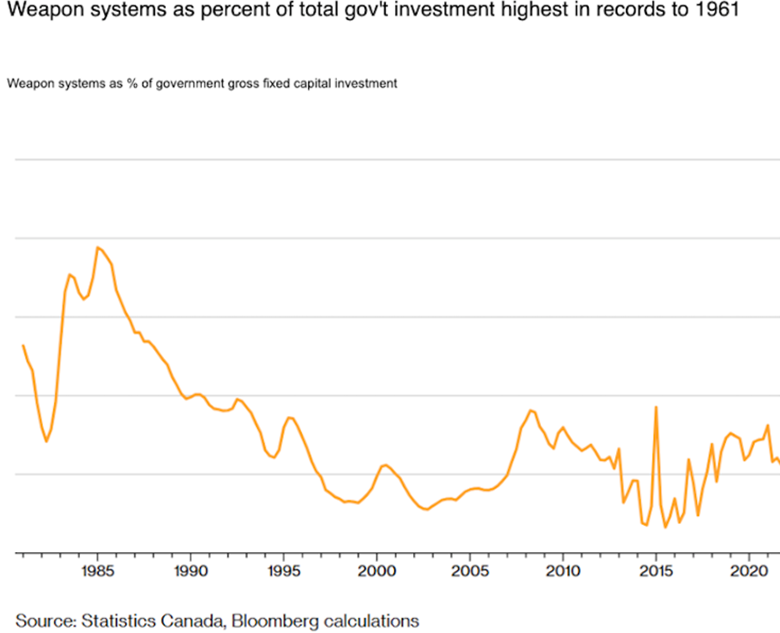
Meanwhile, Canada is heavily investing in Arctic military capabilities, with over $81.8 billion in defense funding for 2025, including $6.6 billion to implement the new Defence Industrial Strategy.
Key initiatives include $2.67 billion for Northern Operational Support Hubs in Inuvik and Yellowknife, enhanced satellite communications and $1 billion for dual-use infrastructure. The focus is on strengthening surveillance, increasing year-round presence, and addressing security gaps in response to regional changes (AI Overview).
China particularly is on Canada’s Arctic defense radar.
CBC News reports that last September, The annual exercise is known as Operation Nanook, and took on particular significance this year with a collision of geopolitical changes: China’s growing ambition in the Arctic, Prime Minister Mark Carney’s plans to substantially increase the capabilities of the military and the newly recognized value of minerals in the North…
Canada’s traditional adversaries have shown growing interest in the North’s rich deposits of critical minerals. Not to mention the opening of new, shorter shipping routes between Asia, North America and Europe through the Northwest Passage as climate change makes for an increasing number of ice-free days.
“That would be Russia and, increasingly, China,” said Stephanie Carvin, a former national security official and now an academic with Carleton University in Ottawa.
“[China] has an ambitious plan to basically control a lot of the rare-earth elements and mining and wants to invest in the Canadian Arctic.”
Or maybe more than just invest.
The article notes that China’s interest in the Arctic has been closely monitored by the Canadian military and Coast Guard, with the air force earlier this summer keeping watch over a Chinese vessel that returned to Arctic waters for a second year in a row.
The backbone of maritime surveillance are the CP-140s, some of which date from the 1980s. They are set to be replaced by the P-8 Poseidon — which is larger, with a significantly more sophisticated surveillance system, allowing the air force to see in greater detail over longer distances.
Canada has also partnered with Australia to develop a new Arctic over-the-horizon radar system, replacing the Cold War-era system used to detect missile and maritime threats.
Conclusion
Not everybody likes what Prime Minister Mark Carney is doing to reset the Canada-US relationship and embrace middle-power diplomacy.
But many do, and his speech at Davos was regarded by some Canadians as the best public address by the country’s leader in decades.
Carney is traveling all over the world, signing agreements, forging new relationships, talking up Canadian companies, minerals and energy.
Two of his initiatives are a significant departure from his predecessor, Justin Trudeau: critical minerals and defence. Trudeau did not support mining and in fact went out of his way to condemn it, and oil and gas production. Consider his government’s ban on tankers off the coast of British Columbia, the killing of an oil pipeline from Alberta to BC, the carbon tax, and the hated (by the resource sector) Bill C-69.
Canadian military spending under Trudeau fell below NATO’s 2% target, and he planned to maintain the country’s decrepit submarine fleet until 2040 instead of replacing it. Another faux pas was committing to purchase 88 F-35 fighter jets from the US despite their serious shortcomings which I pointed out earlier. And let’s not forget the 2019 SNC Lavalin scandal, where Trudeau and his staff were found to have improperly pressured then-Attorney General Jody Wilson-Raybould to halt a criminal prosecution against SNC-Lavalin. A report concluded this violated the Conflict of Interest Act by attempting to influence her decision to benefit the company.
Trudeau’s foreign policy was at best a capitulation to the US and at its worst an embarrassment. Who can forget his family’s trip to India where they posed in traditional Indian garments? During the same trip, Trudeau invited to a reception a convicted Sikh separatist involved in a 1986 assassination attempt on an Indian minister.
The former girl’s school drama teacher managed to alienate a third of the world’s population by pissing off China and India.
China by arresting Huawei’s CFO when she arrived at Vancouver Airport on a US warrant for fraud related to Iran sanctions. Meng Wanzhou then spent three years in Vancouver under house arrest. China retaliated by arresting Canadians Michael Kovrig and Michael Spavor on trumped-up espionage charges. The two Michaels were held in poor conditions for over 1,000 days. The Canadian government later banned Huawei from participating in Canada’s 5G networks, citing national security risks, bringing Sino-Canadian relations to one of their lowest points in history.
Regarding India, Trudeau has long been accused of pandering to Sikh separatists. In September 2023, Trudeau announced in parliament that there were “credible allegations” linking agents of the Indian government to the murder of Hardeep Singh Nijar, a Canadian citizen living in Surrey, BC who was prominent in the Khalistani movement seeking an independent Sikh state. India considered Nijar a terrorist. Before resigning as prime minister in January 2025, Trudeau accused Indian agents of engaging in a broader campaign of extortion targeting South Asian Canadians and agreed to the expulsion of several Indian diplomats from Canada, including the High Commissioner.
Carney is taking steps to repair these broken relationships, mostly through economic engagement. He understands the idea of making trade deals for energy and minerals and agriculture with people that want to reciprocate fairly.
Government money is flowing into the mining sector for upgrades to the Northwest Transmission Line in BC and the support of critical mineral projects nation-wide. Other good ideas include a National Energy Corridor, the lifting of interprovincial trade barriers, new oil pipelines that are supported by a majority of Canadians, and securing new trade ties with the European Union, Germany, Australia, Japan, and perhaps most importantly, China.
Carney’s focus on defence is a refreshing change from previous leaders who took a narrow, sometimes dim view of defence spending.
Canadians know how to build ships and planes (Avro Arrow, anyone?). The current government is looking at options beyond the American F-35— a flawed airplane in many ways — to what Sweden, for example, can offer in the Gripen, which would be a good plane for Canada.
There are bids in from Germany and South Korea for replacing Canada’s decrepit submarine fleet.
At Davos Carney said, “Our commitment to Article 5 is unwavering”. Article 5 is the clause that states an attack on one NATO member is an attack on the entire alliance. He has also committed to increase defence spending to 5% of GDP by 2035, and to reach NATO’s 2% target by this month. Trudeau said Canada wouldn’t reach that percentage until 2032.
To conclude, let’s remember that mostly what Carney has done so far is make announcements. As John Ivison wrote in a recent National Post column, “Voters have limited patience for capriciousness after 10 years of Justin Trudeau. The days of government-by-announcement are over.”
Ivison’s right. Talk is cheap. But if Carney and his government put their money where their mouth is, they could be onto something big. Canada doesn’t have to be the little brother to the United States. We can reach across the globe through middle-power diplomacy to become more united, powerful, prosperous and respected.
Richard (Rick) Mills
aheadoftheherd.com
Legal Notice / Disclaimer
Ahead of the Herd newsletter, aheadoftheherd.com, hereafter known as AOTH.Please read the entire Disclaimer carefully before you use this website or read the newsletter. If you do not agree to all the AOTH/Richard Mills Disclaimer, do not access/read this website/newsletter/article, or any of its pages. By reading/using this AOTH/Richard Mills website/newsletter/article, and whether you actually read this Disclaimer, you are deemed to have accepted it.