Richard (Rick) Mills
Ahead of the Herd
As a general rule, the most successful man in life is the man who has the best information
The rare earths are a group of 17 elements comprising Scandium, Yttrium, and the Lanthanides. The Lanthanides are a group of 15 (Cerium, Dysprosium, Erbium, Europium, Gadolinium, Holmium, Lanthanum, Lutetium, Neodymium, Praseodymium, Samarium, Terbium, Thorium, Thulium, Ytterbium) chemically similar elements with atomic numbers 57 through 71, inclusive.
Yttrium, atomic number 39, isn’t a lanthanide but is included in the rare earths because it often occurs with them in nature - it has similar chemical properties. Scandium, atomic number 21 is also included in the group although it usually occurs only in minor amounts.
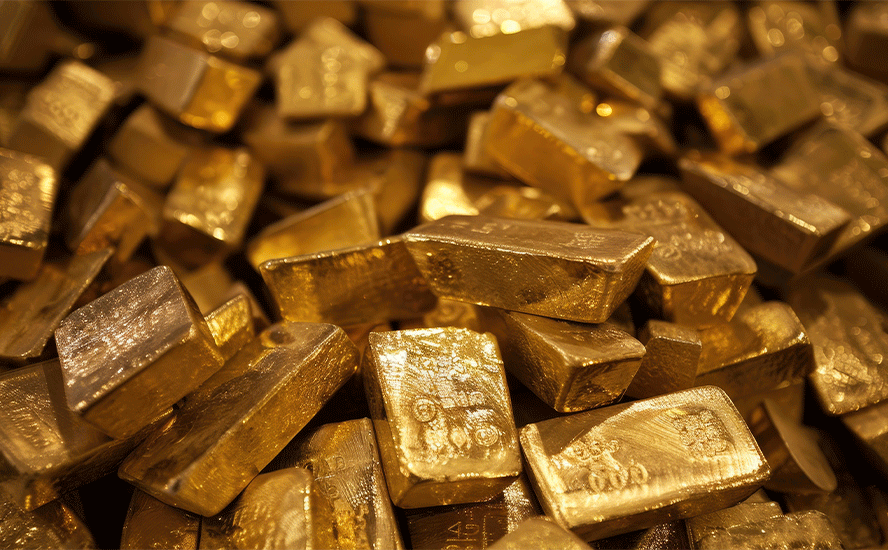
The most abundant rare earth elements (REE) are each found in the earth’s crust in amounts equal to nickel, copper, zinc, molybdenum, or lead - Cerium is the 25th most abundant element of the 78 common elements in the Earth’s crust. Even the two least abundant REEs (Thulium, Lutetium) are nearly 200 times more common than gold. Overall Rees have an abundance greater than silver and similar amounts to copper and lead.
The “rare” in rare earth elements came from frustrated 19th century chemists who decided they were uncommon after trying to isolate these atomically very similar elements. REES are also very hard to find in economic concentrations.
The Lanthanides are divided into light rare elements, LREE, and heavy rare earth elements, HREE. Light REE's are made up of the first seven elements of the lanthanide series - Lanthanum (La, atomic number 57), Cerium (Ce, atomic number 58), Praseodymium (Pr, atomic number 59), Neodymium (Nd, atomic number 60) Promethium (Pm, atomic number 61) and Samarium (Sm, atomic number 62).
HREEs are made up of the higher atomic numbered elements - Europium (EU, atomic number 63), Gadolinium (Gd, atomic number 64), Terbium (TB, atomic number 65), Dysprosium (Dy, atomic number 66), Holmium (Ho, atomic number 67), Erbium (Er, atomic number 68), Thulium (Tm, atomic number 69), Ytterbium (Yb, atomic number 70) and Lutetium (Lu, atomic number 71).
REEs with even atomic numbers have greater abundance than their odd numbered cousins. LREEs are more incompatible with other minerals and this makes them more strongly concentrated in the earth’s crust than the HREEs. In most rare earth deposits, the first four
REE - La, Ce, Pr, and Nd - constitute 80 to 99 percent of the total.
REEs occur in a wide range of igneous, sedimentary and metamorphic rocks and in a broad range of mineral types including halides, carbonates, oxides and phosphates. But REE deposits are most commonly associated with late-stage vein and replacement mineralization either within carbonatites or the surrounding host rock. Most carbonatites are intrusive igneous rocks, this means that the rock masses contain more than 50% carbonate minerals, and cooled from a melt.
According to the geological literature there are about 600 known occurrences of carbonatites worldwide, but almost all are small and noncommercial.
The principal economic sources of rare earths are the minerals bastnasite, monazite, and xenotime. Bastnasite and monazite are the primary source of LREE (Ce,La,and Nd) with monazite containing less La, more Nd and some HREE. Xenotime is dominated by the heavier HREE including y, Dy, Er, Yb, and Ho.
The bulk of the world's supply of rare earth elements comes from the mineral bastnasite. Bastnasite is a mixed lanthanide fluoro-carbonate mineral (Ln F CO3) that’s found in carbonatites.
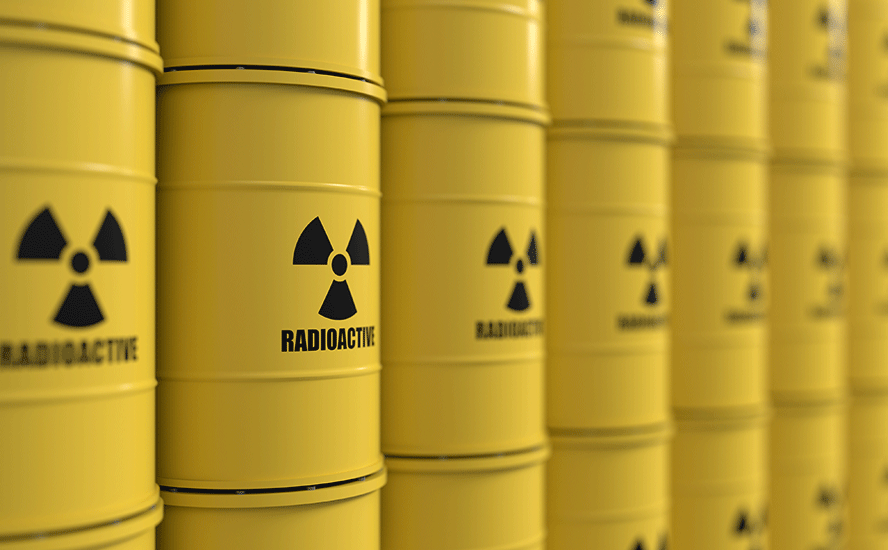
Monazite, the single most common REE mineral generally contains elevated levels of thorium (Th). Thorium itself is only weakly radioactive but is accompanied by highly radioactive products like radium that can accumulate during processing.
Uses
Many REE applications are highly specific and substitutes are inferior or unknown:
- Color cathode-ray tubes and liquid-crystal displays used in computer monitors and televisions employ europium as the red phosphor
- Terbium is used to make green phosphors for flat-panel TVs and lasers
- Lanthanum is critical to the oil refining industry, which uses it to make a fluid cracking catalyst that translates into a 7% efficiency gain in converting crude oil into refined gasoline
- Rechargeable batteries
- Automotive pollution control catalysts
- Neodymium is key to the permanent magnets used to make high-efficiency electric motors. Two other REE minerals - terbium and dysprosium – are added to neodymium to allow it to remain magnetic at high temperatures
- Fiber-optic cables can transmit signals over long distances because they incorporate periodically spaced lengths of erbium doped fiber that function as laser amplifiers
- Cerium oxide is used as a polishing agent for glass. Virtually all polished glass products, from ordinary mirrors and eyeglasses to precision lenses, are finished with CeO2
- Gadolinium is used in solid-state lasers, computer memory chips, high-temperature refractories, cryogenic refrigerants
- Used in improving high-temperature characteristics of iron, chromium, and related alloys
- Y, La, Ce, Eu, Gd, and Tb are used in the new energy-efficient fluorescent lamps. These energy-efficient light bulbs are 70% cooler in terms of the heat they generate and are 70% more efficient in their use of electricity
- REEs are used in metallurgy as an alloying agent to desulphurise steels, as a nodularising agent in ductile iron, as lighter flints and as alloying agents to improve the properties of superalloys and alloys of magnesium, aluminium and titanium
- Rare-earth elements are used in the nuclear industry in control rods, as dilutants, and in shielding, detectors and counters
- Rare metals lower the friction on power lines, thus cutting electricity leakage
Rare earths are not listed on a metals exchange and there is no set or official price for REEs or their compounds. The buying and selling of REEs happens on a company-to-company basis. Essentially they are traded one deal at a time.
Richard (Rick) Mills
rick@aheadoftheherd.com
www.aheadoftheherd.com
If you're interested in learning more about the junior resource market please come and visit us at www.aheadoftheherd.com
Membership is free, no credit card or personal information is asked for.
***
Richard is host of www.aheadoftheherd.com and invests in the junior resource sector. His articles have been published on over 200 websites, including: Wall Street Journal, SafeHaven, Market Oracle, USAToday, National Post, Stockhouse, Lewrockwell, Casey Research, 24hgold, Vancouver Sun, SilverBearCafe, Infomine, Huffington Post, Mineweb, Resource Investor, 321Gold, Kitco, Gold-Eagle, The Gold/Energy Reports, Calgary Herald, Resource Investor, FNArena, MetalsNews and Financial Sense.
***
Legal Notice / Disclaimer
This document is not and should not be construed as an offer to sell or the solicitation of an offer to purchase or subscribe for any investment. Richard Mills has based this document on information obtained from sources he believes to be reliable but which has not been independently verified.
Richard Mills makes no guarantee, representation or warranty and accepts no responsibility or liability as to its accuracy or completeness. Expressions of opinion are those of Richard Mills only and are subject to change without notice. Richard Mills assumes no warranty, liability or guarantee for the current relevance, correctness or completeness of any information provided within this Report and will not be held liable for the consequence of reliance upon any opinion or statement contained herein or any omission.
Furthermore, I, Richard Mills, assume no liability for any direct or indirect loss or damage or, in particular, for lost profit, which you may incur as a result of the use and existence of the information provided within this Report.
Richard Mills does not own shares of any companies mentioned in this report