|
Understanding
Drill Assays Keith M. Barron Ph.D. Pretty much every week I get shown some
assays and asked on the spot if they are "any good". Is there a
quickie way of telling? Is there a "Drill Core Assays for Dummies"
Handbook? The short answer is "No". It
can be very hard to interpret drill hole results
outside of any context - even for a career geologist. So, how would an investor who is not a
geologist or a geological engineer be able to tell if results are any
good….is it a "buy" signal? A "sell"? A "hold"?
Suppose it is the only information out there? Such things can be tough to
decide, but I've boiled it down to a few guidelines. Firstly, something that may sound rather
obvious - if you aren't already fully comfortable with the metric system, take time to learn it. If you don't know what a metre is you're setting yourself up for disaster. Any
dictionary or encyclopedia should be able to give you conversion tables for
weights and measures. The overwhelming majority of mining and exploration
companies listed on the ASX, JSE, TSX, or AIM give assay values in grams per tonne and measure drill core lengths in metres. Continuity and Geological Models To make sense of press releases you have
to navigate your way around the jargon we geologists use. Before any drilling
takes place the geologist should always have an idea of which way the
mineralization is trending. Geologists will often refer to the
"strike" of the mineralized rock (you can think of it as
"direction trend"), and the "dip" (which way the
mineralization is tilted or inclined). As important as the metal content or
"grade"; is demonstrating continuity - does the mineralization extend
to depth and along the strike? You can't "build tonnage"
(incrementally increase the size of the mineralization through discovery) if
you don't have continuity. So the geologist will try to hit the buried
mineralization with drill holes both along the trend, and at increasingly
deeper levels. Sometimes geologists will use early information to drill
"step out" holes, to test for continuity some distance away from
earlier drill holes. They're called step-out holes because they step away or
jump some distance from the known to the unknown (sometimes these step-outs
are a very real "leap of faith"!). A positive result from a step
out hole will often make the share price rapidly move because it's a way to
quickly demonstrate size potential. If a step-out hole is successful, the geologist
might want to track back in the opposite direction with "in-fill"
holes. The geologist will also want to know how thick the mineralization is,
and the best way to do that is to try to intersect it underground at right
angles in drilling. A perfect right angle intersection will give you a
"true thickness". If you hit it at any other angle the
mineralization will appear wider in the drill hole than it actually is in
nature. This is a function of geometry. With a couple of drill holes at
different inclinations you can use trigonometry and figure out the thickness
(yes, High School Trig is important…tell your kids!) What any competent
geologist will try to avoid is "drilling down the dip". You can
think of it this way: take any hardbound book and pretend that the closed
book is an ore-bearing geological unit. Prop up one end so that the cover is
inclined. Now take a pencil and rest the tip on the inclined cover. Orient
the pencil so that it sticks straight up out of the cover at an angle of 90
degrees. That's the best angle you should use if you were going to
"drill" your book. A hole at this orientation is going to give you
an accurate representation of the book thickness. However if you drilled
through and down the spine of the book between the covers that's like drilling
down dip and will give you a false impression of thickness. Sometimes it can
be tricky to figure the dip of mineralization, and it can often take a couple
of cracks at it, drilling from different angles, to begin to sort it out. If
a Company has been drilling narrow high grade veins and suddenly comes up
with an extremely wide vein intersection, always be a bit skeptical and ask
yourself if they may have drilled "down the dip". The geologist should also have a fair
idea of a geological model. He may not have it completely understood at first
pass but he or she should have it down to a few possibilities. This is one of
the most important considerations in whether or not mineralization has the
potential to eventually be "proved up" into an economic orebody. Let's say that we're drilling a gold-bearing
quartz vein, which is "shallow" (near the surface). It might be
possible to eventually mine that vein with a small open pit from surface. If
it's rich enough, it might pay you to afterwards go underground and sink a
shaft to mine it from the subsurface. But if the vein is narrow and low
grade, and only starts a couple of hundred metres
down and not from surface, mining it will probably never be a paying
proposition. Some quartz veins however can be very rich, and will support
economic mining to very great depths. Let's say you have a second orebody which is a vuggy silica
unit (vuggy silica is very hard and porous quartz
which has formed by replacing pre-existing rock, often by very acidic hotspring waters). The vuggy
silica may be low grade, say 1 or 2 grams/tonne in
gold and possibly 50 or even a hundred metres
thick. Vuggy silica is usually a shallow
mineralization type, and at those grades, if there is a considerable
thickness, it can be very lucrative to mine it using open pit methods. High grade has always moved markets, but
today, in 2004, many mining people have noticed a trend in North America
towards rewarding companies that come up with high grade numbers and paying
less attention to anything else. My own personal "take" on this is
that investors have been spoiled by the grades that have come out of
Goldcorp's Red Lake Mine. Many of the investors who were around in the early
1990's during the last junior mining boom were permanently shaken out by the
triple whammy of the Bre-X scandal, low gold
prices, and expansion of the internet bubble which siphoned away venture
capital (much of which historically went into junior mining). Over the last
several years Bob McEwen has done a splendid job of promotion, giving the Red
Lake Mine a high profile (even advertising on the radio!) so that many of the
new crop of investors around today may falsely
believe that all profitable gold mines have to have super high grade. The Red
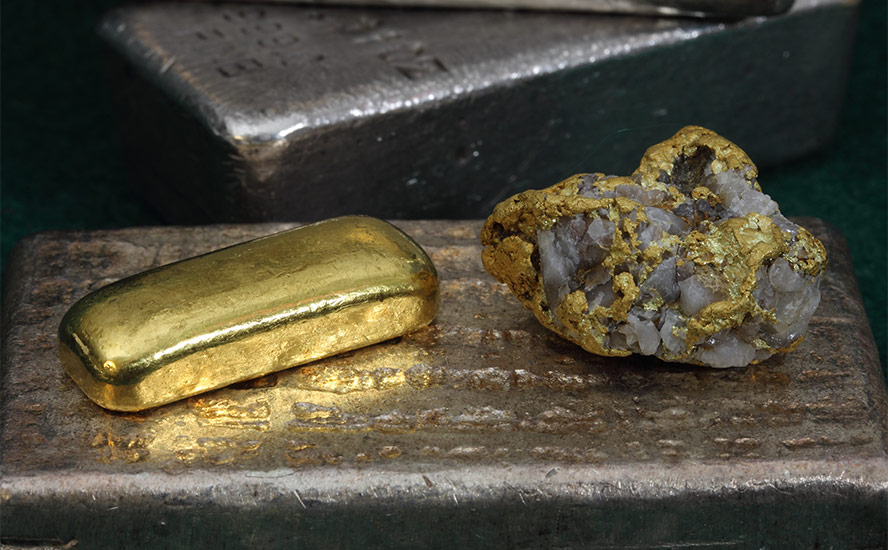
Lake mine has so much gold in some areas that visible gold can actually be
mapped underground! You can draw a chalk line around the visible gold and
enclose a sizable area. Proven and probable resources as of Dec 31, 2003 were
3.178 million tons at a grade of 1.23 oz/ton [42.17 g/t] gold for 4.939
million contained ounces. I was underground in 1987 when the mine was called
the Dickinson, and was privileged to see such extreme high grade, which the
miners explained to me they got into only twice or so a year. The miners call
such places "jewel boxes". I saw a drill bit clogged with gold, and
two muckers horsing around trying to kick a piece
of high grade down the drift (tunnel) with their steel-toed boots that was so
heavy with gold it was reluctant to easily budge. Unless I get invited to go underground
there again I don't expect to see such high grade gold soon, if ever. I want
to stress again, grades like these are pretty rare and the new discoveries
over the next few years are not going to look like this. You have to realize that the majority of
highly profitable mining operations mine much lower average grades, and that
many operating mines don't have any "bonanza" grades like the
example above. In fact, there are a number of senior mining companies that
shy away altogether from high grade vein deposits. They may represent highly
profitable low cost ounces but they typically represent a small number of
contained ounces, say less than 1 million gold ounces - Red Lake is highly
unusual. Many of the big Senior Gold Producers are trying to grow their
reserves and want to do it in one foul swoop through finding a low grade but
high tonnage and high number contained ounces deposit - like Barrick Gold has done with Pascua Lama (almost 300
million tons containing 16.862 million proven & probable gold ounces at a
grade of 0.057 oz/ton [1.95 g/t], as of December 31, 2003). Exploration
success doesn't come easily and so most Senior Companies can only grow or
even keep their reserve numbers level through mergers and acquisitions -
witness the Harmony - Norilsk - Gold Fields - IAMGOLD bun fight currently in
progress. High grade vein deposits are also very drill intensive (need to be
very intensively [and expensively] drilled to accurately forecast the grade
and tonnage), and the grade in veins can be erratic and veins themselves
difficult to follow underground. Many Senior Miners want deposits that their
engineers can plan for 5, 10 or even 20 years production, and they want to
boast to fund managers that their reserve profile has been boosted by 3 or 5
million ounces. These big senior producers are looking to grow their ounces
and are looking 5 or 10 years outboard. Meridian Gold took it on the chin
recently from investors who didn't like how much money was being spent on
exploration, but if you're going to find those low cost ounces, as Meridian
has a track-record of doing - it gets pretty spendy. Low grade big tonnage versus high grade
low tonnage - both are important and both potentially highly valuable. As a
rule-of-thumb many geos look at gram-metres as to whether or not a drill result is
interesting. Simply put, this is the grade multiplied by the width. A vein
that is 5 metres wide and averages 60 g/t will
represent 300 gram-metres, but so will a zone that
is of lower grade, say 100 metres wide, grading 3
g/t. It of course would depend on the geological context as to which is the
more interesting drill hole, but any exploration manager would be ecstatic to
receive either result! An intersection of 10 gram-metres
may or may not make it. An intersection of 50 gram-metres
is pretty good; of 100 or 200 gram-metres is pretty
gosh darn good, and anything higher becomes exceptional. |